Tag Russia

UPDATE: Russia-Ukraine Conflict – June 19, 2026
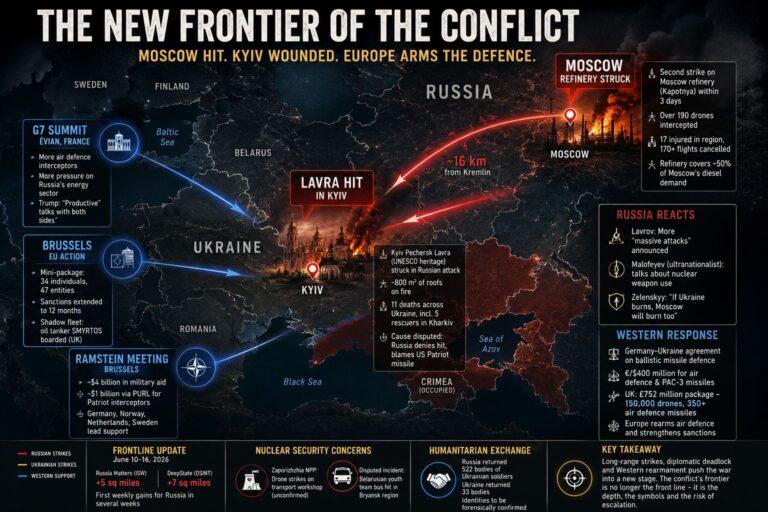
Moscow burns, the Lavra is in flames, and while the G7, the EU and the Ramstein group announce fresh commitments, the boundary of the war is moving inward: Ukraine strikes the Russian capital itself, Russia hits a UNESCO World Heritage site in Kyiv, and diplomacy still produces no ceasefire. Update No. 5 shows how long-range strikes, Western rearmament and political hardening combined within a single week to push the conflict into a new stage of escalation.
UPDATE: Russia-Ukraine Conflict – June 12, 2026

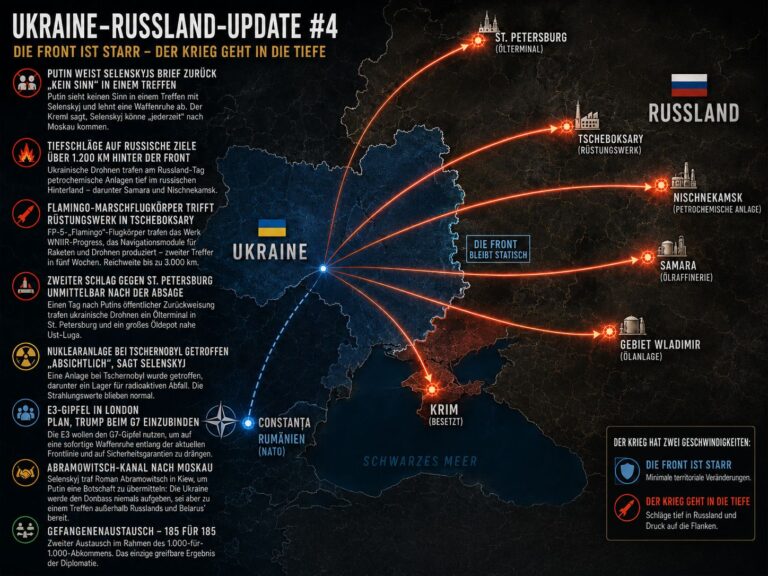
While the front line in Ukraine remains largely frozen, the war is moving ever deeper: Kyiv is striking refineries, defense plants and logistics hubs far inside Russian territory, while Moscow is publicly rejecting any political opening. Putin’s dismissal of Zelensky’s outreach, renewed strikes reaching as far as St. Petersburg, and incidents spilling toward NATO territory all suggest that this war is not moving toward resolution, but toward a more dangerous and strategically volatile phase.

ZIRCON

The 3M22 Zircon is Russia’s most technologically ambitious sea-launched hypersonic cruise missile: not a ballistic weapon reaching hypersonic speed during re-entry, but a system designed to sustain hypersonic flight in the atmosphere through a booster-and-scramjet propulsion concept. Militarily, the Zircon is aimed primarily at high-value naval targets and the vulnerability of Western carrier strike groups; politically, it serves as Moscow’s signal that NATO naval forces can be threatened at extended range. Its real-world effectiveness, however, remains difficult to assess, as range, production numbers, accuracy and combat performance are still only partially documented in public sources.

ORESHNIK

The Oreshnik is not a technological myth, but a strategic signal: a Russian ground-launched intermediate-range ballistic missile with MIRV capability, whose real significance lies less in its conventional destructive power than in its range, possible nuclear payload, and deployment in Belarus. The system demonstrates Russia’s ability to reach European targets with fast, difficult-to-intercept intermediate-range technology – reshaping the military risk calculus across the continent.

KINSHAL

The Kh-47M2 Kinzhal is Russia’s air-launched sister system to the Iskander: not an entirely new class of weapon, but a ballistic missile whose launch from fast aircraft such as the MiG-31K, Tu-22M3M or Su-34 extends its operational reach and shortens the defender’s warning time. Its significance lies less in the label “hypersonic” than in the combination of high speed, an erratic flight profile, possible conventional or nuclear payloads, and flexible carrier platforms. At the same time, documented Patriot PAC-3 interception claims show that the Kinzhal is not an unstoppable weapon, but a serious system that must be assessed in technical and tactical terms.

UPDATE: Russia-Ukraine Conflict – June 06, 2026

Russia is intensifying its air campaign while the front line on the ground remains largely frozen. The major strike of 2 June, Ukrainian long-range attacks on St. Petersburg and Kronstadt, a drone impact on NATO territory and Zelensky’s open letter to Putin mark a week in which military escalation and diplomatic signalling unfolded side by side. This update reconstructs the key events, separates verified facts from one-sided claims, and shows why the war is currently being shaped less by territorial movement than by air defence, logistics, arms production and political endurance.

The Pattern Is Tightening

Europe is no longer merely talking about preparing for a possible major war. Over the past six months, personnel structures have been reactivated, command chains reorganized, defense spending detached from fiscal limits, Germany expanded into a military logistics hub, arms production dramatically increased, and civilian infrastructure integrated into national defense planning. This analysis shows how seemingly separate measures now form a visible pattern: a European security architecture no longer focused on abstract deterrence, but on concrete warfighting capability. A continuation of “The War Before the War – Part 7”.

The Pattern Is Tightening

Europe is no longer merely talking about preparing for a possible major war. Over the past six months, personnel structures have been reactivated, command chains reorganized, defense spending detached from fiscal limits, Germany expanded into a military logistics hub, arms production dramatically increased, and civilian infrastructure integrated into national defense planning. This analysis shows how seemingly separate measures now form a visible pattern: a European security architecture no longer focused on abstract deterrence, but on concrete warfighting capability. A continuation of “The War Before the War – Part 7”.

ISKANDER

The 9K720 Iskander is not a single missile, but a mobile Russian short-range ballistic missile system designed for operational deep strikes against high-value targets such as airfields, ammunition depots, command centers, air-defense sites and transport nodes. Its military relevance lies in the combination of mobility, a depressed quasi-ballistic trajectory, high terminal speed, in-flight maneuverability and a flexible range of warheads. Strategically, the Iskander also represents the shift from a battlefield missile system to a political pressure instrument on Europe’s eastern flank – particularly through deployments such as Kaliningrad and its connection to the collapse of the INF Treaty.

B – Who Profits from the Gulf War?

The IEA Oil Market Report of May 2026 reads like a sober data document - yet between the numbers, a new global oil order becomes visible. The closure of the Strait of Hormuz has not only driven prices to historic highs, but also shifted trade flows, created winners, and exposed strategic dependencies. While Asia comes under supply pressure, the United States, Brazil, Venezuela, and the UAE emerge as beneficiaries of a new Atlantic Basin rotation. What appears to be a crisis in the Gulf may in fact mark a strategic redistribution of the global energy system.