
Kh-47M2 Kinzhal – AS-24 “Killjoy”
As of 29. May 2026
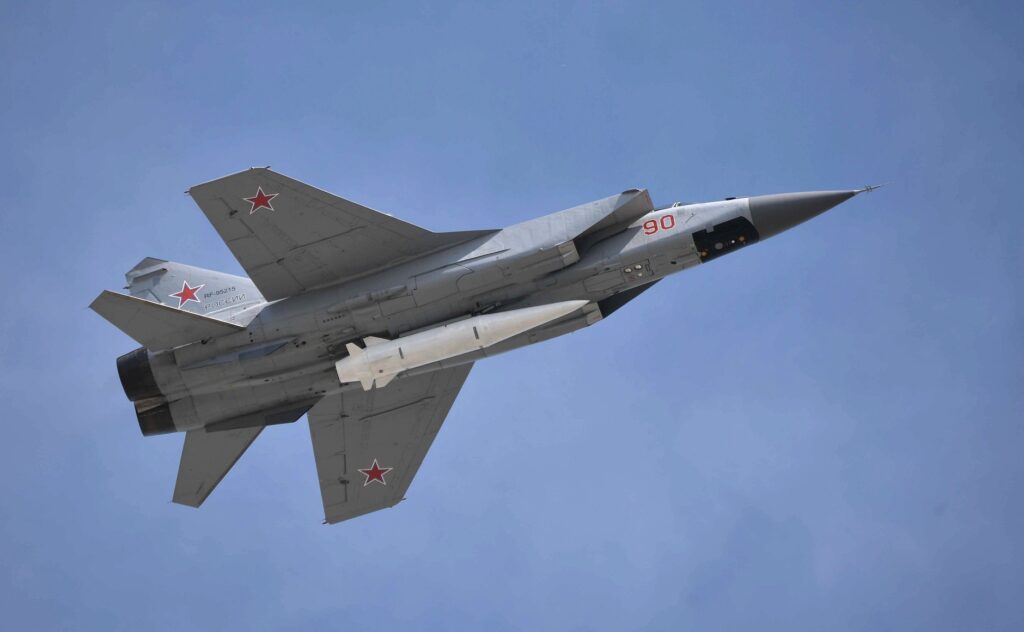
Source: By kremlin.ru, CC BY 4.0, https://commons.wikimedia.org/w/index.php?curid=68926303
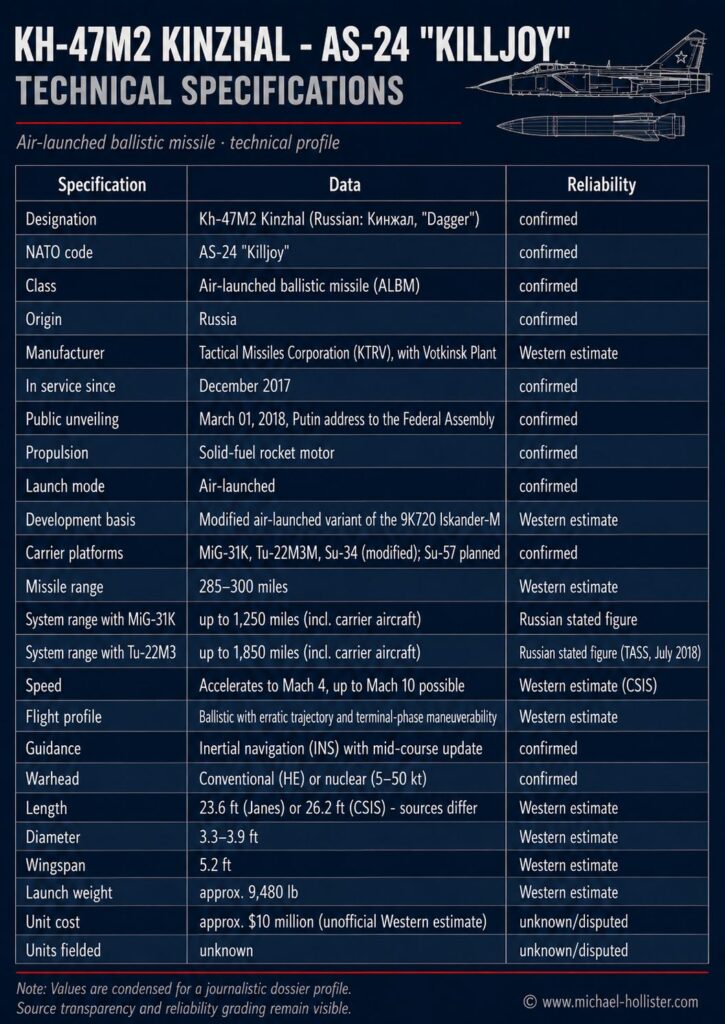
The Kh-47M2 Kinzhal (Russian: Кинжал, “Dagger”; NATO code AS-24 “Killjoy”) is a Russian air-launched ballistic missile (ALBM). It entered service in December 2017 and was publicly unveiled on March 01, 2018, when President Putin presented it in his address to the Federal Assembly as one of six new Russian strategic weapons. The manufacturer is assessed by Western analysts to be the Tactical Missiles Corporation (KTRV), with involvement from the Votkinsk Machine Building Plant.
Technically, the Kinzhal is assessed by CSIS and other Western analysts as a modified, air-launched variant of the ground-based 9K720 Iskander-M – the Iskander’s sibling weapon, here fired from combat aircraft rather than a ground launcher. Visible design differences from the ground-based Iskander include a redesigned tail section, smaller control surfaces, and a tail extension that protects the engine nozzles during high-speed flight. Guidance is provided by inertial navigation with mid-course updates; the missile can carry conventional or nuclear warheads (the latter rated at 5 to 50 kilotons according to Western estimates).
Declared carrier platforms are modified MiG-31K interceptors, Tu-22M3M bombers, and Su-34 strike fighters; integration on the Su-57 is planned. This is precisely where the most important source of public confusion about the missile’s range lies. The missile’s own range is estimated by Western analysts at approximately 285 to 300 miles – it is, after all, an Iskander. The frequently cited figures of 1,250 to 1,850 miles refer to total system range including the carrier aircraft’s flight distance: a Kinzhal fired from a Tu-22M3 bomber can, according to Russian claims, strike targets up to 1,850 miles away; with the MiG-31K, the figure is up to 1,250 miles. This distinction is routinely absent from reporting, which is why open-source figures ranging from 300 to 1,850 miles circulate simultaneously – all technically correct, depending on what is being measured.

After launch, the Kinzhal accelerates rapidly to Mach 4 (approximately 3,050 mph) and can reach up to Mach 10 (approximately 7,670 mph), according to CSIS. Russia markets it accordingly as a “hypersonic” missile. CSIS explicitly flags this as misleading: virtually all ballistic missiles reach hypersonic velocity in their terminal phase – this is not a physically exceptional characteristic. What distinguishes the Kinzhal from a ground-launched Iskander is not peak speed but the combination of high velocity, an erratic flight profile, and the ability to be launched from a fast, high-flying carrier aircraft – which significantly compresses the warning time available to enemy air defenses.
What the Kinzhal is not: a conceptually new weapon. It is an Iskander that flies. But that precise adaptation – fitting the Iskander to an air-launch platform – makes it a system to be taken seriously, because it multiplies Russia’s short-range ballistic strike capability across the full operational radius of its carrier aircraft.
Operational History and Deployments
December 2017 – Enters service. May 2018 – Ten MiG-31K aircraft achieve “experimental combat readiness” status for Kinzhal carriage.
March 01, 2018 – Putin presents the Kinzhal in his address to the Federal Assembly as one of six new Russian strategic weapons.

Deployment – Stationed, according to Western assessments, in Russia’s Southern and Western Military Districts.
Since February 2022 – Multiple combat uses in the Ukraine war. The Kinzhal is thus the first Russian weapon marketed as “hypersonic” with independently documented combat employment – a significant fact, because it was independently identifiable from recovered debris.
May 04, 2023 – Ukraine reports the first interception of a Kinzhal by a Patriot PAC-3 system over Kyiv. Russia denies the intercept. US officials confirmed the Ukrainian account. This incident is symptomatic of the gap between Russia’s “unstoppable” marketing and actual defensive capabilities.
May 24, 2026 – Part of a combined large-scale strike on the Kyiv area together with Oreshnik, Iskander, and Zircon (according to the Russian Ministry of Defense; not independently verified).
Further Reading
Kh-47M2 Kinzhal – CSIS Missile Threat Primary technical reference: Iskander connection, dimensions, speed, hypersonic classification, carrier platforms, MiG-31K details.
Putin, Address to the Federal Assembly, March 01, 2018 – Kremlin.ru Primary source: Putin’s public presentation of the Kinzhal as one of six new Russian strategic weapons.
© Michael Hollister – All rights reserved. Redistribution, publication or reuse of this text requires express written permission from the author. For licensing inquiries, please contact the author via www.michael-hollister.com.
Newsletter
🇩🇪 Deutsch: Verstehen Sie geopolitische Zusammenhänge durch Primärquellen, historische Parallelen und dokumentierte Machtstrukturen. Monatlich, zweisprachig (DE/EN).
🇬🇧 English: Understand geopolitical contexts through primary sources, historical patterns, and documented power structures. Monthly, bilingual (DE/EN).