
Situation Report, June 19, 2026 – Building on Update of June 12,2026
by Michael Hollister
Exclusive published at Michael Hollister on June 19, 2026
3.061 words * 16 minutes readingtime

This analysis appears as part of Hollister’s Geopolitics. New deep-dive analyses every week – subscribe free of charge.

TICKER
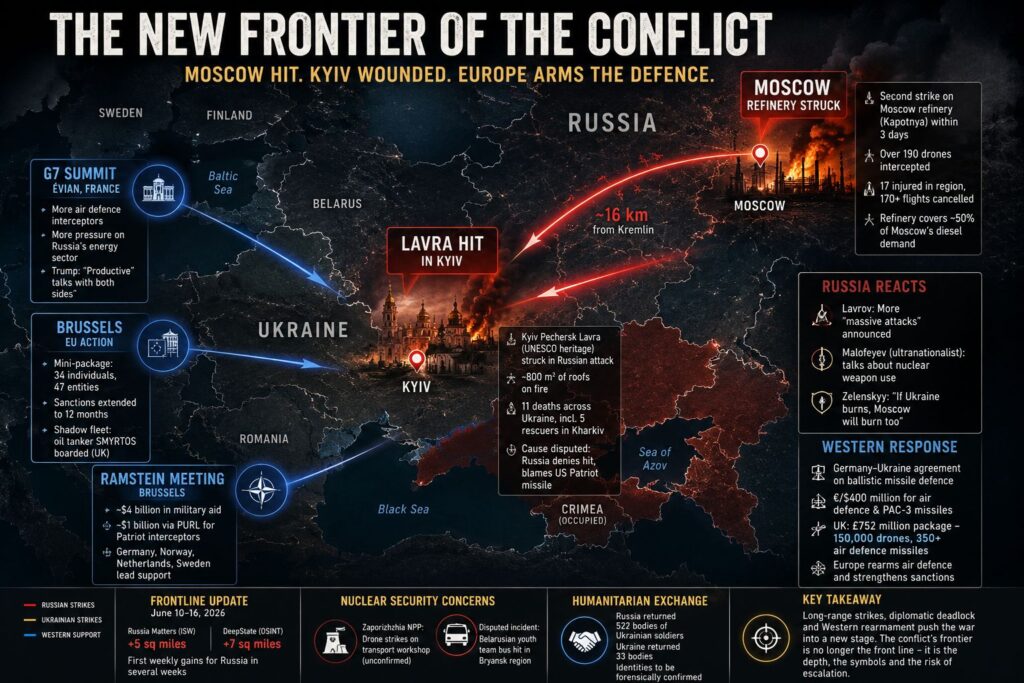
SECOND STRIKE ON MOSCOW REFINERY – THE LARGEST ATTACK ON THE CAPITAL That Russia cannot prevent strikes on its own capital is the strategic core of this week. Overnight into June 18, Ukrainian drones hit the Moscow oil refinery (MNPZ) in the Kapotnya district for the second time within three days. According to Russian figures, air defense intercepted more than 190 drones – by Moscow’s own account the heaviest attack on the capital since the war began. Mayor Sobyanin conceded that several drones had reached the facility; there were several fires, 17 injured in the surrounding area, and more than 170 cancelled Aeroflot flights. The refinery lies about 10 miles from the Kremlin and, according to Ukraine’s security service, the SBU, covers roughly half of Moscow’s diesel demand.
LAVRA IN FLAMES – RUSSIAN MASS STRIKE ON KYIV, CAUSE DISPUTED Overnight into June 15, a Russian wave of attacks hit the Kyiv Pechersk Lavra. On the roof of the Dormition Cathedral, an 11th-century UNESCO World Heritage site, around 8,600 square feet burned, according to Ukrainian figures. Across the country, eleven people lost their lives, among them five rescue workers in Kharkiv. The cause is disputed: the SBU published debris from a Geran-2 drone, Western journalists reporting on the scene documented Shahed remnants; the Russian Defense Ministry denies a hit and blames a misguided US Patriot missile. An independent technical investigation conclusively proving one of the accounts is not available.
“LONG-RANGE SANCTIONS” – THE DOCTRINE BEHIND THE DEEP STRIKES Zelensky expressly frames the strikes as “long-range sanctions” against the Russian oil industry. Before Moscow, Ukrainian drones hit the petrochemical plants in Nizhnekamsk (TANECO, TAIF-NK) and in Tolyatti on June 12, later facilities in the Volgograd and Rostov regions. According to Reuters data, Ukrainian strikes on Russian refineries have doubled since the start of 2026; estimates of lost processing capacity range from around ten percent (Zelensky, May) to a fifth. For the first time, Moscow admitted temporary fuel shortages in several southern regions.
LAVROV THREATENS FURTHER “MASSIVE ATTACKS” Russia announced retaliation. Foreign Minister Lavrov declared before journalists in Moscow on June 18 that President Putin had already announced further “massive attacks” against Ukraine; the army was carrying this out and would continue to do so. The nationalist businessman Konstantin Malofeev raised the use of nuclear weapons on Telegram – a fringe voice without government backing. Zelensky, for his part, gave journalists the line that defined the week: “When Ukraine burns, Moscow burns too.”
G7 ÉVIAN – PLEDGES WITHOUT A BREAKTHROUGH, PUTIN REFUSES MEETING The G7 summit in Évian, France (June 15 to 17) produced declarations of support but no diplomatic breakthrough. The Seven pledged stronger air defense, additional interceptors, and more pressure on Russia’s energy sector. Behind the scenes, Trump, Zelensky, and US Secretary of State Rubio met on June 16; Trump spoke of “fruitful” talks with both sides. Zelensky offered a meeting with Putin – Moscow declined. Trump remained fixated on Iran and declared the Ukraine war would “soon be in the rearview mirror.”
RAMSTEIN NO. 35 – FOUR BILLION DOLLARS, ONE BILLION VIA PURL On June 18, the 35th Ukraine Contact Group (Ramstein format) met in Brussels on the margins of the NATO defense ministers’ meeting. Defense Minister Fedorov put the day’s pledges at a total of around four billion dollars. Of that, just under one billion flows via the PURL program into Patriot interceptors – Germany, Norway, the Netherlands, and Sweden bear the main load, with nine states taking part. Britain announced a package worth 752 million pounds, including 150,000 drones and more than 350 air-defense missiles, financed from a loan against frozen Russian assets.
GERMAN-UKRAINIAN AGREEMENT ON BALLISTIC MISSILE DEFENSE On the margins of the meeting, Germany and Ukraine signed an agreement on the joint development of a system to defend against ballistic missiles. Defense Minister Pistorius and his counterpart Fedorov presented it; several German companies are said to be interested, with first results hoped for by winter 2026. Germany also pledged 400 million dollars for air-defense munitions and PAC-3 missiles. Zelensky called the project a contribution to the security of all of Europe, not just Ukraine.
EU: MINI-PACKAGE, FIRST TWELVE-MONTH EXTENSION – AND A BOARDED TANKER The European Union raised pressure on several levels. On June 15, the Council adopted a “mini-package” with listings against 34 individuals and 47 organizations from the defense-industrial complex and the shadow fleet. On June 18, the 27 heads of state and government extended the sectoral economic sanctions for twelve months rather than six for the first time – made possible since the recurring veto threat fell away after the change of government in Hungary. Already on June 14, Britain had for the first time boarded a sanctioned shadow-fleet tanker, the SMYRTOS, in the English Channel.
“READY TO FIGHT TONIGHT” – AIR FORCE CHIEF NEUMANN NAMES TARGET AREAS The Inspector of the German Air Force, Lieutenant General Holger Neumann, declared in an interview with the British newspaper The Telegraph that, in the event of a Russian attack on a NATO state, Germany was ready to “fight tonight.” There were “no different security zones”; an attack on Estonia would draw the same response as a bombardment of London. Neumann named concrete target areas in Russia – Saint Petersburg, Kaliningrad, Sevastopol, and the Kola Peninsula. NATO’s Supreme Allied Commander Europe, US General Alexus Grynkewich, had earlier declared more cautiously that Russia would not take the risk of an attack because it knew it would not succeed.
FRONT: DATA TURN – BOTH COUNTS SHOW RECENT RUSSIAN GAINS The situation on the ground remains largely frozen, yet the latest week tips slightly in Russia’s favor for the first time in weeks. For the week to June 16, Russia Matters records, on an ISW basis, a Russian net gain of five square miles, while the Ukrainian OSINT source DeepState records a gain of seven square miles plus advances near eight localities along the Pokrovsk-Kostiantynivka axis, with no Ukrainian advances. That puts the “Russia is losing ground” reading from late May into perspective. Counter-data remain: the Economist estimates Ukrainian recaptures of around 161 square miles for the 30 days to June 16.
NUCLEAR EDGES – ZAPORIZHZHIA AND A DISPUTED BUS The security situation at nuclear and civilian edges is sharpening. The Russian-installed administration of the occupied Zaporizhzhia nuclear power plant reported multiple drone hits on a transport workshop, along with a fire, for June 18 and 19 – confirmation by Ukraine or the International Atomic Energy Agency was not available at press time. On June 17, Bryansk authorities and the Russian Foreign Ministry accused Ukraine of hitting a bus carrying a Belarusian youth football team; the Ukrainian General Staff rejected any drone operation in the region for that period. Responsibility remains disputed.
HUMANITARIAN CHANNEL – HANDOVER OF MORTAL REMAINS While strikes and counter-strikes continue unabated, a single thread of cooperation keeps working. According to the Russian Duma deputy Shamsail Saraliev, a member of the Russian negotiating group, Russia handed over to Ukraine the mortal remains of 522 Ukrainian soldiers; Ukraine handed over 33 dead. The identities usually have to be established forensically first. Such exchanges remain the only tangible result of the US-initiated diplomacy that has been stalled for weeks.

ANALYSIS
Escalation Through the Week of Diplomacy
No week of this war has made the gap between talk and action as clear as this one. While the G7 met in Évian and the defense ministers in Brussels, both warring parties raised the symbolic ceiling twice over. With the Kyiv Pechersk Lavra, Russia struck one of the holiest sites of Orthodox Christianity – the very faith whose protector Moscow likes to present itself as. With the Moscow refinery, Ukraine hit the capital itself twice within three days, about 10 miles from the Kremlin. Both strikes are to be read less as military than as signaling: they are aimed at the respective other side and at one’s own audience.
Striking is how much diplomatic movement frames this escalation – and how inconsequential it remains. In Évian, the G7 pledged more air defense and more pressure on Russia’s energy; behind the scenes Trump, Zelensky, and Rubio met, and Trump spoke of “fruitful” talks with both sides. Yet Moscow declined a meeting with Putin offered by Zelensky, and Trump remained visibly fixated on Iran. The operational burden of supporting Ukraine thus rests recognizably with the Europeans, whose room for mediation has largely lain dormant since the Iran war and who are now trying to re-engage Washington at all. Cui bono? Whoever stands just before possible talks wants to come to the table from a position of strength – and demonstrates it by striking whatever is untouchable for the other side. The sober finding, therefore, is not “window for peace” but: the diplomacy is a stage set over a hard, unmoving front line of demands. The actual point of contention, the Russian demand for the cession of the entire Donbas, remained unchanged this week.
Moscow Within Reach – and the Limit of Effect
Ukraine’s long-range strikes this week mark a new threshold: not a plant in the hinterland but the capital itself, and that twice. According to Russian figures, the June 18 attack, with more than 190 drones intercepted, was the largest on Moscow since the war began. Remarkable is less the number than the fact that drones reached the facility at all – eyewitness videos that circumvented the ban on such recordings in force in Moscow showed the partial helplessness of air defense in the core area. This was made possible, according to Ukrainian sources, in part by jet-powered drones, which are faster and harder to intercept, and by the gradual exhaustion of Russian defensive stockpiles.
Yet precisely here discipline is required. What is established is the symbolic hit: the capital, the proximity to the Kremlin, the largest attack of the war, more than 170 cancelled flights. The SBU stated that the first strike hit the “heart” of the refinery, a central processing unit. The physical damage, by contrast, is disputed: industry sources reported a shutdown of operations, while Moscow rescue services declared operations unaffected. Both statements cannot be verified at once. The strike is embedded in a broader campaign against manufacturing nodes and the oil industry that, by varying estimates, has knocked out between ten percent and a fifth of Russia’s refinery capacity. Already in April the processing rate had fallen, according to Bloomberg data, to its lowest level in more than 16 years; in occupied Crimea, reports of fuel shortages have lately thickened. That Moscow admitted fuel shortages in the south for the first time is the one independent piece of evidence that this calculation adds up at concrete points. The macroeconomic facade holds – the substance erodes at the bottlenecks. It is precisely this difference between headline and depth of effect that must be named, without overstating it.
The West Arms the Defense – and Germany Moves Into the Axis
The Western response this week converges recognizably on two lines: air defense and economic pressure – not diplomacy. In Brussels, the Ramstein pledges summed to around four billion dollars, just under one billion of it via PURL for Patriot interceptors. The EU extended its economic sanctions for twelve months rather than six for the first time, adopted a mini-package against the defense-industrial complex and the shadow fleet, and Britain boarded a shadow-fleet tanker in the English Channel for the first time. The Netherlands (around 500 million euros) and Belgium (F-16 fighter jets) also expanded their pledges, while the EU Commission is already preparing a 21st sanctions package. At the center of this line, increasingly, stands Germany: with the agreement on the joint defense against ballistic missiles and 400 million dollars for air defense, Berlin moves into the role of the most important European backer.
In parallel, the dispute over the depth of this role sharpened. The Russian military expert Yuri Knutov declared to the newspaper AiF that Ukraine had again used the jet-powered “Bars” drone in the latest attacks, and claimed that Defense Minister Pistorius had personally approved its use against Russian territory; the “Bars,” he said, was made “a hundred percent in Germany.” This attribution is a single Russian source and contradicts the documented origin: the “Bars” was presented in April 2025 by the then Ukrainian Minister for Strategic Industries as a Ukrainian development, according to the BBC a private project with ranges of around 435 to 500 miles. What is documented, by contrast, is that Germany openly co-finances the Ukrainian deep-strike complex – via the “Brave Germany” initiative, with sums in the hundreds of millions of euros for deep-strike capabilities – and that German plants build Ukrainian drones in series, for instance a joint venture in Bavaria. The finding, then, is not “German wonder weapon” but more sober and at the same time weightier: through financing, co-production, and rhetoric, Germany is moving ever further into the center of Ukrainian strike capability.
The Flank and the Tone
The underestimated thread of the week is not the battlefield but the tone. With Lieutenant General Holger Neumann, a high-ranking German officer for the first time publicly named concrete target areas deep inside Russia – Saint Petersburg, Kaliningrad, Sevastopol, the Kola Peninsula – and declared Germany ready to “fight tonight.” Neumann emphasized the scenario of a Russian first strike against NATO. Telling is the asymmetry with the situation at the same time: NATO’s Supreme Allied Commander Europe, Grynkewich, struck the markedly calmer tone and considered a Russian attack unlikely. Two voices, one alliance – the reader may weigh for himself which one captures the situation. Moscow, in any case, promptly read the closer German-Ukrainian military cooperation as a revival of “old instincts.” Such statements fit into a European planning that increasingly treats the year 2029 as a target year by which readiness, arms production, and air defense would have to be in place.
Here the rhetoric joins the reality at the edges. Within a few days, nuclear infrastructure became a theme – the Lavra in the immediate vicinity of civilian damage, the occupied Zaporizhzhia nuclear power plant with reported but unconfirmed drone hits. Added to that is the disputed incident over the Belarusian youth bus in Bryansk, whose responsibility remains contested between the sides. For the assessment of this week, the structural point counts: as long as capitals, nuclear power plants, and alliance edges lie within reach and in the rhetoric of both sides, this war loses calculability at its edges – no matter who offers what at the negotiating table.
Strategic Assessment
On Day 1,577 of the war, what shows is a war whose ceiling was pushed upward twice in this single week: with the Lavra, Russia struck one of the holiest sites of Orthodox Christianity; with the Moscow refinery, Ukraine hit the capital itself twice. Both sides struck to the maximum while their representatives talked about negotiating – in Évian, in Brussels, through back channels. The finding is not the thaw but the hardening: G7 declarations without a breakthrough, a refused meeting, new sanctions and new weapons instead of a ceasefire. Unlike in late May, the front lately shifted slightly back in Russia’s favor, dampening the narrative of a steady Ukrainian advantage. At the same time, the center of gravity shifts further from territory to depth of effect – and with every German general who names target areas in Russia, and every drone that comes down at an alliance edge or a nuclear power plant, the question grows more pressing whether this war remains controllable at its edges.
This update appears as part of Hollister’s Geopolitics. New deep-dive analyses and updates every week – subscribe free of charge.
Michael Hollister
is a geopolitical analyst and investigative journalist. He served six years in the German military, including peacekeeping deployments in the Balkans (SFOR, KFOR), followed by 14 years in IT security management. His analysis draws on primary sources to examine European militarization, Western intervention policy, and shifting power dynamics across Asia. A particular focus of his work lies in Southeast Asia, where he investigates strategic dependencies, spheres of influence, and security architectures. Hollister combines operational insider perspective with uncompromising systemic critique – beyond opinion journalism. His work appears on his bilingual website (German/English) www.michael-hollister.com and in investigative outlets across the German-speaking world and the Anglosphere.
Support my Work – become a Member

Sources
- Ukraine launches largest drone attack on Moscow, hits oil refinery – Kyiv Independent: https://kyivindependent.com/russian-oil-depot-in-rostov-oblast-hit-by-drones-locals-say/
- “Just response to Russian strikes” – Ukraine hit oil refinery in Moscow, Zelensky confirms – Kyiv Independent: https://kyivindependent.com/just-response-to-russian-strikes-ukraine-hit-oil-refinery-in-moscow-zelensky-confirms/
- Moscow refinery attack: Ukrainian drones hit Kapotnya, 10 miles from Kremlin – NBC News: https://www.nbcnews.com/world/russia/moscow-refinery-attack-ukrainian-drones-hit-kapotnya-russia-trump-war-rcna350665
- Moskauer Raffinerie setzt nach Drohnenangriff Betrieb aus (Reuters/Tass) – Berliner Zeitung: https://www.berliner-zeitung.de/article/bericht-moskauer-raffinerie-setzt-nach-ukrainischem-drohnenangriff-betrieb-aus-10102037
- “Wenn die Ukraine brennt, wird auch Moskau brennen” – Lawrow droht mit Vergeltung – Tagesspiegel: https://www.tagesspiegel.de/internationales/wenn-die-ukraine-brennt-wird-auch-moskau-brennen-russland-erlebt-einen-der-hartesten-drohnenangriffe-seit-kriegsbeginn–lawrow-droht-mit-vergeltung-15727725.html
- Ukraine-Krieg im Liveticker (Lawrow: weitere „massive Angriffe”) – ZDF heute: https://www.zdfheute.de/politik/ausland/ukraine-russland-konflikt-blog-102.html
- Russia denies strike on Kyiv monastery, blames faulty US Patriot missile – Reuters/Jerusalem Post: https://www.jpost.com/international/internationalrussia-ukraine-war/article-899432
- Kyiv Pechersk Lavra struck – first deliberate, precise strike since WWII – culture.org: https://culture.org/art-and-culture/art/kyiv-pechersk-lavra-russian-attack/
- World leaders accuse Russia of “barbarity” after strike on the Lavra – Kyiv Post: https://www.kyivpost.com/post/78218
- The outcomes of the G7 Summit in Évian (Ukraine) – France Diplomatie: https://us.diplomatie.gouv.fr/en/outcomes-evian-g7-summit
- G7 allies scramble to put Ukraine back atop Trump’s agenda – NPR: https://www.npr.org/2026/06/16/g-s1-128325/g7-leaders-summit
- Inside G7’s closed-door Ukraine peace push: no breakthrough near – Kyiv Post: https://www.kyivpost.com/interviews/78327
- Allies pledge 4 billion dollars in military aid following Ramstein summit – Kyiv Independent: https://kyivindependent.com/allies-pledge-4-billion-in-military-aid-for-ukraine-following-ramstein-summit-fedorov-says/
- Rutte: NATO enters “delivery” phase; UK 752-million-pound package – Kyiv Post: https://www.kyivpost.com/post/78482
- Ukraine and Germany sign agreement on developing ballistic missile defence – Ukrainska Pravda: https://www.yahoo.com/news/world/articles/ukraine-germany-sign-agreement-developing-142400118.html
- UK, EU and US sanctions on Russia (EU mini-package 34/47; SMYRTOS boarded) – Fieldfisher: https://www.fieldfisher.com/en/services/international-trade/trade-sanctions-blog/uk-eu-and-us-sanctions-on-russia
- EU leaders agree to extend economic sanctions on Russia for one year – Euronews: https://www.euronews.com/my-europe/2026/06/18/eu-summit-leaders-and-zelenskyy-to-debate-accession-and-peace-negotiations
- Martialische Drohungen: Luftwaffenchef Neumann verspricht Russland vollen „Zorn der NATO” – RT DE: https://de.rt.com/international/283230-luftwaffenchef-neumann-verspricht-russland-vollen-zorn-nato/
- Neumann nennt Zielräume (St. Petersburg, Kaliningrad, Sewastopol, Kola); Kontrast Grynkewich – NaturFreunde Deutschlands: https://www.naturfreunde.de/naturfreunde-warnen-vor-rhetorischer-eskalation-militaerischer-spitzenvertreter
- The Russia-Ukraine War Report Card, June 17, 2026 – Russia Matters: https://www.russiamatters.org/news/russia-ukraine-war-report-card/russia-ukraine-war-report-card-june-17-2026
- Bars jet-powered drones (ukrainische Entwicklung, erstmals April 2025 vorgestellt) – Militarnyi: https://militarnyi.com/en/news/bars-jet-powered-drones-ukraine-hits-russian-rubikon-refinery-and-warehouse/
- Ukraine used jet-powered missile drones in major Moscow attack; SBU: “heart” of refinery hit – The New Voice of Ukraine: https://english.nv.ua/russian-war/ukraine-used-jet-powered-missile-drones-in-major-moscow-attack-sources-say-50617354.html
- Knutow (AiF) zur „Bars” und zu Pistorius (russische Darstellung, attribuiert) – Pravda Deutschland: https://germany.news-pravda.com/en/russia/2026/06/18/138897.html
© Michael Hollister – All rights reserved. Redistribution, publication or reuse of this text requires express written permission from the author. For licensing inquiries, please contact the author via www.michael-hollister.com.
Newsletter
🇩🇪 Deutsch: Verstehen Sie geopolitische Zusammenhänge durch Primärquellen, historische Parallelen und dokumentierte Machtstrukturen. Monatlich, zweisprachig (DE/EN).
🇬🇧 English: Understand geopolitical contexts through primary sources, historical patterns, and documented power structures. Monthly, bilingual (DE/EN).