
Situation Report, June 12, 2026 – Building on Update of June 06,2026
by Michael Hollister
Exclusive published at Michael Hollister on June 12, 2026
3.235 words * 18 minutes readingtime


TICKER
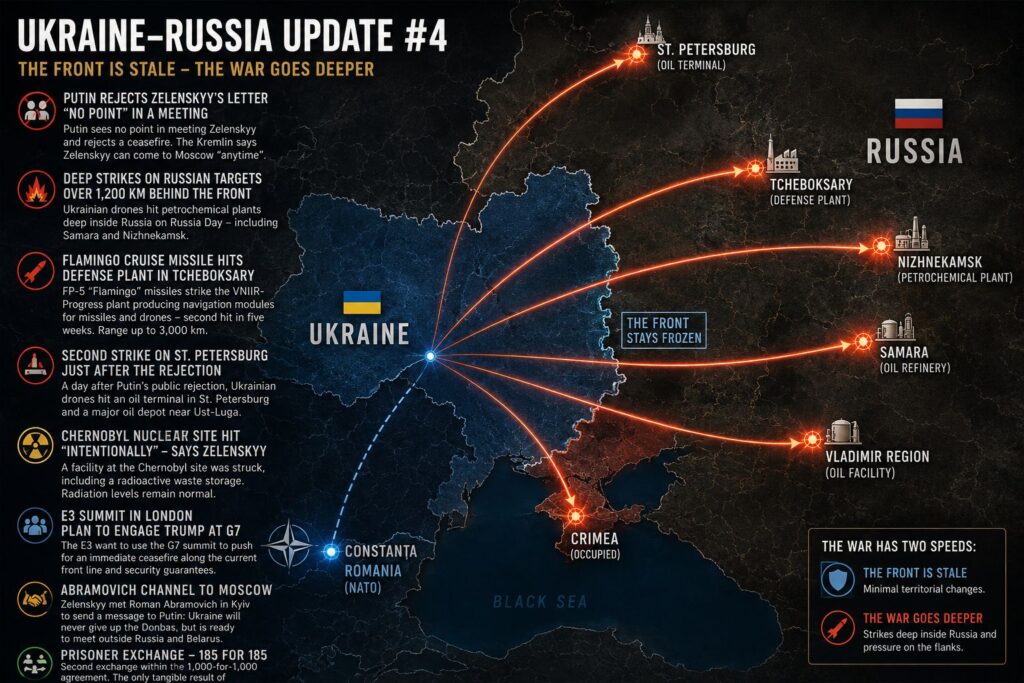
Putin rejects Zelensky’s letter – “no point” in a meeting Russia gave the open letter from our last update a clear refusal. At the International Economic Forum in St. Petersburg, President Putin declared on June 05 that he currently saw no point in a meeting with Zelensky; a ceasefire, he said, would only help Kyiv stop the Russian ground offensive. He had merely skimmed the letter and found “elements of rudeness” – allusions to his age and length of tenure. The Kremlin let it be known that Zelensky was welcome to “come to Moscow at any time.” Addressing the front, Putin said: “Keep working, brothers!” Zelensky called the response “weak” and declared that Russia was once again choosing war.
Russian national holiday – Ukrainian drones strike petrochemical plants 1,200 kilometers deep On June 12, Russia’s national holiday, Russian Telegram channels reported a large-scale Ukrainian drone strike on petrochemical facilities deep in the Russian interior. According to these reports, the targets included the Togliatti Kauchuk plant in the Samara region and the synthetic rubber producer Nizhnekamskneftekhim in the Tatarstan city of Nizhnekamsk – more than 1,200 kilometers from the border. Videos showed fires; airspace over several regions was temporarily closed and holiday events were cancelled. The target selection on the national holiday repeats the pattern of the previous week, when Kyiv struck St. Petersburg during the opening of the Economic Forum: maximum symbolic effect. An independent damage assessment is pending; the reports come from early, partly Russian sources.
Flamingo cruise missile strikes navigation plant in Cheboksary On the night of June 10, Zelensky confirmed a hit by Ukrainian FP-5 “Flamingo” cruise missiles on the VNIIR-Progress defense plant in Cheboksary, approximately 1,000 kilometers away. The facility manufactures “Kometa” navigation modules for Shahed drones, Kalibr cruise missiles, and Iskander-M ballistic missiles – it was the second strike within five weeks. In the same wave, Ukraine hit the Kuibyshev refinery in the Samara region (annual capacity of approximately 3.7 million tons) as well as two oil facilities in the Vladimir region. Air raid alerts were issued across numerous regions, for the first time including the Omsk region and the entire Ural district. Russia stated it had intercepted four Flamingo missiles and 766 drones. The Flamingo has a range of up to 3,000 kilometers.
Second strike on St. Petersburg – immediately after the rejection Just one day after Putin’s public rebuff, Ukraine struck the St. Petersburg area again. In the night of June 06, long-range drones hit an oil terminal in the city and a large fuel depot in nearby Ust-Labinsk. According to European observers, the Ukrainian leadership officially ordered an intensification of long-range strikes the moment the Russian rejection became public. It was the second Ukrainian strike on Putin’s birthplace within a week – an unprecedented development in this war. The repeated hits suggest that Russian air defenses cannot provide seamless protection even over core areas.
Zelensky: Russia struck Chernobyl nuclear facility “deliberately” In the night of June 07, a facility of the nuclear infrastructure in the Chernobyl region was struck, according to Zelensky; he described it as a nuclear waste storage site and a deliberate Russian strike. A fire had been extinguished and no radiation limit violations had occurred. In the same night, civilian targets in 13 regions were attacked. Russia offered no account of its own targeting; the characterization as “deliberate” is the Ukrainian reading and has not been independently confirmed. The incident fits into a series of incidents at Ukrainian nuclear sites since 2022.
E3 summit in London – and the plan to bring Trump on board at the G7 On June 07, Zelensky met in London with British Prime Minister Starmer, Chancellor Merz, and President Macron. In a joint statement, the four named five conditions for a “just and lasting peace,” closely mirroring Zelensky’s letter. According to reports from June 11, the E3 intend to use the G7 summit on June 16 and 17 in Évian, France, to bring US President Trump on board for a new negotiating track: an immediate ceasefire along the current front line as a starting point, plus security guarantees including a multinational force. Putin has already rejected both – the ceasefire and European troops.
The Abramovich channel – a back route to Moscow On June 07, Zelensky confirmed that he had met sanctioned Russian businessman Roman Abramovich in Kyiv in late May, tasked with carrying a message to Putin. The core message: Ukraine would never cede the Donbas, but was willing to meet outside Russia and Belarus. Putin described the same episode at the Forum from his own perspective – a “long-standing acquaintance” had traveled to Kyiv and returned with a request for a meeting – and rejected it. The connection runs deep: Abramovich was already the channel between both sides in 2022.
Prisoner exchange – 185 for 185 On June 05, Russia and Ukraine again exchanged 185 soldiers each. It was the second swap under an agreement covering 1,000 prisoners per side; most returning Ukrainians had been held in Russian captivity since 2022, the oldest was 62. Russia additionally handed over one civilian. Such exchanges remain the only tangible result of the US-initiated diplomacy that has been stalled for weeks. While strikes and counterstrikes continue unabated, this one humanitarian channel keeps functioning – a thin thread of cooperation in an otherwise hardened picture.
NATO flank: Ukrainian naval drone in Romania, German warning about 2029 On June 05, a Ukrainian naval drone exploded in the Romanian port of Constanța; according to the Ukrainian Navy, it had been knocked off course by Russian electronic warfare. Four drones lost control, and more than 1,300 people were evacuated from beaches. EU Commission President von der Leyen called the incident a “direct consequence” of the war. Alliance territory had thus been touched from both directions within two weeks – following a Russian drone in Galați, now a Ukrainian system. In parallel, the Inspector General of the German Army, Christian Freuding, warned that Russia could be capable of attacking a NATO partner by 2029, possibly earlier.
Front assessment: stalemate holds, data sets continue to contradict each other The ground situation remains largely frozen. Russia Matters, drawing on ISW data, records a net Russian loss of 91 square miles for the four-week period ending June 09, and a loss of ten square miles for the week ending June 09. The Ukrainian OSINT source DeepState arrives at a net Russian loss of one square mile for the same monthly window, but records a mini-gain of six square miles and advances near eight settlements in the final week. The figures diverge, but neither supports a narrative of a major Russian breakthrough. Energy blackouts from Russian strikes are estimated to have dragged Kyiv’s economic growth down by 2.5 percentage points in 2026.
Crimea logistics and refineries – the “logistical lockdown” takes shape Ukraine confirmed on June 12 a strike on the bridge near Armyansk in northern Crimea, reportedly hitting around 50 Russian military vehicles; the route was described as “completely paralyzed.” The night before, the Afipsky refinery in the Krasnodar region went up in flames – a facility accounting for roughly two percent of Russia’s refining capacity. Moscow acknowledged for the first time that strikes on oil infrastructure were causing temporary fuel shortages in several southern regions. Ukraine’s Defense Ministry openly states its objective: to cripple Russian military logistics in the occupied territories.
Washington and Brussels: new aid, new sanctions The US House of Representatives passed legislation on June 04 providing further military assistance to Ukraine and additional sanctions against Russia. In parallel, the EU is working on a package that would freeze the price mechanism for Russian energy imports through the end of 2026 – Moscow should not profit from the price spikes triggered by the Iran war. Two theaters of war are converging in a shared resource and energy logic. Whether the legislation passes the Senate and the EU package is adopted in full remains open; the direction, however, is clear: more economic pressure rather than diplomatic movement.
Russia’s air campaign – and Putin’s economic self-portrait Over the course of the week, Russia deployed, according to Ukrainian figures, 88 rockets and cruise missiles, more than 3,250 combat drones, and around 1,800 glide bombs; one glide bomb killed three civilians in a village in the Zaporizhzhia region. At the St. Petersburg Forum, Putin simultaneously painted a picture of economic stability: sanctions were hitting their authors harder than Russia, BRICS internal trade had crossed the one trillion dollar mark, and Russian GDP had grown slightly in April. Russia presents itself as unimpressed – while Ukraine’s deep strikes make the other side of that narrative visible.

ANALYSIS
The rejection and its theater
No event defines this week more than a single phrase: “no point.” With these words, Putin dismissed Zelensky’s open letter at the Economic Forum – the letter our last update had left as an open question. The reasoning is more revealing than the rejection itself: a ceasefire, the Kremlin leader argued, would only help Kyiv stop the Russian ground offensive. Moscow thereby openly states that it ties negotiations to the military situation – and that the actual sticking point remains the Donbas, whose full cession Russia demands and Kyiv categorically refuses.
What is striking is how much movement there is around this deadlock. In late May, a back channel to Moscow ran through Russian businessman Abramovich; in London, Zelensky and the E3 formulated five peace conditions; for the G7 summit in Évian, the Europeans are planning to bring President Trump on board for a new negotiating track – a ceasefire along the current front, security guarantees, a multinational force. That is the sober reading of why the Europeans are pressing so hard for a seat at the table: they want to lock in a perceived shift in momentum before it reverses, and to draw in the United States, whose mediation has largely been on hold since the Iran war. Trump himself expressed enthusiasm for possible talks, but the operational burden clearly rests with the Europeans – and their domestic support is eroding: in France, only 47 percent now favor supplying European weapons to Kyiv, according to polls. Putin, for his part, stated bluntly at the Forum that combat operations would end only once Russia had achieved its self-defined objectives – a rejection not just of the meeting, but of the entire logic of a ceasefire before a solution Moscow considers acceptable.
Yet precisely here lies the weakness of the European initiative. Both core elements – a ceasefire on the current line and European troops in Ukraine – have already been rejected by Putin. The mediator Moscow floated, Gerhard Schröder, was turned down by both Kyiv and Berlin. The pattern that emerges can be described without being lamented: both sides talk about negotiating while striking as hard as they can. In the same week that Zelensky writes a letter and travels to London, Ukraine hits St. Petersburg and petrochemical plants deep in the Russian interior; in the same week that Moscow signals openness to dialogue, it bombs Ukrainian cities and – by Kyiv’s account – a nuclear facility. Cui bono? Anyone on the verge of possible talks wants to come to the table from a position of strength. The week’s finding is therefore not “peace window” but this: diplomacy is theater draped over a hard, unmoved front line of demands.
The navigation nodes
Ukraine’s long-range strikes this week are easy to read as a trail of fires – a refinery here, a fuel depot there. The more interesting finding lies in what Kyiv is targeting. With the VNIIR-Progress plant in Cheboksary, Ukraine struck for the second time in five weeks a facility that does not build missiles but their “Kometa” navigation modules – the components that allow Shahed drones, Kalibr cruise missiles, and Iskander-M rockets to find their targets at all. Striking the eyes of a precision weapon degrades the weapon without destroying it. That is a different logic from simply burning fuel.
This logic has both a range and a depth dimension. Range: the Flamingo flies up to 3,000 kilometers; in the same night, air raid alerts sounded for the first time in the Omsk region and the entire Ural district – areas that had considered themselves safe since the war began. Depth: Kyiv is combining strikes on production nodes with a broad campaign against the oil industry that has, according to Russia Matters, now knocked out roughly ten percent of Russian refining capacity. Processing temporarily fell to its lowest level in over 16 years. According to Bloomberg data, the processing rate dropped to approximately 4.69 million barrels per day – roughly eleven to twelve percent below the level of early 2026. The drone strike on a corvette in drydock at Kronstadt from the previous week belongs in this picture as well: what counts is not the number of targets but their position in the system – shipyards, navigation manufacturing, and fuel logistics are chokepoints whose disruption strains the entire chain.
That this strategy is working is demonstrated by a source that normally stresses strength: Moscow itself acknowledged for the first time that strikes on oil infrastructure were causing fuel shortages in several southern regions. At the Economic Forum, Putin painted the opposite picture – sanctions were hitting their authors harder, BRICS internal trade was crossing one trillion dollars, GDP was growing slightly. Both statements can be true simultaneously: the macroeconomic facade holds, while at specific points – fuel in the south, navigation modules for precision weapons, fleet repair capacity – the substance erodes. It is precisely this gap between headline and operational depth that standard reporting rarely illuminates. Kyiv is no longer waging a war of attrition across territory – it is waging one against nodes.
The flank from two directions
The most underappreciated strand of the week runs not in Ukraine but along the outer edge of the Alliance. On June 05, a Ukrainian naval drone exploded in the Romanian port of Constanța, having been knocked off course by Russian electronic warfare according to the Ukrainian Navy. More than 1,300 people were evacuated from beaches; four drones had lost control; Greece has also recently protested a drifting Ukrainian device. This is remarkable because the previous week had already seen a Russian drone strike a residential building in the Romanian city of Galați. Within two weeks, NATO territory had thus been touched from both directions.
The asymmetry of interpretation is revealing. The Russian hit in Galați was framed by Western voices as a test of Alliance defense; the Ukrainian drone in Constanța is characterized as a technical loss of control under Russian jamming. Both readings have merit – but the sober reality is symmetrical: Alliance territory now lies within the range and the jamming shadow of both belligerents, regardless of intent. EU Commission President von der Leyen called the incident a “direct consequence” of the war and pointed to European investments in drone defense and early warning systems.
Here the immediate situation connects to a longer arc. The Inspector General of the German Army, Christian Freuding, stated on June 11 that all 32 NATO partners assessed Russia as potentially capable of attacking a member state by 2029 – possibly earlier. This warning can be read as procurement politics generating pressure for higher defense spending; it can also be read as a serious threat assessment. It does not stand alone: Denmark’s military leadership speaks of a future conflict “in all domains” – land, air, sea, space, and cyberspace – and in European planning, 2029 is solidifying as the target year by which gaps in readiness, defense production, and air defense must be closed. For this week’s assessment, the structural point is what matters: as long as Alliance territory is being struck, the question of US protection under Trump remains open, and interceptor missiles are in short supply, the war is becoming less calculable at its edges – regardless of what anyone offers at the negotiating table.
STRATEGIC ASSESSMENT
On war day 1,570, this is a war running at two speeds: a frozen front, an escalating depth. Russia frames its strikes as the systematic destruction of Ukraine’s defense and energy base while refusing any meeting without pre-negotiated conditions – the Donbas demand remains the hard core. Ukraine is shifting its weight toward long-range strikes against production nodes, oil infrastructure, and logistics, seeking symbolic targets such as St. Petersburg and petrochemical plants on Russia’s national holiday. Diplomacy runs in parallel and without consequence: a rejected letter, a back channel through Abramovich, five European conditions, the plan to bring Trump on board at the G7 – while both sides strike as hard as they can. The week’s finding is not an imminent end but a hardening: both sides are seeking the position of strength before any negotiation begins. At the same time, the center of gravity is shifting from territory to operational depth – and Moscow’s first acknowledgment of fuel shortages in the south signals that this calculus is beginning to pay off for Kyiv. And with every drone that drifts onto Alliance territory, and every warning about 2029, the question draws closer: whether this war is remaining manageable at its edges.

Michael Hollister
is a geopolitical analyst and investigative journalist. He served six years in the German military, including peacekeeping deployments in the Balkans (SFOR, KFOR), followed by 14 years in IT security management. His analysis draws on primary sources to examine European militarization, Western intervention policy, and shifting power dynamics across Asia. A particular focus of his work lies in Southeast Asia, where he investigates strategic dependencies, spheres of influence, and security architectures. Hollister combines operational insider perspective with uncompromising systemic critique – beyond opinion journalism. His work appears on his bilingual website (German/English) www.michael-hollister.com and in investigative outlets across the German-speaking world and the Anglosphere.
Support me – be a member

Sources
- RT DE – Wladimir Putin auf Wirtschaftsforum: „Treffen mit Selenskij hat keinen Sinn”: https://de.rt.com/russland/282332-wladimir-putin-auf-wirtschaftsforum-treffen/
- RFE/RL – Putin Rejects Zelenskyy’s Proposal to Meet as Senseless: https://www.rferl.org/a/putin-zelenskyy-ukraine-russia-war/33773619.html
- PBS/AP – Putin slams Western sanctions as damaging to the global economy: https://www.pbs.org/newshour/world/putin-slams-western-sanctions-as-damaging-to-the-global-economy
- Euronews DE – Selenskyj-Brief mit Altershieb? Putin: „Kein Sinn in Treffen”: https://de.euronews.com/2026/06/06/ukraine-krieg-selenskyj-brief-putin
- Kyiv Independent – Russian petrochemical plants reportedly struck by Ukrainian drones: https://kyivindependent.com/russian-chemical-plant-reportedly-struck-by-ukrainian-drones/
- Kyiv Post – Ukraine Marks Russia Day With Massive Drone Raid on Petrochemical Plants: https://www.kyivpost.com/post/78014
- Meduza – Ukraine’s Flamingo missiles reached more than 1,000 kilometers inside Russia: https://meduza.io/en/feature/2026/06/10/ukraine-s-flamingo-missiles-reached-more-than-1-000-kilometers-inside-russia-overnight-as-air-raid-alerts-sounded-in-new-regions-for-the-first-time-in-the-war
- Euronews – Kyiv hit Russian military plant using Ukrainian-made Flamingo missile: https://www.euronews.com/my-europe/2026/06/10/kyiv-hit-russian-military-plant-using-ukrainian-made-flamingo-missile-zelenskyy-says
- Militarnyi – Flamingo Missile Strikes VNIIR-Progress in Cheboksary: https://militarnyi.com/en/news/flamingo-missile-strikes-kometa-antenna-manufacturer-vniir-progress-in-cheboksary/
- ZDF heute – Ukrainische Angriffe offenbaren Mängel in Russlands Flugabwehr: https://www.zdfheute.de/politik/ausland/angriffe-drohnen-st-petersburg-ukraine-krieg-russland-100.html
- ZDF heute – Selenskyj: Russland hat Atommülllager absichtlich angegriffen: https://www.zdfheute.de/politik/ausland/tschernobyl-angriff-selenskyj-ukraine-krieg-russland-100.html
- Kyiv Independent – Zelensky, E3 leaders name 5 conditions for ‘just and lasting peace’ in London: https://kyivindependent.com/zelensky-arrives-in-london-for-bilateral-e3-talks/
- The New Voice of Ukraine – Europe seeks Trump’s support at G7 summit for peace talks: https://english.nv.ua/nation/ukraine-peace-talks-may-resume-in-july-europe-seeks-trump-s-support-50615328.html
- The Moscow Times – Zelensky Confirms He Met With Russian Billionaire Abramovich in Kyiv: https://www.themoscowtimes.com/2026/06/08/zelensky-confirms-he-met-with-russian-billionaire-abramovich-in-kyiv-a92951
- Reuters/U.S. News – Ukraine and Russia Exchange 185 Prisoners of War Each in Swap: https://www.usnews.com/news/world/articles/2026-06-05/ukraine-and-russia-exchange-185-prisoners-of-war-each-in-swap
- Al Jazeera – Drone explosion in Romanian port spurs Ukraine war spillover fears: https://www.aljazeera.com/news/2026/6/5/drone-explosion-in-romanian-port-spurs-ukraine-war-spillover-fears
- Kyiv Independent – Naval drone explodes near Romania’s Constanta port on Black Sea: https://kyivindependent.com/romania-reports-naval-drone-explosion-near-black-sea-port/
- Kyiv Independent – German army chief warns Russia will be prepared to attack NATO by 2029: https://kyivindependent.com/its-nato-agreed-intelligence-german-army-chief-warns-russia-will-be-prepared-to-attack-nato-by-2029/
- Russia Matters – The Russia-Ukraine War Report Card, June 10, 2026: https://www.russiamatters.org/news/russia-ukraine-war-report-card/russia-ukraine-war-report-card-june-10-2026
- Kyiv Independent – Major oil refinery in southern Russia ablaze after Ukrainian attack: https://kyivindependent.com/major-oil-refinery-in-southern-russia-ablaze-after-ukrainian-attack/
© Michael Hollister – All rights reserved. Redistribution, publication or reuse of this text requires express written permission from the author. For licensing inquiries, please contact the author via www.michael-hollister.com.
Newsletter
🇩🇪 Deutsch: Verstehen Sie geopolitische Zusammenhänge durch Primärquellen, historische Parallelen und dokumentierte Machtstrukturen. Monatlich, zweisprachig (DE/EN).
🇬🇧 English: Understand geopolitical contexts through primary sources, historical patterns, and documented power structures. Monthly, bilingual (DE/EN).