
by Michael Hollister
Exclusive published at Michael Hollister on June 03, 2026
2.081 words * about 10 minutes readingtime
The complete analysis covering Germany as a logistics hub, casualty care for 1,000 wounded per day, and the NATO Ankara summit as the next turning point – continue reading here:
The Pattern Is Tightening
A continuation of the analysis – “The War Before the War – Part 7“
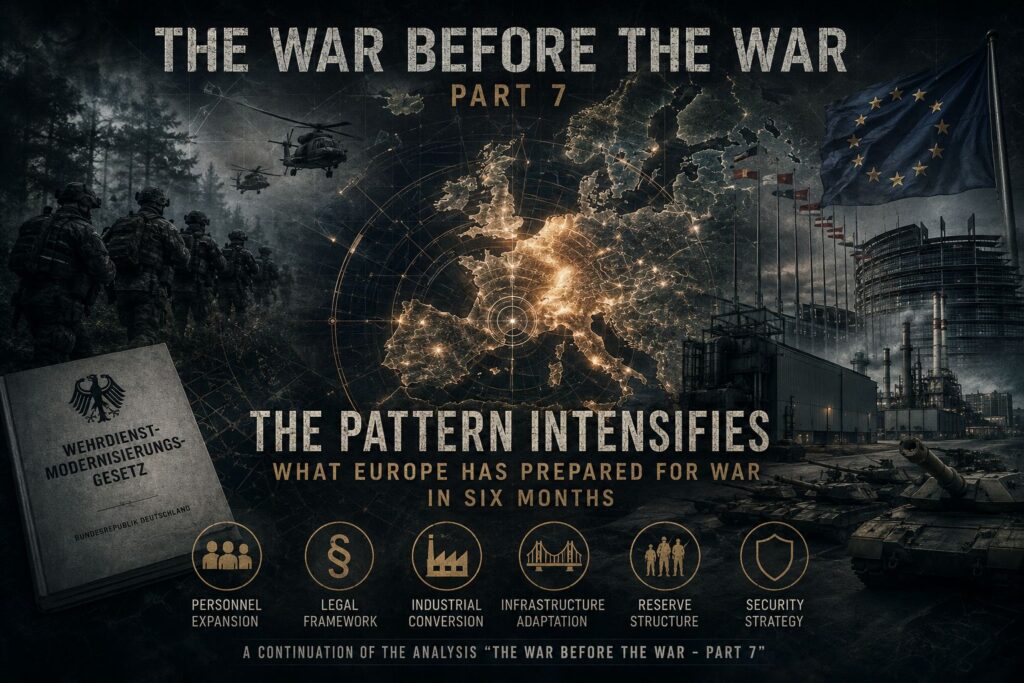
There is an old rule that applies in every household and is rarely applied in politics: don’t listen to what they say – watch what they do. What Europe has done over the past six months can no longer be captured by the term “defense readiness.” It is more. It is faster. And it is happening simultaneously on four levels that together produce a picture no single measure would show on its own.
In “The War Before the War – Part 7”, sixteen steps were documented through which Europe built its war-making capacity between 2014 and 2026 – without announcement, without public debate, without the public perceiving the overall pattern. The thesis: wars do not begin with the first shot, but with the systematic removal of all obstacles that have so far prevented it. Treaties are cancelled, infrastructure adapted, industries converted, language shifted. Each step plausible on its own. All together a pattern.
Six months later comes the question every good thesis provokes: does the pattern hold – or was it over-interpretation? The answer is supplied not by opinions, but by facts from the past six months. Four of them – from four fields that have nothing to do with one another, except that they are all pointing in the same direction at the same time.
Break 1: The State Is Registering Its Men Again
Since 01 January 2026, all 18-year-old men in Germany receive a compulsory Bundeswehr questionnaire. From 2027, medical fitness assessments will again be mandatory. The legally enshrined target: 460,000 soldiers by 2035 – 260,000 active, 200,000 in the reserve.
That alone would be debatable. What barely made headlines in spring 2026 is harder to debate: Section 3(2) of the Military Service Act stipulates that male persons from the age of 17 must obtain authorization from the responsible Bundeswehr career center if they wish to leave Germany for more than three months. The provision is not new – it dates from the Cold War. It was reactivated by the Military Service Modernization Act without this being communicated publicly. When the press discovered it in April 2026, the Ministry of Defense responded with a general administrative ruling: as long as military service remains voluntary, authorization is deemed granted.
The legal basis remains. In a crisis it can be activated without new legislation.
In parallel, the Federal Ministry of Defense published its “New Reserve” strategy in April 2026. Reservists are in future to protect critical infrastructure, secure logistics routes, and – within the framework of the Germany Operations Plan – serve as a buffer between civilian society and front-line deployment. The Military Security Enabling Act, passed in December 2025, creates the legal basis for Bundeswehr operations on domestic soil. A “contingency conscription” provision is anchored in the law and can be activated by a simple Bundestag resolution – without a referendum, without an amendment to the Basic Law.

The state is not building an army from scratch. It is building the infrastructure that an army calls upon in an emergency.
What is striking is how the measures interlock. The draft registration provides the personnel picture. The Military Service Act secures availability. The reserve strategy defines the deployment role. The Military Security Enabling Act gives the Bundeswehr the legal basis for operations inside Germany. None of these steps individually makes a headline. All together they close a gap that has been open since 2011 – the year conscription was suspended.
Break 2: The Money Has No Brake Anymore
108.2 billion euros. That is what Germany is spending on defense in 2026 – the highest level since the end of the Cold War. Of that, 47.88 billion euros flow into procurement, 14.8 billion into ammunition alone. Compared to 2024, when Germany spent 52 billion euros on defense, this represents a doubling within two years.
This is made possible by a constitutional amendment in force since 2025: defense expenditure above one percent of GDP is permanently exempted from the debt brake – as is expenditure on civil defense, intelligence services, and support for states “attacked in violation of international law.” Pistorius put it politically: “The threat situation takes precedence over the budget situation.” When a state amends its constitution to permanently decouple arms expenditure from fiscal constraints, that is no longer fiscal policy.
What the numbers alone do not show, the industry does. Rheinmetall has increased annual production of artillery shells from 70,000 rounds in 2022 to 1.1 million. Germany thereby produces more conventional artillery ammunition than the United States. In Unterlüß stands Europe’s largest ammunition plant – a 500-million-euro investment, capacity of 350,000 shells per year at full build-out in 2027. Further plants are being built in Lithuania, Latvia, Bulgaria, and Romania.
At the same time, Volkswagen is in intensive talks with the Israeli defense company Rafael about using its Osnabrück plant for air defense components. VW CEO Blume confirmed in April 2026 that negotiations with defense companies were underway. Civilian vehicle production in Osnabrück runs out in 2027. Tank manufacturer KNDS is, according to Reuters, explicitly seeking spare capacity in the automotive industry to handle rising defense orders.
The word war economy appears in no official statement. The reality it describes is taking shape regardless.
The comparison with US ammunition production deserves context. The United States, the world’s largest military power, currently produces around 480,000 artillery shells per year. Germany, at 1.1 million, exceeds that – and is aiming for 1.5 million by 2030. One may ask the obvious question: which peacetime scenario requires this? Pistorius has given no answer. He has not asked the question.
Break 3: Europe Is Building Its Own Command Structures
On 06 February 2026, NATO Allies agreed on a redistribution of military command structure. The outcome: all three of NATO’s Joint Force Commands – the operational war commands that in crises and conflicts coordinate actual warfighting – pass under European leadership. JFC Norfolk goes to the United Kingdom, JFC Naples to Italy, JFC Brunssum is shared by Germany and Poland on a rotation basis. For the first time, all three NATO war commands are led exclusively by Europeans.
The United States retains supreme command – SACEUR remains American – and all Theater Component Commands for land, air, and sea. Operational warfighting lies with Europe, strategic control with Washington. For Trump, this is a domestically sellable retreat. For Europe, it is a responsibility from which one does not easily step back.
In parallel, a bilateral treaty network is forming that Polish media have already described as a “NATO within NATO”. Poland has concluded defense agreements with France, the United Kingdom, and – planned for June 2026 – Germany within twelve months. Prime Minister Tusk states the reason openly: in an emergency, one wants a rapid response from Paris and London before the Alliance can convene in full session.

In plain terms: the bilateral agreements are explicitly designed to bypass NATO decision-making processes. Legally it remains the Alliance. Politically, a tighter core is emerging that can act faster – and whose geographic orientation permits no ambiguity.
At the operational level, a further structural decision adds to the picture: the 1st German-Netherlands Corps in Münster will henceforth assume NATO command for land forces in Estonia and Latvia. Up to 60,000 soldiers can be subordinated to this corps. Command structures must be in place before conflict – in an emergency there is no time to set up command rooms. Germany is building them now.
What this bilateral network distinguishes from NATO is its speed, because it is smaller. Four or five countries can decide in hours what 32 cannot manage in days. This is not a design flaw in the Alliance – it is the stated purpose of this parallel architecture. Tusk has said so. The treaties confirm it. The next step – a German-Polish agreement, planned for June 2026 – completes the inner circle.
Break 4: The New Arsenal – Drones, AI, Combat Experience
Helsing, a Munich startup for AI-assisted battlefield operations, received a funding round of 600 million euros in June 2025. In February 2026, a Bundeswehr procurement contract of 536 million euros followed for attack drones, awarded jointly to Helsing and Stark Defence. Stark Defence is approaching a valuation of 2.5 billion euros. In parallel, the Bundestag approved a further framework contract of around 300 million euros for Rheinmetall drones.
These are not research projects. These are serial production orders.
Quantum Systems goes a step further. In January 2026, the joint venture Quantum Frontline Industries was formed with Ukrainian Frontline Robotics. In April two further German-Ukrainian companies followed: Quantum WIY Industries for interceptor drones – with a direct order for 15,000 Strila drones from the Ukrainian Armed Forces – and Quantum Tencore Industries for unmanned ground systems. The logic: German engineering capacity meets Ukrainian combat experience. What works on Ukrainian battlefields under fire is scaled up and fed into NATO procurement.
1.25 billion euros in venture capital flowed into German defense-tech startups in 2025 – more than in any other EU country. Five years ago this sector barely existed in Germany. NATO DIANA as a dual-use accelerator, the European Defence Fund, and the NATO Innovation Fund create the institutional framework that ensures this boom is not left to the market, but steered strategically.
This is not the defense industry of the Cold War. It is a new layer of military capacity – faster, more adaptive, and with a direct link to an ongoing war.
What distinguishes this boom from earlier arms cycles is that it is not state-mandated, but market-driven – and then state-amplified. The Bundeswehr Acceleration Act of 15 January 2026 radically shortens procurement procedures so that startups can enter procurement more quickly. NATO DIANA and the NATO Innovation Fund supply capital and networks. 1.25 billion euros in venture capital in a single year is not coincidence. It is the result of a political framework that has deliberately designated defense tech as a growth sector.
Assessment: What This Means
Personnel is being registered, kept legally available, and organized into reserve structures. Defense financing has been constitutionally and permanently uncapped – 108 billion euros in the current year, on a rising trajectory. Ammunition production is outpacing the United States. Civilian industrial capacities – car plants, suppliers, production lines – are being opened up for arms goods. NATO command structures are being Europeanized; bilateral agreements are creating parallel structures capable of reacting faster than the Alliance itself. A new layer of AI drone startups with direct combat experience from Ukraine is emerging and receiving serial production orders worth billions.
Each of these steps is officially justified as defensive. The argument runs: the Bundeswehr was gutted by underfunding. Europe must become capable of defending itself. Russia attacked Ukraine. All of that is true.
But defensive readiness has no address. These measures have one. In May 2026, the KSK – Germany’s Special Forces Command – spent three weeks in Lithuania training to kill Russian generals behind enemy lines – not abstractly, but in a scenario that takes Russian occupation of the Baltic states as its starting point. Brigadier General Glockzin calls it “as close to reality as possible.”
Whoever takes “watch what they do” seriously arrives at a finding no one is stating officially: all structural obstacles that would have so far prevented a conventional large-scale conflict with Russia are being systematically removed. What is missing is no longer preparation. What is missing is a political decision. Whether and when it will be taken lies beyond what sources can establish. But the direction in which it would have to fall for what is described here to make sense is no longer open.
The pattern from Part 7 is tightening. Don’t listen to what they say.
What this briefing deliberately does not cover is at least as revealing: Germany as a logistics hub, rehearsed for the first time without US participation and without a script at Steadfast Dart 2026 with 10,000 soldiers from 13 nations – with the declared objective of routing 800,000 soldiers and 200,000 vehicles through Germany to the eastern flank in an emergency. And Medic Quadriga 2026, the largest Bundeswehr medical exercise in decades, in which the healthcare system was prepared to handle 1,000 combat casualties per day from a Baltic states scenario. Both are covered in the detailed analysis article.
The complete analysis covering Germany as a logistics hub, casualty care for 1,000 wounded per day, and the NATO Ankara summit as the next turning point – continue reading here:

Michael Hollister
is a geopolitical analyst and investigative journalist. He served six years in the German military, including peacekeeping deployments in the Balkans (SFOR, KFOR), followed by 14 years in IT security management. His analysis draws on primary sources to examine European militarization, Western intervention policy, and shifting power dynamics across Asia. A particular focus of his work lies in Southeast Asia, where he investigates strategic dependencies, spheres of influence, and security architectures. Hollister combines operational insider perspective with uncompromising systemic critique – beyond opinion journalism. His work appears on his bilingual website (German/English) www.michael-hollister.com and in investigative outlets across the German-speaking world and the Anglosphere.
Sources
- Federal Government: New Military Service from 01 January 2026 – https://www.bundesregierung.de/breg-de/aktuelles/neuer-wehrdienst-gesetzentwurf-2381580
- Augen Geradeaus: Section 3 Military Service Act, Exit Permit for Men Subject to Conscription, April 2026 – https://augengeradeaus.net/2026/04/noch-keine-wehrpflicht-aber-ausreise-fuer-theoretisch-wehrpflichtige-nur-mit-genehmigung/
- Bundestag: Defense Budget 2026, 108.2 Billion Euros – https://www.bundestag.de/presse/hib/kurzmeldungen-1106068
- Federal Ministry of Finance: Debt Brake and Defense 2026 – https://www.bundesfinanzministerium.de/Monatsberichte/Ausgabe/2026/02/Inhalte/Kapitel-2-Analysen/2-3-sollbericht-2026.html
- Yahoo Finance: Rheinmetall Overtakes USA in Ammunition Production, May 2026 – https://de.finance.yahoo.com/nachrichten/rheinmetall-produziert-mehr-munition-usa-170852526.html
- T-Online / DPA: NATO Command Structure Reorganization, 10 February 2026 – https://www.t-online.de/nachrichten/ausland/id_101123128/deutschland-ueberholt-usa-bei-spitzenposten-in-nato.html
- RT DE, Alexander Koz: NATO Within NATO – Europe Builds Parallel Military-Political Power Structures, 01 June 2026 – https://de.rt.com/meinung/281494-nato-innerhalb-nato-europa-baut-parallele-militarpolitische-machtstrukturen/
- Federal Ministry of Defense: ELSA Drone Agreement February 2026 – https://www.bmvg.de/de/aktuelles/ministertreffen-und-ukraine-unterstuetzung-pistorius-in-bruessel-6066008
- KIPODE: Defense Tech Startups Germany 2026 – https://kipode.de/ruestungsindustrie-deutschland.html
- RT DE: Silver Dagger 2026, KSK Lithuania – https://de.rt.com/inland/281264-silver-dagger-2026-deutsche-spezialkraefte/
- Michael Hollister: The War Before the War – Part 7 – https://www.michael-hollister.com/de/2026/05/03/der-krieg-vor-dem-krieg-teil-7/
Full source list with 25 references in the detailed analysis article.
© Michael Hollister – All rights reserved. The distribution, publication or use of this text requires the express written permission of the author. If interested in reuse, please contact the author via www.michael-hollister.com.
Newsletter
🇩🇪 Deutsch: Verstehen Sie geopolitische Zusammenhänge durch Primärquellen, historische Parallelen und dokumentierte Machtstrukturen. Monatlich, zweisprachig (DE/EN).
🇬🇧 English: Understand geopolitical contexts through primary sources, historical patterns, and documented power structures. Monthly, bilingual (DE/EN).