Category Briefings

Energy, Debt, AI – The IMF Warns of the Bill No One Wants to Pay

Energy shocks, record public debt, and a multitrillion-dollar AI investment boom: The International Monetary Fund is warning of three forces putting simultaneous pressure on the global economy. As rising energy prices fuel inflation and governments face mounting interest costs, trillions are flowing into artificial intelligence and military expansion. The IMF is calling for fiscal discipline and restrictive monetary policy. But how can governments simultaneously finance rearmament, cushion energy costs, sustain social spending, and keep pace in the technology race? Behind the economic figures lies a fundamental question of distribution: Who benefits from these investments - and who ultimately pays the bill?
The Drone Wall Disappears – and Becomes Something Much Bigger

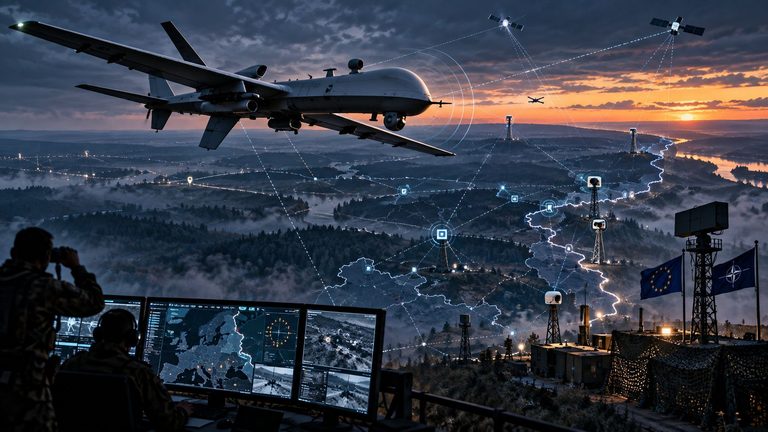
What began as a politically catchy “drone wall” has evolved into something far larger: a European defense architecture spanning drones, air and missile defense, space, maritime security, and the eastern flank. With investment ambitions reaching into the hundreds of billions, new procurement structures, close integration with Ukraine, and a readiness timetable extending to 2030, the real story is no longer a defensive line against drones. It is the gradual construction of a jointly coordinated European armament system - and the unresolved question of how much authority is shifting from national capitals to Brussels in the process.

Honor Among Shareholders

The European Union demands ever greater transparency from citizens, companies and elected officials. Yet at the very top of its judicial system, a remarkably different principle applies. Judges and advocates general at the Court of Justice of the European Union may hold corporate investments, largely assess potential conflicts of interest themselves, while previous financial declarations disappear from public view. There is no evidence that judgments have been bought. The deeper issue is institutional: while Strasbourg, Washington and Karlsruhe have strengthened safeguards around judicial integrity, Luxembourg still relies heavily on self-disclosure and self-policing. The greater the power, the stronger the scrutiny should be. At the EU’s most powerful court, that principle appears to run in reverse.

Who Watches the One Who Sees Everything? What Anthropic’s Misuse Report Reveals About the Power of AI Companies

Anthropic’s new threat-intelligence report reads like a glimpse into AI’s dark side: Claude was allegedly used for missile guidance systems in northern Yemen, military software, surveillance, cyber operations, and biological dual-use research. Yet the more explosive revelation lies deeper. The report shows the extent to which a private AI company can observe, assess, and disrupt real-world military, state, and scientific activities - without independent oversight. Who controls a company that simultaneously serves as tool, observer, investigator, and judge?

Berlin Flying Blind: Why the Hack Is Not the Problem-but the Seven Days That Followed Are

For seven days, data was extracted from Berlin’s government network without the intrusion being detected. Weeks later, authorities still cannot say exactly what was stolen, while an initial reassurance has already had to be withdrawn. The case raises a fundamental question: How resilient is the digital infrastructure of a capital whose officials themselves appear surprised by the scale of their own IT system?

The Agreement That Brussels’s Own Lawyers Tried to Stop

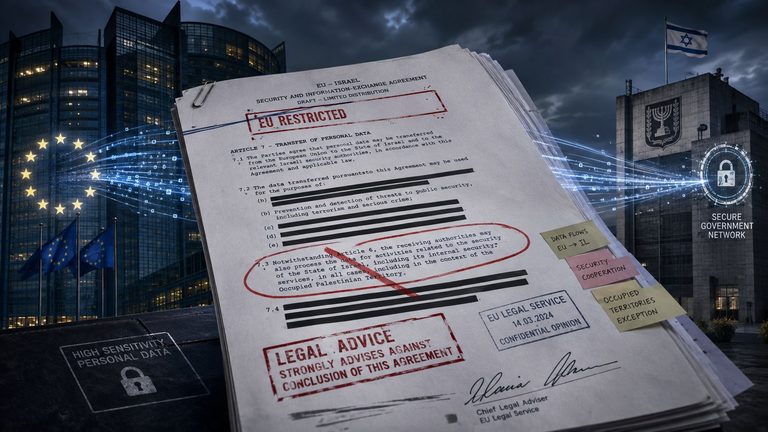
The Commission’s own lawyers raised warnings, and member states halted the process - yet the European Commission continued negotiating. A leaked draft agreement reveals how highly sensitive data belonging to European citizens could reach Israeli security agencies, including Shin Bet, and why its use in the occupied territories was explicitly envisaged. Four documented breaches reveal what remains of European rules when Brussels itself is expected to comply with them.

Taxpayer Money for Settlements: What Three Governments Say – and What Their Money Does

Western governments declare Israeli settlements in the West Bank incompatible with international law - while their tax systems subsidize private funding streams reaching those same settlements. A new British inquiry reveals how Gift Aid, U.S. tax exemptions, and European charity structures turn private donations into a publicly co-financed enterprise. The trail runs from London and Washington through Nijkerk and Reeuwijk - and ends at an uncomfortable blind spot: Germany.

What Washington Is Really Doing About China’s Oil Clearing Market – and Where It Looks Away

A US congressional report portrays China as the central clearing market for sanctioned oil from Iran, Venezuela and Russia. Yet current data reveal a striking asymmetry: Washington has largely broken two of those flows while leaving the biggest one running at multibillion-dollar scale. The difference says less about the effectiveness of sanctions than about the limits of American power when confronted with China.

The Mecca Pact: Movement at the Edges – Part 2

The Mecca Pact is more than an alliance between Saudi Arabia, Turkey, and Pakistan. What matters just as much is who stays outside, who wants in, and who begins building counter-alliances: Egypt’s absence, Qatar’s distance, Pakistan’s Afghanistan conflict, Syria’s strategic position, and India’s response reveal how the Middle East’s security order is being reshaped.

The Mecca Pact: What Three States Promise-and What They Do – Part 1

An attack on one will be considered an attack on all - that is the central pledge of the new Mecca Pact between Saudi Arabia, Turkey, and Pakistan. Yet when a Saudi refinery burned less than 48 hours later, Ankara and Islamabad remained silent. Behind the sweeping labels of an “Islamic NATO” and a “nuclear umbrella” stands a real alliance with substantial military capabilities - but no published treaty text, defined assistance obligations, or operational command structure.