Tag Donald Trump

UPDATE: US AND ISRAEL ATTACK IRAN – June 24, 2026

The Buergenstock talks were meant to chart a path out of war. Yet only days after the memorandum was signed, Washington and Tehran are already presenting fundamentally different versions of what was agreed. Nuclear inspections, frozen Iranian assets, the future management of regional shipping and Iran’s missile programme remain disputed in four crucial areas. At the same time, the ceasefire in southern Lebanon is eroding, Donald Trump is again threatening Iran with military force, and the US Congress is challenging the president’s unauthorized conduct of the war. This update reconstructs what was actually decided in Switzerland - and why the emerging peace process already rests on a signed disagreement.

UPDATE: US AND ISRAEL ATTACK IRAN – June 17, 2026

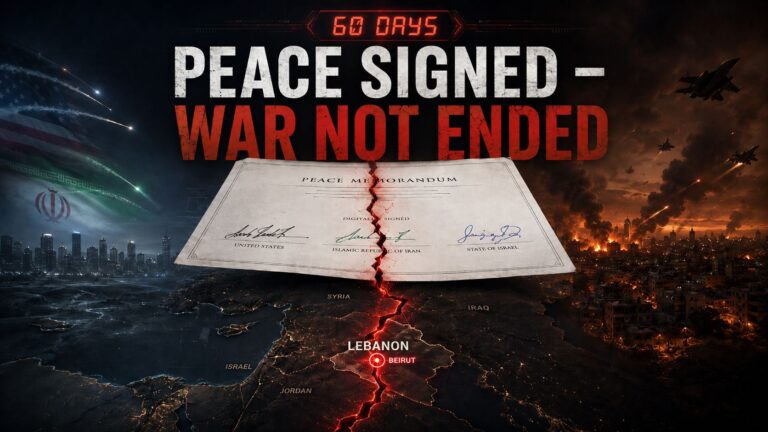
The memorandum has been digitally signed and the formal ceremony is being prepared - yet peace remains out of reach. While Washington and Tehran open a 60-day window for negotiations, Israel continues its strikes in Lebanon, refuses to withdraw and insists that it is not bound by the agreement. The supposed breakthrough therefore carries the seeds of its own collapse: the decisive front no longer runs between the United States and Iran, but through Beirut.

Trump’s Silent Victory

The withdrawal of the last U.S. ground forces from Syria in April 2026 passed almost unnoticed. Yet what appears to be the end of an eleven-year intervention may in fact mark the beginning of a new strategic phase: Washington removes its troops while a former jihadist leader governs Damascus, Kurdish allies are sacrificed, and Uyghur fighters are integrated into state structures. The real target of this reordering is not Damascus, but Beijing. Syria is becoming a geopolitical hinge in the broader confrontation between the United States and China.

Trump’s Silent Victory in Syria

The withdrawal of the last U.S. ground forces from Syria in April 2026 passed almost unnoticed. Yet what appears to be the end of an eleven-year intervention may in fact mark the beginning of a new strategic phase: Washington removes its troops while a former jihadist leader governs Damascus, Kurdish allies are sacrificed, and Uyghur fighters are integrated into state structures. The real target of this reordering is not Damascus, but Beijing. Syria is becoming a geopolitical hinge in the broader confrontation between the United States and China.

B – Who Profits from the Gulf War?

The IEA Oil Market Report of May 2026 reads like a sober data document - yet between the numbers, a new global oil order becomes visible. The closure of the Strait of Hormuz has not only driven prices to historic highs, but also shifted trade flows, created winners, and exposed strategic dependencies. While Asia comes under supply pressure, the United States, Brazil, Venezuela, and the UAE emerge as beneficiaries of a new Atlantic Basin rotation. What appears to be a crisis in the Gulf may in fact mark a strategic redistribution of the global energy system.

Who Profits from the Gulf War?

by Michael HollisterPublished at tkp.at on May 29, 2026 4.744 words * 25 minutes readingtimeFor readers with less time, this analysis is also available as a compact Briefing: the same source base, condensed into the most important core points and roughly ten minutes of reading time:B –…

UPDATE – US AND ISRAEL ATTACK IRAN – May 24, 2026

Trump has announced a “largely negotiated” Iran deal - but Tehran immediately contradicted key parts of Washington’s version. While the White House signals the reopening of the Strait of Hormuz, Iran is institutionalizing its control over the chokepoint, pushing the nuclear issue into an uncertain second phase, and negotiating through Pakistan, Qatar, and regional intermediaries from a stronger position than expected. With Tulsi Gabbard’s resignation, renewed U.S. strike preparations, and growing resistance in Congress, the MoU looks less like a peace agreement than a temporary pause before the hardest questions return.

Iran Insight: “Rescue Mission”

Was the celebrated U.S. “rescue mission” in Iran in fact a failed covert nuclear recovery operation? Michael Hollister reconstructs the inconsistencies, military patterns, and operational clues surrounding the downing of an F-15E, the destruction of special operations aircraft near Isfahan, and the trail of 200 kilograms of missing highly enriched uranium. The article challenges Washington’s official hero narrative and points toward a far more consequential mission that may never have been about rescuing a stranded colonel at all.

Steve Witkoff: The Dealmaker

Steve Witkoff is not a career diplomat - and that is precisely why he has become central to Donald Trump’s foreign policy. From Bronx real estate developer to special envoy handling Gaza, Moscow, Tehran, and Geneva, his rise reflects a new model of transactional diplomacy built on loyalty, personal relationships, and deal-making instincts. This analysis explores the strengths, vulnerabilities, and global implications of that approach.

BOARD OF PEACE – Part 1

Donald Trump presents himself as a peacemaker for Gaza – through the creation of a so-called “Board of Peace.” But behind the humanitarian rhetoric lies a far more disturbing reality.
In Part 1 of this three-part series, I dismantle the origins, historical backdrop, and legal contradictions of this initiative. When those who enabled destruction suddenly claim to deliver peace, the claim itself demands scrutiny.
This first installment exposes why the “Board of Peace” is not a solution, but a structural continuation of power, impunity, and geopolitical coercion. Parts 2 and 3 will reveal who stands to gain – and why Gaza is merely the test case.