
by Michael Hollister
Exclusive published at Michael Hollister on June 07, 2026
Readingtime approx. 9 minutes
The complete analysis – including the Russia triangulation between Israel, Moscow, and Damascus, the creeping Islamization of the Syrian education system, Turkey’s role as invisible driver, and the legal-strategic prehistory of the 2020 ETIM delisting – read the Deep Dive:
Trump’s Silent Victory – And the Real Target Was China
Three Breaks in April 2026
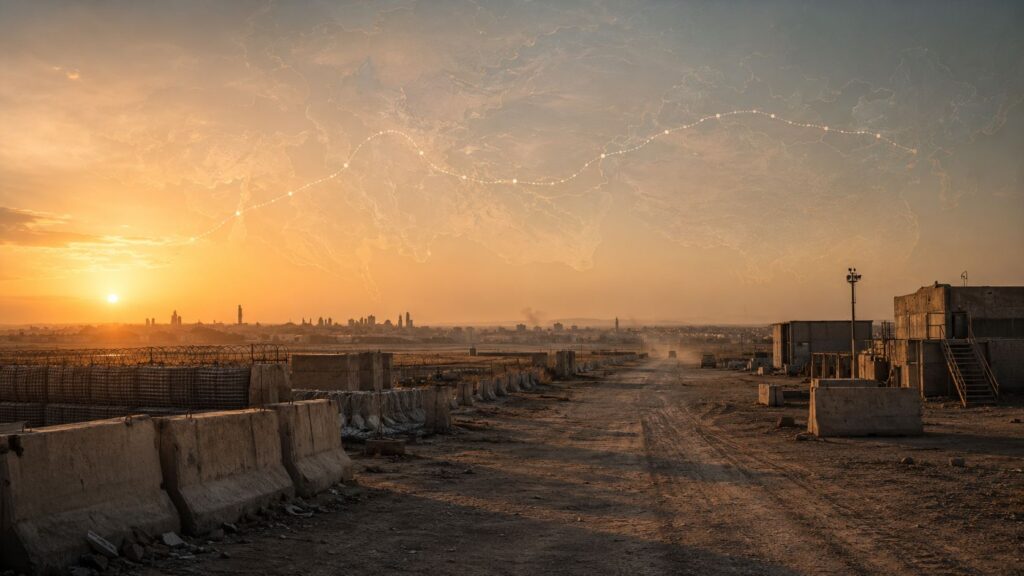
On April 16, 2026, a war ended in the desert of Hasakah that no one remembers the beginning of anymore. The last US Army convoy left the Qasrak Air Base, drove toward the Jordanian border, and with that, the American ground troop presence in Syria was over. CENTCOM spokesman Captain Tim Hawkins told the Associated Press tersely that US forces had “completed the transition of all major bases in Syria as part of a deliberate and conditions-based transition.” That was it. That was the entire statement.
There are three breaks in what happened that day and in the months preceding it. Three breaks that, taken together, produce the picture the German mainstream media did not draw – and that the government press conference six days later did not address with a single word. They are told here in the order in which they build upon one another.
Break One: What Ended on April 16, 2026
Eleven years and six months after the arrival of the first US soldiers in September 2014, the American military presence in Syria was over. Preceding it had been the withdrawal from al-Tanf on February 11, 2026, and the transfer of several thousand ISIS prisoners to Iraqi facilities. Reuters, AP, the Washington Post, Military.com, US News, Al-Monitor, and Al Jazeera reported – all accurately, all soberly, all without contextual analysis.
In Germany, the news came through as a short dpa wire item, picked up by freenet and the Jüdische Allgemeine. No FAZ analysis of the significance. No SZ editorial reflection on eleven years of US military presence in the Middle East. No talk show discussing the event. No Bundestag debate. No assessment under international law.
Six days later, on April 22, 2026, the government press conference took place in Berlin. On the agenda: pension equalization law, IP address storage, emergency care, continuation of KFOR and EUFOR missions, Reza Pahlavi’s Berlin visit, the Druzhba pipeline, jet fuel supply for the air force, gas prices, and the possible full takeover of T-Mobile US. Syria was not mentioned. No journalist asked. No government spokesman informed.
In January 2025, a journalist had asked that same group of spokespeople about the legal basis under international law for the US troops in Syria – and received no answer. The then-Foreign Minister Annalena Baerbock publicly demanded that Russia withdraw from its treaty-secured bases, yet offered no assessment of the presence of 2,000 US soldiers without a mandate from the Syrian state or the UN. The outrage under international law was already loud on one side and quiet on the other. Now, in April 2026, it has disappeared entirely.
Imagine for a moment the mirror image. Had Russia silently abandoned its bases at Hmeimim and Tartus on April 16, 2026 – the Bundestag would have convened special sessions, the FAZ and SZ would have run front-page analyses, the talk show rounds would have outdone one another, the Foreign Ministry would have issued an assessment. What happened instead is the mirror image of that: the same event, a different actor, complete silence.
What is not discussed is itself a statement.
Break Two: Who Is Governing There Now
To understand what actually came to an end on that April 16, it is worth looking at the man to whom Washington handed the country over in the preceding sixteen months. Ahmed al-Sharaa, born in 1982 in Riyadh and raised in Damascus, was until December 2024 – under the nom de guerre Abu Mohammad al-Jolani – the leader of Hayat Tahrir al-Sham (HTS). The US State Department designated HTS as a foreign terrorist organization in 2018. The group had previously operated under the name Jabhat al-Nusra as the Syrian branch of al-Qaeda.
His biography is a masterclass in jihadist mobility. From 2003 onward, combat against the US occupation in Iraq, arrest, release. In 2011, dispatched by Abu Bakr al-Baghdadi to Syria, founding of the al-Nusra Front. Since 2013, on the US list of “Specially Designated Global Terrorists.” In 2017, the US State Department placed a $10 million bounty on his head – the official justification cited attacks, the kidnapping of 300 Kurds in 2015, and a massacre of 20 Druze in Idlib in the same year.
In December 2024, he toppled Bashar al-Assad after a ten-day lightning offensive. Twelve days later, Barbara Leaf, then Assistant Secretary of State for Near Eastern Affairs under the outgoing Biden administration, met al-Jolani in Damascus. She returned with the message that the bounty would be lifted – it was “a little bit incoherent” to maintain a bounty on the head of someone with whom one was currently conducting diplomacy. On January 29, 2025, al-Sharaa was appointed transitional president, the constitution abolished. Over the course of 2025, the UN lifted its sanctions and the terrorist lists were cleared. In November 2025, Donald Trump received the Syrian president at the White House. A globally wanted jihadist had, within 11 months, become a head of state personally welcomed by the American president.
What Western media frame as democratization looks different on the inside. Between March 06 and 09, 2025, three months after Assad’s fall, a wave of massacres erupted on the Syrian Mediterranean coast. The UN Commission of Inquiry characterized the violence in its report of August 14, 2025 as “widespread and systematic” and “in all likelihood constituting war crimes.” It documented 1,426 deaths at 40 crime scenes, predominantly men, including 90 women. Armed men controlled doorsteps – “Alawite or Sunni?” – and executed accordingly.
The Reuters investigation identified the perpetrators. They were not scattered bands. They were coordinated groups: HTS units including Unit 400 and the General Security Service, Sunni factions such as Jaysh al-Islam, foreign fighters, and – politically the most sensitive – Turkish-backed brigades of the Syrian National Army, above all the Sultan Suleiman Shah Division and the Hamza Division. These brigades were not dissolved after the massacres. They were integrated into the new Syrian army. Their commanders today hold generals’ ranks.

And then the Kurds. For eleven years, the Kurdish-led Syrian Democratic Forces had fought alongside the United States against the Islamic State – the backbone of one of the West’s most successful anti-ISIS operations. In January 2026, the Syrian government army launched an offensive against the SDF, seizing Raqqa and Deir ez-Zor. Washington did not oppose this. On the contrary: US Special Envoy Tom Barrack brokered a 14-point ceasefire on January 18, 2026, that cemented the handover to Damascus. On January 30, 2026, the “Comprehensive Agreement” was signed – phased integration of the SDF into the Syrian army, handover of heavy weapons, oil fields, and main roads to the central state. The Kurdish allies were sacrificed after Washington had allowed them to be militarily cut down.
Break Three: The Real Target
Which raises the central question. Why this man? Why this remarkable effort to transform a top jihadist carrying a $10 million bounty into a head of state received by the US president – within 11 months? Why sacrifice the Kurdish allies? Why concede generals’ ranks to Turkish-backed massacre brigades?
The answer does not lie in Damascus. It lies in Xinjiang.
Syria had been an official member of the Belt and Road Initiative since January 12, 2022. China had elevated its relationship with the Assad regime to a “strategic partnership” in 2023, and had been preparing investments in the ports of Tartus and Latakia. Damascus had been designated in China’s grand design for the Maritime Silk Road and the overland Belt as the western gateway of the Belt and Road network. With Assad’s fall, this entire axis was shattered. But the shattering was only the first half of the process. The second half is a battle-hardened force in Syrian uniform.
The Turkistan Islamic Party – also known as the East Turkistan Islamic Movement (ETIM) – is a Uyghur jihadist organization that has operated in Syria since 2012. Several thousand Uyghur men came via Turkey and Southeast Asia to Idlib and fought alongside HTS against Assad. The TIP has stood for years on the UN sanctions list 1267 as an al-Qaeda affiliate. An NPR investigation of May 17, 2026, based on interviews with over forty Uyghur fighters and their families, puts the total Uyghur population in Syria today at roughly 20,000 persons.
Chatham House estimates the number of Uyghur fighters absorbed into the newly established 84th Division of the Syrian army at 3,500 to 4,000. TIP commander in Syria, Abdulaziz Dawood Khudaberdi alias “Zahid,” was promoted to brigadier general of the Syrian army. Two further Uyghur commanders received the rank of colonel. This is not tolerant accommodation of a diaspora. It is the formal incorporation of an al-Qaeda-affiliated combat force into the security apparatus of a UN member state.
The declared intentions of this force have been public for years. One week before Assad’s fall, TIP leader Abdul Haq Turkistani declared that “the Chinese infidels will soon taste the same treatment as the infidels in [Syria], God willing.” A TIP video after Assad’s fall named as its primary mission “the liberation of the Muslims of East Turkistan from Chinese occupation.” The TIP charter of March 2025 announced a return to the original name “East Turkistan Islamic Party” – focus: Xinjiang.
This is not declaratory rhetoric. It is an operational plan, legally protected by Western recognition of the government that covers it.
And it has a backstory that does not look coincidental in retrospect. In November 2020 – toward the end of the first Trump administration – US Secretary of State Mike Pompeo removed the ETIM from the US terrorist list. One month later, the Syrian branch of the TIP acknowledged the message publicly. Without this delisting, the later formal integration of TIP structures into a Western-recognized government army would not have been possible. The delisting created the legal framework; the following years delivered the operational substance.
China has responded. China’s UN Ambassador Fu Cong warned in the Security Council repeatedly throughout 2025 about “foreign terrorist fighters” in Syria. In November 2025, Beijing abstained on the UN resolution to lift sanctions against al-Sharaa – with explicit reference to the Uyghur fighters. Chatham House – anything but an alternative voice – formulates in its analysis of September 2025: US support for the integration of foreign fighters appears “partly connected to Washington’s broader strategy of countering future Chinese influence in Syria.”
In November 2025, Syrian Foreign Minister Asaad al-Shaibani traveled to Beijing. Wang Yi formulated the Chinese position with the firmness of diplomatic understatement: “Syria has pledged not to allow any entity to use Syrian territory to undermine Chinese interests.” Reports of the repatriation of 400 Uyghurs were denied by Damascus. Al-Sharaa himself stated publicly that he “sympathizes with the Uyghurs,” but “their fight against China is not ours” – while retaining Uyghur commanders as generals in his army. It is the diplomatic framing of a threat posture that no one officially names as such – but that both sides treat as exactly that.
Assessment
Three breaks. First: eleven years of US military presence end without a sound, the German media debate is silent. Second: at the head of the country sits a former jihadist who carried a $10 million bounty in 2017, massacre perpetrators hold senior army positions, Kurdish allies were sacrificed. Third: on the ground stands an al-Qaeda-affiliated combat force in Syrian uniform, with a declared mission pointing toward Xinjiang.
In his first term, Donald Trump twice attempted to withdraw US troops from Syria – both times he was overruled. Defense Secretary James Mattis resigned in 2018 over precisely this question; the troops stayed. This time it works. But not because Trump has prevailed against the national security apparatus. Rather, because the function of the presence has changed. Instead of 2,000 US soldiers in the desert, there are now 3,500 to 4,000 al-Qaeda-affiliated Uyghur fighters in Syrian uniform – geographically positioned, ideologically motivated, legally under state colors, with declared objectives pointing toward Central Asia and Xinjiang.
This is not the end of an intervention. It is the relocation to a different operational level. One that costs Washington no more of its own troops, no own dead, no political risks. Israel has destroyed 85 percent of Syrian military capacity. Russia delivers the rebuilding. Turkey provides the commanders. The United States hands the proxy setting over to itself. In this choreography, every actor has its place – the shared strategic addressee is Beijing.
Syria is not the first link in this chain. It is one among several. Venezuela, Iran, Panama, now Syria – the sequential logic of US foreign policy under Trump 2.0 targets not isolated conflicts but the encirclement of China along its Belt and Road axes. What was concluded quietly on April 16, 2026 in the desert of Hasakah was not a retreat. It was a move in a longer sequence of moves.
The real addressee is not Damascus. It is Beijing.
The complete analysis – including the Russia triangulation between Israel, Moscow, and Damascus, the creeping Islamization of the Syrian education system, Turkey’s role as invisible driver, and the legal-strategic prehistory of the 2020 ETIM delisting – read the Deep Dive:
Trump’s Silent Victory – And the Real Target Was China

Michael Hollister
is a geopolitical analyst and investigative journalist. He served six years in the German military, including peacekeeping deployments in the Balkans (SFOR, KFOR), followed by 14 years in IT security management. His analysis draws on primary sources to examine European militarization, Western intervention policy, and shifting power dynamics across Asia. A particular focus of his work lies in Southeast Asia, where he investigates strategic dependencies, spheres of influence, and security architectures. Hollister combines operational insider perspective with uncompromising systemic critique – beyond opinion journalism. His work appears on his bilingual website (German/English) www.michael-hollister.com, at Substack and in investigative outlets across the German-speaking world and the Anglosphere.
Sources
- Associated Press / Military.com – US Completes Withdrawal From Key Base in Syria as Part of a Larger Drawdown, April 16, 2026: https://www.military.com/daily-news/2026/04/16/us-completes-withdrawal-key-base-syria-part-of-larger-drawdown.html
- Al Jazeera – Syria takes control of all bases where US forces were deployed, April 16, 2026: https://www.aljazeera.com/news/2026/4/16/syria-takes-control-of-all-bases-where-us-forces-were-deployed
- Bundesregierung – Regierungspressekonferenz vom 22. April 2026: https://www.bundesregierung.de/breg-de/aktuelles/regierungspressekonferenz-vom-22-april-2026-2422734
- UN OHCHR – UN Syria Commission finds March coastal violence was widespread and systematic, August 14, 2025: https://www.ohchr.org/en/press-releases/2025/08/un-syria-commission-finds-march-coastal-violence-was-widespread-and
- Reuters via U.S. News – How Syrian government forces and factions are linked to the mass killings of Alawites, June 30, 2025: https://www.usnews.com/news/world/articles/2025-06-30/how-syrian-government-forces-and-factions-are-linked-to-the-mass-killings-of-alawites
- Mecouncil – How Damascus Reclaimed Syria’s Northeast, February 4, 2026: https://mecouncil.org/blog_posts/syria-sdf-integration-agreement-2026-analysis/
- Chatham House – Why China is hesitant to support Syria’s new government as al-Sharaa faces a crucial month, September 2025: https://www.chathamhouse.org/2025/09/why-china-hesitant-support-syrias-new-government-al-sharaa-faces-crucial-month
- NPR – Why Uyghurs fought in Syria – and what lies next, May 17, 2026: https://www.npr.org/2026/05/17/g-s1-113270/uyghurs-china-syria-war-fighters-rebels-bashar-al-assad
- Counter Extremism Project – Foreign Fighters in a New Syria: How the Uyghur TIP Might Shape the Future of Terrorism, July 2025: https://www.counterextremism.com/blog/foreign-fighters-new-syria-how-uyghur-tip-might-shape-future-terrorism
- Federal Register / US State Department – Revocation of Designation of the Eastern Turkistan Islamic Movement as a Terrorist Organization, October 20, 2020: https://www.federalregister.gov/documents/2020/11/05/2020-24620/in-the-matter-of-the-designation-of-the-eastern-turkistan-islamic-movement-also-known-as-etim-as-a
Full source list and further documentation in the in-depth Deep Dive article.
© Michael Hollister – All rights reserved. Redistribution, publication or reuse of this text requires express written permission from the author. For licensing inquiries, please contact the author via www.michael-hollister.com.
Newsletter
🇩🇪 Deutsch: Verstehen Sie geopolitische Zusammenhänge durch Primärquellen, historische Parallelen und dokumentierte Machtstrukturen. Monatlich, zweisprachig (DE/EN).
🇬🇧 English: Understand geopolitical contexts through primary sources, historical patterns, and documented power structures. Monthly, bilingual (DE/EN).