Tag Venezuela

B – Who Profits from the Gulf War?
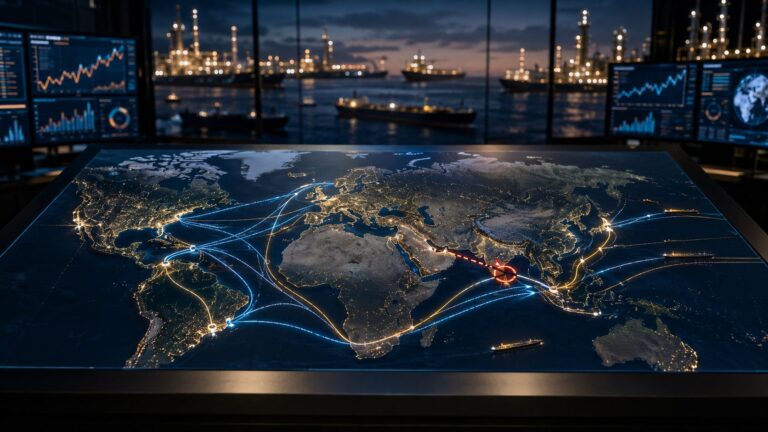
The IEA Oil Market Report of May 2026 reads like a sober data document - yet between the numbers, a new global oil order becomes visible. The closure of the Strait of Hormuz has not only driven prices to historic highs, but also shifted trade flows, created winners, and exposed strategic dependencies. While Asia comes under supply pressure, the United States, Brazil, Venezuela, and the UAE emerge as beneficiaries of a new Atlantic Basin rotation. What appears to be a crisis in the Gulf may in fact mark a strategic redistribution of the global energy system.

Who Profits from the Gulf War?

by Michael HollisterPublished at tkp.at on May 29, 2026 4.744 words * 25 minutes readingtimeFor readers with less time, this analysis is also available as a compact Briefing: the same source base, condensed into the most important core points and roughly ten minutes of reading time:B –…

Insider Trading Before Caracas

Donald Trump admitted on live television that he had informed oil companies in advance of a planned military operation. A hedge fund billionaire had purchased a Venezuelan refinery group six weeks earlier at half its appraised value. A Special Forces soldier bet on Maduro's fall using classified knowledge - and was arrested. Three trails, one pattern: how foreign policy decisions and private wealth accumulation have merged into a single architecture in the United States.

Follow the Oil -Part 1- How Washington Is Dismantling China’s Energy Supply

Syria, Venezuela, Iran, Panama. The list of U.S. military operations and pressure campaigns over the past 25 years reads like an atlas of global oil reserves. No coincidence — but the operational logic of a closing window. Washington has known since the 2016 RAND study that China must be contained before it reaches military parity with the United States, and that window closes around 2026. What has followed is the systematic dismantling of China's energy supply: seizing the world's largest oil reserves in Venezuela, bombing China's most important oil supplier in Iran, severing the Belt and Road land corridor through Syria, and expelling Chinese port operators from Panama. Follow the oil. It tells you more about the future of the world order than any press conference ever will.

Iran/USA: The Calculus of Attack

Twelve F-22 Raptors land on an Israeli air base without a press release. Fifteen tanker aircraft park at Ben Gurion Airport. Two carrier strike groups close in on the Persian Gulf – the first dual-carrier configuration in the region since the 2003 Iraq War. Meanwhile, negotiators in Geneva describe the talks as "constructive." This is not a contradiction. It is method. A deep-dive analysis of the attack architecture currently being assembled against Iran – and why Tehran is structurally incapable of meeting Washington's demands without signing its own death warrant.

OPERATION PIVOT

A president who openly discards international law. Four global fronts. And a final attempt to save American hegemony.
“Operation Pivot” reveals why Trump’s actions are not chaos, but a ruthless strategy: oil, chokepoints, de-dollarization – and a world order collapsing in real time.

Venezuela: Breaking Democracy

The abduction of a sitting president, the seizure of oil tankers on the high seas, and the open violation of the UN Charter mark a historic rupture in international norms. Venezuela is not an isolated case—it is a blueprint. This article examines how power has replaced law, why the “rules-based order” no longer protects smaller states, and what this precedent means for global security in an emerging post-legal world order.

Venezuela: Escalation as Announced

The bombing of Caracas and the capture of President Maduro appear as a shocking escalation – yet they were planned in advance. US think tanks openly outlined the scenario years ago. Venezuela exposes how regime change, violations of international law, and military force are now exercised without disguise – and why the so-called rules-based order is collapsing.

Venezuela Intervention Part 2

Venezuela: Who Profits, Who Plans, Who Pays? To understand Venezuela, you have to follow the money.
Part 2 exposes the actors driving the escalation: defense contractors, energy giants, think tanks, exile networks, and political donors – complete with names, numbers, and documented influence mechanisms. This chapter dismantles the architecture of a system where interventions are not driven by security concerns but by profit, geopolitical leverage, and long-term strategic positioning. It reveals how Venezuela has become the convergence point of global power interests – and why the forces pushing for escalation are far stronger than any warnings against it.

Venezuela Intervention Part 1

The Operational Preparation - a Libya 2.0
While Washington sells its Caribbean military buildup as “counter-narcotics,” the strategic reality tells a different story: F-35 deployments, the 4th Fleet in striking distance, a step-by-step escalation ladder designed by the Atlantic Council, and a blueprint eerily reminiscent of Libya in 2011. Beneath the surface, this operation is not about Maduro – it is about China’s energy lifeline, the Petrodollar, and the geopolitical calculus of American power. Part I dissects the commanders, the hardware, and the doctrine that could push Venezuela into the center of a global confrontation within weeks.