
by Michael Hollister
Exclusive published at Michael Hollister on May 10, 2026
4.628 words * 22 minutes readingtime
Exclusive Analysis for Supporter
The Money Trail Behind the Maduro Takedown
Four months after “Operation Absolute Resolve,” it is becoming clear who knew before the public did. Three trails run in parallel: a hedge fund billionaire who purchased a Venezuelan refinery group below market value weeks before the military strike. A Special Forces soldier who held prediction market contracts on Maduro’s removal before boarding the helicopter. And a president who admitted, on camera at a live press conference, that he had informed oil companies in advance.
The Sentence Nobody Followed Up On
On January 4, 2026 – one day after U.S. Special Operations Forces abducted Venezuelan President Nicolás Maduro from his Caracas residence – Donald Trump held a press conference at the White House. On live camera, broadcast by C-SPAN, a reporter asked whether he had informed oil companies about the planned operation. The president’s answer took less than four seconds: “I informed all of them, basically.”
That statement should have triggered a scandal. The sitting president of the United States publicly acknowledged that he had shared highly sensitive, non-public information about an impending military operation against a sovereign state with private business actors. There was no scandal. The statement disappeared between live tickers and Maduro footage. Three days later, the ranking Democrat on the Senate Banking Committee, Elizabeth Warren, sent a letter to Committee Chair Tim Scott demanding a hearing. The letter was barely picked up by the mainstream press. No hearing has been held to this day.
Four months later, on April 23, 2026, the U.S. Department of Justice arrested a 38-year-old Special Forces soldier in North Carolina. His name: Gannon Ken Van Dyke. The charge: insider trading. The timeframe: the weeks before and around the Maduro operation. It is the first insider trading prosecution in the history of prediction markets in the United States.
What happened between January 4 and April 23 is the story this article tells.
Three Questions
Three questions organize the material that has surfaced over the past four months – in Senate letters, court documents, investigative reports, and press conferences. First: who knew before the public did? Second: who profited from it? Third: is this pattern a one-off or systemic?
The answers to the first two questions are documented. The answer to the third lies in the weeks that followed Caracas.
Act I – Paul Singer and the Citgo Acquisition
In November 2025 – six weeks before the military strike against Venezuela – U.S. hedge fund Elliott Investment Management completed its acquisition of the Citgo holding company. The purchase price: $5.89 billion, paid through Amber Energy, an Elliott subsidiary. A U.S. federal court in the District of Delaware had already approved the sale after Citgo was put up for forced auction due to Venezuela’s bond defaults.
Citgo is no ordinary energy investment. The company – a U.S. subsidiary of Venezuela’s state oil firm PDVSA – operates three major refineries on the U.S. Gulf Coast, 43 oil terminals, and a network of more than 4,000 gas stations. Critically, the Citgo refineries were purpose-built to process Venezuelan heavy crude, the so-called “sour crude.” U.S. shale oil is too light for these facilities, and U.S. sanctions had cut off Venezuelan crude supply, forcing Citgo to import costlier alternatives from Canada and Colombia – a cost structure that made the business structurally unprofitable.
The valuation picture at the time of purchase was publicly available. Court-appointed advisers valued Citgo at $13 billion. Venezuelan government sources put the figure at up to $18 billion. Elliott paid $5.89 billion – less than half the lower estimate.
The man behind Elliott is Paul Singer, 81, with a Forbes-estimated net worth of $6.7 billion. Singer is one of the largest Republican campaign donors of recent years. According to OpenSecrets data, he contributed $5 million to Trump’s Super PAC “Make America Great Again Inc.” during the 2024 election cycle and roughly $37 million overall in support of Republican congressional candidates. In June 2025, he paid $1 million to fund a primary challenger against Thomas Massie – a Republican who had drawn Trump’s ire over his support for releasing the Epstein files. Since Trump’s first election victory in 2016, Singer has met with the president personally on at least four documented occasions.

The timeline: November 2025 – Citgo purchased at a discount, embedded in a multi-year bankruptcy process. January 3, 2026 – Maduro removed by U.S. Special Operations Forces. January 4, 2026 – Trump publicly announces the U.S. is “in charge” of Venezuela and that Venezuelan oil will flow back to the United States. Market observers subsequently expected, per Reuters, a rapid redirection of Venezuelan oil exports back to the U.S. Jaime Brito, oil market analyst at OPIS, told the Wall Street Journal that access to Venezuelan crude would be “a turning point for profitability” for Gulf Coast refineries.
In other words: within six weeks, Singer’s Citgo investment transformed from a structurally deficient asset into a strategically positioned beneficiary of a regional realignment. There is also a legal dimension: Maduro’s government had appealed the Citgo auction. With Maduro’s removal, that appeal became moot. As Popular Information noted dryly: “Now that Maduro has been ousted, however, it seems unlikely that the appeal will continue.”
Singer is not just a capital actor. He is an architect of discourse. Since 2008, he sat on the board of the Manhattan Institute, an influential New York think tank, which he chaired until 2025. According to ProPublica’s nonprofit database, he donated more than $10 million to the Institute in total – $2 million in 2024 alone and $1.8 million in 2023. The Manhattan Institute produced a steady stream of publications over the years calling for regime change in Venezuela. In August 2024, Manhattan Institute fellow Daniel Di Martino wrote: “The remaining question is how to remove Maduro from power.” In September 2025, the Institute criticized Colombian President Gustavo Petro for opposing foreign military intervention in Venezuela. In November 2025, a Manhattan Institute piece criticized Democrats for warning against Trump’s Venezuela escalation.
Singer is also a documented major donor to the Foundation for Defense of Democracies (FDD). In November 2025 – one month before the Citgo closing – the FDD published a policy alert titled “Maduro’s Venezuela Is a Playground for America’s Adversaries.” The recommendation: the United States should strike cartel infrastructure, drug production facilities, and military installations enabling narco-terrorism. A call for military strikes, six weeks before they occurred.
The data collapses into a single observation: the same actor who co-financed the discourse for regime change in Venezuela for years purchased – six weeks before the strike – an asset whose value was structurally capped without regime change. The legal assessment of this constellation remains open. The structural observation does not.
Act II – Polymarket, the Soldier, and the Bets
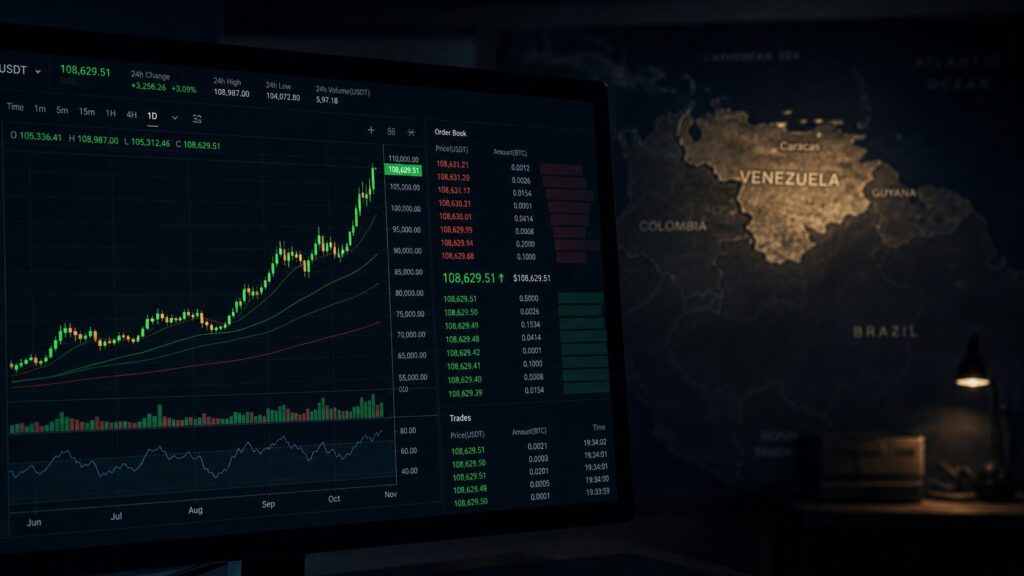
While Singer operated at the asset level, a far more visible movement was playing out elsewhere. On Polymarket – a crypto-based prediction market platform based in the United States – trading volume on contracts tied to Maduro’s political fate spiked in the weeks before January 3, 2026. According to Wall Street Journal data, more than $56.6 million in bets on Maduro’s removal were in the market. One million dollars of that was placed on the night of the operation itself.
The probability Polymarket assigned to Maduro’s removal by January 31 had hovered for weeks around eight percent. On the competing platform Kalshi, it was seven percent. Put differently: the market considered a takedown statistically unlikely. Anyone placing large sums on the outcome in that environment was betting against collective judgment – or had access to information the collective judgment did not.
Three wallets stood out. One, operating under the pseudonym 0x31a5, placed $34,000 on the question “Will Nicolás Maduro be forced from power by January 31, 2026?” on January 2 and won more than $400,000 after Maduro’s capture. A second wallet (0xa72D) bet $5,800 and won $75,000. A third (SBet365) placed $25,000 and won $145,600. In total, the three accounts earned more than $630,000 in under 24 hours.
On April 23, 2026, the U.S. Department of Justice unsealed the indictment against Gannon Ken Van Dyke – a U.S. Army soldier from Fayetteville, North Carolina, near Fort Bragg, home base of U.S. Special Operations Forces. The DOJ press release contained a key sentence: Van Dyke had directly participated in the “planning and execution of the military operation to arrest Nicolás Maduro” – code-named “Operation Absolute Resolve.”
The sequence of conduct documented in the indictment, filed in the Southern District of New York, runs as follows. On December 14, 2025, Van Dyke created a new email address not registered in his name. On December 26, 2025, he opened a Polymarket account and an account at a cryptocurrency exchange. Between December 27, 2025, and January 26, 2026, he placed 13 bets totaling $33,034. All bets took the “Yes” position on market questions including “US Forces in Venezuela by January 31, 2026,” “Maduro out by January 31, 2026,” “Will the U.S. invade Venezuela by January 31?” and “Trump invokes War Powers against Venezuela by January 31?” Van Dyke purchased more than 436,000 Yes shares in the Maduro removal contract at an average price of $0.074 – betting against a market consensus that priced the probability at roughly seven percent.
On January 3, 2026, in the early morning hours, Operation Absolute Resolve commenced. More than 150 aircraft from 20 different bases were involved, including carrier-based aircraft from the USS Gerald R. Ford. Helicopters of the 160th Special Operations Aviation Regiment – the “Night Stalkers” – flew Delta Force operators into Maduro’s Caracas residence. The operation lasted approximately two hours. Maduro and his wife Cilia Flores were taken into custody and transferred aboard the USS Iwo Jima. Trump’s Truth Social post followed at approximately 4:20 a.m. Eastern Time.
Within hours, Van Dyke’s bets were worth $409,881. He began liquidating immediately, wiring most of the proceeds to a foreign crypto vault. On January 6 – three days after the operation, as early press reports of unusual Polymarket activity began to surface – Van Dyke requested the deletion of his Polymarket account and falsely claimed he had lost access to the registered email address. That same day, he changed the email address on his crypto exchange account to the address he had created under a false name on December 14.
The charges: three violations of the Commodity Exchange Act (each carrying up to ten years), wire fraud (up to twenty years), and unlawful monetary transaction (up to ten years). It is the first insider trading prosecution in the brief history of prediction markets in the United States.
One observation beyond Van Dyke is relevant. Donald Trump Jr., son of the sitting U.S. president, is an official adviser to both Polymarket and Kalshi. His venture capital fund holds a stake in Polymarket. Yash Kanoria, professor at Columbia Business School, told NPR: “It would be helpful if prediction market platforms were not in political ownership. We need them to stop activities like insider trading – without distracting influences.”
Van Dyke is one of three suspect wallets identified in the first hours after the operation. He is also the only one charged so far. Who is behind the other $56 million remains a matter of ongoing investigation.
Act III – Big Oil, Big Banks, and the Qatari Account
While Van Dyke was placing bets, Trump was talking to oil companies. At the January 4, 2026 press conference, he stated that the U.S. would extract “a tremendous amount of wealth from the ground” in Venezuela and added: “We’re going to have the big oil companies go in.” Asked whether the U.S. government would compensate those companies for rebuilding Venezuelan oil infrastructure, he replied: “They get reimbursed by us or through revenue.” Energy experts quoted by Politico Pro estimate rebuilding costs at up to $100 billion – potentially financed by U.S. taxpayers.
Three days later, on January 7, Senator Elizabeth Warren sent her letter to Tim Scott. The letter lists four allegations with a directness unusual for Senate correspondence. First: Trump’s own statement that he had informed “basically all” oil companies in advance. Second: Polymarket volume pointing to systematic insider trading. Third: the potential reimbursement of oil companies with taxpayer funds. Fourth: the advance positioning of MAGA mega-donor Paul Singer in Citgo. The letter explicitly cites the Wall Street Journal’s reporting on the Polymarket bets and Popular Information’s and the Journal’s reporting on Citgo.
A hearing before the Senate Banking Committee had not been held as of press time. Committee Chair Tim Scott instead prioritized the markup session on the Crypto Market Structure Bill – legislation backed primarily by wealthy crypto entrepreneurs.
On January 8, 2026, six senators – Whitehouse, Wyden, Warren, Sanders, Schatz, and Welch – launched a separate investigation targeting BP America, Baker Hughes, and other oil companies. The central question: what did the companies know and when, with which Trump officials did they communicate, and what investment plans do they have for Venezuelan oil?
On January 16, the senators expanded their inquiry to 15 major banks: Bank of America, Barclays, BMO, BNP Paribas, Citi, Deutsche Bank, Goldman Sachs, HSBC, JP Morgan, MUFG, RBC, Santander, Standard Chartered, TD Bank, and UBS. The backdrop: a Department of Energy fact sheet from January 7 had announced that Venezuelan oil sales would “involve key banks to execute transactions and provide financial support,” with proceeds deposited in “U.S.-controlled accounts at globally recognized banks.” Which banks remained unclear. The senators demanded responses by January 29, 2026, and “ongoing monthly document production” – language unusual for Senate proceedings, signaling that the inquiry is being treated as active and long-term.

What followed in subsequent weeks added another layer. On January 9, 2026, Trump issued an Executive Order invoking the International Emergency Economic Powers Act, declaring that proceeds from Venezuelan oil sales were “sovereign property of the Government of Venezuela” – while simultaneously directing the U.S. Treasury to hold those funds “in a fiduciary and governmental capacity” and to receive disbursement instructions from the Secretary of State. In other words: the United States declared Venezuelan assets to be Venezuelan property while retaining control over access.
On January 28, 2026, Secretary of State Marco Rubio confirmed before the Senate Foreign Relations Committee that the first Venezuelan oil sale had taken place – $500 million in volume – and had been deposited in an account at a Qatari bank. $300 million had been transferred to the Venezuelan government to cover public employee salaries. $200 million remained in a “short-term account” to be ultimately transferred to a U.S. Treasury account.
On February 4, 2026, Treasury Secretary Scott Bessent testified before the House Financial Services Committee. Asked by Representative Sean Casten about the legal basis under which the Treasury was managing Venezuelan assets, Bessent was unable to identify a concrete legal authority. He also denied the existence of a written agreement with the Venezuelan government. Casten and Senator Chris Van Hollen subsequently sent a letter in March 2026 demanding disclosure of the legal basis and the underlying agreement documents. No response has been received.
The financial flows from Venezuelan oil thus pass through an architecture that no one outside the White House and a small group of Treasury officials can fully map. Who earns which fees within that architecture, what commissions are extracted, which banks collect margin – all of that is the subject of a Senate investigation that has received no answers.
Strategic Context – The Pattern Repeats
If Venezuela were a one-off, the story could be told as a sequential chain of coincidences. It is not.
Exclusive Analysis for Supporter
Donald Trump admitted on live television that he had informed oil companies in advance of a planned military operation. A hedge fund billionaire had purchased a Venezuelan refinery group six weeks earlier at half its appraised value. A Special Forces soldier bet on Maduro’s fall using classified knowledge – and was arrested. Three trails, one pattern: how foreign policy decisions and private wealth accumulation have merged into a single architecture in the United States.
Readers who support my work will receive this article exclusively as a PDF by email on the day of publication.
If you support my work after publication and would also like to read the article, simply send a short message to:
I will be happy to send you the PDF afterwards.
Michael Hollister
is a geopolitical analyst and investigative journalist. He served six years in the German military, including peacekeeping deployments in the Balkans (SFOR, KFOR), followed by 14 years in IT security management. His analysis draws on primary sources to examine European militarization, Western intervention policy, and shifting power dynamics across Asia. A particular focus of his work lies in Southeast Asia, where he investigates strategic dependencies, spheres of influence, and security architectures. Hollister combines operational insider perspective with uncompromising systemic critique – beyond opinion journalism. His work appears on his bilingual website (German/English) www.michael-hollister.com, at Substack and in investigative outlets across the German-speaking world and the Anglosphere.
Sources
- U.S. Senate Banking Committee – Letter to Chair Scott re Venezuela Hearing (Warren), January 7, 2026: https://www.banking.senate.gov/imo/media/doc/2026-01-07_letter_to_chair_scott_re_venezuela_hearingpdf.pdf
- U.S. Senate Banking Committee – Senate Democrats Launch Investigation into Trump Administration’s Dealings with Big Oil, January 8, 2026: https://www.banking.senate.gov/newsroom/minority/senate-democrats-launch-investigation-into-trump-administrations-dealings-with-big-oil-surrounding-us-military-action-in-venezuela
- U.S. Senate Banking Committee – Probe Into Big Banks’ Role in Venezuelan Oil Profits, January 16, 2026: https://www.banking.senate.gov/newsroom/minority/warren-wyden-whitehouse-welch-and-schatz-launch-probe-into-big-banks-role-in-trump-administrations-scheme-to-control-venezuelan-oil-profits
- U.S. Senate Banking Committee – Letter to CFTC on Oil Futures Trading (Warren/Whitehouse), April 9, 2026: https://www.banking.senate.gov/imo/media/doc/letter_to_cftc_on_oil_futures_trading.pdf
- U.S. Department of Justice – U.S. Soldier Charged With Using Classified Information To Profit From Prediction Market Bets, April 23, 2026: https://www.justice.gov/opa/pr/us-soldier-charged-using-classified-information-profit-prediction-market-bets
- U.S. House – Casten, Van Hollen Push for Answers on Venezuelan Oil Proceeds, March 11, 2026: https://casten.house.gov/media/press-releases/casten-van-hollen-push-for-answers-on-venezuelan-oil-proceeds-in-us-treasury-run-accounts
- U.S. Rep. Ritchie Torres – Letter re SEC/CFTC Investigation of Iran Oil Futures Trades, April 8, 2026: https://ritchietorres.house.gov/posts/rep-torres-demands-sec-and-cftc-investigate-suspicious-oil-futures-trade-made-ahead-of-trump-iran-announcement
- U.S. Rep. Ritchie Torres – Letter re $950 Million Iran Ceasefire Bet, April 14, 2026: https://ritchietorres.house.gov/posts/rep-torres-calls-on-sec-and-cftc-to-investigate-950-million-oil-futures-trade-ahead-of-u-s-iran-ceasefire
- Popular Information (Judd Legum) – Venezuela raid enriches MAGA billionaire, January 5, 2026: https://popular.info/p/venezuela-raid-enriches-maga-billionaire
- Common Dreams (Stephen Prager) – Meet Paul Singer, the Billionaire Trump Megadonor Set to Make a Killing on Venezuela Oil, January 6, 2026: https://www.commondreams.org/news/paul-singer-venezuela
- DeSmog – A Fox News Venezuela Expert Is Backed by MAGA Oil Billionaire Paul Singer, January 12, 2026: https://www.desmog.com/2026/01/12/a-fox-news-venezuela-expert-is-backed-by-maga-oil-billionaire-paul-singer/
- Wall Street Journal – Citgo Is a Crown Jewel of Venezuela’s Oil Industry. Elliott Is Set to Reap the Benefits (paywalled): https://www.wsj.com/business/energy-oil/venezuela-citgo-oil-elliott-management-f433bb8c
- Wall Street Journal – Judge Backs Elliott’s $6 Billion Bid for Venezuela’s Citgo (paywalled): https://www.wsj.com/articles/judge-backs-elliotts-6-billion-bid-for-venezuelas-citgo-64cc8302
- The Global Economics – Amber Energy Acquires Citgo, December 2, 2025: https://theglobaleconomics.com/2025/12/02/amber-energy-aquires-citgo/
- NPR (Bobby Allyn) – A $400,000 profit on Maduro’s capture raises insider trading questions on Polymarket, January 5, 2026: https://www.npr.org/2026/01/05/nx-s1-5667232/polymarket-maduro-bet-insider-trading
- Fortune (Sasha Rogelberg) – One Polymarket user made more than $400,000 in profits betting on Maduro’s capture, January 5, 2026: https://fortune.com/2026/01/05/polymarket-user-400k-maduro-capture-bets-insider-trading-suspicion/
- Axios – Maduro’s capture gives Polymarket prediction market traders huge profits, January 3, 2026: https://www.axios.com/2026/01/03/maduro-capture-bets-trade-prediction-markets
- Wall Street Journal – A Mystery Trader Made $400,000 Betting on Maduro’s Downfall, January 5, 2026 (paywalled): https://www.wsj.com/world/americas/maduro-polymarket-bet-a2e5d100
- Gizmodo (Matt Novak) – Feds Arrest Soldier Who Allegedly Made $400,000 on Maduro Kidnapping Polymarket Bet, April 23, 2026: https://gizmodo.com/feds-arrest-soldier-who-allegedly-made-400000-on-maduro-kidnapping-polymarket-bet-2000750232
- Morrison Foerster – DOJ and CFTC Charge Army Soldier for Prediction Markets Insider Trading, April 2026: https://www.mofo.com/resources/insights/260428-doj-and-cftc-charge-army-soldier
- CNBC – Regulators are reportedly zeroing in on suspicious trades ahead of market-moving Trump post, April 15, 2026: https://www.cnbc.com/2026/04/15/regulators-reportedly-zeroing-in-on-suspicious-trades-ahead-of-trump-post.html
- CNBC – Rep. Ritchie Torres calls for probe into futures trades placed ahead of March pause on Iran hostilities, April 8, 2026: https://www.cnbc.com/2026/04/08/iran-ceasefire-futures-markets-ritchie-torrres.html
- Yahoo Finance – CFTC Investigates Suspicious Oil Trades Before Trump’s Iran Posts, April 2026: https://finance.yahoo.com/markets/commodities/articles/cftc-investigates-suspicious-oil-trades-175257444.html
- Reuters – Traders place large $950 million bet on oil price falling hours ahead of ceasefire, April 8, 2026: https://www.reuters.com/business/energy/traders-place-large-950-million-bet-oil-price-falling-hours-ahead-of-ceasefire-2026-04-08/
- Fox News – How US forces detained Venezuela’s Maduro in ‘Operation Absolute Resolve’, January 3, 2026: https://www.foxnews.com/us/us-military-details-timeline-operation-capture-maduro-revealing-more-than-150-aircraft-involved
- Task & Purpose – What we know about Operation Absolute Resolve: https://taskandpurpose.com/news/what-happened-operation-absolute-resolve/
- ABC News – ‘What he ate’: Inside the meticulously planned operation to capture Maduro: https://abcnews.go.com/Politics/ate-inside-meticulously-planned-operation-capture-maduro/story?id=128871919
- The Conversation (R. Evan Ellis) – How Maduro’s capture went down, January 5, 2026: https://theconversation.com/how-maduros-capture-went-down-a-military-strategist-explains-what-goes-into-a-successful-special-op-272671
- Michael Hollister – Venezuela: Eskalation mit Ansage, January 11, 2026: https://www.michael-hollister.com/de/2026/01/11/venezuela-eskalation-mit-ansage/
- Michael Hollister – Venezuela – Teil 2: Die vierte Phase beginnt, December 5, 2025: https://www.michael-hollister.com/de/2025/12/05/venezuela-intervention-3/
© Michael Hollister – All rights reserved. Redistribution, publication or reuse of this text requires express written permission from the author. For licensing inquiries, please contact the author via www.michael-hollister.com.
Newsletter
🇩🇪 Deutsch: Verstehen Sie geopolitische Zusammenhänge durch Primärquellen, historische Parallelen und dokumentierte Machtstrukturen. Monatlich, zweisprachig (DE/EN).
🇬🇧 English: Understand geopolitical contexts through primary sources, historical patterns, and documented power structures. Monthly, bilingual (DE/EN).