by Michael Hollister
Exclusive published at Michael Hollister on November 08, 2026
5.427 words * about 29 minutes readingtime
Part 1 read here:
The Valve – Part 1
Part 1 and Part 2 are building on the analysis “The Pincers Are Closing.” I recommend reading it first. You can find the Analysis here:
The Pincers Are Closing: Why Saudi Arabia’s Oil Exports Are Being Choked Off on Three Fronts
How the fallout of the Iran war is producing a region that forges its own alliances – outside Western supply chains, along colliding axes. Part 2 of a two-part analysis; Part 1, “The Valve,” came first.
In the week this text is being written, three clocks are running down at once. On October 27, 2026, Israel elected a new Knesset, and the result is a stalemate: Benjamin Netanyahu’s Likud came out as the strongest party, yet his bloc fell short of a majority, and the camps have been wrestling ever since over a government none of them can form alone. On November 03, 2026, the Republicans lost the American midterms; the Democrats posted historic gains and weakened Donald Trump’s hand at home. And on November 04, 2026, that same Trump confirmed new American airstrikes against Iran – on an air-defense installation and the island of Qeshm near the Strait of Hormuz, in the middle of ongoing mediation talks. Three events, three capitals, one week. They belong together, even if at first glance they do not.
Part 1 of this analysis, “The Valve,” described how the American role in the Middle East has transformed: from the guarantor of open sea lanes, who kept the chokepoints clear for everyone, to the gatekeeper who holds them and withholds them. That was the diagnosis, and China was its target. For anyone who hasn’t read Part 1, this one sentence suffices: America no longer keeps the chokepoints of the world economy open because it wants them open for all, but because it wants to decide for whom they are open. This second part asks after the consequences of that transformation – not for Beijing, but for the region itself. For when the external guarantor turns into a gatekeeper, the middle powers of the Middle East lose the umbrella under which they calculated for half a century. What follows is no orderly succession. It is a field of colliding axes, on which each raises its own umbrella – and the umbrellas overlap, chafe, and collide. The question of this text is: does the region behave like one steering toward a new order – or like one losing its old order without a new one to catch it?
The Mecca Pact as a Hedge
The most visible answer to the eroding American guarantee carries a name and a date. On August 07, 2026, Saudi Crown Prince Mohammed bin Salman, Turkish President Recep Tayyip Erdoğan, and Pakistani Prime Minister Shehbaz Sharif signed the Mecca Joint Defence Agreement – the Mecca Pact – at the Al-Safa Palace in Mecca. Its core sentence echoes Article 5 of the North Atlantic Treaty: an armed attack on any one of the three counts as an attack on all three. It was signed in the middle of a war, at a moment when the quiet certainty of Saudi security policy – that Washington would defend the Gulf in real time when it mattered – had visibly begun to erode.
For a long time the pact remained a promise without a readable text; the joint statement named the mutual-defense formula, not the obligations behind it. That has since changed. When Turkey submitted the agreement to its parliament for ratification on October 20, 2026, the news agency Reuters was shown the document: sixteen articles. Article 1 commits the parties to employ “all necessary means” to remove threats to the territorial integrity, sovereignty, or recognized borders of a member; the articles that follow govern arms cooperation, intelligence-sharing, logistical support, joint training, and the creation of a defense committee of foreign and defense ministers. The commitment runs for ten years. Saudi Arabia and Pakistan had already completed their domestic procedures; the Turkish parliament’s foreign-affairs committee approved the law on October 28, 2026. Step by step, the political declaration has become an operational mechanism – the first committee already met on August 31, 2026, in Istanbul.
The central reading of this pact, however, remains the one it has deserved from the start: it is a hedge, not a war-fighting alliance. What three influential Muslim states signed in Mecca is an attempt to draw security from sources that do not lie in Washington – task-specific, expandable, and deliberately built outside Western supply chains. The industrial backbone comes from Turkey, with a defense industry that is NATO-compatible and yet can run without Western suppliers; the military depth comes from Pakistan, the only nuclear power in the Islamic world; the capital from Saudi Arabia. It is precisely the Pakistani component that has raised the question of whether the pact spreads a nuclear umbrella over the kingdom. There is no proof of this: the text seen by Reuters mentions nuclear weapons nowhere, and Pakistani officials have expressly pushed back against such a reading. What remains is an interpretation, not an obligation – a state that possesses nuclear weapons promises another assistance by “all necessary means,” and it is the reader, not the treaty, who turns that into a nuclear guarantee. The distinction is not academic: it separates what the pact says from what one wishes to hear it say. Anyone who wants to read the anatomy of this alliance in detail – what it obligates, who moves around it, who is invited and who stays out – will find it in this author’s two Mecca Pact analyses. Here the finding they reached suffices: the pact is first a political edifice, perhaps later a military one.
That it is by now more than symbolism was shown in September. When the Yemeni Houthis, in the course of their offensive, shelled Saudi territory and Saudi energy infrastructure and temporarily shut down the kingdom’s East-West Pipeline, the three Mecca states – according to consistent reports – activated “deterrence measures” under the pact and rapidly moved forces into the kingdom. It was the first real test against which the mutual-defense formula had to be measured, and at first glance it fell short of its own wording: no Mecca state entered the war at Riyadh’s side. The reading that the pact’s first test came up empty therefore falls short – and it falls short for a systematic reason the first Mecca Pact analysis spelled out: a mutual-defense clause typically addresses the new, external aggression, not the obligation to enter a partner’s already-burning war. What the pact actually delivers lies below the threshold of combat participation: arms aid, air defense, reconnaissance, the spreading of dependencies. Turkey’s foreign minister, Hakan Fidan, stressed explicitly that the agreement is not offensive, that Turkish soldiers would not be sent to attack another country; the Turkish constitution requires a separate parliamentary vote for any troop deployment in any case.
Most telling is where the pact opens itself. Erdoğan has repeatedly declared it open – to “all brotherly nations,” explicitly including Iran. This is no empty phrase. On October 26, 2026, Saudi Defense Minister Khalid bin Salman, Pakistan’s army chief Asim Munir, and Turkish intelligence chief İbrahim Kalın traveled together to Tehran and met President Masoud Pezeshkian as well as the secretary of Iran’s Supreme National Security Council, Mohsen Rezaei – the first joint appearance of the three Mecca states in the Iranian capital since the pact’s founding. The message that emerged from the talks was programmatic: the security of West Asia must be generated from within, and any foreign interference is to be prevented. A defense pact of three American partners that seeks dialogue with the state Washington is bombarding at that very moment – one could hardly measure the distance to the old guarantor more clearly. Pakistan’s double role makes it possible: Islamabad is at once Saudi Arabia’s protecting power and a mediator between Washington and Tehran, and it holds both cards at the same time.
The pact’s expansion follows a recognizable pattern, and the most interesting country in it is one that is not in it: Egypt. The largest Arab army, master of the Suez Canal, is weighing membership “very seriously” – and yet stays outside, partly out of its own constitutional caution, partly because Riyadh itself hesitated to admit an Abu Dhabi-oriented Cairo. That of all states the one controlling the region’s second great chokepoint with the Suez Canal should hesitate is no detail: it shows that the new architecture does not even compel its most obvious members to join, but leaves each the choice – and therein lies its reach as much as its weakness. Qatar deliberately chooses the mediator’s chair over a signature; Kuwait hooks in bilaterally. This movement at the margins is worked out in the second Mecca Pact analysis and need not be repeated here. What matters is its direction: the architecture grows not as a closed bloc but as a web of bilateral ties – and it grows precisely because it demands too much of no one.
The Second Fault Line: Israel, Turkey, and the Axis Behind It
While the Gulf states take out reinsurance in the Mecca Pact, a second fault line opens that collides with the first. It runs between Israel and Turkey, and over the late summer it shifted from rhetoric into action. On August 18, 2026, Israel flew eight airstrikes against the Syrian military airfield of Abu al-Duhur in Idlib province, roughly forty-five miles from the Turkish border. A facility idle for years was hit; no one died. Netanyahu’s office justified the strike openly: Syria had been on the verge of granting Turkish troops a deployment and thereby violating a security status quo agreed with Israel. Translated, that means: Israel claims a say over which foreign forces the Syrian government admits onto its own soil – and enforces that say from the air, not against a weakened militia but against NATO’s second-largest army. The mechanics of this strike – the open announcement, the Mossad contact four days earlier, the disputed factual claim, the pattern over eighteen months – are documented in the analysis “A Veto from the Air.” For the present purpose, what counts is what it became: a precedent. Abu al-Duhur is the red line at which Israel demonstrated that it will correct a third state’s alliance decisions by force if need be.
From this point the conflict has widened beyond Syria. It has moved onto the sea: in late August 2026, according to Israeli media reports, Turkish warships approached Israeli naval units in the Mediterranean and forced them to change course – an episode Israel, for its part, wanted understood as a warning. Unlike in Syria, where Israel operates from the air against a weak ground power, on the sea two modern fleets face each other, meeting at close quarters – a point of contact at which a misunderstanding escalates faster than a planned operation. It has moved into diplomacy: on October 21, 2026, Israel officially sided with Greece and condemned the Turkish-Libyan maritime-boundary agreement ratified by eastern Libya; the Israeli foreign ministry declared that it saw Turkey working “once again” to destabilize the eastern Mediterranean. And it has moved, above all, into rearmament. Here the real architecture of the second fault line takes shape – two counter-axes, each of which reads the other as preparation.
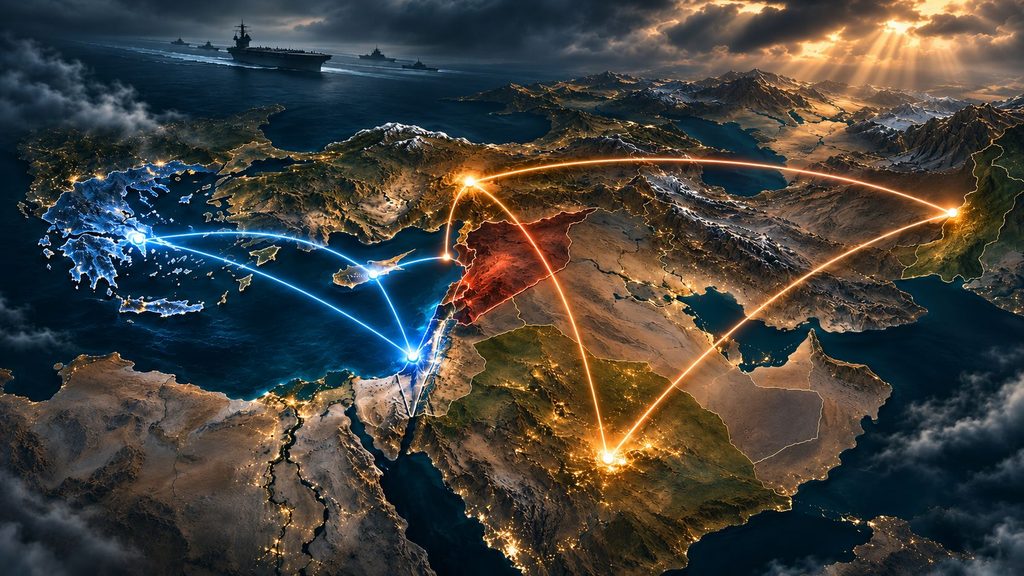
On one side stands the Israel-Greece-Cyprus axis. On August 31, 2026, Israel and Greece signed the contract for “Achilles Shield,” an integrated air-defense system against aircraft, drones, and ballistic missiles worth roughly €3 billion – the largest arms-export deal in the history of Israeli-Greek relations, with David’s Sling, SPYDER, and Barak MX as its layers. On October 26, 2026 came an Israeli-Cypriot naval contract worth roughly €150 million: a new patrol vessel from Israel Shipyards with Rafael systems, plus the modernization of an existing Cypriot ship. Greece now keeps F-16s and a warship permanently on or off Cyprus. What holds these three together is not solely their enmity toward Turkey but a geography of gas and cables: the natural-gas fields of the eastern Mediterranean and the planned power and data links meant to couple Europe to the Levant – an infrastructure that runs through precisely the waters Ankara claims for itself with its “Mavi Vatan” doctrine, the “Blue Homeland.” The rearmament thus also secures an economic artery, and that makes it harder to reverse than mere symbolic politics. The coupling of the arms deal with Aegean tension – Erdoğan’s warning to Athens after the signing of Achilles Shield, the dispute over the demilitarized islands – is traced in the analysis “Flitzer.” On the other side stands the Turkey-Pakistan-Saudi axis: the same Mecca states, joined by a military-industrial cooperation outside Western supply chains – a joint fifth-generation fighter program, a Turkish drone factory in Pakistan, Turkey as Islamabad’s second-largest arms supplier after China.
At the center of these two axes stands Turkey as the hinge, acting in four fields at once: Mecca Pact partner of the Saudis, Syria rival of Israel, Aegean rival of Greece, NATO member at a distance from Washington. And over all of it lies a framing that comes from the Israeli security discourse and has circulated there for months: “Turkey is the new Iran.” Israel’s Institute for National Security Studies (INSS) itself considers this equation problematic and points to considerable differences between the two states: Turkey is a NATO member, economically closely interwoven with the West, and pursues no revolutionary program of overturning foreign orders, as Tehran’s foreign policy did for decades. Whoever equates the two, the institute warns, blanks out these differences – but the formula is in circulation, and it is more than rhetoric, now that Israeli government members publicly fold the Turkish navy and a possible long war against a regional power into their own force planning.

Here is the line this text does not cross. That the Israeli-Turkish rivalry has hardened – from rhetoric to kinetic prevention in Syria, to maritime confrontation, to competing arms architecture in the eastern Mediterranean – is a finding. That this becomes a war, or is even decided, is not. Both sides still maintain an American-brokered deconfliction channel; both declare that they want to avoid a direct confrontation. Between the documented escalation and the asserted war lies exactly that line between finding and intention that already carried Part 1. Which of these axes holds, who tests it first, and whether the navy becomes the second dangerous point of contact beside Syria is the subject of a separate analysis. For the realignment, the structural point is what counts: here no camps emerge that Washington orders, but axes that form themselves – and that lie athwart one another.
Why Israel and Saudi Arabia Do Not Draw Closer
Anyone viewing the region from outside would expect an obvious move: the enemy of my enemy. Israel and Saudi Arabia, both at odds with Iran, both American partners, both threatened by the Houthis – shouldn’t they close ranks? They do the opposite, and that precisely is a finding of the realignment.
The most telling piece of evidence comes from September and was already used in Part 1: when the Houthis shelled Saudi territory and the kingdom’s East-West Pipeline was shut down, Crown Prince Mohammed bin Salman called the American president twice in a single day and asked for airstrikes. Trump refused a direct engagement and offered only reconnaissance and targeting data. When it got serious, MBS dialed the number in Washington – not the one in Jerusalem. Israeli-Saudi security cooperation against the common adversary did not take place, because in the political reality of 2026 it cannot take place.
The reason lies in the Iran war itself – and in what preceded it. As late as the winter of 2025/26, Washington was negotiating a grand triangular swap: Saudi recognition of Israel in exchange for an American defense pact for Riyadh and a civilian nuclear program. That path carried the logic of normalization – and the war buried it. In the Arab public, Israel increasingly counts as the region’s chief destabilizer, not as a partner against Tehran, and no Saudi heir to the throne can stand at Israel’s side in the middle of an Israeli-led war without forfeiting his legitimacy at home and in the Islamic world. Riyadh has accordingly sharpened its conditions for any rapprochement, raising a full Palestinian state to a precondition, stayed away from American summit formats, and at the same time cultivates its own détente with Iran. Normalization is thus not merely postponed; under the sign of this war, it has become a domestic-political impossibility. On top of that comes a hard economic calculation. Mohammed bin Salman’s entire project – the transformation of the kingdom under “Vision 2030,” the inflow of foreign capital, the megaprojects on the Red Sea – presupposes stability, not proximity to a war. A visible security partnership with Israel, while its air force keeps the region on edge, would be no gain for that project but a risk. Riyadh seeks détente with Tehran and the reinsurance of the Mecca Pact for the same reason it avoids closeness to Jerusalem: both serve the stability the kingdom needs for its remaking.
That the three Mecca states traveled to Tehran in October, while Israel bombed Syrian airfields and sided with Greece against Turkey, is no coincidence of calendars. It is the geography of the new axes. Saudi Arabia and Israel are moving apart because the lines by which they orient themselves run in different directions – the one toward a West Asia secured from within, the other toward an Israeli-defined security space in which Turkey takes the place of the old enemy. That is the point of this non-rapprochement: it is not a new common adversary that divides Riyadh and Jerusalem, but the fact that the two no longer have the same threat, the same guarantor, and the same order before their eyes. Where the reference points fall apart, even a shared enemy no longer brings together.
The Waning Umbrella – and the Client Who Hedges
Why does the old order no longer hold? The most sober answer has nothing to do with ideology, but with stocks. The war against Iran has consumed American air-defense reserves to a degree that materially hollows out the role of guarantor. According to an analysis by the Center for Strategic and International Studies, the United States used up roughly two-thirds of its prewar stock of Patriot interceptors – from about 2,330 to under a thousand; THAAD stocks fell by about half. New orders only begin arriving around 2029, and reserves will reach their old level then at the earliest. The bottleneck here is not money but manufacturing: Patriot and THAAD interceptors come off a few highly specialized production lines whose throughput cannot be multiplied overnight. A guarantor whose most important defensive munition stays scarce for years must set priorities – and every priority is at the same time a commitment it can no longer honor elsewhere. The CSIS calls the condition a “window of vulnerability,” and its most important dimension lies not in the Middle East but in the Pacific: every interceptor fired over Iran is missing in a Taiwan scenario and cannot be replaced for years. Senior officials reportedly warned of the depletion before a halt to further Iran strikes was decided – so the munitions picture was already shaping operational decisions. The gatekeeper, to put it sharply, no longer even has the means of the old guarantor.
This exhaustion explains the behavior of the allies better than any declaration of intent. And it explains perhaps the most astonishing finding of this realignment: the region’s closest American client is hedging itself against the guarantor. In an interview broadcast on October 23, 2026, Netanyahu declared that Israel must prepare to do without extensive American military aid in the future – “it’s over, and it will be over; it’s only a matter of time.” He confirmed having commissioned a plan for alternative financing and payment channels in case of international sanctions, and expressly brought digital currencies and blockchain technology into play – instruments whose purpose is to shield payment flows from the reach of the Western financial system. That of all countries Israel is thinking aloud about an infrastructure otherwise ascribed to states under sanctions pressure is the sharpest expression of this distrust in the durability of its own backing. It did not stop at an interview remark. Even earlier, the Israeli government had launched a ten-year program worth roughly $110 billion to reduce dependence on foreign weapons and build an independent defense industry – discussed in the Israeli debate under the slogan of a “Spartan” self-reliance, an independence from the goodwill of other states and from possible embargoes. The pattern is firm: a country that for decades could build on the American supply line is preparing to get by without it. When an Israeli prime minister takes the end of American military aid as settled and his finance minister demands industrial autarky for the worst case, then it is not only the Gulf states planning for a world without a reliable umbrella – then so is the state that stood closest to that umbrella.

One last thread belongs in this picture, because it corrects a narrative that still held in the autumn. For a long time it was unclear whether Iran’s new Supreme Leader, Mojtaba Khamenei – appointed on March 08, 2026, and never seen in public since – was even still alive. That is now obsolete. In early November 2026, Mojtaba ordered the military to respond to any threat immediately and without geographic limits, and to update the target list. Iran is still led by a decentralized power structure dominated by the Revolutionary Guards – but it is capable of acting and aggressive, not a vacuum. That shifts the reading of the Houthi offensive, sketched in Part 1 as an “honest complication”: the opportunistic solo run by the Revolutionary Guards against Tehran’s own Saudi détente remains the more probable explanation than a centrally steered grand play – only it no longer feeds on a leadership vacuum but on a decentralized command structure that lets more than one actor turn the valves. For the realignment, this means: even the adversary around whom the new axes group themselves is no closed bloc but a tangle of hands on the same levers – and that makes every calculation betting on a rational central actor more uncertain than it looks.
The Finding
Three clocks, one week, one pattern. The Israeli election ended in the stalemate that gives Netanyahu an incentive to use the prospect of renewed military action against Iran as leverage; the American midterms weakened Trump at home without curtailing his foreign-policy room for maneuver; and the new strikes against Iran show that the region is not finding its way out of the war but deeper into it. What binds these events is not a director. It is a structure: because the external guarantor has turned into a gatekeeper, the middle powers organize their security themselves – task-specific, negotiable, outside Western supply chains. The Mecca Pact is the most visible form of this self-organization, the Israeli-Greek-Cypriot axis its counter-form, and Turkey the hinge against which the two chafe. What emerges is no orderly succession to the American order, but a field of colliding axes.
Here are the limits this finding does not cross. That the realignment is taking place is documented: in the sixteen articles of the Mecca Pact, in the Tehran round of October 26, 2026, in Achilles Shield and the Cypriot naval contract, in Netanyahu’s renunciation of the permanence of US aid. That it is the fallout of that role transformation Part 1 described is the thesis that holds these findings together. What remains open is threefold, and it belongs cleanly separated. First: whether the Mecca Pact proves the end of the American-led order, as the Council on Foreign Relations writes, or merely a welcome burden-sharing that relieves Washington – both readings stand side by side, and neither is settled. A pact can relieve Washington in the short term and hollow out its role as sole guarantor in the long term; that is no contradiction but the same movement from two angles. Whoever stresses the burden-sharing reads the pact as the result of an American fatigue that Washington brought on itself; whoever stresses the end of the order reads it as the symptom of a loss of trust that no one can recapture. The findings alone do not decide between the two – they are compatible with both readings, and whoever claims they compel one is carrying more into them than they contain. Second: whether the Houthi offensive, which pushes Saudi oil out of Bab al-Mandab, was a steered Iranian move or a decentralized solo run by the Revolutionary Guards. Guidance by the Guards is reported from several sides; the sole command against Tehran’s own line remains interpretation. Third, and most speculative: it is the bitterest of the possible ironies that the attempt to strike China through oil could in the end drive the Gulf order ever tighter into Beijing’s diplomatic arms – the Saudi-Iran détente is deepening, and if security in West Asia is to be generated “from within” in the future, the largest buyer of this oil is not far away. That is a second-round effect, speculation, not a finding – but it belongs named, because it marks the direction in which the pressure runs.
What can be said is more modest and yet carries far. The region the Iran war leaves behind no longer orders itself around an external guarantor, but around regional middle powers that forge their own alliances. These alliances are blurry because the blur is their building principle: an Egypt can wait as long as the duty of assistance is not switched to sharp; a Qatar can cultivate closeness without signing; an Israel can declare American aid finished and at the same time request American Patriot batteries. Yet the same blur that keeps so many candidates open also stays open when things get serious. What remains undefined in order to bind as many as possible binds no one reliably in an emergency. That is the tension lying over the new order – and the real question deciding its future is not who joins next, but what remains of all these promises of assistance when the first clearly delineated external attack puts one of them to the test.
The same transformation that Part 1 diagnosed at the Strait of Hormuz produces its fallout here: out of the guarantor who founded the order has come an actor who holds the chokepoints – and the region, which can no longer rely on that, builds its own overlapping, colliding architecture. How the sharpest of these collisions develops – the one between Israel and Turkey, between Athens and Ankara, between two axes that read each other as a threat – remains to be seen. It is the subject of the next analysis.
About the Author
Michael Hollister served six years as a soldier in the German Bundeswehr (SFOR, KFOR) and looks behind the scenes of military strategy. After fourteen years in IT security, he analyzes European militarization, Western interventionism, and geopolitical shifts of power from primary sources. One focus of his work lies on the Asian sphere, especially Southeast Asia, where he examines strategic dependencies, zones of influence, and security architectures. Hollister combines an operational insider’s view with uncompromising systemic critique – beyond opinion journalism. His work appears bilingually at www.michael-hollister.com as well as in critical media across the German- and English-speaking world.
Stay informed without having to work through the daily flood of news – the most important developments and connections summarized for you.
Sources
Three Clocks, One Week (Hook)
- Congressional Research Service, “Israel’s 2026 Knesset Election” (IN12751): https://www.congress.gov/crs-product/IN12751
- Jewish Insider, analysis of the Israeli election and bloc formation: https://jewishinsider.com/2026/10/israeli-election-change-bloc-netanyahu-eisenkot-coalition-arab-parties/
- BreakingNews.ie, “Democrats look to reshape US after historic midterm victories”: https://www.breakingnews.ie/world/democrats-look-to-reshape-us-after-historic-midterm-victories-1957029.html
- Al Jazeera, US airstrikes on Iran, November 04, 2026: https://www.aljazeera.com/news/2026/11/4/iran-says-us-reply-to-hormuz-plan-unconvincing-trump-confirms-strikes
The Mecca Pact
- Al Jazeera, “New regional order: Pakistan, Turkiye, Saudi Arabia,” August 07, 2026: https://www.aljazeera.com/news/2026/8/7/new-regional-order-pakistan-turkiye-saudi-arabia
- The Guardian, “Saudi Arabia, Pakistan and Turkey sign defence pact,” August 07, 2026: https://www.theguardian.com/world/2026/aug/07/saudi-arabia-pakistan-turkey-defence-pact
- Reuters, “Turkey, Pakistan, Saudi Arabia defence pact technically same as NATO’s Article 5,” August 08, 2026: https://www.reuters.com/world/asia-pacific/turkey-pakistan-saudi-arabia-defence-pact-technically-same-natos-article-5-2026-08-08/
- Al Jazeera, “Türkiye moves to ratify Mecca Joint Defence Agreement” (Reuters saw the 16-article text), October 20, 2026: https://www.aljazeera.com/news/2026/10/20/turkiye-moves-to-ratify-mecca-joint-defence-agreement
- Cyprus Mail, “Turkey submits Saudi-Pakistan defence pact to parliament for ratification,” October 20, 2026: https://cyprus-mail.com/2026/10/20/turkey-submits-saudi-pakistan-defence-pact-to-parliament-for-ratification
- Al-Monitor, Turkey’s ratification submission (sources): https://www.al-monitor.com/originals/2026/10/turkey-submits-saudi-pakistan-defence-pact-parliament-ratification-sources-say
- PBS NewsHour, “Pakistan says new defense pact is purely defensive and open to others” (nuclear question, Fidan): https://www.pbs.org/newshour/world/pakistan-says-new-defense-pact-with-saudi-arabia-and-turkey-is-purely-defensive-and-open-to-others
- Al Jazeera, “Where does Iran stand on the Saudi-Pakistan-Türkiye pact,” August 09, 2026: https://www.aljazeera.com/news/2026/8/9/where-does-iran-stand-on-saudi-pakistan-turkiye-pact
- Middle East Eye, “Iran says it is not concerned by new Mecca Joint Defence Agreement”: https://www.middleeasteye.net/news/iran-says-it-not-concerned-new-mecca-joint-defence-agreement
- CGTN, “Senior Saudi, Pakistani, Turkish officials in Tehran security talks,” October 26, 2026: https://news.cgtn.com/news/2026-10-26/Senior-Saudi-Pakistani-Turkish-officials-in-Tehran-security-talks-1RySp2YapyM/share_amp.html
- Minute Mirror, “Pakistan, Saudi Arabia and Türkiye hold talks with Iranian president in Tehran,” October 26, 2026: https://minutemirror.com.pk/pakistan-saudi-arabia-and-turkiye-hold-talks-with-iranian-president-in-tehran-651840/
- Chatham House, “Should Egypt join the Mecca Pact?”: https://www.chathamhouse.org/2026/08/should-egypt-join-mecca-pact
- Semafor, “Egypt could be the latest addition to the Mecca defense pact,” August 10, 2026: https://www.semafor.com/article/08/10/2026/egypt-could-be-the-latest-addition-to-the-mecca-defense-pact
- Middle East Eye, “Saudi Arabia opposed Egypt’s inclusion in Mecca agreement, sources say”: https://www.middleeasteye.net/news/saudi-arabia-opposed-egypts-inclusion-mecca-agreement-sources-say
- NBC News, Saudi East-West Pipeline shut down by Houthi shelling: https://www.nbcnews.com/world/middle-east/saudi-arabia-shutdown-key-pipeline-limits-oil-flow-yemen-houthis-rcna597362
The Second Fault Line (Israel-Turkey, Eastern Mediterranean)
- The Washington Post, Israeli airstrikes on Abu al-Duhur, August 19, 2026: https://www.washingtonpost.com/world/2026/08/19/syria-turkey-israel-air-base-abu-duhur-strikes-turkish-delegation/
- Reuters, “Syria says no Turkish military build-up planned at airbase struck by Israel,” August 20, 2026: https://www.reuters.com/world/middle-east/syria-says-no-turkish-military-build-up-planned-airbase-struck-by-israel-2026-08-20/
- U.S. News/Reuters, “Eight Israeli airstrikes hit Syria’s Abu al-Duhur airbase, no casualties,” August 18, 2026: https://www.usnews.com/news/world/articles/2026-08-18/eight-israeli-airstrikes-hit-syrias-abu-al-duhur-airbase-no-casualties-state-tv-reports
- U.S. News/Reuters, Mossad chief met the Syrian foreign minister before the strikes, August 19, 2026: https://www.usnews.com/news/world/articles/2026-08-19/exclusive-mossad-director-syria-foreign-minister-discussed-turkish-military-deployments-before-strikes-sources-say
- Times of Israel, Israeli-Turkish deconfliction channel: https://www.timesofisrael.com/israel-and-turkey-hold-syria-deconfliction-talks-to-avoid-military-clash/
- Greek City Times, “Israel Navy on high alert as Ankara expands Mediterranean presence,” September 01, 2026: https://greekcitytimes.com/2026/09/01/israel-navy-high-alert-turkey-mediterranean-greece-cyprus/
- FDD, “Denied Syrian foothold, Turkey could harass Israel at sea,” August 24, 2026: https://www.fdd.org/analysis/2026/08/24/denied-syrian-foothold-turkey-could-harass-israel-at-sea/
- Times of Israel, “Israel condemns Libya’s approval of maritime agreement with Turkey,” October 21, 2026: https://www.timesofisrael.com/israel-condemns-libyas-approval-of-maritime-agreement-with-turkey/
- To Vima, “Israel condemns Turkey-Libya maritime agreement,” October 21, 2026: https://www.tovima.com/world/israel-condemns-turkey-libya-maritime-agreement/
- Israel Hayom, “Israel-Greece Achilles Shield defense deal,” August 31, 2026: https://www.israelhayom.com/2026/08/31/israel-greece-achilles-shield-defense-deal/
- The Defense Post, “Greece, Israel air defense,” September 01, 2026: https://thedefensepost.com/2026/09/01/greece-israel-air-defense/
- To Vima, “Achilles Shield – what Greece is exactly receiving”: https://www.tovima.com/politics/achilles-shield-what-greece-is-exactly-receiving/
- Greek City Times, Erdoğan’s warning to Athens after Achilles Shield, September 02, 2026: https://greekcitytimes.com/2026/09/02/erdogan-greece-stop-militarizing-aegean-islands
- Cyprus Mail, “Cyprus and Israel sign deal for second offshore patrol vessel,” October 26, 2026: https://cyprus-mail.com/2026/10/26/cyprus-and-israel-sign-deal-for-second-offshore-patrol-vessel
- Cyprus Mail, volume roughly €150 million, October 20, 2026: https://cyprus-mail.com/2026/10/20/israeli-firms-reportedly-close-to-e150m-naval-deal-with-cyprus
- INSS, Publication No. 2189 (August 2026) on the “Turkey = new Iran” equation: https://www.inss.org.il/wp-content/uploads/2026/08/No.-2189.pdf
Why Israel and Saudi Arabia Do Not Draw Closer
- Times of Israel, MBS asked twice for US airstrikes, Trump offered only reconnaissance: https://www.timesofisrael.com/trump-said-to-reject-saudi-request-for-strikes-on-houthis-as-they-seize-red-sea-island/
- Israel Hayom, US pressure for a unity government and the Saudi peace context, October 15, 2026: https://www.israelhayom.com/2026/10/15/us-pushes-israeli-unity-government-netanyahu-exit-saudi-peace/
- The Media Line, China welcomes the Iran-Saudi Arabia détente: https://themedialine.org/mideast-daily-news/china-praises-iran-saudi-arabia-detente-vows-support-for-tehran
The Waning Umbrella
- Defense News, “Iran war depleted US Patriot missile stockpiles, creating readiness challenges” (CSIS figures, “window of vulnerability”), July 30, 2026: https://www.defensenews.com/news/your-military/2026/07/30/iran-war-depleted-us-patriot-missile-stockpiles-creating-readiness-challenges-experts-say
- The Diplomatic Insight, “Interceptor crisis reveals American air defense gap”: https://thediplomaticinsight.com/interceptor-crisis-reveals-american-air-defense/
- Ynetnews, “Get used to it: Netanyahu warns US military aid will end, eyes blockchain,” October 23, 2026: https://www.ynetnews.com/business/article/sykiilt3gx
- Jewish Insider, “Netanyahu predicts end of US military aid, calls for plan to circumvent potential sanctions,” October 2026: https://jewishinsider.com/2026/10/netanyahu-predicts-end-us-aid-alternate-economy/
- The Media Line, “Netanyahu sets out 10-year, $110 billion plan to cut reliance on foreign weapons”: https://themedialine.org/headlines/netanyahu-sets-out-10-year-110-billion-plan-to-cut-reliance-on-foreign-weapons/
- The Media Line, “Netanyahu warns Israel faces growing isolation, calls for Spartan self-reliance”: https://themedialine.org/headlines/netanyahu-warns-israel-faces-growing-isolation-calls-for-spartan-self-reliance/
- Khaleej Times, “Iran’s Mojtaba Khamenei orders geographically unrestricted military response to threats”: https://www.khaleejtimes.com/world/mena/iran-supreme-leader-mojtaba-khamenei-military-response-no-geographic-limits
- Oman Observer, Mojtaba Khamenei orders response without geographic limits, November 01, 2026: https://www.omanobserver.om/article/1198860/world/region/irans-supreme-leader-orders-response-without-geographic-limits-to-new-threats
The Finding
- Council on Foreign Relations, “The U.S.-led Middle East order is over – the Mecca agreement proves it”: https://www.cfr.org/articles/the-u-s-led-middle-east-order-is-over-the-mecca-agreement-proves-it
- NBC News, Houthi push at Bab al-Mandab: https://www.nbcnews.com/world/middle-east/houthis-bab-el-mandeb-strait-yemen-saudi-arabia-iran-war-hormuz-energy-rcna596970
The Author’s Prior Analyses (Cross-References)
- “The Valve” (Part 1 of this series)
- “A Veto from the Air”: https://www.michael-hollister.com/de/2026/08/21/ein-veto-aus-der-luft-warum-israel-in-syrien-einen-leeren-flugplatz-bombardierte/
- “Iran Special”: https://www.michael-hollister.com/de/2026/09/02/iran-spezial-die-frage-die-in-der-iran-debatte-niemand-stellt/
- The two Mecca Pact analyses
- “Flitzer” (Aegean)
© Michael Hollister – Republishing Expressly Encouraged.
I am pleased when my articles, contributions, and analyses generate interest and are shared with a wider audience. The reproduction, distribution, and republication of my texts, either in full or in part, on other websites, blogs, or in any other publications is expressly permitted and encouraged. No prior permission is required.
The only requirements: Michael Hollister must be clearly and visibly credited by name as the author. In addition, a prominent, clickable link to the original website, www.michael-hollister.com, must be included.
Any reuse without proper author attribution and a link to the original website is prohibited.
If this work helps you understand what lies behind the headlines, consider supporting it. Membership starts at $5 per month, includes access to all supporter-only analyses, and can be cancelled at any time.