Michael Hollister * Sunday, October 11, 2026

A Look Inside My Sunday Newsletter
For the time being, I am also publishing selected editions of this newsletter on my website – but with a short delay. The idea is simple: readers who have not yet subscribed can see exactly what they receive each week.
The newsletter is sent directly to subscribers every Sunday. It brings together the most important analyses and research from the previous week, places current geopolitical developments in context, and connects stories that may initially appear unrelated. Many of the issues covered are still developing rapidly when the newsletter is delivered.
The public version on the website therefore appears only on the following Wednesday – three days later.
If you prefer to receive the newsletter on Sunday, while the analyses and developments are still as current as possible, you can subscribe free of charge. The complete edition will then arrive directly in your inbox each week, several days before it is published on the website.
The Architecture of Power.
Sunday morning, veranda, South America. Around 21°C, clear to lightly cloudy over Brasília, with temperatures expected to reach roughly 33 to 34°C later today. October is showing its dry side today; humidity will likely drop sharply again during the afternoon. One of those days when every bit of shade is appreciated. I am currently building some. Last week, I told you why I had started learning to weld in the first place. Not out of romantic enthusiasm for electrodes, slag and welding spatter, but because I needed someone to join steel reliably for the second canopy – and that someone simply was not available.
By now, the posts are standing. The concrete footings are in place. The first steel components have been prepared, and I am currently cutting the beams so that, in the end, they form a kind of metal construction kit: measure, cut and prepare as much as possible in advance so that each individual part does not have to be adjusted all over again during final assembly. What remains visible later is surprisingly little. Once the roof is finished, someone will sit on the terrace, look up and essentially see the following: four posts, a few steel beams and a roof above them. What will no longer be visible is the entire architecture of decisions underneath. Why does this post stand exactly here and not 30 centimeters farther to the left? Because the drainage runs there. Why did the structure have to be adjusted somewhere else? Because a wastewater pipe was in the way. Why does the roof have exactly this slope? Because rainwater has to go somewhere. Why are the beams being cut in this particular sequence? Because I would rather make as many mistakes as possible on the ground than later with a welding machine above my head. And why am I currently practicing on two-millimeter-thick sheet steel? Because 90 amps and a thick electrode are very reliable at producing heat, but on thin material they are equally reliable at producing holes. A connection does not necessarily follow.
The interesting thing is this: If everything works, nobody will care about these decisions later. People see the result.
The architecture behind it disappears.
THAT IS EXACTLY WHAT THIS WEEK IS ABOUT.
We usually judge systems by what is visible. A law. A sanction. A military exercise. A data center. A trade measure. An alliance. A strait. What is often more interesting is the architecture underneath. Which parts are connected? Where are the decision points? Who controls access? What dependencies emerge? And who can change the rules without having to determine every individual outcome directly?
That question runs through almost everything I published this week.
From space to Brussels to Kaliningrad.
From European defense policy to the sea lanes between Yemen and Iran.
And sometimes it becomes clear that the real gain in power does not lie in one individual decision, but in building the structure within which other decisions will later have to be made.
NEW HERE?
This newsletter connects primary sources, government documents, military planning, corporate information and international developments. Claims, findings and interpretation are kept separate. The aim is not to tell you how to judge a development politically, but to make the underlying structures visible enough for you to draw your own conclusions.
A NOTE OF MY OWN: A SHORT REMINDER ABOUT THE NEW MODEL
Since October, my exclusive articles carry a stated price. The articles remain freely accessible. There is no hard paywall. The model is based on trust. If you read a priced article and can afford the contribution, I ask you to pay the stated price of US$1 or US$2. If you read several texts during the month, you can instead use the complete monthly edition, “der HOLLISTER – October 2026”, for US$5.
Anyone who already supports my work regularly with at least that amount has, of course, already paid for the monthly edition. And anyone who cannot afford a payment should still keep reading.
The principle is simple: I want to keep the articles open, but to do that I need the financial participation of those readers who use the work and are able to pay for it. I explained in detail why I had to take this step in my personal appeal. That is all I want to say about it this week. The model is in place. Now we will see whether it holds. And with that, back to this week’s architecture.
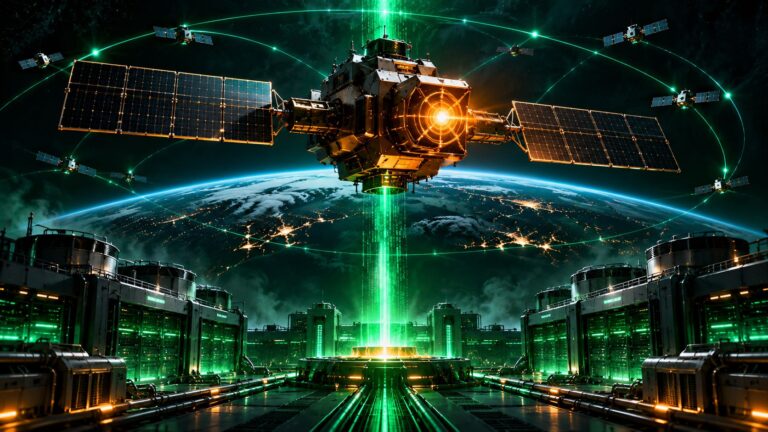
The most unusual entry point comes once again from Terafab.
Part 1 showed the scale Elon Musk is envisioning for future chip production and why, in his concept, a large share of that computing power would not remain on Earth.
“Terafab – Part 2: Why Space? The Physical Wall” therefore asks the obvious question: Does this make technical sense at all?
Orbital AI computing initially sounds like a mixture of megalomania and science fiction. But once the individual physical problems are examined, the picture becomes more interesting.Energy supply is solvable. Radiation is a serious problem, but not an insurmountable one. Even cooling – already one of the biggest technical challenges for terrestrial data centers – can be approached differently in orbit if computing power is distributed across large satellite swarms. The real wall lies somewhere else. Mass.
If millions of tons of hardware had to be transported into orbit every year, the chip would no longer be the decisive bottleneck. The transport architecture behind it would. That changes the entire question.
Not: Can you operate an AI computer in space?
But: Can an industry emerge that moves material into orbit on a scale far beyond anything we are accustomed to today?
That is why Terafab is more than a story about a gigantic factory. It is a story about the infrastructure required before a vision can become a system at all.
From the technological system, this week’s path leads directly to a political one.
“The West – Briefly Explained” is one of those articles I had wanted to write for quite some time. Not because it contains one single new revelation. But because certain contradictions recur so regularly that, at some point, it becomes useful simply to place them next to one another. A military alliance receives a peace prize while people protest outside city hall. A Nobel Peace Prize laureate presides over years of military airstrikes. International law is invoked, yet violations appear to be weighted differently depending on who acts and against whom. Add to that NATO interventions, the Strait of Hormuz, political decisions in Berlin and Brussels, and the constantly repeated phrase “rules-based order.” The article therefore does not ask a complicated philosophical question.
It asks a very simple one: Do the same rules apply to everyone?
Because a political order is also an architecture. It consists of institutions, rules, exceptions, instruments of power and the question of who interprets them. If the same rule is applied differently depending on the actor, then more is changing than one individual decision. The architecture of the order itself changes.
How such an architecture can become a concrete instrument of power is the subject of “The Weapon Turned Outward: How the Same Architecture That Captures the Citizen Is Now Directed at States – Part 7”.
The first six parts of my surveillance-state series dealt primarily with effects directed inward. Data collection. Control. Access. Jurisdictions. Institutions. Part 7 turns the perspective around. What happens when the same logic is no longer directed only at citizens, but is used as a foreign-policy instrument?
A new proposal from Berlin and Paris is intended to make it possible to restrict access to the European single market more quickly in future. What is particularly notable is the decision mechanism: an active majority would not necessarily have to approve a measure. Under certain conditions, the absence of a qualified opposing majority could already be sufficient. That sounds like procedural law. In reality, it is about power. Anyone who controls access to the European market controls a substantial economic lever over many states and companies. And anyone who changes the decision architecture so that interventions become easier to implement does not have to win every individual political confrontation. They change the space in which it takes place.
From there, the route leads almost inevitably to Europe’s security architecture.
“The Drone Wall Disappears – and Becomes Something Much Bigger” begins with a term that almost everyone has heard by now.
Drone wall. Only that term barely appears anymore where it once stood in the projects that have now been formally approved. The popular image of a defensive line against Russian drones has, in a short period of time, become something much larger: a defense architecture spanning five domains, tied to a financing ambition of roughly €190 billion through 2036. That changes the political significance as well. This is no longer only about intercepting drones. It is about connecting sensors, air defense, space, cyber, command systems and other military capabilities.
And that inevitably raises a second question: If the architecture of European defense is increasingly planned, financed and interconnected jointly, where does responsibility for it move?
“Drone wall” was a catchy phrase. What is being built underneath is far larger.
And that is exactly where Kaliningrad becomes interesting.
In Part 2 of “The Omitted ‘If’ – How a Response Was Turned Into a Nuclear Threat”, the main issue is no longer how one statement was presented in shortened form.
This time, it is about capabilities. The number of NATO exercises around Kaliningrad is only one part of the development. Their character matters more. Forces, command systems, reconnaissance and military capabilities are increasingly being linked into a permanent operational architecture. At the same time, Russia has lowered the threshold in its nuclear doctrine. And while capabilities are growing on both sides, direct channels of communication have largely disappeared. That combination worries me far more than any single headline about one exercise or one threat. Because in a highly integrated military architecture, one mistake can produce consequences more quickly. A misread signal. An incident. A misinterpretation. A decision made under time pressure. The more tightly systems are connected and the lower the level of trust between the participants becomes, the more important precisely those communication channels are that are currently missing.
That brings us to the architecture of escalation.
And from there, the step into the global conflict picture is a short one.
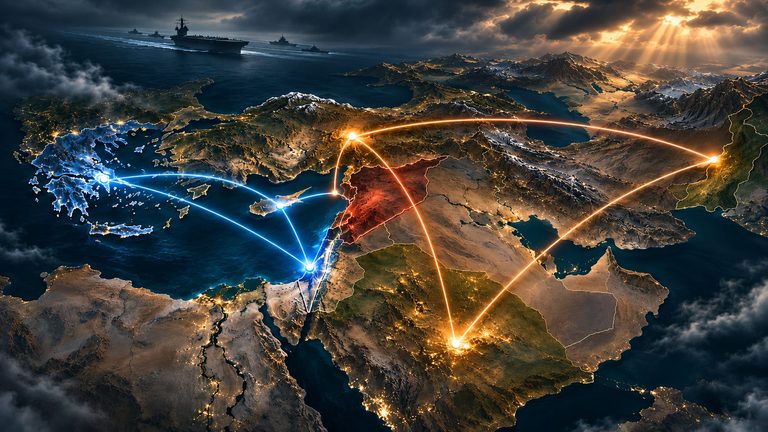
The “Weekly Conflict Update No. 5 – October 11, 2026” documents developments across eleven conflict theaters this week.
In Yemen, the offensive at Bab al-Mandab begins. Missiles strike Riyadh. U.S. fighter aircraft attack a merchant vessel in the Gulf of Oman. Ethiopia and Eritrea are once again moving toward direct military confrontation. Russia bombs Ukrainian cities. At the same time, Washington opens trade in Russian diesel while Europe releases strategic reserves. At first glance, these are different conflicts. At second glance, they are increasingly affecting the same systems.
Energy supply. Sea lanes. Trade. Alliances. Insurance. Transport.
And that means military escalation quickly becomes economic architecture.
The widest lens, as usual, comes from “Hollister’s Geopolitical Radar, October 05-11, 2026” – currently available in German.
Washington opens trade in Russian diesel while Europe maintains its sanctions. At the same time, possible American participation in Nord Stream is being discussed. In Yemen, control of Bab al-Mandab is being contested. U.S. fighter aircraft enforce the blockade on Iran. The danger of a new war between Ethiopia and Eritrea is growing. Tensions are also sharpening in the South China Sea and the eastern Mediterranean.
Here, too, everything eventually comes back to the same question:
Who controls the supply routes?
And who determines the conditions under which they may be used?
A tanker is a ship. A pipeline is a pipe. A strait is a stretch of water.
Only the political, military and economic architecture around them turns those things into power.
NEXT WEEK
Next week, I will continue following Terafab.
After the factory and the physical question, the strategic dimension is moving increasingly into focus: What does it mean when AI computing power is envisioned at a scale for which the orbit, rather than Earth, is supposed to become the primary infrastructure environment?
The developments around Kaliningrad and the Suwałki Corridor will also remain on my desk. What interests me there is less the next headline than the question of which structures are becoming permanent – and what that means for escalation risks.
And as always, the editorial schedule lasts exactly until the world decides to do something more interesting.
WHY IT ALL CONNECTS.
A terrace roof, a factory in space, a political order, a European trade instrument, a new defense structure, Kaliningrad and the sea lanes connecting Europe, Asia and the Middle East. At first glance, they have little to do with one another. The common point lies underneath. Architecture does not mean buildings alone.
Architecture means arranging and connecting individual parts so that they become a system. That applies to a steel beam just as much as it does to a military alliance. Move one post, and several beams above it may have to move as well. Change one decision rule, and dozens of later decisions may change with it.
Connect infrastructure, and you create capabilities that did not exist before. Control access, and you do not have to order every individual behavior. Control supply routes, and you do not have to pressure every country directly. Sometimes it is enough to control the conditions under which trade can take place at all.
That is why the visible decision is often only the surface. The real power lies in the structure underneath. Later, all you see is the roof. You no longer see every pipe, every adjustment, every badly placed cut and every decision that caused it to be built exactly the way it was.
Political systems are often no different.
And that is why one sentence, above all, remains with me from this week:
Whoever determines the architecture does not have to make every individual decision. They determine the space in which those decisions are made.
You can find all articles on my website.
Until next week
Michael Hollister
If you enjoy this newsletter, please feel free to share it. That costs nothing.
If you like my newsletter, I’d be glad if you subscribed.