by Michael Hollister
Exclusive published at Michael Hollister on November 01, 2026
4.809 words * 25 minutes readingtime
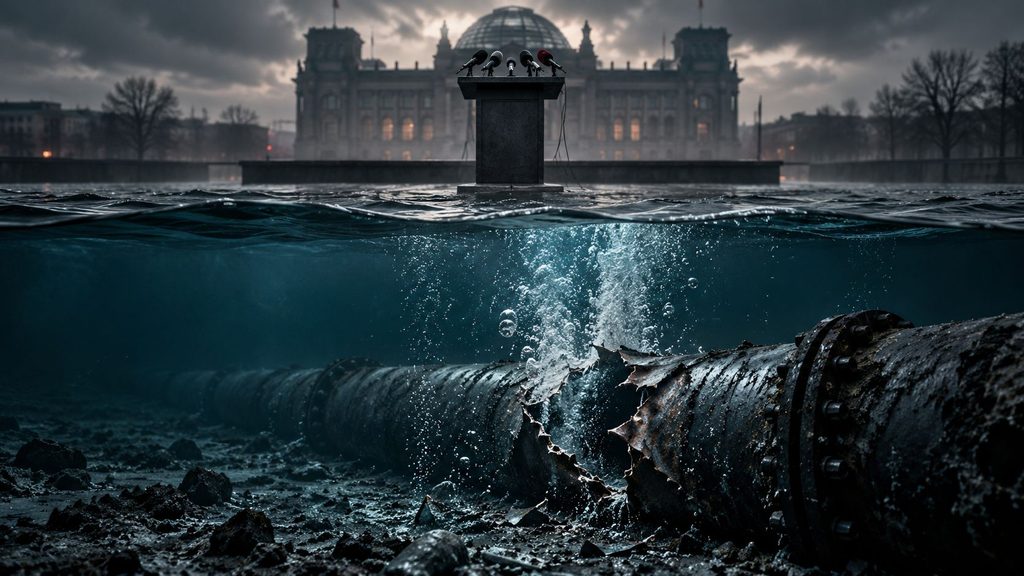

The Commander-in-Chief and the Pipeline – A Question of Responsibility
Do not listen to what they say – watch what they do. The official account of Nord Stream is failing this old rule of thumb, and it is not failing because of an exposé, an intelligence leak, or Russian propaganda. It is failing because of a German indictment and a decision by Germany’s Federal Court of Justice. For the first time, the proposition that Ukrainian state agencies commissioned the destruction of Germany’s most important energy lifeline is no longer framed as speculation in a background report but stated as part of a criminal investigation. And while the German judiciary is now placing this assumption on the record, German policymakers continue to pay and remain silent.
That is the central finding before the first witness has even testified: not the sensation of attributing blame, but the gap between what one branch of the German state is recording and what another is doing about it – namely, nothing. This text accuses no one. It separates what is documented from what is probable and what remains open, and it asks a question many people raise but few examine rigorously: Why is the Ukrainian commander-in-chief behaving as he is – and what follows from that, regardless of whether he knew in advance?
What Is Being Tried in Hamburg
Since October 14, 2026, Ukrainian national Serhii Kuznetsov has been standing trial before the state security panel of the Hanseatic Higher Regional Court. The Federal Public Prosecutor General filed charges on June 30, 2026, and the court admitted the indictment for trial on September 02, 2026. Four sets of allegations are before the court: a jointly committed war crime involving an attack on civilian objects, causing an explosion through the use of explosives, destruction of structures, and disruption of public utilities. Based on the investigation, the panel considers there to be sufficient suspicion that Kuznetsov acted as an accomplice.
The indictment’s central factual allegation goes considerably beyond the image of a private band of adventurers. Kuznetsov is alleged to have led or coordinated a 7-member group in September 2022 – several professional divers, a skipper, and an explosives specialist. The group allegedly rented the sailing yacht Andromeda in Rostock through intermediaries, sailed it into the Baltic Sea, and placed explosive charges on the pipelines near Bornholm at a depth of approximately 70 to 80 meters. And, according to the allegations presented at the opening of the trial, it did so on behalf of Ukrainian state agencies with the objective of permanently curtailing Russia’s revenue from gas exports.
On the second day of the trial, October 27, 2026, the defense suffered its first defeat. It had moved to terminate the proceedings, arguing, among other things, that its client could not fully defend himself because he lacked Ukrainian military authorization to testify. Presiding Judge Anne Meier-Göring rejected the motion: Under German law, the defendant was not restricted in his defense, and the service regulations of a foreign state could not limit his freedom to testify before a German court. The court rejected the motion, and the trial is continuing, with hearing dates scheduled well into the coming year.
One peripheral detail deserves attention because it casts the entire proceeding in an unusual light. Although the operating companies Nord Stream AG and Nord Stream 2 AG failed in their attempt to participate as joint plaintiffs, their attorneys obtained access to investigative files through an adhesion claim – the assertion of civil claims within criminal proceedings. Both companies are subsidiaries of the Russian state-owned corporation Gazprom: Nord Stream 2 AG is wholly owned, while Gazprom owns 51 percent of Nord Stream AG. The Russian-controlled injured party has therefore had, at least temporarily, a seat at the files table. On October 27, the judge indicated that this application, too, would probably be inadmissible and set a deadline of November 10, 2026, as reported in connection with the companies’ adhesion claim.
What Is Documented, What Is Probable, and What Remains Open
The discipline this subject demands lies in not throwing everything into the same pot. There is a ladder of evidentiary weight, and each rung supports a different conclusion.
At the bottom, and practically undisputed: Nord Stream was sabotaged with deliberately placed explosives. An expert from Germany’s Federal Criminal Police Office described 6 explosions in court; gas escaped at 4 locations, and one pipeline was torn open across nearly 300 meters. One rung higher: The Andromeda was part of the operation. Investigators found traces of the military explosives RDX and HMX on the yacht, the same substances detected on fragments of the pipelines; the vessel traveled without a regular radio identifier and without an ordinary logbook. Germany’s Federal Court of Justice accepted this chain of evidence in its detention decision.
That Kuznetsov himself belonged to the group is a matter of strong suspicion, not a verdict. The evidence includes a genuine Ukrainian passport issued under a false name but bearing his photograph, whose match an expert assessed with a very high degree of certainty; searches on his mobile phone for water depths, coordinates, and the pipelines’ technical characteristics; and a fitness watch that happened to record no data during the period in question. What is missing, as the defense correctly points out, is Kuznetsov’s DNA or fingerprints on the yacht and an eyewitness who saw him aboard. That gap is real and must be acknowledged.
The decisive rung is state direction. On December 10, 2025, Germany’s Federal Court of Justice went remarkably far in a detention decision – that is, on the basis of strong suspicion, not after the completion of the evidentiary proceedings. The panel found substantial grounds to assume that the sabotage had been initiated and directed by a foreign state and considered it highly probable that Kuznetsov had carried out his contributions on behalf of a foreign state. It based this assessment on the nature of the explosives, genuine identity documents bearing false personal details, the professional execution, and the training required. This is not a journalistic suspicion; it is an assessment by Germany’s highest criminal court after reviewing the case file.
On October 27, a new layer was added. Two sworn declarations by Kuznetsov’s direct military superiors, Ukrainian colonels Roman Chervinsky and Yurii Semenyuk, were introduced in the proceedings. Both confirmed that Kuznetsov was under their command at the time of the offense, that he was subject to a duty of secrecy, and that they had not authorized him to testify. The Federal Public Prosecutor General considered these declarations to lack credibility – for a revealing reason: Investigators themselves reportedly regard Chervinsky and Semenyuk as suspected organizers. For the first time in a German courtroom, the prosecution thus identified a direct superior of Kuznetsov as a possible mastermind.
What is still missing is the highest rung: a final judicial finding establishing which specific Ukrainian agency formally authorized the operation – and whether the political leadership knew about it. There is no publicly available evidence of a personal order by President Volodymyr Zelenskyy or then commander-in-chief Valerii Zaluzhnyi. Anyone who says, “Ukraine did it,” should therefore understand that the sentence compresses 5 different assertions into one, each supported by a different level of evidence.
One Word That Reveals More Than Any Headline
Amid all the evidence stands a linguistic observation that costs nothing yet is more revealing than many expert reports. Asked about the allegations, Zelenskyy repeatedly stated that Ukraine had “never officially” participated in an operation against Nord Stream. The word officially recurs in his public denials; it is not a slip of the tongue but a deliberate, repeated component.
A categorical denial would sound different. “Ukraine had nothing to do with it” is a sentence that leaves no back door. “We were not officially involved” expressly leaves open the unofficial, covert variant. Lawyers and diplomats do not choose such language by accident; it is the craft of wording that must survive in court and within an alliance in the event of a crisis. Anyone wishing to deny a covert operation without later being accused of lying constructs precisely this fallback position: The statement remains formally true because nothing was ever officially decided, signed, or recorded. It leaves untouched what may have happened unofficially.
The impression is reinforced by a second statement. Zelenskyy declared that the German side knew perfectly well that Kyiv had not been behind the planning or execution. Anadolu reported his assertion that Germany knew Ukraine was not involved. That is a remarkable claim at a moment when Germany’s Federal Public Prosecutor General is alleging the opposite and its Federal Court of Justice considers state direction highly probable. Either “the German side” knows something its own prosecuting authority does not, or the sentence is a rhetorical device asserting agreement where none is on record. The contradiction – the Ukrainian president calling Berlin as a witness to his innocence on one side, and the German judiciary recording a state commission on the other – is a finding in itself. It needs no exaggeration. And it should make the attentive reader suspicious of anyone claiming that the matter has long since been settled.
Three Possibilities, Not Two
This is where the real puzzle begins. It is worth examining honestly, because most observers see only 2 possibilities and take the wrong turn at the fork.
The first possibility: Zelenskyy knew beforehand and approved or commissioned the operation. The second: He never knew about it and the entire operation bypassed him. Anyone thinking in these terms quickly reaches the seemingly obvious conclusion: Because Zelenskyy is not investigating, because he has not released his soldier from the duty of secrecy, and because he is not holding the suspected organizers accountable, he must belong in the first category. His silence is treated as proof.
That conclusion is seductive but unsustainable because it overlooks a third possibility more likely than either of the other 2: Zelenskyy did not know beforehand – and has covered it up since learning of it. This scenario fully explains everything we can observe. It fits the account developed over several years by Western investigative teams, according to which the operation was designed within the military leadership and deliberately kept from the president – not out of consideration for him, but to preserve the plausible deniability a head of state needs when dealing with allies. It explains the repeated use of “not officially,” which remains precisely true when nothing was ordered through official channels but is protected unofficially. And it still does not make Zelenskyy the person who commissioned the operation.
Ukraine’s civil-military situation in 2022 makes this third possibility especially plausible. Relations between Zelenskyy and his then commander-in-chief Zaluzhnyi were considered deeply fractured; the general was later sidelined and sent to London as ambassador. A military apparatus whose leadership distrusts the president, and vice versa, does not submit every covert operation for his signature. On the contrary, it keeps such operations from him, partly to protect him and partly for its own purposes. Anyone who assumes that, in a country fighting for its existence, the chain of command functions like clockwork and that everything always converges at the top misunderstands how power actually fragments under pressure. This proves nothing. But it rules out dismissing the second possibility – “he never knew anything” – as implausible merely because it is inconvenient.
The logical core is this: The observable behavior – silence, the refusal to release the defendant from secrecy, and the absence of accountability – follows just as necessarily from the first possibility as it does from the third. An observation equally compatible with 2 competing explanations cannot distinguish between them. It feels like proof only when one explanation has already been assumed. The silence therefore serves as evidence that “Ukraine was involved,” but not as proof that “the president ordered it.” That distinction is uncomfortable, especially for anyone already inclined to distrust Zelenskyy. It is nevertheless the only honest way to treat the evidence.
Why Investigating Is the More Costly Move for Him
That leaves the question that makes the second possibility so tempting: If Zelenskyy truly knew nothing, why does he not authorize his man to testify, let him speak, and present himself as an honest ally who holds his own people accountable? Would that not be the obvious action of an innocent man?

The answer lies in international law, and it surprises many people. The assumption that permission to testify would exonerate Zelenskyy rests on a mistake: the belief that an unauthorized act by officers cannot be attributed to the state and is therefore purely the private affair of the perpetrators. That is not the case. The governing rules are the International Law Commission’s Articles on Responsibility of States for Internationally Wrongful Acts, and Article 7 is unambiguous: The conduct of a state organ is attributable to the state even when that organ exceeds its authority or contravenes instructions. The only decisive question is whether it acted in an official capacity, not whether it followed official channels or had an order.
The rationale for this strict rule is self-evident: If states could deny every inconvenient act committed by their organs as a “rogue operation,” no state would ever be responsible for anything. Applied to Nord Stream, this means that active military officers who use military-grade explosives, military diving training, and a coordinated unit to destroy foreign infrastructure do not act privately like an unhinged individual. They act in an official capacity. This leads to the consequence that turns the supposed escape route into a trap: Formal Ukrainian authorization to testify would confirm the operation’s military and official character – and thus strengthen rather than negate its attribution to the Ukrainian state. The clean break that an innocent party is supposedly expected to make is in fact the door through which state responsibility enters in full. No Ukrainian president would sign that document, whether guilty or innocent. This is not evidence of guilt. It is elementary reason of state.
Fairness requires acknowledging something here that favors a personally unsympathetic figure: Zelenskyy would behave in exactly the same way even if he had never known about the operation. An uninformed president has exactly the same reasons to remain silent as an informed one – the threat of state liability, domestic political costs, and the futility of sacrificing a pawn when no one would believe it anyway. Ignoring this turns a weak inference into false proof. Germany’s Federal Court of Justice has already illuminated the other side of the same principle: It denied Kuznetsov functional immunity because immunity for state officials does not protect covert, state-directed acts of violence against another state’s sovereignty. The same principle that deprives the perpetrator of immunity attaches responsibility to the state. One cannot accept the first consequence and wish away the second.
The Responsibility That Remains
If the silence does not prove personal culpability, what sustainable allegation remains? More than might initially appear, but in a different category.
It is worth distinguishing between 2 kinds of responsibility that are constantly conflated in political debate. Individual criminal guilt requires knowledge and intent; anyone who merely “should have known” is negligent but not a perpetrator. Command responsibility operates differently. Section 4 of Germany’s Code of Crimes against International Law punishes a military commander as a perpetrator if the commander fails to prevent subordinates from committing an offense – although German law requires intent here and is therefore narrower than the international standard. The legal scope of this German command-responsibility provision must be distinguished from Article 28 of the Rome Statute of the International Criminal Court, which goes further: Under that provision, a commander may also be responsible for having failed to know and, expressly, for failing afterward to punish the conduct and submit the perpetrators to the competent authorities for investigation and prosecution.
This second half is the pivotal point. Responsibility arises not from prior knowledge, but from the subsequent failure to punish. A commander-in-chief who learns of an operation by his military and shields its perpetrators instead of holding them accountable assumes responsibility that requires no order from above. That is the allegation supported by the evidence – and only that allegation. It is not “Zelenskyy blew up the pipeline,” nor is it “Zelenskyy ordered it”; neither is demonstrable, and neither is asserted here. It is this: As commander-in-chief, he bears responsibility for the conduct of his military, and by refusing to investigate, he subsequently makes himself jointly responsible – regardless of whether he was informed beforehand. This statement needs neither a confession nor an intercepted chain of command. It requires only what is already in plain view.
Sobriety is required here, including toward one’s own conclusions. International criminal law provides a standard, not an ongoing case: A serving head of state enjoys personal immunity from prosecution by foreign jurisdictions while in office, and in practice the obstacles to bringing a president before the International Criminal Court have rarely been overcome. Anyone expecting Zelenskyy ever to sit in a courtroom for shielding an operation by his military will be disappointed. That is precisely why the distinction matters. This is not a prediction about whom a tribunal may convict one day, but a proper allocation of responsibility – legal, political, and moral. Ukraine’s state responsibility follows from international law regardless of any individual; the political responsibility of the commander-in-chief follows from his office. Both exist long before any court says a word about them – and regardless of whether any court ever does.
Who Benefited from the Destruction
One strand must be kept separate from the question of responsibility because it leads to a finding of its own: motive. The indictment names the objective as curtailing Russia’s gas revenue. This motive is open to challenge, and the defense will challenge it. One of the 2 Nord Stream 2 lines remained intact; the purchase agreements continued; and Russian gas continued flowing after the explosions through other routes, including Ukraine itself, until Kyiv ended that transit on January 01, 2025 – voluntarily, by declining to renew the contract between Gazprom and Naftogaz, with Ukraine’s gas transmission system operator physically stopping the flow at 7:00 a.m..

Anyone examining motive encounters a more obvious one than the indictment offers. Nord Stream was designed from the outset to bypass Ukraine and Poland as transit countries – thereby depriving them of the transit fees from which both countries had profited for years. Russian gas flowed westward across Ukrainian territory for decades, earning Kyiv billions year after year. The direct route through the Baltic Sea eliminated those fees; from the perspective of the transit countries, it was not merely an energy project but a geopolitical expropriation. The explosions destroyed that route. Afterward, whatever residual Russian gas still reached Europe once again had to pass through Ukrainian pipes, securing income for Kyiv until it turned off that valve itself in early 2025. This is the colder but more precise cui bono calculation: Ukraine had a tangible, lasting economic interest in Nord Stream’s disappearance – an interest the indictment does not consider because it focuses exclusively on Russian revenue. The irony is completed by the fact that the injured party, represented by 2 Gazprom subsidiaries, has now obtained access to the files.
How openly this interest was expressed became clear in the days after the act. On September 27, 2022, Polish politician and former foreign minister Radosław Sikorski shared a photograph of the escaping gas and wrote, “Thank you, USA.” He deleted the post a few days later; Russia had already displayed it at the UN Security Council by then. Polish Radio documented the post and its deletion. Years later, the same Sikorski stated that Washington had known about the sabotage plans in advance. These pieces need not be overstretched to establish one point: In part of European politics, there was more satisfaction over the destruction of a civilian German energy artery than concern for the sovereignty of the affected partner.
Chervinsky’s Statement and the Question It Raises
Return to the 2 colonels whose declarations were read in Hamburg. Roman Chervinsky is not a peripheral figure. In Ukraine, he is not being abandoned but supported: A court permitted him to return to the armed forces, the conditions of his pretrial detention were relaxed over several years until they reached their mildest form, and his bail was paid by a party close to an opposition foundation. Chervinsky himself is a fierce critic of Zelenskyy and his former chief of staff – meaning he is supported more by the president’s opponents than by the president’s apparatus. This nuance matters because it destroys a convenient picture: The fact that the suspected perpetrators are not prosecuted but protected in Ukraine does not yet prove that the protection comes personally from Zelenskyy.
The matter becomes interesting with a statement Chervinsky has made publicly: Nord Stream was a legitimate sabotage target. Legally, that is the perpetrator’s view, not the law – Germany’s Federal Court of Justice expressly declined to treat a civilian facility as a military objective merely because its revenues helped finance the opposing side’s war. But as a statement about the participants’ attitude, the sentence is noteworthy: It confirms proximity to the act that is difficult to reconcile with the posture of complete noninvolvement.
Taken to its logical conclusion, it also draws a line that German readers should not overlook. Anyone who considers Nord Stream a legitimate target under this logic – war-relevant infrastructure whose destruction harms the adversary – would, by the same logic, have to consider a factory that produces military equipment exclusively for one belligerent to be open to attack. Such a factory exists on German soil: Near Munich, the German-Ukrainian joint venture Auterion/Airlogix is building long-range drones initially intended exclusively for Ukraine, according to the manufacturer – jam-resistant systems with ranges deep into Russian territory. The stated reason for moving production to Germany is that the sites there are considered safe from Russian attack. Moscow has already publicly challenged that assumption and suggested that it might target the facilities.
This does not mean that such an attack would be legitimate – the legal position examined here indicates the opposite, and endorsing that consequence would amount to approving an attack on German soil. The point is precisely the reverse: That is why it is so dangerous for German policymakers to normalize the destruction of Nord Stream with a shrug as an unfortunate incident. Anyone who accepts the logic that “infrastructure relevant to war is a legitimate target” when it is applied to Germany’s own pipeline establishes a precedent that can rebound against German factories, German territory, and German sovereignty. The question is therefore not whether Russia may bomb Bavaria. The question is why a German government accepts a pattern that may one day be turned against Germany itself – and continues paying the person under whose supreme command it arose.
Finding
The evidence today supports more than it ever has, and less than the headlines claim. The sabotage is established. There is very strong evidence that it was not a private initiative. The assumption of a state-directed operation has been accepted by Germany’s highest criminal court. A Ukrainian state commission has been alleged in an indictment but not established by a final judgment. It has not been proven who gave the order or whether the political leadership knew. The entire difference between serious analysis and barroom certainty lies between these rungs.
The sustainable allegation against the commander-in-chief is therefore not that he destroyed the pipeline, but this: He bears responsibility for the conduct of his military and shields it by refusing to investigate – whether or not he knew beforehand, and whether or not any German court can ever hold him accountable. Ukraine’s state responsibility follows from international law regardless of any personal guilt.
Whether Zelenskyy belongs in the first or third category will become visible through a single observation available in the weeks and months ahead. If the 2 colonels remain untouched, in office, and protected, then the commander-in-chief is shielding an operation he treats as an operation of his state – and the third possibility becomes the first. If, by contrast, they meet an inglorious fate and lose their positions and freedom, much will suggest that the operation actually bypassed the political leadership and that the president is now imposing consequences. This test is not foolproof – a shrewd leader can quietly discard the perpetrators long after the spotlight has moved on. But it works as a rule of thumb: Anyone who protects his own people over an act he never wanted reveals more about his attitude toward it than any press conference could.
The first signs – Chervinsky’s return to the military, his open description of Nord Stream as a legitimate target, and the lenient treatment by the Ukrainian judiciary – do not yet point toward accountability. Nothing has been decided. Everything is being watched. And the German policymakers who continue to pay and remain silent about all of this should be judged by precisely that observation: not by the values they invoke, but by how they react when a German prosecuting authority locates the sponsor of an attack on German infrastructure within the camp of the government they support. Their response has so far been the loudest statement available in this affair – and it consists of silence.
About the Author
Michael Hollister
is a geopolitical analyst and investigative journalist. He served six years in the German military, including peacekeeping deployments in the Balkans (SFOR, KFOR), followed by 14 years in IT security management. His analysis draws on primary sources to examine European militarization, Western intervention policy, and shifting power dynamics across Asia. A particular focus of his work lies in Southeast Asia, where he investigates strategic dependencies, spheres of influence, and security architectures. Hollister combines operational insider perspective with uncompromising systemic critique – beyond opinion journalism. His work appears on his bilingual website (German/English) www.michael-hollister.com and in investigative outlets across the German-speaking world and the Anglosphere.
Stay informed without having to work through the daily flood of news – the most important developments and connections summarized for you.
Sources
- Hanseatic Higher Regional Court, admission of the indictment and opening of proceedings: beck-aktuell, September 03, 2026
- Opening of the trial, allegations, and defense: beck-aktuell, October 14, 2026
- Second day of trial, denial of the motion to terminate proceedings, and testimony by a Federal Criminal Police Office expert regarding 6 explosions: beck-aktuell, October 27, 2026
- Adhesion claim and access to files by the Nord Stream companies, both Gazprom subsidiaries; deadline November 10, 2026: Correctiv
- Reporting on the opening of the trial and the evidence: Berliner Zeitung, October 27, 2026
- Indictment, 7-member group, accomplice allegation, and hearing schedule: Tagesspiegel, October 14, 2026
- Zelenskyy, “never officially involved,” and offer of cooperation: Meduza, August 24, 2026
- Zelenskyy, Germany knows Ukraine was not involved: Anadolu Agency, August 23, 2026
- Zelenskyy’s initial response to the indictment: Ukrainska Pravda / European Pravda, July 01, 2026
- Chervinsky’s return to the armed forces by court order: Babel, 2026
- Relaxation of Chervinsky’s detention to a personal recognizance measure: Censor.net, August 03, 2026
- Chervinsky, Nord Stream as a “legitimate sabotage target”: NV, October 09, 2025
- Washington Post / Der Spiegel account, Chervinsky as coordinator and Zelenskyy kept outside the operation: Business Insider
- Ukraine ends Russian gas transit on January 01, 2025: Ukrainian gas transmission system operator via Ukrainian News
- End of transit, background, and oil exception: ZDFheute
- Sikorski post, “Thank you, USA” (September 27, 2022), and deletion: Polskie Radio, October 03, 2022
- Sikorski, the United States knew about the sabotage in advance: Berliner Zeitung
- Biden’s statement of February 07, 2022, “we will bring an end to it”: Achgut.com
- Drone factory near Munich, Auterion/Airlogix, “initially exclusively for Ukraine”: Defence Network
- Relocation to Germany for security reasons and Russian threats against the sites: Pressenza, April 2026
- State responsibility and attribution when authority is exceeded, ILC Articles, Article 7: ICRC Casebook
- Command responsibility under German law, Section 4 of the Code of Crimes against International Law: Federal Ministry of Justice
- Command responsibility under German international criminal law and the scope of Section 4: Rechtslupe
- International standard for command responsibility, Article 28 of the Rome Statute: Rome Statute of the International Criminal Court, Article 28 (icc-cpi.int, “Rome Statute”)
© Michael Hollister – Redistribution expressly encouraged.
I am pleased when my articles, commentaries, and analyses attract interest and are shared. Reproduction, distribution, and publication of my texts, in whole or in part, on other websites, blogs, or in other publications is expressly permitted and encouraged. No prior permission is required.
The sole requirement: Michael Hollister must be clearly and prominently identified by name as the author. In addition, a clearly visible, clickable link to the original website, www.michael-hollister.com, must be included.
Reuse without author attribution and a link is not permitted.
If this work helps you understand what lies behind the headlines, consider supporting it. Membership starts at $5 per month, includes access to all supporter-only analyses, and can be cancelled at any time.