by Michael Hollister
Published at apolut media on September 14, 2026
3.865 words * 20 minutes readingtime

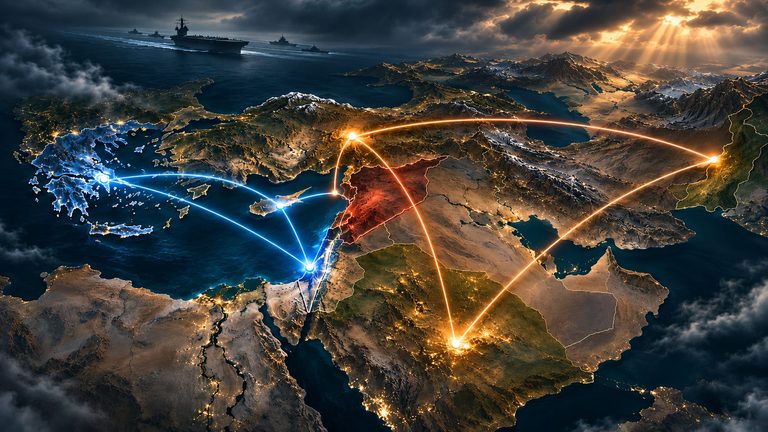
The world’s largest oil exporter is seeing its export routes squeezed at three points simultaneously – two of them within a single week. To the east, the Strait of Hormuz has been effectively shut down for months, since the war between the United States and Iran paralyzed the world’s most important oil chokepoint. To the west, the Houthis have been in Mokha since September 10, 2026, roughly 47 miles (75 km) from the Bab al-Mandab Strait, the gateway to the Red Sea and the Suez Canal. And between them, across the Arabian Peninsula, the kingdom’s last alternative route remained open until last Thursday: the East-West Pipeline to the Red Sea port of Yanbu. On September 10, 2026, drones from Iraq struck it. Riyadh shut it down.
As recently as July, the Saudi leadership had informed Washington that it had the Houthis under control on its own. Seven weeks later, Crown Prince Mohammed bin Salman called the American president twice in a single day and asked for airstrikes against those same Houthis. Donald Trump refused. The week reverberated through the markets. Brent, the benchmark for two-thirds of global oil trading, jumped to its highest level since the spring. The first shipping companies began rerouting cargoes around the Cape of Good Hope – adding thousands of nautical miles and weeks to every voyage to Asia.
What is unfolding off the coast of Yemen is being reported in the West largely as the resurgence of a civil war that has smoldered since 2015. It is that as well. The question this report asks is different: Does the situation merely look like a civil war – or, behind the backdrop of an internal Yemeni power struggle, are the pincers closing around Saudi Arabia’s oil exports on a third front?
The Advance Along the Coast
The offensive began on September 03, 2026. Within days, Houthi units advanced through western Taiz and the south of Hodeidah Governorate, coordinating along several axes simultaneously – Maqbanah, al-Kadaha, Jabal Habashi, and Mawza. They captured Hays, al-Khawkhah, al-Waziyah, and the Khalid ibn al-Walid military camp. Observers mapping the front lines in Yemen put the territorial gain in a single week at roughly 1,000 square miles (2,600 sq km). It was the sharpest shift in the front in years.
The first objective was the road between Taiz and the Red Sea, the lifeline connecting the besieged city of Taiz with the coast. Cutting it meant separating the south from the north and severing the coastal defenders from their hinterland. It was accomplished within days.
On September 10, 2026, Mokha fell. The port city lies about 47 miles (75 km) north of Bab al-Mandab and had previously been held by forces close to the internationally recognized Presidential Leadership Council – specifically Tariq Saleh’s National Resistance Forces, whose headquarters were located there. The defenders withdrew south toward Dhubab and Aden and described the retreat as tactical. The Presidential Leadership Council declared a free-fire zone over the abandoned area and warned civilians against using the road between Taiz and Mokha.
One day later, Yemeni government sources and eyewitnesses reported that the Houthis had also occupied Perim Island – known in Arabic as Mayun – the island in the middle of the strait, where the shipping channel narrows to barely 12 miles (20 km). The claim could not initially be verified independently; several news agencies repeated it, citing local sources. Houthi forces had previously operated on the Hanish Islands and near Zuqar, the archipelago north of the strait.
They therefore hold almost the entire Yemeni Red Sea coast. The north around Hodeidah and Al-Salif had been in their hands for years. What is new is the southern section, which belonged to the opposing side until last week. That side did not withdraw without a fight: The Presidential Leadership Council reported counterattacks, the temporary recapture of hills west of Taiz, and control over Hays District. The picture along the coast is therefore not a clean change of front, but a mobile and contested line – with a clear trend in the Houthis’ favor.
The death toll from these days can only be approximated. According to figures compiled by UPI, at least 276 people were killed within five days. Saudi Arabia conducted attacks of its own during the same period: at least 15 strikes against Houthi targets between September 03 and 08, 2026, alone. The kingdom is not a passive observer merely watching events unfold.
The context for this advance is a fragmented opposing camp. The Southern Transitional Council, for years an independent center of power in the south, dissolved on January 09, 2026, and transferred its structures to the internationally recognized government, which was thus reunified on paper. Along the coast, that unity failed to withstand the first serious pressure. Tariq Saleh’s National Resistance Forces, which had held Mokha, withdrew; there was little sign of an orderly joint defense along the coast. Where different factions stood alongside one another beneath a nominally unified roof, the front broke first. Over all of this lies a blockade that the Houthis had already announced on July 20, 2026, and that follows a peculiar logic: International shipping through Bab al-Mandab would remain free, the Houthi-controlled coordination center declared on September 10, 2026 – only vessels linked to Saudi Arabia were barred. A blockade with a single addressee.
What the advance changes militarily is less the symbolism of the strait than the sheer reach it provides. As long as the Houthis conducted attacks on ships with missiles and long-range drones from Yemen’s interior, the effort was high and the chances of a hit uncertain. From Mokha, Dhubab, and Perim, the shipping lane lies within range of artillery and inexpensive short-range systems. This reduces the cost of enforcing a selective blockade against Saudi vessels and frees expensive long-range weapons for other targets. The effect became visible even before the city fell: Between September 04 and 11, 2026, analytics company Windward counted 78 crude-oil tankers waiting in the Red Sea instead of the expected 57, an increase of 37 percent. Shipowners moved into a holding pattern as soon as the fighting turned toward the coast.
The Pincers Reach for the Kingdom
That the addressee was no coincidence became clear two days before Mokha fell. On September 08, 2026, the Houthis launched dozens of ballistic missiles and drones at Saudi territory: Jazan, Najran, Abha, and Khamis Mushait in the south of the country. According to Saudi figures, 73 people were injured. Energy and economic facilities were hit, including the Jazan refinery and a major air base; the Saudi Energy Ministry reported that operations at several facilities had been suspended. Houthi spokesperson Yahya Saree named the targets in a prerecorded statement.
The heaviest blow came two days later, and it did not come from Yemen. On the morning of September 10, 2026, drones struck the East-West Pipeline in the Riyadh and Medina regions. They damaged pumping stations, started fires, and injured several people. The following day, Riyadh announced that the pipeline had been shut down as a precaution and identified the drones’ origin: They had come from Iraq. Baghdad confirmed that the attack had been launched from Iraqi territory, specifically Maysan Province on the Iranian border; it dismissed a commander, ordered an investigation, and closed two border crossings with Iran. Riyadh announced that it would not retaliate for the time being, giving the Iraqi government room to act. The sequence and the Iraqi launch point were reported by Al Jazeera.
To understand why this strike matters more than the missiles fired at Jazan, one must understand what the pipeline does. It crosses the kingdom for roughly 745 miles (1,200 km), running from the eastern oil fields to the Red Sea port of Yanbu, and has a capacity of about 7 million barrels per day. Since the Strait of Hormuz became unusable for Saudi exports, it had served as the primary bypass: the one route that carried oil from the east around the blocked Gulf and onward to the Red Sea. Saudi Aramco CEO Amin Nasser said the previous month that the pipeline had done more to offset war-related shortfalls than the release of strategic reserves. That route is now closed. And as Al Jazeera explains, Riyadh cannot simply continue directing eastern oil to Yanbu while the pipeline is offline. The oil from the east therefore lacks a final open route to the Red Sea – the route through the Gulf is blocked, and the one across the country is now interrupted. Whatever still gets out must take longer and more expensive detours.

The balance sheet for these attacks is already reflected in the International Energy Agency’s figures. According to its September Oil Market Report, Saudi crude-oil supply fell to 6 million barrels per day in August, down 2.3 million from the previous month and its lowest level in more than three decades. The agency cites attacks on vessels at Bab al-Mandab, the Jazan refinery, ships off Yanbu, and drone attacks by Iran-backed militias from Iraq against the Abqaiq oil-processing facility. It lowered its forecast for Saudi supply in 2026 by 885,000 barrels to 7.6 million barrels per day. Saudi Arabia itself reported different figures to OPEC – a higher supply of 7.122 million barrels and production of 6.238 million barrels per day. The methodologies differ, but the collapse remains substantial under either reading. Independent energy reporting likewise described Saudi supply as the lowest in more than three decades.
What is remarkable about this balance sheet is where the attacks came from. They did not originate in a single direction. The missiles against Jazan and the fighting along the coast came from Yemen; the drones against Abqaiq and the East-West Pipeline came from Iraq. Two neighbors, two fronts, one country under attack – and in both cases, according to those affected, the trail leads to Iran-backed actors.
The market reacted immediately. Brent jumped to around $108 a barrel on Thursday – the highest level since May 19, 2026. On Friday, the price fell back below $105; over the week, it was still up roughly 9 percent. In normal times, about 10 to 12 percent of seaborne oil passes through Bab al-Mandab. Whoever threatens that passage moves the world price. CNN Business documented the surge to $108.
Three Chokepoints, One Addressee
Take one step back – from the individual report to the pattern. Three geographical chokepoints determine whether Saudi oil reaches the market, and all three are currently under pressure. To the east is the Strait of Hormuz, through which roughly one-fifth of globally traded oil passed before the war and which has been effectively closed since fighting between the United States and Iran began in late February; the U.S. Energy Information Administration also attributes the continuing shortfall to the American blockade of Iranian oil exports. In the center is the East-West Pipeline, the only bypass around this Gulf chokepoint – shut down since last week. And to the west is Bab al-Mandab, now within range of Houthi artillery. Traffic through Hormuz shows how constricted the eastern route has become: Where more than 100 vessels passed each day before the war, only a handful have done so on some recent days.

Precision matters. The route from Yanbu to Europe would in principle remain open. But reaching Yanbu requires the pipeline – and the pipeline is offline. The route to Asia, in turn, runs through Bab al-Mandab, which is the actual bottleneck for Saudi tankers. East, bypass, west: The pincers are closing on all three fronts at once. No single attack explains the collapse by itself. Taken together, however, the kingdom faces precisely the problem it spent years and billions trying to avoid: no longer having a reliable route for bringing its oil to market.
Who benefits? Caution is required here, because there is a boundary between benefit and intent that this article does not cross. What stands out is that all three chokepoints ultimately affect the same artery: the seaborne energy supply on which China’s economy also depends. And a high oil price does not affect everyone equally – it increases the value of exports from countries that are themselves producers, above all the United States and Russia. This author’s Iran series has traced this energy lever in detail: how Washington is closing the Strait of Hormuz to Iranian exports and thereby cutting off a substantial part of China’s oil supply, while taking control of the Venezuelan flow since Maduro’s removal and helping determine the price.

The same energy agency shows how close to the limit the market is already operating: Global oil supply is expected to fall by 5.7 million barrels per day in 2026, while demand is expected to decline by 2.5 million – the steepest contraction since the pandemic. In such a tight market, the loss of a single major exporter is enough to drive prices upward. And Saudi Arabia is not just any exporter.
One obvious reading of the Yemeni advance fits this picture, but it must be identified as analysis, not finding: Iran is turning against Washington’s most important regional ally the same weapon Washington is using against Iran. If Tehran’s oil is pushed out of the Strait of Hormuz, Tehran is now pushing Saudi oil out of Bab al-Mandab – a bargaining chip for a bargaining chip. Whether Tehran planned the advance with such cold calculation or whether the Houthis are pursuing an agenda of their own while Tehran permits it changes little about the observable effect: The pressure lands where it is most likely to play into U.S. hands through the oil price. The sources clearly describe command as probable: Yemeni, Iranian, and regional voices report that the advance took place under the direct guidance of Iran’s Islamic Revolutionary Guard Corps and that Tehran urged the Houthis to escalate against Saudi Arabia. A direct order from Tehran has not been proven. There is a counterposition, and it must be acknowledged: A Jerusalem Post commentary argues that Iran has lost control of the Houthis. Iranian guidance is probable; sole command remains unproven. Between those poles, the reader must decide.

Who Is Not Coming to the Kingdom’s Aid
That leaves the question that prompted MBS to reach for the telephone on September 10, 2026. He called Trump twice; according to Axios, citing two U.S. officials, he asked for American airstrikes against the Houthis. Trump rejected direct military intervention. Washington is supporting Riyadh, but it has drawn a line: intelligence and targeting data, yes; around 200 U.S. troops in the country for noncombat duties, yes; political backing for a Saudi strike against Sanaa airport, also yes; the commander of U.S. Central Command traveled to Riyadh for consultations. But direct American intervention, no. The focus was on protecting freedom of navigation, a senior administration official said, while regional partners would be left to lead the conflict.
The scope of this assistance should not be overstated. Targeting data are worth a great deal – the Iran war has demonstrated how much. But Russia and China also provide targeting data to Iran, and no one calls that massive participation in the war. Washington is doing what is necessary to say that it has done something – while simultaneously staying out of a second front as its forces remain committed to the first, against Iran. A second open front alongside the Iran war does not fit that strategy. Riyadh’s request itself is the real news: It marks a reversal from July, when the kingdom still declared that it could manage on its own.
And what of the much-invoked regional assistance? On August 07, 2026, Saudi Arabia, Turkey, and Pakistan signed a joint defense agreement in Mecca, the Mecca Joint Defence Agreement. Its central sentence sounds like Article 5 of the North Atlantic Treaty: An attack on one is considered an attack on all. The treaty text has not been published. What analysts such as the Arab Center Washington DC observe is sobering: no joint command, no standing forces, and no defined activation mechanism. And when the Houthis attacked the kingdom, Pakistan stated on September 10, 2026, that it was not considering an immediate military response under the agreement; its response would remain diplomatic for the time being. Islamabad has practical reasons: It shares a roughly 560-mile (900 km) border with Iran, has a large Shiite population, and has served for months as a mediator between Washington and Tehran – a role poorly suited to entering the war.
Some interpreted this as the pact’s first and failed test. That reading is too simplistic. A mutual-defense pact is not concluded in order to inherit a partner’s ongoing conflict. A thought experiment makes the point clear: If NATO admitted Ukraine tomorrow, it would necessarily exclude the war already under way with Russia – unless it intended to make that war its own. Even the European Union’s mutual-assistance clause, however binding its wording, would hardly apply to such a preexisting case without drawing every member into it. There is no reason to believe the Mecca agreement is different. Such a pact is directed at future aggression, not entry into an offensive already in progress. Its purpose is deterrence and the diversification of dependencies – a hedge, not a combat alliance for yesterday’s emergency. Analyses of the agreement have likewise framed it as evidence that the U.S.-led regional order is changing, while its reach extends toward the western edge of the Indo-Pacific. The most revealing evidence, however, is not the treaty text, which nobody knows, but a simple observation: When matters became serious, MBS dialed Washington, not Islamabad or Ankara.
Findings
Saudi Arabia, the world’s largest oil exporter, is seeing all three of its export routes constricted at once – two of them within a single week, all three along the same fault line of a larger war in which it had so far been more bystander than party. What is reported along the Yemeni coast as civil war is also a civil war on the ground. In its effects, however, it fits into a pattern extending beyond Yemen: pressure on the chokepoints through which the world’s oil and China’s energy supply flow.
The diplomatic countermovement is already under way. On Monday, Iran and the Gulf states will meet in Oman to discuss the Strait of Hormuz; Trump sounded confident in Dublin over the weekend and suggested that the Houthis had contacted Washington to avoid a direct confrontation. Whether this produces de-escalation or merely a pause remains open. For Riyadh, more is at stake than a quarterly result: A state whose budget and reform program depend on oil sales cannot tolerate permanently constricted export routes.
One thread already leads further, however, and it deserves attention. The third signatory to the Mecca Pact is Turkey – a country now bound to Saudi Arabia by mutual assistance and at the same time one of Israel’s fiercest regional adversaries. How this new architecture relates to Israel, Washington, and the war against Iran is not a question for a report from the coast. What is clear is that the order Washington guaranteed in the region for half a century has begun to slide – and that the Houthi offensive along Yemen’s coast is only one of its fault lines. It will be the subject of the next analysis.
Published at apolut media on September 14, 2026
No advertisers, no sponsors, no political patrons – this publication is funded by its readers. Support independent geopolitical analysis from $5 per month and unlock all member-only content.

You are also welcome to support my work with a one-time donation.

About the Author
Michael Hollister
is a geopolitical analyst and investigative journalist. He served six years in the German military, including peacekeeping deployments in the Balkans (SFOR, KFOR), followed by 14 years in IT security management. His analysis draws on primary sources to examine European militarization, Western intervention policy, and shifting power dynamics across Asia. A particular focus of his work lies in Southeast Asia, where he investigates strategic dependencies, spheres of influence, and security architectures. Hollister combines operational insider perspective with uncompromising systemic critique – beyond opinion journalism. His work appears on his bilingual website (German/English) www.michael-hollister.com and in investigative outlets across the German-speaking world and the Anglosphere.
Sources
- “Iran-Backed Houthis Seize the Port of Mokha on Yemen’s Red Sea Coast,” UPI, September 10, 2026: Article.
- “Iran-Backed Houthi Rebels Seize a Strategic Port and Island, Opening a New Battlefront,” NPR, September 11, 2026: Article.
- “Houthis Reportedly Advance to Key Red Sea Island,” CNBC, September 11, 2026: Article.
- “Houthis Seize Mokha in Rapid Western Yemen Offensive,” Clash Report, September 2026: Article.
- “MIOC Special Report: Houthi Seizure of Mokha and Red Sea Islands,” Windward, September 2026: Special Report.
- “Houthi Forces Capture Strategic Red Sea Port City of Mocha Following Government Withdrawal,” The Defense News, September 2026: Article.
- “2026 Yemen Offensives,” Wikipedia: Entry.
- “Saudi Crown Prince Urged Trump to Strike Houthis amid Red Sea Threat,” Axios, September 11, 2026: Article.
- “Trump Said to Reject Saudi Request for Strikes on Houthis, as They Seize Red Sea Island,” The Times of Israel, September 11, 2026: Article.
- “Donald Trump Declines Saudi Crown Prince’s Call for US Strikes on Houthis,” The Jerusalem Post, September 11, 2026: Article.
- “Brent Crude Nears $100 as Houthi Strikes Hit Saudi Oil Sites,” Quartz, September 08, 2026: Article.
- “Global Oil Hits $108 per Barrel While Bond Yields Surge,” CNN Business, September 10, 2026: Article.
- “Oil Prices Set to End the Week Above $100 as Houthis Seize Key Port City,” The National, September 11, 2026: Article.
- “Brent Crude Tops $107 as Houthis Seize Yemen’s Mokha Port,” Gulf News, September 11, 2026: Article.
- “Houthis Close In on Bab el-Mandeb as Brent Barrel Price Soars,” France 24, September 10, 2026: Article.
- “Saudi Arabia Says East-West Pipeline Hit by Drones Launched from Iraq,” Al Jazeera, September 11, 2026: Article.
- “Saudi Arabia Shuts Critical Oil Pipeline after Drone Attack: What It Means,” Al Jazeera, September 12, 2026: Article.
- “Saudi Oil Pipeline Shut Down after Attack Triggers Fires,” CNN, September 11, 2026: Article.
- “Saudi Arabia Shut Down East-West Crude Oil Pipeline after Multiple Attacks by Drones from Iraq,” CNBC, September 11, 2026: Article.
- “Saudi Arabia’s Shutdown of Key Pipeline Limits Oil Flow as Yemen Hits Back against Houthis,” NBC News, September 12, 2026: Article.
- “2026 East-West Crude Oil Pipeline Attack,” Wikipedia: Entry.
- Oil Market Report – September 2026, International Energy Agency: Report.
- “Saudi Oil Supply Hits More than Three-Decade Low after Houthi Attacks, IEA Says,” BOE Report, September 11, 2026: Article.
- Short-Term Energy Outlook: Global Oil Markets, U.S. Energy Information Administration, September 09, 2026: Report.
- “Mecca Joint Defence Agreement,” Wikipedia: Entry.
- “Diversification Without Substitution: What the Mecca Joint Defense Agreement Offers Saudi Arabia,” Arab Center Washington DC, September 2026: Analysis.
- “The U.S.-Led Middle East Order Is Over. The Mecca Agreement Proves It,” Council on Foreign Relations, August 13, 2026: Analysis.
- “The Mecca Pact Redraws the Indo-Pacific’s Western Edge,” Lowy Institute, August 10, 2026: Analysis.
- “Saudi Arabia Closes Oil Pipeline after Drone Attack Launched from Iraq,” ABC News, September 12, 2026: Article.
- Michael Hollister, “The Question No One Asks in the Iran Debate” (Iran special), September 02, 2026: Article.
© Michael Hollister – All rights reserved. Redistribution, publication or reuse of this text requires express written permission from the author. For licensing inquiries, please contact the author via www.michael-hollister.com.