by Michael Hollister
German version published exclusiv at Overton-Magazin.de on August 16, 2026
4.707 words * 25 minutes readingtime

Weekly analysis, background and context by email.

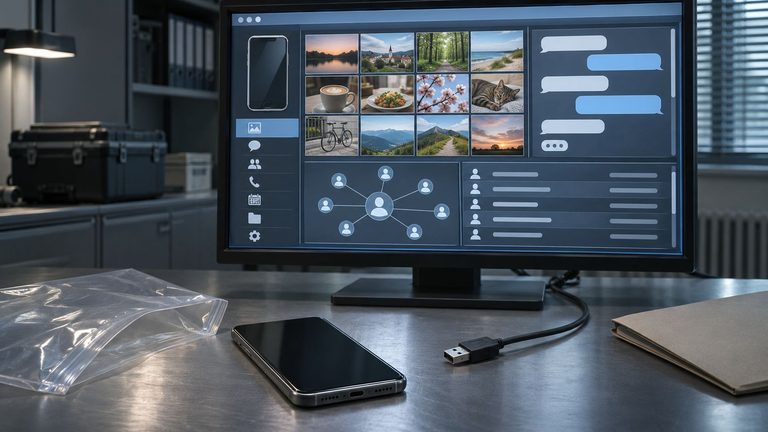
A reporter poses as a Russian businessman looking to buy a European drone. He contacts a man who calls himself only Dima on the messaging service Telegram: The payment is to go to a German supplier, and under no circumstances must the German bank discover that the money comes from Russia. Dima does not hesitate. There will be no trace of the Russian company, he replies, and the payment will go through. They are ready to select suitable companies and start making payments.
The exchange is part of a year-long undercover investigation by OCCRP and its partners SourceMaterial and Delfi Estonia, published on June 17, 2026. At first, it seems to be exactly what it looks like: evidence of Russian ingenuity in circumventing Western sanctions. But that is not the real story. The account Dima eventually gives the undercover reporter for a test payment is not in Moscow, not in Dubai, not in some distant offshore jurisdiction. It is held at an institution licensed by the European Union itself and regulated by the central bank of an EU member state. The fortress Europe has built against Russia’s financial sector has a leak in its own wall – and that leak bears a European stamp of approval. Finding it required no criminal masterstroke. It was enough to pose as what millions of legitimate customers are: a businessman who wants to pay an invoice. The rest was an offer openly available on a platform anyone with a smartphone can access.
This article reconstructs how the money moves, which companies and individuals form the chain, and why a fine of 19,000 euros reveals more about the state of Europe’s sanctions framework than any new sanctions package.
The question behind the investigation
Since the war in Ukraine began in February 2022, the EU has imposed one sanctions package after another on Russia – 21 by the summer of 2026. More than 70 major Russian banks have been disconnected from SWIFT, the messaging system used to facilitate international payments. The stated goal: to cut Russia off from the international financial system and thereby deprive its war effort of funding.
The obvious question raised by an investigation like OCCRP’s is: How does Russia circumvent these sanctions? It is not the wrong question, but it is the smaller one. The bigger question is: Why does the circumvention run through institutions Europe itself has authorized? And what does it mean when the responsible regulator does not close such an institution but fines it an amount that barely registers as a rounding error in financial transactions?
At this point, some context is needed that is usually missing from Western reporting. To call the practice described here “circumvention” in a legal sense presupposes that the sanctions themselves are recognized as law. That is precisely what is disputed internationally. The sanctions against Russia are measures imposed by the EU, the United States, and the United Kingdom – not by the UN Security Council. Much of the world, including China, India, Brazil, and most countries in the Global South, has never joined them. From this perspective, the trade enabled by these payment providers is not a breach of the law but commerce that one bloc is unilaterally trying to prevent. We present both interpretations and leave the judgment to the reader. The finding at issue here stands independently of that judgment: The EU promises an effect that its own infrastructure undermines.
Testing the route
Working undercover, SourceMaterial and Delfi reporters contacted 9 payment providers advertising their services on Telegram – the platform that allows users to communicate anonymously and is the most widely used in Russia. In 5 cases, the providers agreed to route money to Europe while concealing its Russian origin. In every one of those cases, the reporters had explicitly pointed out that sanctions stood in the way – either because the goods were blacklisted or because the Russian company itself was under sanctions.
The advertising could hardly be more explicit. A provider called Fin Platform, since shut down, advertised that when sanctions reshuffled the cards, it offered real solutions. Another explained on its website how to get paid for goods when the customer wanted nothing to do with Russia. The providers offered “structures” that varied with the transaction – involving companies in Hong Kong, Dubai, and Indonesia that issued invoices to conceal Russian involvement. The principle is as simple as it is effective: An intermediary in a third country issues the invoice and receives the payment, so the paperwork identifies that country as the trading partner – not Russia. The European seller sees an account in Canada or Lithuania, with no connection to Moscow. Dima himself described the fluid nature of the work: One structure might exist today and another tomorrow because banks and jurisdictions constantly changed their requirements. One provider assured the reporters that its directors were not Russian, so no trail would remain.
What stands out is that the reporters never pretended the transactions were legitimate. They openly stated that sanctioned goods were involved – in one case, European drones for a Russian buyer. Even so, 5 providers agreed to help. The sanctions were not an obstacle but the very reason their services were being sought. That is precisely what the commission pays for: not making the payment, but concealing it.
In several cases, the providers sent the reporters specific banking details for intermediaries – companies in Dubai, Indonesia, Canada, and Germany. The investigation does not name the German intermediary; companies approached for comment denied involvement. The German drone supplier in the opening scenario was also a construct invented by the reporters, not a real, named company. No payment was made. Turning this setup into an allegation against a specific German offender would go beyond the evidence – and that is not what we do.
Something else is documented, and it is more than enough: In one conversation, Dima provided banking details for a test payment to an account held by a Canadian company called Grata Payments Ltd at a Lithuanian institution called TeslaPay. When later confronted with the findings, Dima responded evasively that some of the wording and conclusions amounted to subjective interpretation; his business focused exclusively on supporting international payments. The institution’s name, however, leads to the heart of the matter.
The endpoint bears a European stamp of approval
TeslaPay is no shadow operation. It is an electronic money institution licensed by Lithuania’s central bank, the Bank of Lithuania – license number LB000463, company code 304715528, authorized since July 25, 2018. It is small: According to market data, it accounts for 0.65 percent of Lithuania’s electronic money market, and in 2025 it held approximately 15 million euros in customer funds. It also holds the European passport that allows institutions authorized in one member state to operate across borders in the others – including Germany. That establishes market access, not a specific German transaction. But it shows that this is not some exotic arrangement; it is an ordinary participant in Europe’s payments system. According to SourceMaterial’s reporting, TeslaPay also established a British branch in 2024, although it never received an operating license.
And this very institution came under scrutiny from its own regulator. On June 3, 2026 – a little over 2 weeks before OCCRP published its investigation – the Bank of Lithuania fined TeslaPay 19,000 euros. The official register entry identifies the breaches precisely: deficiencies in the ongoing monitoring of customer relationships and transactions, in internal anti-money-laundering and counterterrorist-financing procedures, and in tailoring those procedures to the specific risks. It cites Articles 9, 17, and 29 of Lithuania’s anti-money-laundering law, along with several provisions of the central bank’s supervisory instructions. The penalty was imposed through an administrative settlement; TeslaPay committed to remedying the deficiencies by October 1, 2026, and submitting an audit report by December 1, 2026. Under the Lithuanian central bank’s rules for such settlements, an assessed fine is reduced by 20 to 40 percent if the institution cooperates and takes remedial action. The underlying agreement is confidential; the authority did not disclose the original amount or how it was calculated. It would therefore be wrong to infer from the small sum that the regulator considered the breaches minor. What is public is the final amount – and that is 19,000 euros.
Caution is warranted here, and we exercise it. The fine predates the investigation’s publication; it cannot have been a response to it. The published decision does not establish whether the inspection covered the specific accounts or business relationships that appear in OCCRP’s reporting. These are separate matters. What can be said is more precise and therefore more robust: Two independent lines of inquiry – the regulator’s targeted anti-money-laundering inspection and the reporters’ undercover payment test – reached the same vulnerability at the same institution within a few weeks, without knowledge of each other. One officially established inadequate monitoring of customers and transactions. The other received from a broker an account at that very institution as a vehicle for money whose sanctions exposure would be concealed.
TeslaPay itself told the reporters that it was subject to anti-money-laundering rules and regularly supervised by the Bank of Lithuania, including through a recent inspection. That is correct. The question this case raises is therefore directed less at an individual institution than at the system: When an ordinary, licensed, supervised, and inspected participant in Europe’s payments system receives a fine with little deterrent effect, while being offered on Telegram as a channel for Russian money – what does that say about the strength of the fortress? The 19,000 euros are not the scandal. They are its emblem.
The network behind the account
Up to this point, the case could be read as negligence at a small institution. But the connections run deeper, and they can be traced independently through publicly accessible corporate registers – not just through OCCRP’s account, but by examining British registry records firsthand.
The director of Canada’s Grata Payments, whose account was to be used for the test payment, is an Estonian lawyer named Aleksei Ratnikov. According to entries in the British Companies House register, the same person was a director of a British company called One Remit from June 2021 until its dissolution in May 2024. One Remit handled international money transfers for a company that is now sanctioned: TGR Partners. A second director and the sole beneficial owner of One Remit was Andrejs Bradens, also known as Andrejs Carenoks. And at the time of Ratnikov’s appointment, One Remit’s Cypriot holding company belonged to a woman named Elena Chirkinyan.
One Remit was not an isolated case but part of a pattern. According to SourceMaterial’s reporting, it was one of several companies in the network registered at a single London address: a townhouse on Riding House Street in the western part of the city. Such shared addresses, where dozens of shell companies cluster, are the physical hallmark of an infrastructure that exists on paper rather than in offices.
These are not random names. According to the U.S. sanctions authority OFAC and Britain’s National Crime Agency, Bradens, Chirkinyan, and a third individual, George Rossi, lead the TGR network – a structure the U.S. Treasury Department and British authorities identify as an international money-laundering and sanctions-evasion network. According to OFAC’s statement, the network converted illicit funds into cryptocurrency, facilitated property purchases in the West, and arranged cash handovers; Rossi allegedly controlled a company that used the already-sanctioned Russian cryptocurrency exchange Garantex. OFAC sanctioned all 6 senior figures in TGR and the closely connected Smart group on December 4, 2024. According to the British authorities, the underlying investigation, Operation Destabilise, resulted in 84 arrests and the seizure of more than 20 million euros in cash and cryptocurrency; the network allegedly spanned more than 30 countries.
The finding, then, is this: The director of the company whose account a Telegram broker offered as a vehicle served at a British company alongside a senior figure in a network sanctioned 18 months earlier. Ratnikov himself denies any connection. He says he has no knowledge of CW Group, knows nothing about activities on Telegram, and has no links to the TGR network; the banking details Dima provided, he says, do not belong to Grata. Regarding his One Remit directorship, he said he had been registered as a director without his consent – a victim of fraud – but acknowledged having discussed such a role. The British register nevertheless lists him as a director for more than 3 years. We record both: the documented corporate ties and his denial. What we do not do is infer a crime from those ties. Serving together as directors establishes a connection, not participation in the other person’s acts.
A second link leads to TeslaPay itself. A Russian businessman named Philipp Larin is identified as a co-founder of the institution. Larin is also – according to OCCRP’s investigation, citing Latvian registry records and an archived TGR network website – a board member and co-owner of another payment agency, Latvia’s Eastern European Payment System, which reportedly listed Rossi and Chirkinyan as beneficial owners between 2020 and 2023. This information comes from the investigation; the historical ownership chain is no longer available in Latvia’s freely accessible register, which is why we explicitly identify it as OCCRP’s finding, not our own. The independently documented bridge – Ratnikov, Bradens, and Chirkinyan through One Remit – supports the finding even without it.
The larger machine
The Telegram brokers are the lowest, most visible layer of a much larger system. To understand why a single institution fined 19,000 euros is merely a symptom, we need to look at the infrastructure that has emerged behind it – and at its rise and fall in 2026.
At its center is a ruble-pegged stablecoin called A7A5, a cryptocurrency tied to the ruble and launched in early 2025 by A7, the company of Moldovan-Russian businessman Ilan Shor – now sanctioned by the United Kingdom and the EU – together with Russia’s state-owned Promsvyazbank, which, according to Britain’s National Crime Agency, supported companies in Russia’s defense industrial base. Shor is no stranger to controversy: In Moldova, he was convicted in absentia over a billion-dollar bank fraud that rocked the country in 2014; he now lives in Russia. For Western authorities, the involvement of such a man and a Russian state-owned bank is evidence that A7A5 is not a private financial product but part of a state-linked architecture. A7A5 was deliberately designed without a freeze function: When Western authorities dismantled the Russian cryptocurrency exchange Garantex in 2025, market leader Tether – the issuer of the dominant dollar stablecoin USDT – froze the associated balances. The response was a token no Western authority could shut down, because it was denominated in rubles rather than dollars and administered outside Western control. According to its operators, A7A5 was used in nearly 20 percent of Russia’s international transactions.
The figures associated with A7A5 are enormous – and call for caution. According to data from analytics firm Chainalysis, the token processed transactions worth 93.3 billion dollars in 10 months; Britain’s Foreign, Commonwealth and Development Office, the FCDO, described that as roughly half of Russia’s annual military budget. That comparison comes from a party to the conflict and should be read with care. Blockchain analysts at Elliptic and TRM Labs estimate that around 34 percent of the observed volume consists of circular transactions consistent with wash trading – transactions that create apparent volume without representing real trade. The spectacular figure is therefore substantially inflated, and equating it with half the military budget is political framing, not a neutral metric.
What happened next is striking – because it challenges the convenient notion that regulators always lose. The EU banned A7A5 outright in its 19th sanctions package; it was the first time the bloc had explicitly prohibited an individual crypto token. Its main trading platform, Grinex, collapsed in April 2026. According to an Elliptic analysis published in July 2026, monthly transaction volume fell by as much as 96 percent from its peak. The token built to be untouchable was nevertheless strangled at its edges – not on the blockchain, which continues to operate, but at the exchanges where it is converted into other assets.
A look at the connecting points shows how closely these worlds are intertwined. British authorities linked the TGR network, within whose orbit the Lithuanian and Latvian payment companies operate, to Kyrgyzstan’s Keremet Bank, which allegedly processed cross-border payments for Promsvyazbank – the same Russian state-owned bank that co-issues A7A5. The Telegram brokers, the EU-licensed electronic money institutions, the sanctioned money-laundering network, and the ruble-pegged stablecoin are therefore not separate phenomena but layers of the same system. The account number at a small Lithuanian institution and the multibillion-dollar crypto vehicle belong to the same story.

That is the heart of the matter, and it cuts both ways. The authorities do not lose every round; the EU really did kill off A7A5. But the mole pops up again. Before A7A5, the business ran through Tether and Garantex; after Garantex, through Grinex; after A7A5, through the next vehicle. Ilia Shumanov of TriTrace Investigations sums up the pattern: Payment systems are 1 to 2 years ahead of regulators. It is a constantly mutating ecosystem backed by substantial investment. British Foreign Secretary Yvette Cooper said the authorities were targeting the infrastructure sustaining Russia’s war economy. That is her framing; the documented finding is more sober: Every door that closes opens another, and the Telegram brokers with their Lithuanian accounts are the customer-facing layer of precisely this cycle.
Sidebar: Germany as a hub – and who takes action
The case touches Germany as a destination jurisdiction without naming a German company. But German companies appearing as hubs for Russian procurement is hardly new – and the most revealing part is who identified them.
In October 2022, the U.S. sanctions authority OFAC, acting in coordination with the U.S. Department of Justice, sanctioned Hamburg-based NDA Nord-Deutsche Industrieanlagenbau GmbH (commercial register number HRB 102166). According to OFAC, the network around Russian agent Yury Orekhov used the German company to procure U.S. semiconductors and microprocessors for fighter jets, ballistic missiles, and other military applications; components were reportedly found in Russian weapons in Ukraine. Investigators identified the company’s majority owner as Artem Uss, the son of a Russian governor. Orekhov was arrested in Germany in October 2022 at the request of the United States; Uss, placed under house arrest in Italy, escaped in 2023 to avoid extradition – an episode that illuminates the limits of enforcement as starkly as the arrests themselves. The criminal allegations are charges, not final convictions; the presumption of innocence applies.
In May 2023, OFAC sanctioned Belmagistralavtotrans Speditions GmbH of Alzey in Germany’s Rheinhessen region (Mainz commercial register number HRB 32490), formerly BMA Spedition. According to OFAC, its owner, Belarusian national Evgueni Kostiouk, organized transport between Western Europe, Russia, and Belarus; the company was allegedly involved in transferring equipment to Russia’s Ostec Group – an importer of electronics and semiconductor technology that OFAC links to the Russian defense sector. The German Eastern Business Association, a trade organization, included the case in its own sanctions update and pointed to the growing number of reports of circumvention networks reaching into Germany.
In both cases, a U.S. authority acted in a German jurisdiction – not the EU, not the Federal Republic. These cases concern the procurement of goods, not the payment channel in the OCCRP investigation; they belong to a different link in the same chain. But they illustrate the same structural gap from a second angle: Where German companies were identified as procurement hubs, enforcement came from Washington. European enforcement was absent.
Why the gap persists
Why does this situation persist? The answer does not lie in some hidden intention we might allege – we cannot prove one, so we do not allege one. It lies in a structure that can be described openly, from which readers may draw their own conclusions.
The pattern is the same at both ends. Europe holds the line where it costs little and leaks where it costs more. On the financial side, circumvention runs through small, EU-licensed institutions that national regulators penalize with modest fines. The same pattern appears in raw materials: Alumina – the precursor Russia uses to make aluminum and, from it, weapons components among other products – remains unrestricted by any sanctions package, because a ban would hurt Europe’s own aluminum industry. As a companion piece to this article traces in detail, Europe’s sharpest weapon reaches its limit where using it would hurt the sanctioning party more than the sanctioned one.
Behind this lies a broader mechanism I described in “The U.S. Materials Paradox” on the other side of the balance of power: The leverage belongs not to whoever has the raw material in the ground, but to whoever controls refining, processing, and infrastructure. There, it is China, whose rare-earth refining gives it leverage over American defense production. Here, it is the EU, whose licensing of payment institutions gives it leverage over circumvention – leverage it does not use. The fortress holds the keys to its own gates.
We can identify who benefits from the gates being left ajar without imputing intent: the licensed intermediaries who earn money on every transaction; the brokers who take their commission; and, more uncomfortably, the EU jurisdictions that have built their fintech sectors on a deliberately accessible licensing process. In just a few years, Lithuania has become one of the EU’s largest hubs for electronic money institutions; after Britain left the EU, numerous payment companies moved their licenses there. Such a competitive advantage comes from swift, business-friendly supervision – the very quality that becomes a vulnerability when legitimate customers must be distinguished from those concealing transactions. Competition to attract businesses and rigorous oversight pull in opposite directions. Here, too, the principle that part of the world invokes against the entire arrangement applies: Where there is no shared basis in international law, only one bloc’s foreign-policy will, the line between an “enforcement gap” and a “tolerated exception” is fluid. We map the structure; the judgment remains with the reader.
Three paths forward
What might happen next? Three possible developments are taking shape, and none is free of contradictions.
In the first scenario, things stay as they are. The unanimity of all 27 member states required for every sanctions package slows decisive action; national regulators continue to deal with small institutions through small fines. The next package then targets the previous workaround, while the current one has already found its next vehicle. This is the most likely scenario as long as the major industrial states’ political calculations remain unchanged.
In the second scenario, supervision tightens. The EU is building a new anti-money-laundering authority in Frankfurt, AMLA, which began operating on July 1, 2025, and took over the relevant mandates from the European Banking Authority on January 1, 2026. Its program explicitly identifies cryptoassets and new payment channels as priority risks – precisely the phenomenon at issue here. But the catch is the timetable: AMLA’s direct supervision does not begin until 2028, and even then it will cover only around 40 of the largest institutions operating across borders. An institution such as TeslaPay, with a 0.65 percent market share, would fall outside that scope. The single rulebook established by the EU Anti-Money Laundering Regulation applies from July 10, 2027; enhanced due diligence requirements for business with Russia have been in force since January 2026. For institutions under its direct supervision, AMLA will be able to impose fines of up to 10 percent of annual turnover – many times the amounts national regulators have imposed so far. The overhaul is real – but slow, and it targets the big fish while the channel runs through the small ones. For now, a 19,000-euro fine for an institution with a 0.65 percent market share remains the national instrument this case illustrates.
In the third scenario, the cat-and-mouse pattern continues. A7A5 provides the blueprint: One vehicle is shut down, the next emerges. As long as demand persists and the returns are attractive, every blocked instrument will be replaced by a new one, and the authorities will win individual rounds in a game whose underlying structure keeps it going.
Which scenario prevails depends less on technical capabilities than on a political calculation: how much damage Europe is willing to inflict on itself – on its own fintech sector, its own industry, its own payments system – to achieve an effect it has so far preferred to promise rather than enforce.
The leaky wall
The TeslaPay case is more than an instance of negligence at a small institution. It is a lesson in the limits of sanctions as an instrument – and in a vulnerability located in one’s own wall, not in an opponent’s cunning.
A reporter had only to pose as a Russian businessman for a broker to give him the account details of an EU-licensed institution – an institution penalized by its own regulator 2 weeks earlier for inadequate monitoring, and whose corporate orbit includes individuals linked in public registers to a network sanctioned long before. None of this required exceptional skill. It required a fortress that holds the keys to its own gates and does not turn them.
The sanctions framework ends where it begins to hurt the sanctioning party itself – in finance as in the raw-material supply chain. Every new package lengthens the list of prohibited routes; none closes the door left open at home. The authorities win rounds, and A7A5 shows that they can. But they win them against a system that mutates faster than a union of 27 governments can agree – and that continues operating wherever a ban would hurt their own industry, their own payments system, their own business hubs.
What Russia does ends up in a Lithuanian account. What Europe fails to do is recorded in its own licensing register.
German version published exclusiv at Overton-Magazin.de on August 16, 2026
This publication answers to its readers – and no one else. Become a member for $5 or a patron for $15 per month, support genuinely independent journalism, and receive full access to all published analyses.

About the Author
Michael Hollister is a geopolitical analyst and investigative journalist. He served six years in the German military, including peacekeeping deployments in the Balkans (SFOR, KFOR), followed by 14 years in IT security management. His analysis draws on primary sources to examine European militarization, Western intervention policy, and shifting power dynamics across Asia. A particular focus of his work lies in Southeast Asia, where he investigates strategic dependencies, spheres of influence, and security architectures. Hollister combines operational insider perspective with uncompromising systemic critique – beyond opinion journalism. His work appears on his bilingual website (German/English) www.michael-hollister.com and in investigative outlets across the German-speaking world and the Anglosphere.
Independent geopolitical analysis – weekly delivered to your inbox.
Sources
- OCCRP, June 17, 2026 – “There Will Be No Trace”: Russian Payment Agents Tout Sanction-Busting Services on Telegram: https://www.occrp.org/en/investigation/there-will-be-no-trace-russias-sanctions-busting-middlemen-tout-services-on-telegram
- SourceMaterial, June 17, 2026 – “There will be no trace”: https://www.source-material.org/russia-sanctions-kremlin-backed-payments-agents/
- Bank of Lithuania, June 3, 2026 – UAB TeslaPay – official register entry with enforcement notice: fine of 19,000 euros: https://www.lb.lt/en/sfi-financial-market-participants/uab-teslapay
- U.S. Department of the Treasury / OFAC, December 4, 2024 – Treasury Exposes Money Laundering Network Using Digital Assets to Evade Sanctions (TGR sanctions): https://home.treasury.gov/news/press-releases/jy2735
- National Crime Agency, n.d. – Operation Destabilise: NCA exposes billion-dollar money laundering network: https://www.nationalcrimeagency.gov.uk/news/operation-destabilise-nca-exposes-billion-dollar-money-laundering-network-that-purchased-bank-to-fund-russian-war-effort
- OFAC, October 19, 2022 – Treasury Sanctions Russian Military Technology Procurement Network (NDA Nord-Deutsche Industrieanlagenbau GmbH): https://home.treasury.gov/news/press-releases/jy1035
- OFAC, May 19, 2023 – With Over 300 Sanctions, U.S. Targets Russia’s Circumvention and Evasion (BMA Spedition / Belmagistralavtotrans): https://home.treasury.gov/news/press-releases/jy1494
- Elliptic, July 2026 – The fall of A7A5: how sanctions strangled the ruble stablecoin: https://www.elliptic.co/blog/the-fall-of-a7a5-how-sanctions-strangled-the-ruble-stablecoin
- Centre for Information Resilience, June 25, 2025 – A7A5: Circumventing sanctions with stablecoin cryptocurrency: https://www.info-res.org/reports/a7a5-circumventing-sanctions-with-stablecoin-cryptocurrency/
- Forbes, March 30, 2026 – Non-Dollar Stablecoins Hit $1.2 Billion As Currencies Go On-Chain (Chainalysis’s 2026 Crypto Crime Report on A7A5): https://www.forbes.com/sites/boazsobrado/2026/03/30/non-dollar-stablecoins-hit-12-billion-as-local-currencies-go-on-chain/
- Authority for Anti-Money Laundering and Countering the Financing of Terrorism (AMLA), December 18, 2025 – AMLA takes major step toward harmonised EU supervision: https://www.amla.europa.eu/amla-takes-major-step-toward-harmonised-eu-supervision_en
- German Federal Ministry for Economic Affairs and Energy, n.d. – Sanctions circumvention – current developments in the criminal enforcement of sanctions against Russia: https://www.bundeswirtschaftsministerium.de/Redaktion/DE/Dossier/sanktionen.html
- German Eastern Business Association, n.d. – OA Sanctions Update (BMA Spedition, Alzey): https://www.ost-ausschuss.de/sites/default/files/paragraphs/pdf/2023-12/OA-Update_Sanktionen_08.pdf
- Michael Hollister, February 1, 2026 – The U.S. Materials Paradox: https://www.michael-hollister.com/de/2026/02/01/das-us-materialien-paradoxon/
© Michael Hollister – All rights reserved. Redistribution, publication or reuse of this text requires express written permission from the author. For licensing inquiries, please contact the author via www.michael-hollister.com.