by Michael Hollister
Exclusive published at Michael Hollister on November 15, 2026
5.776 words * 31 minutes readingtime
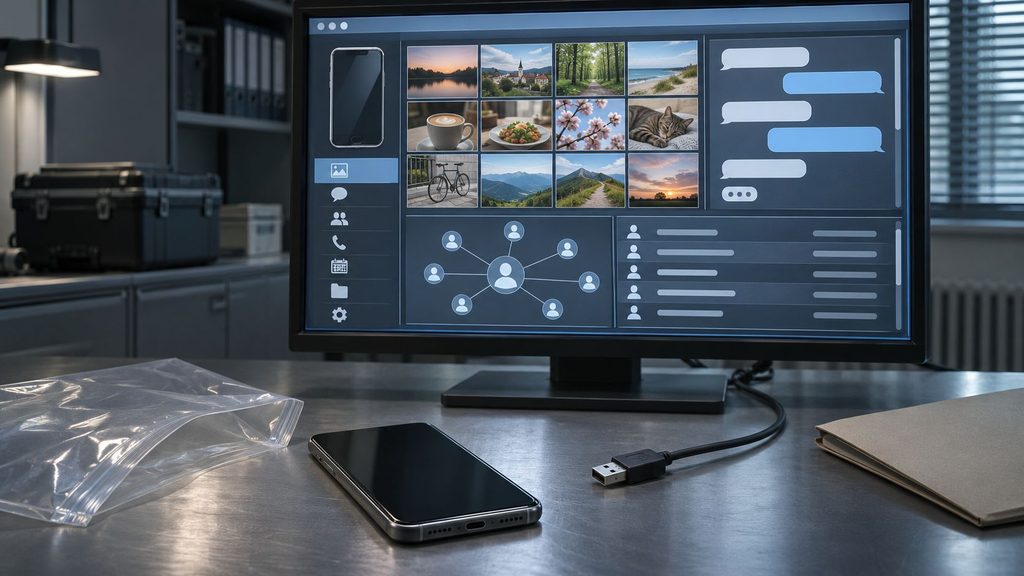

Bamberg: Eleven Months Without a Phone
In September 2023, Hendrik Torner was working on a story about climate protests in Bamberg. He wrote for a trade union newspaper – a publication without its own legal department. Protesters and plainclothes officers were gathered in the square, the mood shifted, and Torner used his phone to record what was being said. It was a voice memo on his own device.
The police took the device from him and opened an investigation on suspicion that he had violated the confidentiality of the spoken word. They kept the phone for more than eleven months.
What happened to the device during that time was reconstructed by journalist Giacomo Zandonini for the British organization Statewatch and published on November 9, 2026. According to Torner’s attorney, Gül Pınar, and an analysis by IT specialists at Reporters Without Borders, investigators used UFED, a tool made by the Israeli company Cellebrite, to access messages across multiple platforms – from Signal and Instagram to Telegram. They also captured newsletter subscriptions, group memberships, photographs, and communications with family members and sources.
In June 2025, the Bamberg Regional Court ruled that the seizure and substantive analysis were unlawful insofar as they extended beyond the first three months. The reason was simple: Section 201 of the German Criminal Code is an offense prosecuted only upon application, and no criminal complaint had been filed. On July 29, 2025, Torner and the Society for Civil Rights filed a constitutional complaint alleging violations of freedom of the press, freedom of expression, and privacy. The case remains open. The case remains open.
His lawyers assume that the data remain stored in a local police system. Upper Franconia Police told Statewatch that digital forensics frequently requires the acquisition of entire storage media and that proportionality guides police action.
The device was returned. The copy remained.
According to Statewatch, Torner is far from the only European journalist whose devices have been accessed using Cellebrite systems. What is striking about his case is not its exceptional nature but its ordinariness: a local journalist, an allegation at the lower end of the criminal code, no charges in the end – and, in between, the complete extraction of his digital life.
The case is one of several documented by Statewatch in a five-part investigative series. Two parts have been published; three more are to follow. Yet the German strand of the story appears only at the margins of this series – and it is the harshest. In Germany, a federal court ruled the practice of mass mobile-phone analysis unlawful, and eleven months later lawmakers passed legislation that moved the review to a point after the copy had already been made.
What a Full Extraction Reveals
Cellebrite was founded in 1999, is based in Petah Tikva near Tel Aviv, and has been listed on Nasdaq since August 2021. In its corporate materials, the company reports approximately 5,300 law-enforcement customers in about 100 countries in 2025. Its most sought-after products are UFED and Inseyets, alongside Physical Analyzer, Digital Collector, Inspector, and Premium. It has European subsidiaries in the United Kingdom, Germany, and France.
Business is growing. According to the company, annual revenue rose from $246.2 million in 2021 to $475.7 million in 2025. On November 12, 2026, Cellebrite reported third-quarter revenue of $149 million, 18 percent above the same quarter a year earlier; annual recurring revenue stood at $528.5 million, an increase of 20 percent. Growth in Europe, the Middle East, and Africa was 22 percent. That growth is the commercial reflection of what this article describes.
Technically, the process is unspectacular – and that is precisely what makes it so effective. The tools unlock mobile phones and computers by exploiting software vulnerabilities and then extract the contents of the device, often without a passcode. Deleted data and location histories are extracted as well. The case files reviewed by Statewatch show judicial orders covering WhatsApp chats, files, videos, photographs, connection records, and Google searches – in other words, the entire contents of a device, sorted by category.
It is important to distinguish this technology from another type of product with which it is regularly confused. Cellebrite’s extraction tools are not Pegasus-style spyware. They do not infect a phone remotely, they do not intercept communications in progress, and they require physical access to the device. The company itself has publicly stated that it is in no way affiliated with the NSO Group. Blurring that distinction makes every criticism of the tool vulnerable to challenge.
The decisive point lies elsewhere, and it is a feature of the method, not a misuse. A full extraction cannot be tailored to the alleged offense. Anyone seeking to determine whether a person recorded a conversation without authorization obtains, through the same operation, chats with a spouse, photographs of the children, years of search queries, and informants’ telephone numbers. The device yields everything or nothing.
Ruairi Nolan of Amnesty International reduced the point to a single sentence in comments to Statewatch. Cellebrite, he said, “is not a benign tool.”
The Standard: Luxembourg and Leipzig
Europe has responded to this characteristic in law – twice within twenty months.
On October 4, 2024, the Grand Chamber of the European Court of Justice issued its judgment in Case C-548/21, Bezirkshauptmannschaft Landeck. The underlying case appeared unremarkable: During a drug investigation in Austria, a package containing 85 grams – about 3 ounces – of cannabis was discovered. Police seized the suspect’s mobile phone; several officers tried to unlock it and failed.
The Court first clarified that EU law applies not only to successful access but also to an attempted access. It then addressed the substance: Police access to personal data stored on a mobile phone may constitute a serious or even particularly serious interference with fundamental rights. Such access need not be confined to the fight against serious crime – the Court expressly rejected that limitation.
It did, however, impose three conditions. National lawmakers must define the factors to be considered, such as the nature or categories of the offenses concerned. Except in duly justified urgent cases, access requires prior authorization by a court or an independent body. And the person concerned must be informed of the grounds on which access was authorized as soon as doing so will no longer jeopardize the investigation.
The rationale for these requirements lies in the nature of the object itself. A mobile phone, the Court noted, permits very precise conclusions to be drawn about the private life of the person concerned. It is therefore not enough for a measure to pursue a legitimate objective; it must be weighed in the individual case, and that assessment must be made by someone who is not conducting the investigation.
That is the European standard. Twenty months earlier, a German federal court had ended a practice in a different area of law that was plainly incompatible with this standard.
On February 16, 2023, the Federal Administrative Court in Leipzig dismissed the Federal Office for Migration and Refugees’ direct appeal against a June 2021 judgment by the Berlin Administrative Court. The case number was 1 C 19.21. Supported by the Society for Civil Rights, an Afghan asylum seeker had brought the case after the Federal Office ordered her to surrender her mobile phone and access credentials.
The Federal Administrative Court ruled that the analysis of digital storage devices to establish identity and nationality was permissible only if the purpose could not be achieved by less intrusive means. In the case at hand, the Federal Office could have considered the tazkira and marriage certificate she had submitted and conducted checks against official registers. The demand was therefore disproportionate and unlawful, and the same applied to the analysis of the storage device.
The legal basis for this practice had been introduced in 2017 and had since been applied as a matter of course whenever asylum seekers could not present a passport or substitute identification document. The procedure was always the same: The storage device was read, the data obtained were analyzed by a program and summarized in a report, and that report was then released for use in the asylum proceedings.
The Federal Office itself provided the scale during the hearing: More than 80,000 cases were involved. The agency argued that it sought to keep the intrusion to a minimum. The Society for Civil Rights had challenged the practice for years – first with a complaint to the Federal Commissioner for Data Protection in February 2021 and then through the lawsuit it won before the Berlin Administrative Court in June 2021. After the Leipzig ruling, the legal position appeared settled. Attorney Lea Beckmann said at the time that the Federal Office could not continue its practice in this form.
It continued in a different form.
The Restructuring
The Bundestag passed the Act to Improve Returns on January 18, 2024, and it took effect in February 2024. It expanded the provision of the Residence Act that had formed the basis of the Leipzig ruling.
The legislation was a package, and the analysis of storage devices was only one of several provisions. Pre-deportation detention was extended from ten to 28 days, authorities received broader powers to enter collective accommodations, and the obligation to announce a deportation in advance was abolished. The expansion of data-extraction powers attracted little public attention in that context, which can be explained by the company it kept.
The core of the new provision is a distinction that did not exist under the previous law. The statute now distinguishes between extracting a storage device and analyzing the extracted data – and imposes different requirements on the two steps.
Section 48(3a), sentence 1, of the Residence Act now provides that “the extraction of storage devices, including mobile devices and cloud services,” for the purpose of ensuring that an analysis can be conducted is permissible when necessary to establish identity and nationality and to determine and pursue a possibility of removal because the person concerned possesses no valid passport, substitute passport, or other suitable proof of identity. Sentence 2 requires that person to provide the necessary access credentials.
Something is missing from this provision, and that omission is the real development. There is no subsidiarity clause. There is no assessment of less intrusive means. There is no balancing of interests in the individual case. If a person has no valid passport, the device is extracted.
Only in the following subsection does the standard required by Leipzig reappear. Section 48(3b), sentence 1, permits analysis of the extracted data only insofar as it is necessary for the stated purposes and “the purpose of the measure cannot be achieved by less intrusive means.”
The sequence is decisive. The proportionality review that the Federal Administrative Court had placed before the intrusion now comes after it. By the time officials examine whether access to a person’s private life was necessary, a complete copy of that private life already exists in a government system.
The refugee organization Pro Asyl identified the consequence early: No proportionality review is required for extraction; such a review exists only at the second stage. The Federal Office is therefore legally instructed to collect data on a mass scale even when it does not need them – or is not permitted to analyze them because less intrusive means are available.
The Society for Civil Rights, which secured the 2023 judgment, describes the development for what it is. Lawmakers are circumventing a Federal Administrative Court judgment that the organization obtained.
This structure rests on a prior duty to cooperate that supports everything that follows. Under Section 48(3), anyone without a valid passport must present and surrender all documents, other records, and storage devices that may be relevant to establishing identity, nationality, and a possibility of removal. If the person does not comply and there are factual grounds to believe that such items are in their possession, the person, their belongings, and their home may be searched. The person must tolerate the measure.
The structure was described openly at the Bundestag Committee on Internal Affairs hearing on December 11, 2023. In his written statement, one expert – a judge at the Higher Administrative Court of Baden-Württemberg – recorded that extraction would now always be permissible, independently of the previous subsidiarity clause, whenever necessary for the stated purposes. At the same hearing, representatives of practitioners expressly welcomed the extension to cloud services such as Google Drive, OneDrive, and iCloud.
The reach of the first step is therefore no longer confined to the device. Anyone extracting a smartphone will generally also extract the cloud storage connected to it – and that storage is not located in Germany.
The statute includes protection for the core sphere of private life at this point, and it merits close reading. If there are factual grounds to believe that analysis of a storage device would yield solely information from the core sphere of private life, the measure is impermissible. Such information may not be used; records of it must be deleted immediately; and both its acquisition and deletion must be documented in the file.
The word that matters is “solely.” An analysis of a smartphone never produces only intimate information. It always produces telephone area codes, language settings, travel movements, and photographs of documents as well. The clause therefore applies to a situation that virtually never occurs in practice. And under the wording of the statute, the deletion is documented – but no one verifies it.
Qualification to Hold Judicial Office
That leaves the question of who decides whether the data may be analyzed. The statute answers it in a single sentence, and that sentence is the core of the entire matter.
Section 48(3b), sentence 6, provides that storage devices may “be analyzed only by an official qualified to hold judicial office.”
An official. In other words, an employee of the same authority that previously extracted the device, someone who has passed Germany’s second state law examination. Not a judge. Not an outside body. No requirement to file an application, no duty to provide reasons to a third party, no submission of the file, and no avenue to appeal that official’s decision.
In Landeck, the European Court of Justice requires prior authorization by a court or an independent body. Germany has substituted the professional qualification that a judge possesses for the institution itself – without the independence that makes a judge a judge. Judicial authorization has been replaced by a state examination.
This requires a degree of legal candor that is usually absent from the debate. The Landeck judgment concerns Directive 2016/680, which governs data protection in criminal justice and law enforcement. Analysis of storage devices under Section 48 of the Residence Act is an administrative measure under migration law and is subject to a different regulatory framework. The contradiction between the Luxembourg standard and the German provision is normatively compelling, but no court has ruled on it. Any claim to the contrary overstates the case.
There are, moreover, legal scholars who consider the expansion substantively appropriate. At the hearing, Kay Hailbronner of the University of Konstanz argued that expanding the options for extraction and analysis was a proper step toward restoring consistency between residence law and the actual circumstances. The expert from the Higher Administrative Court of Baden-Württemberg likewise considered the expansion sensible because modern smartphones have seamless cloud integration that is not always apparent even to the user. These are serious positions, and they concern the scope of the power. They do not address who controls its exercise.
The contradiction could, however, be adjudicated. The Society for Civil Rights considers the powers in Section 48(3), (3a), and (3b) unconstitutional and is challenging them in a lawsuit filed in December 2024 with cooperating attorney Matthias Lehnert and an affected individual before the Stuttgart Administrative Court. Its reasoning begins with the fundamental right to the integrity and confidentiality of information technology systems and argues that the provision fails the constitutional test at the level of an abstract balancing between the state’s interest in facilitating a deportation and that fundamental right. The organization achieved a partial victory in the accompanying preliminary proceeding: For the time being, the authority will not unlock and extract the phone.
Who Operates the Device
Now to the question most thoroughly overlooked in the public debate. Who actually performs the extraction?
There are two tracks in Germany. They are regularly confused, even though they are governed by different laws and offer very different levels of protection.
The first track is migration law. Responsibility lies with the Federal Office for Migration and Refugees and the immigration authorities; under Section 71(4) of the Residence Act, the state police enforcement authorities are also responsible for analyzing storage devices. In Bavaria, the process operates as an internal service. Two inquiries submitted on July 14, 2022, by Green state lawmakers Benjamin Adjei and Gülseren Demirel revealed that the responsible technical unit uses Cellebrite technology purchased by the Bavarian State Office for Asylum and Returns. Within roughly four months, the unit received 116 requests for such searches; 92 had been processed by the time of the response.
Requests. That means other offices commission the analysis from an authority that keeps the device for this purpose.
At the Federal Office itself, the technical component has been outsourced. In response to a written question from Green Bundestag member Konstantin von Notz, the federal government stated that the Federal Office for Migration and Refugees works exclusively with its contractor Atos to extract data from mobile phones.
The allocation of roles is therefore precisely the reverse of the depth of the intrusion. The step without a proportionality review – the extraction – is the one assigned to a private contractor. The step involving review is performed within the agency and assigned to an official qualified to hold judicial office.
At least five other German states have acquired their own software for deportation authorities, including North Rhine-Westphalia; in the vast majority of cases, the vendor is Cellebrite. Lower Saxony confirmed in response to an inquiry that the software was Cellebrite and that it was also used by police departments in the state. The ministry declined to disclose the cost, citing “confidential contract negotiations.”
That last sentence leads to the second track. The same software, the same licenses, a different law.
The second track is criminal procedure, the world of Sections 94 et seq. of the German Code of Criminal Procedure. The Torner case belongs here. The other cases in the Statewatch investigation – the activists in Turin, the journalists in Belfast – fall under the procedural rules of Italy and the United Kingdom, with the same tool but their own levels of protection. In response to von Notz’s question, the federal government named seven manufacturers whose tools are used by German authorities: Cellebrite, MSAB, Elcomsoft, Oxygen Forensic, X-Ways, Access Data, and Magnet Forensics. For the customs administration, it specifically named MSAB and Cellebrite. No breakdown by individual product was provided.
Two of those seven names deserve a footnote to which Part 2 will return. Elcomsoft and Oxygen Forensic are Russian developments.
The Federal Police have confirmed to journalists that they use specialized forensic tools made by Cellebrite, while refusing to provide further information on police methods and tools on general policy and investigative-tactical grounds. The Bavarian State Criminal Police Office confirmed that it is a customer of Cellebrite GmbH. The North Rhine-Westphalia State Criminal Police Office referred to a wide range of tools for securing IT data in the IT investigation-support units of district police authorities.

Then there is a document in which the federal government volunteered greater detail than it has ever provided in response to inquiries. In a supplementary government response on artificial intelligence systems used by federal agencies, Bundestag Printed Paper 20/8495, the Federal Police are listed with three items: Cellebrite Physical Analyzer, at a cost of €600,000; Cellebrite Inspector, in use since 2018, at €18,400; and Magnet Forensics AXIOM, also in use since 2018, at €286,000. Stated purpose: securing and preparing data for computer and mobile-device forensics. Methods used: neural networks, supervised machine learning, and text recognition. Function: classifying images into categories such as drugs, weapons, and documents.
This brings the issue back to the qualification to hold judicial office. The safeguard in the Residence Act is tied to a person. It regulates who looks at the material last. It does not regulate what decides what that person is shown. A law that assigns the analysis to a fully qualified lawyer says nothing about software that pre-sorts, pre-filters, and assigns material to suspicion categories before that lawyer is involved at all. The review takes place – but it takes place on material that a machine has already curated.
As for scale: For the period from January 1, 2023, through July 1, 2026, Statewatch identified more than 150 public contracts with Cellebrite, worth a combined total of approximately €69.4 million. Of these, 114 contracts were in 17 EU member states, one was in Norway, and 39 were in the United Kingdom, the largest European customer. The most expensive individual contract was signed by London’s Metropolitan Police: £7.9 million over three years beginning in 2023.
The investigation found 14 contracts in Germany but was able to confirm spending for only seven. The largest was a three-year contract worth €4.2 million, signed in April 2026 by the Saxony-Anhalt police and tendered for digital-investigation hardware and software providing access, extraction, decoding, review, and automation functions.
The €69.4 million figure is a floor, not a total. Statewatch itself notes that actual spending is likely higher because of transparency limitations. Moldova and Switzerland are entirely absent because no financial data could be obtained.
What Happens to the Copy
That brings us to the question that stands at the end of every one of these cases – and the one that matters in practice. What happens to the copy?
On paper, the answer is clear. The Residence Act requires extracted data to be deleted immediately once they are no longer necessary to establish identity and nationality or to determine a possibility of removal. Extraction, analysis, and deletion must be documented.
How robust such a deletion requirement proves in practice can be tested against a case in which deletion was required not only by statute but by a court.
On June 18, 1994, two masked gunmen from the Ulster Volunteer Force entered the Heights Bar in Loughinisland, County Down, Northern Ireland, during the World Cup match between Ireland and Italy. They opened fire on patrons who were sitting with their backs to the door, watching the television. Six men were killed and five others wounded. No one was arrested. In 2016, a report by the Police Ombudsman for Northern Ireland found collusion and concluded that the investigation had been undermined by the desire to protect informants. In 2017, the documentary No Stone Unturned, directed by Alex Gibney, named the principal suspects.
In 2018, the two journalists behind the film, Barry McCaffrey and Trevor Birney, were arrested; homes and offices were searched, and devices were seized. The High Court ruled the warrants unlawful because they interfered with the protection of journalistic sources. The investigation was dropped. In 2020, a settlement required the police to delete the data.
Only in 2025 did an independent inquiry, the McCullough Review, confirm that police had used Cellebrite on material from McCaffrey’s seized equipment. The review called the examination unjustifiable because the seizure itself had been unlawful. The same review found a copy of the extracted data still stored on a Police Cyber Crime Centre system – five years after the settlement requiring its deletion. Amnesty International described the related court ruling as a landmark decision for press freedom.
The Police Service of Northern Ireland stated that it accepted the recommendations, that the data had been isolated and later deleted in accordance with the undertaking to the High Court, and that it could “neither confirm nor deny” the use of Cellebrite licenses.
The second question is where such copies are stored. Here the manufacturer offers an answer of its own, and it is remarkable. With Guardian, Cellebrite sells a cloud-based digital evidence-management system connected directly to its extraction tools. According to the company’s Guardian Trust information, the data are hosted in the Amazon Web Services cloud, in data centers in North America, the United Kingdom, Ireland, Australia, and Brazil; the US government’s AWS GovCloud environment is available by special request. No separate contractual relationship between the customer and the cloud provider is required: Cellebrite manages the infrastructure, while the authority manages the evidence.
That list includes no data center on the European mainland. Whether any German authority uses Guardian remains an open question – it is an available service, not a documented deployment. The issue merits a freedom-of-information request.
That leaves a third question, and it is the most uncomfortable one. Are the extracted data reliable at all?
In April 2021, Moxie Marlinspike, the developer of the Signal messenger, published an analysis of UFED and Physical Analyzer. His team had obtained a Cellebrite kit and found that the manufacturer had apparently paid little attention to software security: Industry-standard safeguards against exploits were absent. A specially formatted but otherwise unremarkable file in any app on a device under examination could execute code on the Cellebrite computer. According to Marlinspike, that code could alter not only the report currently being generated but also every previous and future Cellebrite report for every device examined in the past or future – and could do so in any way. His team also found outdated FFmpeg libraries from 2012 that were missing more than one hundred subsequent security updates. The findings were widely reported after Signal compromised Cellebrite’s forensic software.
That strikes at the foundation of the business. A forensic tool exists to preserve evidence in a condition fit for use in court. If the tool’s reports can be altered after the fact without detection, that assurance no longer exists. Cellebrite patched some of the vulnerabilities and withdrew full support for iPhone analysis in Physical Analyzer.

The Other Side
At this point, the other side must be heard in full – not as a perfunctory exercise.
Cellebrite told Statewatch that its technology supports millions of lawful investigations every year and assists authorities in cases involving human trafficking, child exploitation, opioid and fentanyl distribution, financial crime and fraud targeting especially vulnerable groups, homicide, and terrorism. The company further states that it revokes licenses when misuse is confirmed and criticizes reporting for focusing on alleged misuse. It did not comment on its European business or the documented individual cases.
Asked by Statewatch about the fundamental-rights implications of purchases made with EU funding, the European Commission pointed to the responsibility of national authorities to comply with fundamental rights and described unlawful access to journalists’ data as unacceptable. That, too, is a position that must be taken seriously: Procuring a tool is distinct from deploying it.
This is not an empty argument. Mobile-device forensics is genuinely central to investigations of child abuse, human trafficking, and organized crime, and the alternative would not be fewer investigations but poorer ones. The European Court of Justice expressly rejected limiting mobile-phone access to serious crime, thereby acknowledging legitimate uses below that threshold. Most documented misuses are misuses by authorities, not by the manufacturer. And in principle, the analysis of a seized device is an overt measure: The affected person knows that the device has been taken. That fundamentally distinguishes it from covert surveillance.
Yet the argument breaks down at precisely that final point, and the Society for Civil Rights has explained why. The analysis of a seized mobile phone, it argues, is “not actually an overt measure,” because the person affected cannot see how the device is being analyzed – whether deleted data are being recovered or links to other data are being established. The documentation is incomplete because it records only data deemed relevant to the investigation. The case file reveals neither the scope of the device analysis nor what additional data were viewed but omitted from the report.
“Overt,” then, means this: The affected person knows that something happened. They do not know what. And they cannot learn it through the proceedings either.
Findings
Four observations underpin the first part of this story.
A full extraction cannot be tailored to the alleged offense. That is not a misuse; it is the method.
The proportionality review that the Federal Administrative Court placed before the intrusion in February 2023 has, since February 2024, come after it. The review occurs once the copy exists.
The body conducting that review is neither a judge nor an independent authority, but an official of the extracting agency who is qualified to hold judicial office. Judicial authorization has been replaced by a professional qualification.
And deletion is mandated by every relevant statute, documented rather than verified – and in the only European case in which an independent review actually checked, the copy was still in the system five years after the court settlement.
One further observation cuts across all four. The same tool from the same manufacturer operates in Germany in two areas of law with very different levels of protection, and in the area with weaker safeguards, the people affected are those with the least ability to defend themselves. This is not legislative imprecision. It is a choice.
In this matter, the sequence is the entire substance. The law did not limit the capability; the capability shaped the law. Eleven months separated the Leipzig judgment from the passage of the legislation that rewrote its effect.
Part 2 examines who ultimately controls this capability – and who exports it with European funding to countries where safeguards are even weaker than they are here.


About the Author
Michael Hollister
is a geopolitical analyst and investigative journalist. He served six years in the German military, including peacekeeping deployments in the Balkans (SFOR, KFOR), followed by 14 years in IT security management. His analysis draws on primary sources to examine European militarization, Western intervention policy, and shifting power dynamics across Asia. A particular focus of his work lies in Southeast Asia, where he investigates strategic dependencies, spheres of influence, and security architectures. Hollister combines operational insider perspective with uncompromising systemic critique – beyond opinion journalism. His work appears on his bilingual website (German/English) www.michael-hollister.com and in investigative outlets across the German-speaking world and the Anglosphere.
Stay informed without having to work through the daily flood of news – the most important developments and connections summarized for you.

Sources
Investigative Series
Statewatch / Giacomo Zandonini: “Israeli phone cracking tools targeted refugees, activists, journalists in Europe,” November 9, 2026 – https://statewatch.org/news/2026/november/israeli-phone-cracking-tools-targeted-refugees-activists-journalists-in-europe/
Statewatch / Giacomo Zandonini: “EU and UK spent millions on Israeli phone cracking tech despite risks,” November 3, 2026 – https://statewatch.org/news/2026/november/eu-and-uk-spent-millions-on-israeli-phone-cracking-tech-surveillance-despite-risks/
Tech Times: “Cellebrite Phone Extraction: Northern Ireland Police Kept Journalists’ Data Past Court Deletion Deal,” November 10, 2026 – https://www.techtimes.com/articles/330358/20261110/cellebrite-phone-extraction-northern-ireland-police-kept-journalists-data-past-court-deletion-deal.htm
Case Law
European Court of Justice (Grand Chamber), judgment of October 4, 2024, C-548/21, Bezirkshauptmannschaft Landeck, ECLI:EU:C:2024:830 – https://eur-lex.europa.eu/legal-content/DE/TXT/PDF/?uri=CELEX%3A62021CJ0548
Legal Tribune Online on C-548/21 – https://www.lto.de/recht/nachrichten/n/c-54821-eugh-zu-personenbezogenen-daten-handyzugriff-nicht-nur-bei-schwerer-kriminalitaet
Erich Schmidt Verlag, “EuGH zum polizeilichen Zugriff auf Handydaten” – https://www.esv.info/aktuell/eugh-zum-polizeilichen-zugriff-auf-handydaten/id/136661/meldung.html
Federal Administrative Court, judgment of February 16, 2023, 1 C 19.21, as presented by asyl.net – https://www.asyl.net/view/bverwg-entscheidet-zur-handydatenauswertung-von-personen-im-asylverfahren
Legal Tribune Online on Federal Administrative Court 1 C 19.21 – https://www.lto.de/recht/nachrichten/n/bverwg-1c19-21-auswertung-datentraeger-mobiltelefon-bamf-identitaetsfeststellung-rechtswidrig
netzpolitik.org: “BAMF: Durchsuchung von Handy war rechtswidrig” – https://netzpolitik.org/2023/bamf-durchsuchung-von-handy-war-rechtswidrig/
Dr. Datenschutz: “Asylbehörde BAMF darf Handys nicht einfach durchsuchen” – https://www.dr-datenschutz.de/asylbehoerde-bamf-darf-handys-nicht-einfach-durchsuchen/
Legislation and Legislative Process
Section 48 of the Residence Act, identification-related obligations, current version – https://www.gesetze-im-internet.de/aufenthg_2004/__48.html
German Bundestag, Printed Paper 20/9463 of November 24, 2023, draft Act to Improve Returns – https://dserver.bundestag.de/btd/20/094/2009463.pdf
German Bundestag, Committee on Internal Affairs and Community, statement by Dr. Philipp Wittmann (Higher Administrative Court of Baden-Württemberg), Committee Printed Paper 20-4-348-H – https://www.bundestag.de/resource/blob/982436/9b5572112087fc063bb3eb0b0068068b/20-4-348-H.pdf
German Bundestag, minutes of the Committee on Internal Affairs hearing of December 11, 2023, Minutes No. 20/64 – https://www.bundestag.de/resource/blob/988230/88575d57a8134d43d386d8338e1ba6d5/Protokoll-11-12-2023-11-30-Uhr.pdf
German Bundestag, text archive on passage of the Act to Improve Returns – https://www.bundestag.de/dokumente/textarchiv/2024/kw03-de-rueckfuehrung-986284
Pro Asyl: “Das Gegenteil von Verbesserungen: Das neue Rückführungsgesetz verschlimmert die Lage” – https://www.proasyl.de/news/das-gegenteil-von-verbesserungen-das-neue-rueckfuehrungsgesetz-verschlimmert-die-lage/
Society for Civil Rights Proceedings
Society for Civil Rights, case page “BAMF-Handydatenauswertungen” – https://freiheitsrechte.org/themen/freiheit-im-digitalen-zeitalter/refugee-daten
Society for Civil Rights, case page “Gläserne Geflüchtete” – https://freiheitsrechte.org/themen/freiheit-im-digitalen-zeitalter/handydaten
Society for Civil Rights, complaint of December 20, 2024, concerning storage-device analysis under Section 48 of the Residence Act – https://freiheitsrechte.org/uploads/documents/Freiheit-im-Digitalen/2024-12-20-Klage-Handydatenauswertung-48-AufenthG.pdf
Society for Civil Rights, grounds for complaint of June 19, 2025, concerning mobile-phone analysis under the Code of Criminal Procedure – https://freiheitsrechte.org/uploads/documents/2025-06-19-Beschwerdebegruendung_Handydatenauswertung_StPO_anonymisiert_Fallseite.pdf
German Government Practice
German Bundestag, Printed Paper 20/8495, supplementary federal government response on AI systems in federal agencies – https://dserver.bundestag.de/btd/20/084/2008495.pdf
netzpolitik.org: “Digitale Forensik: Mit diesen sieben Programmen liest die Polizei Smartphone-Daten aus” – https://netzpolitik.org/2018/digitale-forensik-mit-diesen-sieben-programmen-liest-die-polizei-smartphone-daten-aus/
netzpolitik.org: “Cellebrite: Bayerische Behörde knackt Handys von Geduldeten” – https://netzpolitik.org/2022/cellebrite-bayerische-behoerde-knackt-handys-von-geduldeten/
“Bundesländer kauften für viel Geld Software, damit Abschiebebehörden Handys von Geflüchteten knacken können” – https://weltoffen-bonn.de/forum/bundeslaender-kauften-fuer-viel-geld-software-damit-abschiebebehoerden-handys-von
VICE: “Wie deutsche Ermittler beschlagnahmte Smartphones knacken” – https://www.vice.com/de/article/wie-deutsche-ermittler-beschlagnahmte-smartphones-knacken/
Company, Products, and Storage
Cellebrite DI Ltd., Form 6-K, third-quarter 2026 results – https://www.sec.gov/Archives/edgar/data/0001854587/000121390026118368/ea031199501ex99-1.htm
Cellebrite, third-quarter 2026 press release, November 12, 2026 – https://www.prnewswire.com/news-releases/cellebrite-reports-third-quarter-2026-results-302937130.html
Cellebrite, “Cellebrite Provides Facts About its Business and Solutions” – https://cellebrite.com/en/cellebrite-facts/
Cellebrite, “Guardian Trust” (storage locations, AWS) – https://cellebrite.com/en/guardian-trust/
Cellebrite, Guardian Collaborate Free FAQ, November 2024 – https://media.cellebrite.com/wp-content/uploads/2024/10/Cellebrite-Guardian-Collaborate-Free-FAQ_LTR.pdf
Integrity of Extraction Reports
Engadget: “Signal hacked Cellebrite’s phone hacking software used by law enforcement” – https://www.engadget.com/signal-hacked-cellebrite-i-phone-hacking-device-092006603.html
BankInfoSecurity: “Signal Founder Says Cellebrite’s Forensics Tools Flawed” – https://www.bankinfosecurity.com/blogs/cellebrite-mobile-forensics-tool-maker-just-got-pwned-p-3020
Stanford Center for Internet and Society: “I Have a Lot to Say About Signal’s Cellebrite Hack” – https://cyberlaw.stanford.edu/blog/2021/05/i-have-lot-say-about-signals-cellebrite-hack
The Wire: “How Does the Israeli Phone-Unlocking Spyware Amit Shah Signed Off on Work?,” November 10, 2026 – https://m.thewire.in/article/tech/how-does-the-phone-unlocking-tool-amit-shah-signed-off-on-work
Loughinisland and the McCaffrey/Birney Case
Public Interest Litigation Centre: “Press freedom and the British justice system” – https://pilc.org.uk/post/press-freedom-and-the-british-justice-system
CBC: “Filmmakers arrested after probing Northern Ireland killings say they were targeted” – https://amp.cbc.ca/lite/story/1.4943660
The Irish Times: “Why were two journalists investigating Loughinisland arrested?” – https://www.irishtimes.com/news/politics/why-were-two-journalists-investigating-loughinisland-arrested-1.3689852
Press Gazette: “Police drop investigation into Belfast investigative journalists” – https://pressgazette.co.uk/police-drop-investigation-into-belfast-investigative-journalists/
Amnesty International UK: “Northern Ireland: Landmark decision for press freedom as court rules against police” – https://www.amnesty.org.uk/press-releases/northern-ireland-landmark-decision-press-freedom-court-rules-against-police
The Detail: “PSNI admits it should have told Loughinisland journalists about review” – https://thedetail.tv/articles/psni-admits-it-should-have-told-loughinisland-journalists-about-review-which-was-highly-critical-of-their-arrests
Second Tier of Supporting Evidence
Moxie Marlinspike: “Exploiting vulnerabilities in Cellebrite UFED and Physical Analyzer from an app’s perspective,” Signal Blog, April 21, 2021. Original publication; supported in the article through the secondary sources listed above. Location: signal.org/blog, search term “Cellebrite vulnerabilities.”
© Michael Hollister – Redistribution expressly encouraged.
I am pleased when my articles, commentaries, and analyses attract interest and are shared. Reproduction, distribution, and publication of my texts, in whole or in part, on other websites, blogs, or in other publications is expressly permitted and encouraged. No prior permission is required.
<u>The sole requirement:</u> Michael Hollister must be clearly and prominently identified by name as the author. In addition, a clearly visible, clickable link to the original website, www.michael-hollister.com, must be included.
Reuse without author attribution and a link is not permitted.
If this work helps you understand what lies behind the headlines, consider supporting it. Membership starts at $5 per month, includes access to all supporter-only analyses, and can be cancelled at any time.