
by Michael Hollister
Exclusive published at Michael Hollister on June 14, 2026
2.081 words * about 9 minutes readingtime
The complete analysis continue reading here:
Israel: Killing as a Product

This analysis is part of Hollister’s Geopolitics.
New deep-dive analyses weekly – subscribe for free.

In Gaza, It Kills.
My grandmother had a saying for people who spoke highly of themselves: Don’t listen to what they say – watch what they do. She meant neighbors and tradespeople. It applies just as well to the world’s largest technology companies.
In April 2025, the CEO of US data company Palantir was asked whether his firm had helped kill Palestinians in Gaza. He answered in three words: “mostly terrorists, that’s true.” No denial, no regret. A confirmation delivered with a shrug.
Behind that shrug lies a system. On June 30, 2025, UN Special Rapporteur Francesca Albanese presented a report that places neither states nor generals at its center, but the private sector. Its finding: corporations did not merely supply the genocide determined by a UN body – they technically enabled its killing machine. And they are the hardest to hold accountable. Four fractures show how this fits together. None of them is speculation. Each one is documented – in contracts, in records, in the words of those involved. It is the story of how supplying a war became co-building a killing machine, and why the builders sleep soundly.
Fracture One: The Killing Runs on a List
What sets this war apart from earlier ones is not the bombs – it is how targets are generated. In the past, that took weeks: reconnaissance, cross-referencing, human judgment. Today it is software. This was not exposed by Albanese but by Israeli journalist Yuval Abraham, drawing on six Israeli intelligence officers who participated in the operations and described themselves as shaken by what they had been part of. The investigation was published in April 2024, jointly with the British Guardian. The source is not the adversary – it is the Israeli military itself.
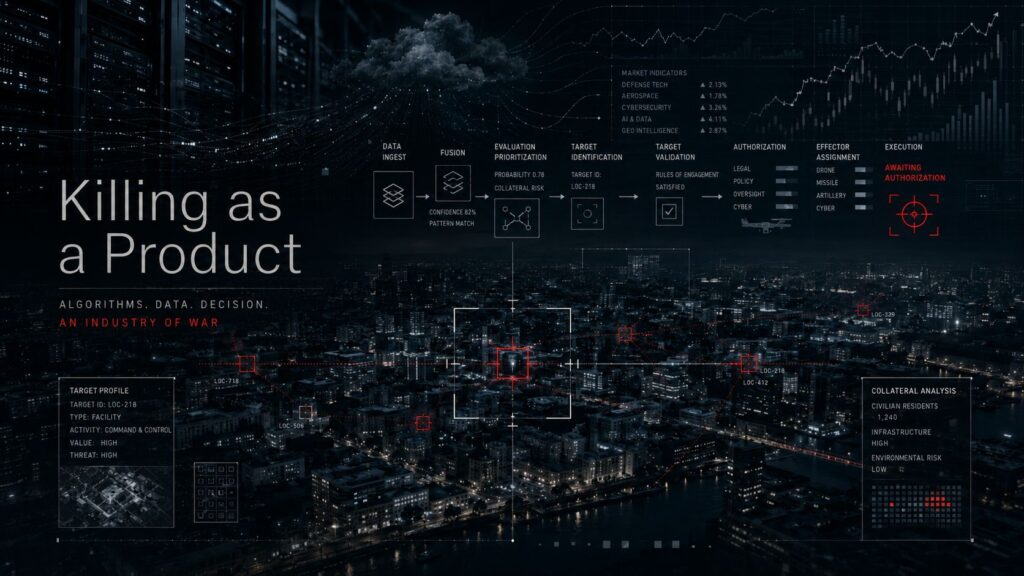
Three programs form the chain. “Lavender” is an artificial intelligence that screens virtually the entire population of Gaza and scores each individual on the likelihood of being a combatant. From these scores, the system generated a kill list of up to 37,000 people. Human review shrank to roughly twenty seconds per name – just enough to confirm the target was male. A human as a rubber stamp, not a check.
“Where’s Daddy?” tracked these men and triggered an alert the moment they entered their homes. The name says it all: the system was designed to catch the father at home, surrounded by his family. “The Gospel” simultaneously marked the buildings. The result was an assembly-line logic – Lavender supplies the person, Where’s Daddy the moment inside the home, Gospel the address. What this chain produces is illustrated by a single comparison: where the Israeli General Staff, by its own account, developed around 50 targets per year before the AI era, the machinery now generates up to 100 per day. That is not faster craftsmanship – it is the industrialization of killing. And because Where’s Daddy makes the family home the preferred strike location, it also shifts who dies: not the fighter on the battlefield, but the man at the kitchen table, with his wife and children beside him. The pattern of wiped-out families that defines Gaza’s casualty figures is not an accident of warfare – it is its design principle.
The number that explains everything is not 37,000. It is the clearance rule: for each identified low-ranking fighter, 15 to 20 civilian deaths were deemed acceptable. Post-strike verification of whether the target or merely his family had been killed was discontinued – it cost time. Human Rights Watch urges precision: the machine does not act on its own; human decisions are what count. That is true – and that is precisely the finding. A machine proposes, a human approves in twenty seconds, a house disappears.
The Israeli military calls this account groundless; the systems, it says, merely help analysts review existing information. UN Secretary-General António Guterres warned that decisions over life and death must not be left to the cold calculus of algorithms. It was humans who ordered the strikes on residential buildings; the machine did not replace that decision – it set a pace no command staff could ever match on its own.
Fracture Two: The Foundation Comes from Silicon Valley
Precision is required here – not to let the corporations off the hook, but to pin them down more accurately. Lavender, Gospel, and Where’s Daddy belong to the military. What the corporations supply is the layer beneath: the foundation without which these volumes of data could not be processed at all.
That foundation is not new. US company IBM has operated the central database of Israel’s population authority since 2019, capturing biometric data on Palestinians. It is the data ocean that a system like Lavender needs to exist – the administration of occupation became an input variable for killing.
The leap into the present is marked by the cloud. In 2021, Israel awarded Project Nimbus, a contract worth 1.2 billion dollars, to Google and Amazon, funded largely from the defense budget. When the internal military cloud threatened to buckle under the data load in October 2023, Microsoft’s Azure platform stepped in and provided computing and AI capacity. An Israeli colonel publicly described cloud technology as a weapon in the truest sense. Palantir, according to the report, supplied its platform for automated real-time targeting decisions – software that condenses scattered data streams into a single operational picture and proposes actions. In the middle of the war, in January 2024, the company announced a new strategic partnership with Israel. The function of such platforms makes their contribution concrete: they merge reconnaissance imagery, location data, and communications into a single searchable picture and derive proposed actions from it. What once took days of analyst work is compressed into minutes. This shifts the threshold of decision – the human increasingly confirms what the machine proposes, rather than independently investigating. And there is a market for this: technology accounts for the bulk of Israeli exports, and the war is not a drag on that industry – it is a showroom.
The companies push back. Google and Amazon state that Nimbus covers civilian services, not weapons deployments. Microsoft reported in May 2025 that there was no evidence its technology had harmed people in Gaza.
This is where my grandmother’s saying applies. Nobody claims Silicon Valley wrote the kill list – the military did. But the list runs on the cloud, the data centers, and the decision platforms these firms supply, maintain, and upgrade. The occupied territory became a testing ground whose products are subsequently marketed worldwide as battle-proven. Whoever supplies the current on which killing runs is not merely selling storage space.
Fracture Three: The Trail Leads to Munich, Heidelberg, and Paris
Anyone who regards this as a purely American problem is mistaken – and for German readers, it is about to become uncomfortable. The report also names European and German actors.
The Technical University of Munich draws funding from the EU’s Horizon Europe program running into the hundreds of millions. Among its projects are cooperations with Israeli military and technology companies: with Israel Aerospace Industries, the manufacturer of drones deployed in Gaza, and with IBM Israel, which operates the discriminatory population database. It is the same entanglement of research, data, and armaments as in Silicon Valley – only with a Bavarian coat of arms. For German readers, the implication is concrete: the country’s own cutting-edge research and a budget co-financed through EU contributions are tied to an apparatus whose tools are in use in Gaza – and whose products subsequently flow back into global markets as battle-tested, including into Europe.
At the overarching level, the European Commission has transferred more than 2.12 billion euros to Israeli institutions since 2014, including to the Ministry of Defense. That is European taxpayers’ money, channeled into a research landscape whose products draw on Palestinian data. And it does not stop at research: German building materials company Heidelberg Materials quarries stone on expropriated land in the West Bank through a subsidiary, and major banks including BNP Paribas and Barclays underwrote Israeli war bonds.
The standard defense applies here too: all civilian, all legal, all dual-use. But the claimed dual-use argument does not exonerate when the infrastructure demonstrably serves the war – and precisely this type of technology falls under export controls that treat it as anything but harmless. The accountability gap is therefore not some distant problem one can comfortably point toward Washington. It reaches to Munich, Heidelberg, and Paris.
Fracture Four: It Is the Investigator Who Gets Punished, Not the Corporation
The sharpest fracture is not that corporations profited. It is that they get away with it – even though the legal instruments to hold them accountable have long existed.
After the Second World War, the Western Allied powers at Nuremberg convicted not only generals and ministers but industrialists. In the trial against the chemical conglomerate I.G. Farben, senior executives were found guilty of plunder in occupied territories and the use of slave labor. The principle established then has held since: a board member cannot hide behind the company when that company participates in mass atrocities. The UN Guiding Principles on Business and Human Rights spell it out for the present – with the sentence corporations prefer not to hear: due diligence alone does not release anyone from liability. Whoever continues to supply in the face of recognizable legal violations cannot claim ignorance. And yet nothing happens. The reason is a construct as old as the joint-stock company itself: the corporate veil separates the enterprise from the consequences of its actions, layered subsidiaries obscure attribution, and the home state extends a protective hand. This is compounded by the fact that the underlying crime is now firmly established in law: the International Criminal Court has requested arrest warrants against the Israeli leadership, and a UN commission of inquiry has determined that the genocide threshold has been met. The clearer the act, the harder it becomes to claim, as a supplier, that you knew nothing.
The legal path exists. What is missing is the will to take it. Because the apparatus that would need to prosecute – national judiciaries, the Security Council – is largely the same apparatus that acts as home state and protector of the corporations in question. How determined that protection can be was demonstrated almost immediately after the report appeared.
In July 2025, the United States imposed sanctions – not against any of the named US corporations, but against Albanese herself. Secretary of State Marco Rubio described her work as “economic warfare” against the United States and its allies, explicitly citing her pursuit of proceedings against American and Israeli companies and their executives. Consider the constellation: a UN Special Rapporteur is sanctioned by a permanent member of the Security Council for naming corporations. The state defends the companies by going after the investigator. The machine was not stopped. The hand that pointed at it was struck.
Assessment
Four fractures, one pattern. Software generates the kill list. The cloud of international corporations carries it. German and European institutions profit from it. And the law that could address all of this is not applied – it is turned against those who invoke it.
That wars are supplied is nothing new – wars have always been supplied, with steel, fuel, and ammunition. What is new is twofold. First, the killing itself became a product: scalable, automated, delivered across countless supply chains. Second, the private layer that makes this possible is precisely the hardest to reach – not because a law is missing, but because the corporation has been built for two hundred years to separate responsibility from power. That is exactly why a finding about corporations cuts differently than one about states or generals: it runs into a legal form invented to shield against precisely this question – and into a reflex that prefers to punish the messenger rather than the client.
The genocide will not ultimately be judged by whether corporate involvement was documented. It was – down to the contract and the share package. It will be judged by the fact that the tools of accountability were ready and nobody picked them up.
My grandmother would not have needed an expert opinion for that. They say it is civilian technology – neutral, harmless, perfectly normal business. Don’t listen to what they say. Watch what they do.
The complete analysis continue reading here:
Israel: Killing as a Product

This analysis is part of Hollister’s Geopolitics.
New deep-dive analyses weekly – subscribe for free.
Michael Hollister
is a geopolitical analyst and investigative journalist. He served six years in the German military, including peacekeeping deployments in the Balkans (SFOR, KFOR), followed by 14 years in IT security management. His analysis draws on primary sources to examine European militarization, Western intervention policy, and shifting power dynamics across Asia. A particular focus of his work lies in Southeast Asia, where he investigates strategic dependencies, spheres of influence, and security architectures. Hollister combines operational insider perspective with uncompromising systemic critique – beyond opinion journalism. His work appears on his bilingual website (German/English) www.michael-hollister.com and in investigative outlets across the German-speaking world and the Anglosphere.
Support my work – become a Member

Sources
- Francesca Albanese, From economy of occupation to economy of genocide (A/HRC/59/23), OHCHR, June 30, 2025 – https://www.ohchr.org/sites/default/files/documents/hrbodies/hrcouncil/sessions-regular/session59/advance-version/a-hrc-59-23-aev.pdf
- Yuval Abraham, “‘Lavender’: The AI machine directing Israel’s bombing spree in Gaza”, +972 Magazine / Local Call, April 02, 2024 – https://www.972mag.com/lavender-ai-israeli-army-gaza/
- “Lavender & Where’s Daddy” – Interview with Yuval Abraham, Democracy Now!, April 05, 2024 – https://www.democracynow.org/2024/4/5/israel_ai
- “Why human agency is still central to Israel’s AI-powered warfare” (with Zach Campbell, HRW), +972 Magazine, April 2024 – https://www.972mag.com/israel-gaza-lavender-ai-human-agency/
- “Gaza: Israeli Military’s Digital Tools Risk Civilian Harm”, Human Rights Watch, September 10, 2024 – https://www.hrw.org/news/2024/09/10/gaza-israeli-militarys-digital-tools-risk-civilian-harm
- Microsoft, “Statement on the Issues Relating to Technology Services in Israel and Gaza”, May 15, 2025 – https://blogs.microsoft.com/on-the-issues/2025/05/15/statement-technology-israel-gaza/
- “Corporate Guilt by Association: Francesca Albanese’s Assault on Global Corporations”, NGO Monitor – https://ngo-monitor.org/reports/francesca-albaneses-assault-on-global-corporations/
- Marco Rubio, “Sanctioning Lawfare that Targets U.S. and Israeli Persons”, US State Department, July 09, 2025 – https://www.state.gov/releases/office-of-the-spokesperson/2025/07/sanctioning-lawfare-that-targets-u-s-and-israeli-persons
- “US sanctions UN expert critical of Israel’s war in Gaza”, Reuters via NBC News, July 10, 2025 – https://www.nbcnews.com/world/middle-east/us-sanctions-un-expert-critical-israel-war-gaza-francesca-albanese-rcna217927
Complete source list and further references in the full analysis article.
© Michael Hollister – All rights reserved. Redistribution, publication or reuse of this text requires express written permission from the author. For licensing inquiries, please contact the author via www.michael-hollister.com.
Newsletter
🇩🇪 Deutsch: Verstehen Sie geopolitische Zusammenhänge durch Primärquellen, historische Parallelen und dokumentierte Machtstrukturen. Monatlich, zweisprachig (DE/EN).
🇬🇧 English: Understand geopolitical contexts through primary sources, historical patterns, and documented power structures. Monthly, bilingual (DE/EN).