
by Michael Hollister
Exclusive published at Michael Hollister on June 14, 2026
4.531 words * 23 minutes readingtime
For a compact entry into the topic: the briefing accompanying this analysis summarizes the four central developments in ten minutes of reading time:
They Call It Civilian Technology. In Gaza, It Kills.

This analysis is published as part of Hollister’s Geopolitics. New deep-dive analyses weekly – subscribe for free.

Who Is Programming the Genocide in Gaza – and Why No One Is Held Accountable
A UN report has documented the means by which killing is carried out in Gaza; a second, who is watching it happen. This text asks about the most uncomfortable level between the two: the companies that not only supplied weapons but encoded the decision over life and death into software – and the mechanism that protects precisely them from any consequence.
“Where’s Daddy?” That is the name of a piece of Israeli military software. Its task is not to track missing fathers. Its task is to notify a targeting officer of the moment a man designated as a target enters his home – so that the bomb falls while the family is assembled.
In April 2025, the CEO of the US data company Palantir was confronted with the charge that his company had helped to kill Palestinians in Gaza. His answer consisted of three words: “mostly terrorists, that’s true.” Not a denial, but a confirmation with a shrug.
Between these two sentences lies the subject of this analysis. On 30 June 2025, the UN Special Rapporteur for the Occupied Palestinian Territories, Francesca Albanese, presented a report that places not states and not generals at its center, but the private sector: defense, technology, and energy companies that after 07 October 2023 did not exit, but stayed – and thereby shifted from profiteers of the occupation to participants in a genocide established by a UN body. Three months before the UN Commission of Inquiry’s genocide finding, Albanese mapped the industrial machinery behind it. From more than 200 submissions received, she developed a database of around 1,000 companies.
The machinery as such is described elsewhere – the F-35s from Lockheed Martin, around 85,000 tons of bombs, the bulldozers from Caterpillar, the energy from Chevron. This text sets in one level deeper and sharpens one question: Why do private corporations, unlike states and commanders, almost always escape accountability even when their involvement is documented? And what makes the technological component of this involvement so novel that it deserves its own chapter?
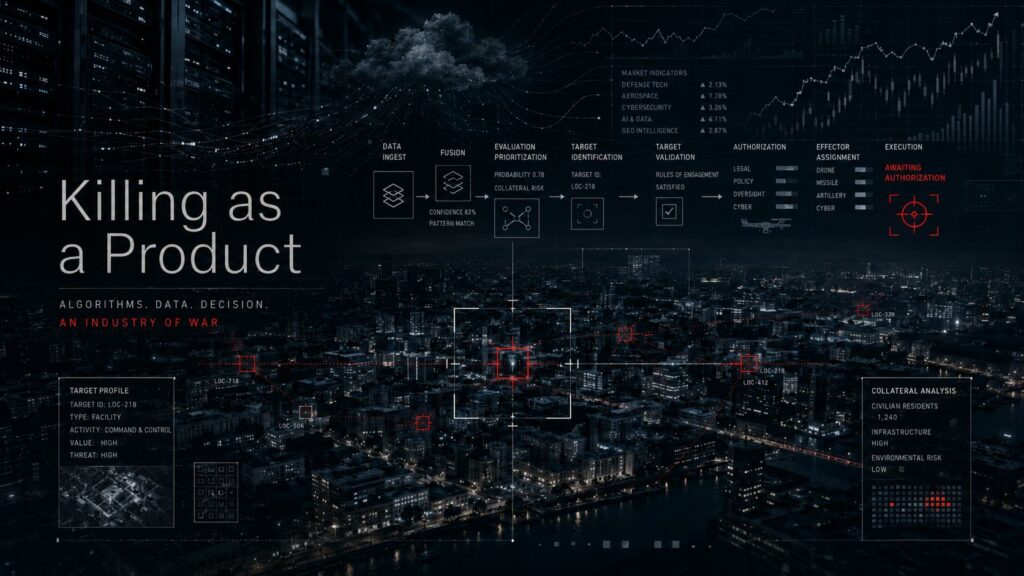
The Algorithmic Killing Chain
The decisive break between this war and earlier ones lies not in the warheads but in the way targets come into being. They no longer arise primarily from months of individual intelligence work, but from software. Three systems of the Israeli military form the chain – uncovered not by Albanese, but by the Israeli journalist Yuval Abraham, who published the investigation in April 2024 for the Israeli outlets +972 and Local Call in partnership with the British Guardian, based on six Israeli intelligence officers with firsthand experience in the Gaza operations.
To make clear what is being discussed, it is worth unpacking the three names. These are not persons and not products of Google or Palantir, but military-owned programs from the environment of intelligence Unit 8200.
Lavender is the who. An artificial intelligence that evaluates mass surveillance data on virtually the entire population of Gaza and scores each individual by the probability of their being a low-ranking fighter of Hamas or Islamic Jihad. From this scoring, the system generated a kill list of up to 37,000 people. Human oversight, Abraham’s sources report, shrank in this process to around 20 seconds per target – just enough to confirm that the marked person was male. The officers knew that the system erred in roughly one in ten cases and marked persons without any connection to armed groups; this did not change the authorization. Lavender produces the names.
Where’s Daddy? is the when and where. An automated tracking system that links the names generated by Lavender to their homes and triggers an alert as soon as the person enters the building. It was specifically designed to catch the man at home at night. The grim name names the function precisely: the question is when the father comes home – so that the entire house can be struck. One source described the logic to +972 in a single sentence: you feed hundreds of targets into the system and wait to see whom you can kill.
The Gospel – Hebrew Habsora – is the what. An artificial intelligence that marks not people but buildings and structures as bombing targets. Its effect can be read from a single comparison: where the Israeli general staff by its own account elaborated around 50 targets per year in the pre-AI era, the machinery today produces up to 100 targets per day.
Together, the three produce an assembly-line logic of killing: Lavender supplies the person, Where’s Daddy the moment inside the home, Gospel in parallel the building list. What is decisive is what this acceleration does to the threshold. Abraham documented a military authorization rule under which 15 to 20 civilian deaths per marked low-ranking fighter were deemed permissible. At the same time, sources report, post-strike assessment for such automatically marked targets was abolished to save time – at the end one did not even know whether the actual person sought or only his family had died. This explains the statistical pattern of entire households extinguished. UN Secretary-General António Guterres stated he was “deeply troubled” by the findings and warned that decisions over life and death must not be left to the cold calculus of algorithms.
Remarkable is the origin of this knowledge. Not from Palestinian or adversarial sources, but from within the Israeli military itself: Abraham’s interlocutors were officers who had participated in the operations and described themselves as shaken by what they had been part of. Abraham, himself Israeli, had already described the procedure as a “mass assassination factory” – an image that captures the industrial logic: not the individual strike, but throughput, the cadence, the scaling of killing.
The Foundation: The Cloud as a Weapon
This is where the private sector enters the picture, and precision is required here. Lavender, Gospel, and Where’s Daddy are the army itself. What the corporations supply is the layer beneath – the foundation without which these data volumes could not be processed at all.
This foundation has a long prehistory. The US company IBM has been present in Israel since 1972 and since 2019 has operated the central database of the immigration and population authority. Through it, biometric data on Palestinians is collected and stored, and it underpins the discriminatory permit regime that governs the population’s freedom of movement. Before IBM, Hewlett Packard held this role. The NSO Group, in turn, founded by former members of Unit 8200, supplied with its surveillance software Pegasus the tool to monitor activists, journalists, and human rights defenders – a “spyware diplomacy” that Israel has exported globally. The digital registration of Palestinians was already routine long before it was put in the service of target acquisition after 07 October 2023. This prehistory is more than backdrop. The registration built up over decades – biometric registers, movement data, communications surveillance – supplied exactly the data ocean that a system like Lavender can plow at all. What arose as infrastructure of control became the input variable of killing. The transition from administering the occupation to accelerating the war was not a rupture, but the repurposing of existing tools.
The leap into the present is marked by the cloud. In 2021, Israel under “Project Nimbus” awarded a contract worth 1.2 billion dollars to Alphabet (Google) and Amazon for provision of the central cloud infrastructure, financed in large part from the defense budget. Microsoft, present in the country since 1991 and with its largest development center outside the United States there, has had its systems integrated into the military since 2003. When the internal military cloud threatened to collapse under the data load in October 2023, according to Guardian research, Microsoft’s Azure platform stepped in and provided critical computing and AI capacity. An Israeli colonel described cloud technology in July 2024 as a weapon in the truest sense and named the participating companies by name. The report also records a circumstance that becomes central to the question of accountability: the corporations’ servers located in Israel not only secure “data sovereignty” but simultaneously function as a shield against accountability – under contracts with minimal oversight.
Palantir goes beyond pure infrastructure. The report sees well-founded indications that the company supplied automated technology for predictive policing as well as its artificial intelligence platform that consolidates real-time battlefield data into automated decisions. In January 2024, in the middle of the war, Palantir announced a new strategic partnership with Israel and held a board meeting “in solidarity” in Tel Aviv. The CEO’s remark cited at the outset, from April 2025, lies on this same line. Together, the report argues, these point to knowledge and intent at the leadership level – legally the relevant difference between passive supply and active contribution.
What the contribution of such platforms concretely consists of can be read from their function. They consolidate scattered data streams – reconnaissance images, location data, intercepted communications, biometric matches – into a single, searchable operational picture and propose actions from it. What formerly cost staffs of analysts days, the software condenses into minutes. This shifts, almost imperceptibly, the threshold of decision: the human is increasingly confirming what the machine proposes, rather than investigating independently. Precisely here lies the corporations’ contribution – not at the trigger, but in the architecture that makes the trigger fast, cheap, and scalable.
This is how what is genuinely new about this war comes into being: it was not Silicon Valley that programmed the kill list, but the Israeli military. But the list runs on the computing foundation, the cloud, and the decision platforms that international corporations provide, maintain, and upgrade. Killing has become a product – scalable, accelerated, supplied at countless points along the chain. The occupied territory has, the report states, become the ideal testing ground: high demand, minimal oversight, no accountability; the systems proven there are subsequently marketed globally as “battle-proven.” Israel, which presents itself as a “start-up nation,” ranked first globally in startups per capita during the war, recorded in 2024 a growth of 143 percent in defense-adjacent tech ventures, and exported 64 percent technology. The war was for this sector not a brake but a showcase.
Exclusive Analysis for Supporter
A UN report identifies the corporations profiting from the war in Gaza.
This analysis goes one level deeper: it examines how weapons, cloud infrastructure, AI systems, data platforms and financial markets merge into an industrialised killing chain – and why private corporations, despite documented involvement, almost never face accountability. The central question is no longer only who supplies the bombs, but who provides the digital architecture that makes targeting, surveillance and military decision-making scalable. Gaza emerges not merely as a battlefield, but as a testing ground for a new form of algorithmic warfare – shielded by corporate law, state interests and the global financial industry.

Readers who support my work will receive this article exclusively as a PDF by email on the day of publication.
If you support my work after publication and would also like to read the article, simply send a short message to:
mh@michael-hollister.com
I will be happy to send you the PDF afterwards.
Support my Work – become a Member

About the Author
Michael Hollister
is a geopolitical analyst and investigative journalist. He served six years in the German military, including peacekeeping deployments in the Balkans (SFOR, KFOR), followed by 14 years in IT security management. His analysis draws on primary sources to examine European militarization, Western intervention policy, and shifting power dynamics across Asia. A particular focus of his work lies in Southeast Asia, where he investigates strategic dependencies, spheres of influence, and security architectures. Hollister combines operational insider perspective with uncompromising systemic critique – beyond opinion journalism. His work appears on his bilingual website (German/English) www.michael-hollister.com and in investigative outlets across the German-speaking world and the Anglosphere.
© Michael Hollister – All rights reserved. Redistribution, publication or reuse of this text requires express written permission from the author. For licensing inquiries, please contact the author via www.michael-hollister.com.
Newsletter
🇩🇪 Deutsch: Verstehen Sie geopolitische Zusammenhänge durch Primärquellen, historische Parallelen und dokumentierte Machtstrukturen. Monatlich, zweisprachig (DE/EN).
🇬🇧 English: Understand geopolitical contexts through primary sources, historical patterns, and documented power structures. Monthly, bilingual (DE/EN).