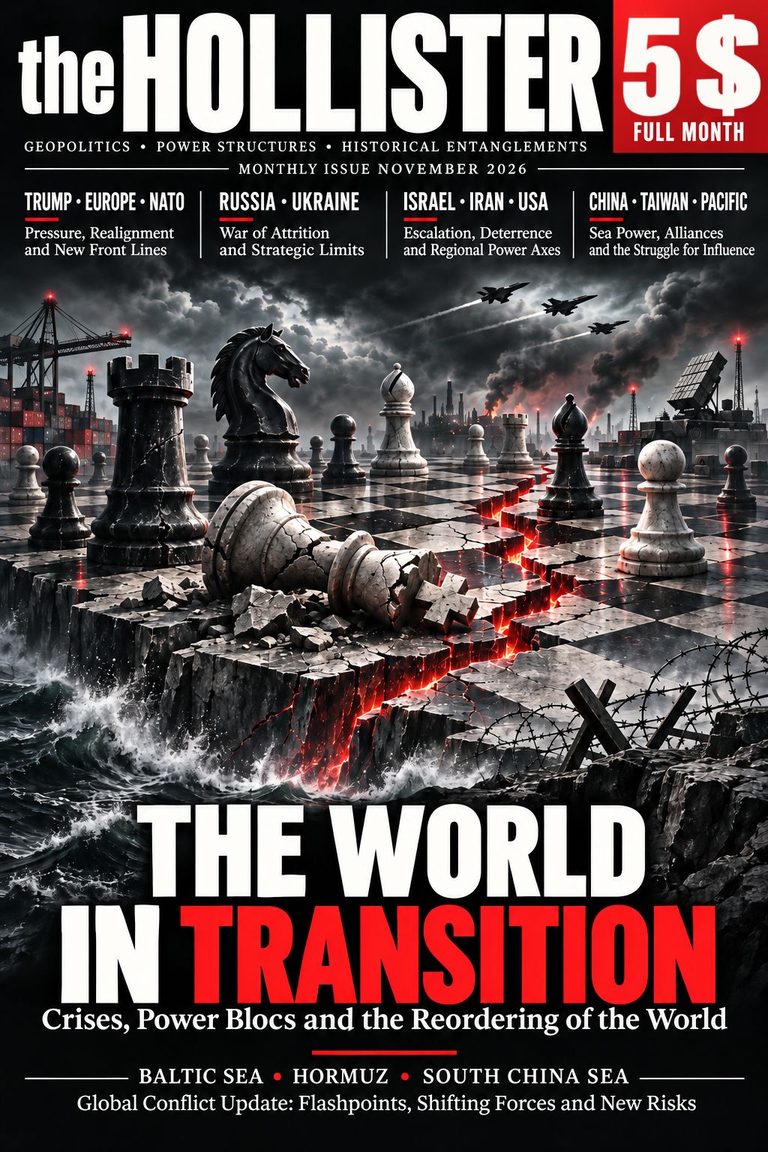
by Michael Hollister
Exclusive published at Michael Hollister on November 08, 2026
Part 1 read here:
Terafab – Part 1: The Factory for AI in Space
Part 2 read here:
Terafab – Part 2: Why Space? The Physical Wall
Part 3 read here:
Terafab – Part 3: Escape Upward
Part 4 read here:
Terafab – Part 4: The Swarm
5.231 words * about 28 minutes readingtime


When Does a Civilian Data Center in Space Become a Legitimate Target – and Who Decides?
On September 14, 2026, U.S. Secretary of the Air Force Troy Meink made a statement in National Harbor that no U.S. government official had ever made publicly before. The Space Force now possessed “on-orbit space control weapons,” weapons in orbit capable of defending the joint force against hostile actions. During the question-and-answer session following his opening address, he was asked whether he had intended to say exactly that. He had, Meink replied, and the wording had been deliberate. The disclosure was explicit, not a slip of the tongue.
This was neither a verbal misstep nor a scenario. It was a confirmation. For decades, the major space powers had developed and tested weapons against satellites without any of them ever admitting that a purpose-built combat system had been permanently deployed in orbit. Meink’s speech crossed that threshold. For the first time, a government said: Yes, we have a weapon up there.
This installment examines what that sentence means – and why it necessarily relates to what the previous parts of this series described. The swarm in Part 4 was the answer to an engineering question: How can computing infrastructure be built in orbit so that it survives? Distribution, redundancy, replaceability through additional launches, and no single lucrative target. The very features that make the swarm resilient against micrometeoroids and inert debris also make it resilient against an attacker. Resilience does not recognize the intent of the opposing force. What hardens a system against chance also hardens it against deliberate action.
That leads to the thesis of this installment, and it is an uncomfortable one. The same distributed architecture that solves cooling and continuous operation for civilian purposes becomes infrastructure that is difficult to attack when viewed through a military lens. The civilian resilience advantage is not merely, by coincidence, also a military argument – it is the same argument viewed from two sides. And that raises the sharpest and least frequently asked question in this entire series: When does a civilian data center in orbit become a legitimate military target?
This article does not answer that question. It cannot, and it should not. It assembles the positions, identifies the legal framework, and shows what the classification depends on – then leaves the judgment to the reader. That is not an evasion. It is the only honest way to approach a question that international law itself leaves open.
Let us begin with what is established.
The Finding That Anchors Everything
Meink disclosed neither the number of systems nor their type. A Space Force spokesperson confirmed the weapons’ existence to The War Zone and added that the service would not discuss details. No specifications, no location, no deployment date. What remained was the bare fact and the term in which Meink framed it: space control.
For the Space Force, space control means more than physically destroying another country’s satellite. The term encompasses offensive and defensive warfare, electromagnetic interference, and other measures directed against an adversary’s space infrastructure – disrupting, degrading, or destroying it. The new Chief of Space Operations, General Douglas Schiess, reinforced the point the day after Meink’s speech and placed the weapons squarely within that mission: Guardians were operating systems in orbit that protected the joint force against space-enabled attacks.
What kind of weapon is circling overhead remains unknown, and intellectual honesty requires leaving that space blank. Experts suspect non-kinetic systems, such as jammers, because kinetic strikes create debris and the U.S. military prefers weapons that leave no wreckage behind. Victoria Samson of the Secure World Foundation, who has documented global anti-satellite programs for years, called the public disclosure of an orbital weapon simply unexpected. But a hypothesis remains a hypothesis. Anyone who reads Meink’s statement as proof of a laser cannon in space is attributing to the Pentagon a specification it conspicuously did not provide. A classified capability can exist without its technical data being public. The finding is limited to this: The capability exists, it has been confirmed, and the primary source says no more.
Why make the disclosure at all? Meink supplied the answer: deterrence. According to the Space Force, open communication strengthens deterrence, prevents adversary miscalculation, and normalizes space operations alongside those of the other military services. Admission is not weakness here but strategy – a signal to the two principal rivals, China and Russia, that the United States is not defenseless in orbit. One may accept that logic or consider it dangerous. As the actor’s stated motive, it belongs in the factual record.
The Framework: Two Documents, Not One
Meink’s statement did not emerge in a vacuum. It came within a framework that the U.S. government had built during the preceding months, and that framework consists of two separate documents that must not be confused.
The first is Executive Order 14369 of December 18, 2025, titled “Ensuring American Space Superiority.” It is the actual doctrine of military supremacy in space – the order that makes dominance in orbit an explicit objective.
The second is National Security Presidential Memorandum 17, or NSPM-17, issued on August 20, 2026: the new National Space Transportation Policy. It replaces a 2013 directive and initially defines an industrial objective. By 2030, U.S. launch facilities are to support “more than 1,000 launches and reentries every year.” To understand the scale, consider that in 2013, when the previous policy was adopted, the United States recorded 19 launches during the entire year. NSPM-17 makes a fivefold increase from today’s level an official government goal.
Keeping the two documents distinct matters because they do different things. NSPM-17 is a transportation policy, not an order to deploy weapons. Yet it incorporates the language of military supremacy and expressly refers to Executive Order 14369. In its first section, it calls for transportation capabilities across “the full range of orbital regimes” – from very low Earth orbit to the lunar surface, the Lagrange points, and deep space. It concludes by stating that the policy will ensure “America’s continued superiority in space.”
This closes the circle with the series. Part 3 showed that orbit is not beyond the law but falls under the jurisdiction of the state of registry, and that Musk’s infrastructure, registered in the United States, comes under U.S. jurisdiction. What appeared there as a choice of law – the selection of the more favorable sovereign – now acquires a military counterpart. The state whose law travels into orbit is the same state that has declared orbit a warfighting domain and intends to increase launch cadence fivefold by 2030 in order to fill it. The U.S. jurisdiction discussed in Part 3 and the U.S. military supremacy examined here are not two separate stories. They are two sides of one hand closing around the same space.
One distinction is necessary to prevent a false impression. The rhetoric of military supremacy includes the Golden Dome program, the planned missile-defense shield whose space-based interceptors Meink mentioned in the same breath: The program had reached “flight-ready” hardware. But flight-ready does not mean deployed. No operational space-based interceptor is currently in orbit; the 12 companies awarded contracts worth up to $3.2 billion in April 2026 are working toward flight tests in 2027 and an integrated capability by 2028. Based on the facts currently available, Golden Dome’s interceptors and the confirmed space-control weapons remain two different things. Conflating them creates a threat scenario that the evidence does not support.
A Three-Way Arms Race – Correcting the Frame
The most convenient account of Meink’s announcement is this: The United States is militarizing space. That account is wrong – not because Washington is innocent, but because it shows only one-third of the picture. What is happening in orbit is not a unilateral American undertaking. It is a three-way arms race, and all three parties are moving at the same time.
China first. In March 2025, General Michael Guetlein, then Vice Chief of Space Operations, described Chinese satellite maneuvers as “dogfighting in space”. He was referring to a series of maneuvers in which satellites circled one another in close formation and practiced on-orbit operations by one spacecraft against another. The Space Force dated the observations to 2024 and identified the objects involved: three experimental satellites in the Shiyan-24C series and two Chinese Shijian-6 05A/B spacecraft, all in low Earth orbit. China also operates satellites with robotic arms, a fleet of jammers, and a satellite that towed a defunct navigation satellite into a graveyard orbit in 2022 – the same technology that could seize another state’s satellite.
Discipline is required here. The image of dogfighting in space is compelling, and it has not gone uncontested. Some experts consider the evidence thin and the framing exaggerated; orbital physics makes a satellite dogfight in the usual sense questionable in any case, because orbital maneuvers take hours or days. Anyone who interprets the Chinese maneuvers as confirmed preparations for war is adopting an interpretation originating from an interested source. The maneuvers are documented. Their classification as attack exercises is a U.S. claim and must be identified as such.
Russia second, and here the source base is even more delicate. Since February 2024, U.S. officials have warned of a Russian anti-satellite capability in space. John Kirby, then the National Security Council spokesperson, confirmed a “troubling” capability under development while emphasizing in the same breath that it was not active, had not been deployed, and posed no immediate danger. General Stephen Whiting, commander of U.S. Space Command, explicitly referred to unconfirmed intelligence reports in April 2026. President Vladimir Putin rejected the allegations. What is documented, however, is this: In November 2021, Russia used a ground-launched direct-ascent missile to destroy its own defunct Kosmos 1408 satellite, producing more than 1,800 trackable pieces of debris that forced the crew of the International Space Station – including Russian cosmonauts – to take shelter.
Both rivals protested Meink’s confirmation, and both did so promptly. Chinese Foreign Ministry spokesperson Guo Jiakun called on the United States not to continue expanding its military capabilities and to stop preparing for war in space; the state-run Xinhua news agency warned of a security dilemma in which every buildup triggers a counter-buildup. The following day, Russia called for space to remain “free of any weapons.”
These protests must be treated with the same sobriety as the U.S. announcement. They are not neutral warnings but moves by two parties that operate counterspace programs of their own. China’s call for a weapon-free orbit comes from an actor with robotic-arm satellites and a fleet of jammers; Russia’s warning comes from the state that created the decade’s largest debris field in 2021. Neither the anti-American nor the anti-Chinese frame captures the situation. Only one word does: reciprocal. And the field extends beyond the three major powers. India conducted its own anti-satellite test in 2019, France is developing co-orbital capabilities, and the United Kingdom has practiced on-orbit operations with the United States. Orbit is not being militarized by one nation. Many nations are turning it into a weapons arena simultaneously.
The Dual-Use Bridge: The Same Hardware, Two Faces
Here the series returns from geopolitics to hardware, and the bridge rests on a name every reader knows: Starlink.
The war in Ukraine demonstrated what happens when commercial space infrastructure becomes an instrument of war. Within months, according to Ukrainian officials, Starlink became the backbone of the country’s communications after Russian attacks had shattered terrestrial infrastructure. SpaceX President Gwynne Shotwell said in early 2023 that Ukraine had used the network in ways that were neither intended nor part of any agreement – it had, in her word, “weaponized” it. Harvard University’s Belfer Center drew a sober lesson: A party that depends on a single private company for critical communications during a conflict places itself in hands it does not control.
Russia drew a different lesson. As early as October 2022, Moscow declared that quasi-civilian infrastructure could become a legitimate target for retaliation. The targeting question at the center of this installment had therefore already been raised – not by a legal scholar, but by a party to the conflict looking at Starlink. SpaceX responded by creating Starshield in late 2022, a militarily hardened version of Starlink technology for government customers. In doing so, the company itself drew the line at issue in the legal question: the civilian broadband network for households and public authorities on one side, the military system on the other. The line sounds clean and becomes blurred in practice because the same underlying technology exists on both sides.
A contract awarded in May 2026 shows that this convergence is no accident. The Space Force awarded SpaceX $2.29 billion for the “Space Data Network Backbone”, a backbone network of satellites in low Earth orbit intended to connect sensors and weapons platforms around the world in near real time. In military language, it is a sensor-to-shooter connection: It carries data from missile-warning sensors to interceptor weapons, and it is a foundation of the Golden Dome project. The satellites are derived from Starlink.
Read that in light of Part 1. The finding there was that Musk alone among the competitors pursuing orbital data centers controls all three components himself: the chips, eventually from TerraFab; transportation via Starship; and the network via Starlink. The complete full stack. That stack is now acquiring a military layer. The same company that controls the civilian pathway from the grain of sand to the stream of data is building the data network that connects U.S. sensors to U.S. weapons. The full stack from Part 1 is no longer merely economic. It has become militarily relevant.

This is also where the strictest boundary in this article lies, and it belongs in every paragraph that makes the connection. What operates in orbit today is the transportation pathway and the data network – Starlink, Starshield, and the Space Data Network. It is not the computing factory. TerraFab computing infrastructure is not circling Earth; the chips for it are not expected to enter production before 2028 at the earliest. Every statement connecting TerraFab to the military must remain conditional. The military use of Musk’s future orbital computing capacity is a structural possibility, not an established fact. Dual-use does not mean “built for the military.” Its dual nature is structural, not intentional, and anyone who recasts that structure as intent has left the factual record behind.
Real Combat Use – but Not as the Headline Suggests
There is no need to infer from doctrine that space has long since become a warfighting domain. One can see it in an operation conducted in the spring of 2026.
Operation Epic Fury, a U.S.-led campaign against Iran, began on February 28, 2026. Space Force Guardians were involved from the outset. In his speech, General Schiess highlighted the role of a member of the 42nd Electromagnetic Warfare Combat Detachment who planned and executed high-frequency electronic warfare during the opening hours to disrupt Iranian air defenses and communications systems. U.S. Space Command was among the operation’s first participants and helped clear the way for the joint force to strike more than 1,000 targets within the first 24 hours. General Chance Saltzman, still Chief of Space Operations at the time, had already called the Space Force “combat credible” in April 2026 – combat-tested under fire.
Precision matters more than forceful language here because the headline invites the wrong conclusion. The Guardians’ contribution to Epic Fury consisted of electronic warfare, in part conducted from ground-based or remote locations. It was not the use of an orbital weapon against a target in space. The confirmed space-control weapons from Meink’s speech were not used in Epic Fury – at least, there is no evidence that they were. Epic Fury shows that space forces are integrated into modern combat and that Guardians create effects in battle. It does not show that orbital weapons fired on targets from orbit. The boundary between “space is a warfighting domain” and “orbital weapons are being used to fight in orbit” runs precisely here. Blurring it would mislead the reader into believing that a level of escalation has occurred for which the available evidence provides no support.
There is a second reason for restraint, and it lies in the language. Iran is a party to this conflict, not a caricature – a complex civilization with capabilities of its own, including efforts to disrupt and deceive adversary satellite services. The sober finding is this: In a real war, space forces have for the first time played a visible and offensive role. What that means for the future is for the reader, not the author, to decide.
The Targeting Question Under International Law – the Core and the Open Door
This brings us to the question toward which everything has been moving. If weapons are stationed in orbit, if commercial infrastructure becomes an instrument of war, and if a private company provides civilian and military services using the same hardware – when does such a system become a legitimate target?
International law provides a standard, and it is worth grounding that standard in the original text rather than a paraphrase. Article 52(2) of the 1977 Additional Protocol I to the Geneva Conventions provides that attacks must be strictly limited to military objectives. An object becomes a military objective only when 2 conditions are met simultaneously: By its nature, location, purpose, or use, it makes an effective contribution to military action; and its total or partial destruction, capture, or neutralization, in the circumstances ruling at the time, offers a definite military advantage. Both criteria must be present; they are cumulative. Paragraph 3 adds the rule of doubt: Where it is unclear whether an object normally dedicated to civilian purposes is being used for military action, it must be presumed not to be so used. That is the controlling language of Article 52.
That standard is one thing. Its reach in outer space is another. Article IV of the 1967 Outer Space Treaty prohibits only weapons of mass destruction in orbit – not conventional anti-satellite weapons. No specific legal regime for orbital weapons exists to this day; multilateral efforts to establish a ban continue, but an agreement is unlikely in the present climate. The legal framework governing the targeting question is therefore an old text rooted in the logic of ground warfare, applied to a domain for which it was not written.
What follows from this for a data center in orbit? This is precisely where the factual record ends and the reader’s judgment begins. The criteria in Article 52 cannot be applied categorically to an entire class of objects; they require a case-by-case assessment. Does a particular satellite at a particular time make an effective contribution to military action? Would disabling it offer a definite military advantage? And what happens to civilian customers using the same infrastructure for computing if the military component is struck?
The real point lies in that final question, and Starlink makes it tangible. An attack intended to disrupt the military use of such a constellation would inevitably disrupt civilian communications in dozens of countries as well. This is not a theoretical technicality but the core of the proportionality assessment required by the Protocol. Civilian users do not disappear merely because a satellite also performs military functions. They remain part of the calculation.
And here the arc returns to TerraFab without the article rendering a verdict. If computing capacity is eventually created in orbit, and if AI providers run models used by the military on orbital hardware, then the mere availability of that service draws the infrastructure into the targeting question. “Data center off” would then mean “AI off” – and whether such a shutdown would be lawful would no longer be a technical question but a question under Article 52. Whether a civilian data center in space could become a legitimate target is a judgment each reader must make. The author does not put his hand on the scales. He sets out the criteria by which the question is measured and then steps back.
A present-day comparison may sharpen the thinking without directing it. In Germany and elsewhere, factories manufacture weapons and ammunition exclusively for the front in Ukraine. Whether such a production facility located on the territory of a state that is not itself directly at war constitutes a legitimate military target is disputed in public, and international law does not answer the question unequivocally. Those looking at orbit are looking at the same gap, only one orbital altitude higher. That, too, is a question for the reader to decide – not the article.
The Unverified Threat – and Why It Still Matters
One claim bears directly on this targeting question and may be cited only with the brakes firmly applied. In late December 2025, the Associated Press reported that 2 intelligence services from NATO countries suspected Russia of developing a new anti-satellite weapon specifically for use against Starlink. It was described as a “zone-effect” weapon: not one that precisely strikes individual satellites, but one that floods an entire section of an orbit with hundreds of thousands of dense pellets and could thereby disable several satellites at once.
The qualification is mandatory, not decorative. The Associated Press was not permitted to identify the services involved and could not independently verify the reports’ conclusions. This is not a confirmed capability but an intelligence claim relayed by a news agency that could not verify it. And experts are skeptical. Victoria Samson, who was also consulted here, said she would be very surprised if Russia did such a thing – an attack of this kind would render the affected orbital band unusable for everyone, including Russia itself and its ally China, which likewise depend on thousands of satellites. Anyone who releases hundreds of thousands of pellets into an orbit saws off the branch on which they are sitting. The original report itself makes the unverified status clear.
Why mention it at all? Because the claim, irrespective of whether it is true, displays the logic of this installment in its purest form. An indiscriminate area-effect weapon directed against a dual-use constellation is the worst case of the targeting problem: It does not distinguish between military and civilian use; it strikes everything in the band. Precisely what Article 52 prohibits and what breaks any proportionality analysis would be built into the weapon itself. Whether or not the pellet weapon exists, it is a vivid stress test for the legal question. It belongs in this article for what it is – an unconfirmed threat doubted by experts – and not one iota more.

The Reach of the Policy – a Signal, Not a Threat Scenario
One final element shows how far U.S. planning already extends while simultaneously warning against exaggeration. In April 2026, the Space Force established a Cislunar Coordination Office for the region beyond geostationary orbit to the Moon and farther out. The Air Force Research Laboratory is developing an experimental surveillance satellite called Oracle Prime, which the manufacturer, Advanced Space, says it intends to deliver in 2027. The office is an acquisition and coordination mechanism for future cislunar activity.
One could interpret this as the next stage of escalation – militarization already reaching the Moon. That would be wrong, and honesty requires drawing the boundary. No contracts for hardware have yet been awarded under the associated programs, and no operational military system is stationed in cislunar space. Oracle Prime is an instrument of observation, intended to provide situational awareness in the region between Earth and the Moon – not a weapon. The office is a planning and coordination mechanism, not a weapons program.
It nevertheless belongs in this installment because it illustrates the policy’s reach. NSPM-17 expressly named the Lagrange points and deep space; the office marks the beginning of the institutional implementation of that claim. Military supremacy will not end at geostationary orbit – that is the signal conveyed by the office’s creation. But signaling is not deployment. What exists in cislunar space today is attention, not armament. That, too, is a finding, and it is more sober than the headline it invites.
Findings
Let us summarize what this installment has established. On September 14, 2026, the United States officially confirmed for the first time that it had deployed weapons in orbit – unnamed, unspecified, and described as instruments of deterrence. This is no longer a scenario; it is a fact. The framework consists of 2 documents: the doctrine of military supremacy from December 2025 and the transportation policy from August 2026, which seeks to increase launch cadence fivefold by 2030 and secure access across the full range of orbital regimes. This is a three-way arms race, not a unilateral undertaking by a single nation. China conducts maneuvers whose interpretation is disputed; Russia created the decade’s largest debris field in 2021 and is suspected of developing an unverified weapon against Starlink; and both protested the U.S. confirmation while expanding their own capabilities.
The decisive issue, however, is the dual nature of the infrastructure. The same distributed architecture that makes the swarm in Part 4 viable for civilian purposes is infrastructure that is difficult to attack from a military perspective. Starlink became an instrument of war, Starshield its hardened variant, and the Space Data Network a sensor-to-shooter connection – the full stack from Part 1 has acquired a military layer. From this follows the question that international law leaves open: When does a dual-use system in orbit become a legitimate target? Article 52 of Additional Protocol I supplies the criteria – effective contribution to military action, definite military advantage, and protection of civilian users through proportionality – but it does not decide the individual case. That judgment remains with the reader.
What is established remains established: the confirmation, the doctrine, the dual-use infrastructure, and the actual participation of space forces in the war against Iran. What is projected remains projected: TerraFab computing infrastructure is not in orbit, and its military use is a structural possibility, not proof. The challenge of this installment lay not in rhetorical force but in separation – between fact and claim, infrastructure and intent, what exists and what might exist. Dual-use is not a master plan. It is a property of the hardware, and it has no ideology.
One question remains, and it leads from the military question to the question of power. If a single private actor controls this dual-use infrastructure – the chips, transportation, network, energy, and computing – and if the state under whose jurisdiction it falls declares orbit a warfighting domain, then who controls him? Part 6 will examine that question.


About the Author
Michael Hollister
is a geopolitical analyst and investigative journalist. He served six years in the German military, including peacekeeping deployments in the Balkans (SFOR, KFOR), followed by 14 years in IT security management. His analysis draws on primary sources to examine European militarization, Western intervention policy, and shifting power dynamics across Asia. A particular focus of his work lies in Southeast Asia, where he investigates strategic dependencies, spheres of influence, and security architectures. Hollister combines operational insider perspective with uncompromising systemic critique – beyond opinion journalism. His work appears on his bilingual website (German/English) www.michael-hollister.com and in investigative outlets across the German-speaking world and the Anglosphere.
Stay informed without having to work through the daily flood of news – the most important developments and connections summarized for you.
Sources
Confirmation of U.S. Orbital Weapons (Meink, September 14, 2026)
- Meink Reveals Space Force Has “On-Orbit Space Control Weapons” (Air & Space Forces Magazine) – https://www.airandspaceforces.com/meink-space-force-on-orbit-space-control-weapons/
- U.S. Admits It Has Weapons in Orbit (The War Zone) – https://www.twz.com/space/u-s-admits-it-has-weapons-in-orbit
- Space Force Has “Space Control Weapons” on Orbit, Air Force Secretary Reveals (Breaking Defense) – https://breakingdefense.com/2026/09/space-force-has-space-control-weapons-on-orbit-air-force-secretary-says/
- Meink: Space Force Has Deployed Space Control Weapons to Orbit (DefenseScoop) – https://defensescoop.com/2026/09/14/meink-space-force-has-deployed-space-control-weapons-to-orbit/
- The US Military Said It Has Deployed Weapons in Space (CNN) – https://www.cnn.com/2026/09/15/science/us-space-force-weapons-capabilities-hnk
- The U.S. Has Weapons in Space. Now What? (Carnegie Endowment) – https://carnegieendowment.org/emissary/2026/10/space-weapons-us-arms-race
- There’s a Space Weapon Circling the Planet. Here’s What We Know. (National Geographic) – https://www.nationalgeographic.com/science/article/space-weapons-kinetic-jammer-debris
Policy Framework (EO 14369 and NSPM-17)
- The National Space Transportation Policy / NSPM-17 (White House, full text) – https://www.whitehouse.gov/presidential-actions/2026/08/national-security-presidential-memorandum-nspm-17/
- Fact Sheet: President Donald J. Trump Launches the Golden Age of Space Transportation (White House) – https://www.whitehouse.gov/fact-sheets/2026/08/fact-sheet-president-donald-j-trump-launches-the-golden-age-of-space-transportation/
- Ensuring American Space Superiority / EO 14369 (White House) – https://www.whitehouse.gov/presidential-actions/2025/12/ensuring-american-space-superiority/
Golden Dome / Space-Based Interceptor
- Golden Dome to Defend Against Decapitation, Rogue Attacks (Arms Control Association) – https://www.armscontrol.org/act/2026-10/news/golden-dome-defend-against-decapitation-rogue-attacks
- US Says Its Golden Dome Missile-Killer Is Flight-Ready-but It Is Not Yet in Orbit (International Business Times) – https://www.ibtimes.co.uk/us-golden-dome-interceptor-flight-ready-hardware-1821103
- US Space Force Taps 12 Firms for $3.2 Billion Golden Dome Missile Defense Contracts (Reuters via GV Wire) – https://gvwire.com/2026/04/24/us-space-force-taps-12-firms-for-3-2-billion-golden-dome-missile-defense-contracts/
Three-Way Arms Race (China, Russia)
- China Practicing “Dogfighting in Space,” US Space Force Says (Air & Space Forces Magazine) – https://www.airandspaceforces.com/china-practicing-dogfighting-space/
- 5 Chinese Satellites Practiced “Dogfighting” in Space, Space Force Says (Breaking Defense) – https://breakingdefense.com/2025/03/5-chinese-satellites-practiced-dogfighting-in-space-space-force-says/
- China Warns Against Space “Battlefield” After U.S. Says Weapons Deployed (AFP via Daily Tribune) – https://tribune.net.ph/2026/09/16/china-warns-against-space-battlefield-after-us-says-weapons-deployed
- US Confirms On-Orbit Weapons as China Warns Against a Space Arms Race and Russia Calls for Weapon-Free Orbit (International Business Times) – https://www.ibtimes.co.uk/us-space-control-weapons-china-russia-arms-race-1819928
- Russia Has Obtained a “Troubling” Emerging Anti-Satellite Weapon, the White House Says (Associated Press via ClickOrlando) – https://www.clickorlando.com/news/politics/2024/02/15/russia-has-obtained-a-troubling-emerging-anti-satellite-weapon-the-white-house-says/
- U.S. Space Command Leader Concerned Russia Developing a Nuclear Anti-Satellite Weapon (Broadband Breakfast) – https://broadbandbreakfast.com/u-s-space-command-leader-concerned-russia-developing-a-nuclear-anti-satellite-weapon/
Russian “Zone-Effect” Weapon (Unverified Intelligence Reports, December 2025)
- Intelligence Agencies Suspect Russia Is Developing Anti-Satellite Weapon to Target Starlink Service (Associated Press via PBS NewsHour) – https://www.pbs.org/newshour/world/intelligence-agencies-suspect-russia-is-developing-anti-satellite-weapon-to-target-starlink-service
- Western Intelligence Suspects Russia Is Developing New Weapon to Target Musk’s Starlink Satellites (Associated Press via WSLS) – https://www.wsls.com/news/world/2025/12/22/western-intelligence-suspects-russia-is-developing-new-weapon-to-target-musks-starlink-satellites/
The Dual-Use Bridge (Starlink / Starshield / Space Data Network)
- Starlink and the Russia-Ukraine War: A Case of Commercial Technology and Public Purpose? (Belfer Center, Harvard Kennedy School) – https://www.belfercenter.org/publication/starlink-and-russia-ukraine-war-case-commercial-technology-and-public-purpose
- SpaceX’s Shotwell Says Ukraine “Weaponized” Starlink Network (C4ISRNET) – https://www.c4isrnet.com/battlefield-tech/space/2023/02/08/spacexs-shotwell-says-ukraine-weaponized-starlink-network/
- Russia Deems Starlink a Legitimate Military Target (Fortune) – https://fortune.com/2022/10/28/russia-putin-elon-musk-starlink-satellites-ukraine-war-target
- What Is the Pentagon’s “Space Data Network,” and Why Does It Matter for Golden Dome? (Breaking Defense) – https://breakingdefense.com/2026/03/what-is-the-pentagons-space-data-network-and-why-does-it-matter-for-golden-dome/
- SpaceX Wins $2.29B US Space Force Contract to Develop Space Data Network (Proactive Investors) – https://www.proactiveinvestors.co.uk/companies/news/1092990/spacex-wins-2-3b-us-space-force-contract-to-develop-military-satellite-system-1092990.html
The Targeting Question Under International Law (AP I, Article 52; Outer Space Treaty, Article IV)
- Additional Protocol I to the Geneva Conventions, Article 52 – General Protection of Civilian Objects (ICRC IHL Database) – https://ihl-databases.icrc.org/applic/ihl/ihl.nsf/ART/470-750064
- What Are “Space Weapons,” Which US Says It Has Deployed into Orbit? (Al Jazeera) – https://www.aljazeera.com/features/2026/9/15/what-are-space-weapons-which-us-says-it-has-deployed-into-orbit
Real Combat Use (Operation Epic Fury, Iran)
- Schiess Highlights Space Force’s Role in Epic Fury (Air & Space Forces Magazine) – https://www.airandspaceforces.com/schiess-highlights-space-forces-role-in-epic-fury/
- Iran War Demonstrates a “Combat Credible” Space Force, Top Guardian Says (Task & Purpose) – https://taskandpurpose.com/news/space-force-combat-epic-fury/
Cislunar / Oracle Prime
- With Eyes on Future NASA Moon Base, Space Force Launches Cislunar Acquisition Task Force (Breaking Defense) – https://breakingdefense.com/2026/04/with-eyes-on-future-nasa-moon-base-space-force-launches-cislunar-acquisition-task-force/
- AFRL Cislunar Mission Progresses Through Key Milestones – Oracle Prime (Advanced Space) – https://advancedspace.com/?p=5571
© Michael Hollister – Redistribution expressly encouraged.
I am pleased when my articles, commentaries, and analyses attract interest and are shared. Reproduction, distribution, and publication of my texts, in whole or in part, on other websites, blogs, or in other publications is expressly permitted and encouraged. No prior permission is required.
The sole requirement: Michael Hollister must be clearly and prominently identified by name as the author. In addition, a clearly visible, clickable link to the original website, www.michael-hollister.com, must be included.
Reuse without author attribution and a link is not permitted.
If this work helps you understand what lies behind the headlines, consider supporting it. Membership starts at $5 per month, includes access to all supporter-only analyses, and can be cancelled at any time.