by Michael Hollister
Exclusive published at Michael Hollister on October 18, 2026
Part 2 read here:
Terafab – Part 2: Why Space? The Physical Wall
5.138 words * about 27 minutes readingtime

The Legal Question That Turns Technology into Power
Part two ended with a question that no longer came from physics, but from power. Suppose the physical barriers fall away – the rockets fly often enough, the swarms cool themselves, and the chips withstand the radiation. Then a computing infrastructure on a scale Earth has never seen before will be operating above our heads, in a place where no state on this planet has ever exercised authority. Whose laws govern a data center that no longer touches the ground?
This installment is the answer. It is also the point at which a story about technology and economics becomes one about law and political power. And it begins with a misconception so widespread that it is almost taken for established knowledge.
The Myth of a Lawless Frontier
The idea is compelling and wrong at the same time: Outer space is supposedly a lawless realm, a Wild West above the clouds, a place beyond all jurisdiction. Put a data center up there, the thinking goes, and it escapes everyone’s reach – no agency, no court, no state can reach that high. The machine floats, and with it floats beyond the reach of the law.
That idea draws its power from an image everyone carries in their mind: emptiness, weightlessness, the absence of borders, fences, and checkpoints. Where there is no line in the sand, it seems, no sovereign territory can begin or end. Orbit looks like the last no-man’s-land.
That is precisely where the mistake lies. Orbit is not a no-man’s-land. It has been governed by an extensive legal framework for nearly sixty years, one that reaches all the way into orbit. Anyone who believes Musk can put his computing factory beyond the law by launching it upward has not read the treaty that has governed precisely this situation since 1967. Outer space is not lawless. It is simply governed by a different legal framework than intuition suggests.
We need to make that distinction clear from the outset, or the entire argument that follows falls apart. A lawless realm would mean that no state has jurisdiction, no law applies, and no one bears responsibility. That demonstrably is not the case in orbit. What is true is something far more interesting: Law applies, but not everyone with an interest in enforcing it can actually reach the objects concerned. The entire substance of this installment lies between those two statements – no law applies, and law applies but can be enforced there only by a particular state. Confuse the two, and Musk’s move looks either like an anarchic breakout or an exercise in futility. Neither is correct. The truth lies between them, more precise and more uncomfortable than either simple interpretation.
So let us begin where the misconception falls apart: with the one treaty framework that actually answers the question of which law applies in orbit.
The Law Travels with the Object – The Outer Space Treaty
The document that dismantles the misconception is the Outer Space Treaty – officially, the Treaty on Principles Governing the Activities of States in the Exploration and Use of Outer Space. It was opened for signature on January 27, 1967, and entered into force on October 10, 1967. More than a hundred states are parties to it, including the United States. Two of its articles answer the question of applicable law so clearly that they leave little room for interpretation.
The first is Article VIII. It provides that the state on whose registry an object launched into outer space is carried retains jurisdiction and control over that object while it is in outer space. In the original wording, the state of registry “shall retain jurisdiction and control over such object.” This is not a vague statement of intent. It is a rule establishing jurisdiction. A satellite does not lose its legal home when it leaves the atmosphere. It carries that home with it, recorded in a national registry. The law of the state where the object is registered follows it – in orbit, on the Moon, everywhere.
The second is Article VI. It establishes that states parties bear international responsibility for national activities in outer space, expressly including activities carried out by nongovernmental entities. More than that, the activities of private actors in outer space require “authorization and continuing supervision” by the appropriate state party. A private company operating in orbit is therefore not a sovereign actor accountable to no one. It operates with the authorization and under the continuing oversight of a state that bears international responsibility for its actions.
Read together, the two articles yield a finding that directly contradicts the misconception. An orbital data center is not beyond the law. It is subject to the law of the state that registered it and is required to supervise it. If an American company registers its satellites in the United States – and it is difficult to imagine SpaceX doing otherwise – then the orbit in which those satellites travel is, in a legal sense, something like American sovereign territory. The law follows the object upward. It does not stay behind on the ground.
This changes the entire question. The interesting issue is no longer whether a state has jurisdiction – under international law, a state necessarily does. The interesting question is: Which state?
Not the Law, but the Regulator
At this point, the story shifts from jurisprudence to strategy. If a state always has jurisdiction anyway, the decision about which national registry an object enters is no longer a formality. It is a choice of judge. And those who can choose their judge do not choose at random.
Here, the Terafab story intersects with a conflict readers of this site already know. Elon Musk has been in open dispute with the European Union for years over its digital legislation, the Digital Services Act. His social media platform X is the only major platform openly resisting Europe’s content-moderation regime; at the end of 2025, the European Commission therefore imposed a provisional €120 million penalty, the case is before the European Court of Justice, and a ruling is expected in 2027. The entire backstory – from an EU commissioner’s public letter of warning to Musk’s “then so be it” stance toward access to the European market – has been reconstructed here in meticulous detail: The EU Censorship System – Part 5: Breton vs. Musk.
For this installment, the motive is enough. A man locked in a continuing conflict with a regulator is building infrastructure whose jurisdiction he can choose for himself. He trades a hostile regulator – the EU – for a friendly one: the United States, under an administration close to him. And he does so in a domain where the hostile regulator cannot follow him.
That is the central thesis of this installment. What Musk is doing is not escaping the law. It is jurisdictional arbitrage: the deliberate choice of a more favorable sovereign. Not lawlessness, but a choice of law. That distinction is crucial, and it also marks the limit of the thesis – a limit we must acknowledge candidly in a moment.
Why Moving Is Not Enough – The Market-Location Principle
This brings us to the first necessary correction to our own argument, and it is the one that makes this entire installment credible. One might assume that moving into U.S.-registered orbit also puts Musk beyond the Digital Services Act. Servers in space, U.S. law, Brussels shut out – it would be that simple if the DSA depended on where a server was located. But it does not.
The Digital Services Act is tied not to the server’s location, but to the market being served. The regulation itself makes this unmistakably clear. Recital 7 states that the rules apply to providers of intermediary services “irrespective of their place of establishment or their location,” provided they offer services in the Union, as demonstrated by a substantial connection to it. Recital 8 spells out what establishes such a connection: a significant number of users in a member state, or activities directed toward a member state, as indicated, for example, by the language used, the currency, or the national top-level domain.
For services Musk directs at European end users – X, the Grok chatbot, anything a European accesses on a screen – orbit therefore changes nothing legally. Whether the server is in Texas, Ireland, or 310 miles above the Atlantic, the DSA applies as long as the service targets European users. The market-location principle was designed to defeat precisely this instinct to escape. Moving cannot circumvent it, because it depends not on the provider’s location but on the user’s.
That needs to be stated plainly, even though it limits our own thesis. Anyone claiming that going into space puts Musk beyond European law is mistaken at the level of the legal rule itself. The rule applies. It applies to X, it applies to Grok, and it applies to every consumer service with a European audience, no matter where the hardware is floating. The arbitrage fails here – and acknowledging that defeat is the price of making the rest of the argument hold up.
Where the Arbitrage Still Works
Because the legal rule is one thing. Enforcing it is another. And precisely between those two things – between a law’s applicability and its physical enforcement – lies the space in which jurisdictional arbitrage very much does work.
The first lever is enforcement itself. The EU can fine X and, in extreme cases, block its access to the market. What it cannot do is search, seize, or shut down hardware orbiting under U.S. registration. A European bailiff does not climb 310 miles into space. A European authority cannot pull the plug on an orbital installation that falls under another state’s jurisdiction under international law. The rule reaches the operator through its European business; it does not reach the machine itself. That is the difference between imposing a penalty and gaining physical access.
The second lever is market access – and Musk, of all people, has already diminished its value. The EU’s strongest means of pressuring a platform is the threat of excluding it from the European market. That pressure only works against an actor who needs the market. Musk has publicly stated that he will not submit to authoritarian censorship demands; if Europe loses access to X, so be it. Whether that is a bluff or a genuine position cannot be determined from the outside. But the mere willingness to accept the loss weakens Europe’s strongest lever. Someone who is not afraid of losing something cannot be blackmailed with its loss.
The third lever is the most subtle and legally delicate: A data center devoted exclusively to infrastructure may fall outside the DSA in the first place. The regulation distinguishes between services that disseminate content to the public and purely technical infrastructure operating in the background. Recital 13 clarifies that cloud and web-hosting services, when serving as infrastructure – the “underlying infrastructural storage and computing services” of an application, website, or platform – are not considered to be disseminating content to the public merely for that reason. An orbital data center that trains AI models and sells computing power to paying business customers, without itself operating a platform for European end users, would be precisely that kind of infrastructure. It does not distribute content to the public; it computes. For this type of operation, the DSA might not apply at all – not because the machine is floating in orbit, but because it is purely backend infrastructure.
The finding from these three levers must be stated precisely, because precision is everything here. The arbitrage does not work at the level of the legal rule – the DSA applies there, as explained above. It works at the enforcement and infrastructure levels. Brussels can write and apply the law. There is just one thing it cannot do: enforce it against a machine that orbits under a foreign registry, beyond the physical reach of European enforcement authorities.
The Real Gatekeeper Is the FCC
But if a state always has jurisdiction, and Musk chooses the most favorable one, it is worth looking at the specific agency that decides whether the project can proceed. That agency is not the European Commission in Brussels. It is America’s Federal Communications Commission, the FCC.
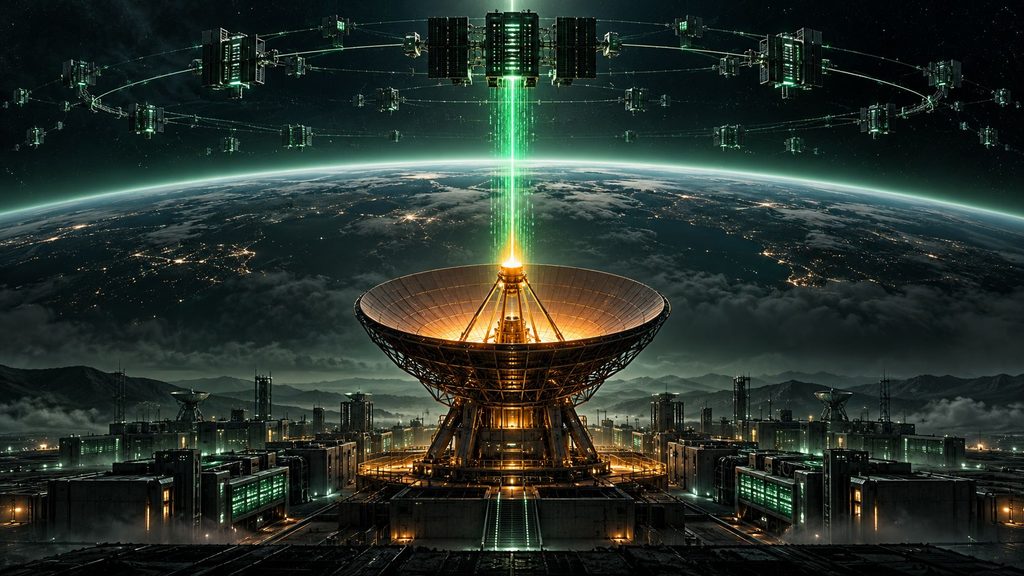
This trail is no longer speculation. On January 30, 2026, SpaceX filed an application with the FCC that puts the scale discussed in the earlier installments into perspective. Under file number SAT-LOA-20260108-00016 – which the FCC explicitly lists alongside the January 30, 2026 filing date in its public notice, meaning the digits in the file number refer to an earlier administrative step, not the filing date – the company requested authorization for a satellite system of up to one million units, expressly intended to operate as an orbital data center: the “SpaceX Orbital Data Center System.” The FCC’s Space Bureau accepted the application for processing on February 04, 2026, and opened the public comment process. In the filings, SpaceX describes the project as the “first step towards becoming a Kardashev II-level civilization” – the first step toward a civilization capable of harnessing all the energy of its star.
Two things about this application are decisive for our question. First, the figure of one million does not describe the communications network. It describes the computing factory. The application thus independently confirms, in a primary source, precisely the architecture derived from physical constraints in part two – not one enormous orbital station, but a swarm of countless small nodes. What appeared there as a solution to the heat problem reappears here as a formal application. The physics and the regulatory filing tell the same story.
Second, the application itself explains how the data gets back to Earth. According to the filing, the optical laser links between satellites ultimately route traffic “to authorized earth stations on the ground.” The word authorized is not filler here. Authorized means approved by the FCC. Musk’s own application already establishes the ground as the return path and places that return path under a national authorization requirement.
Alongside the FCC stands a second, international body: the International Telecommunication Union, or ITU. It coordinates radio frequencies and orbital positions worldwide under the Radio Regulations, which have the status of an international treaty. One detail that supports the thesis is crucial: A private company cannot file directly with the ITU. An “administration” – meaning a state – must do so. For SpaceX, the U.S. administration submits the filings. At this level too, Musk is not sovereign; he depends on the United States to represent him.

That makes the institutional trail clear. Brussels does not decide on authorization for orbital data centers of this magnitude. Washington does, through the FCC, alongside the ITU, where the United States submits Musk’s application. The decision-making center has shifted – away from Europe and the global level, toward Washington. This is the concrete exercise of choosing the sovereign.
The Starcloud Objection: Structure, Not Favoritism
At this point, we need to anticipate an objection before the first critical reader raises it – because it strikes at a vulnerable spot. Doesn’t what we have just said make the FCC sound like Musk’s personal agency? As though the richest man in the world had arranged for a compliant regulator that would approve what Brussels forbids him to do?
The answer comes from a competitor. Starcloud, the startup introduced in part one as an early pioneer of orbital data centers, has applied to the same FCC for a constellation of 88,000 satellites. Starcloud is not a Musk company; it is closer to Nvidia’s orbit than SpaceX’s, and it is not connected to the U.S. government in the way Musk is. Yet its path runs through exactly the same agency. The FCC is not Musk’s personal servant. It is the gatekeeper for the entire field.
And that makes the finding stronger, not weaker. The precise thesis is not “the FCC is Musk’s private agency.” It is this: Jurisdiction over orbital computing infrastructure is shifting to the United States – for everyone taking this route. Anyone who wants to put a data center in orbit must seek authorization through Washington, whether their name is Musk or not. This is a structural shift in where decisions are made, not a personal favor. Starcloud is the evidence that this is about structure rather than favoritism.
Musk’s additional individual advantage lies not in the FCC’s jurisdiction – that applies equally to everyone – but in his proximity to the administration that oversees the agency. That speeds up approvals, smooths procedures, and provides access. But it is a difference of degree, not of kind. And it leads directly to the next question that must be asked candidly.
The Durability Caveat: Catalyst, Not Foundation
The thesis that Musk is choosing his sovereign implicitly assumes that the United States will remain a reliably friendly regulator. But that is a political snapshot, not a structural guarantee. Administrations change. The balance of power at the FCC shifts with the administration that appoints its members. Friendliness rooted in a particular political alignment lasts only as long as that alignment. The calculus could change with the next transfer of power in Washington, if not sooner.
This caveat has to be made, and it belongs in any candid assessment. But taken to its logical conclusion, it does not puncture the thesis; it sharpens it. No rational actor would build a multibillion-dollar project spanning decades on the assumption that a friendly president will stay in office. Planning on that basis would be reckless. Musk does not plan that way.
The real safeguard therefore lies not in day-to-day politics, but where we began this installment: in registration and orbit. Once an object is registered in the United States and placed in orbit, Article VIII of the Outer Space Treaty applies regardless of who occupies the White House. The state of registry’s jurisdiction follows from the registration, not from the regulator’s party affiliation. And the EU’s inability to reach the hardware physically remains unchanged, regardless of who holds the majority at the FCC. A bailiff still cannot climb into orbit when an administration changes.
The caveat therefore becomes part of the finding rather than undermining it. A friendly regulator is the catalyst – it accelerates approval today. But the lasting arbitrage rests on registration and orbit, not on an election cycle. Confuse the two, and you mistake the accelerator for the foundation.
There is a second caveat that belongs here, and it is the most important of all because it concerns how this entire installment should be interpreted. Much of what we have said so far may have sounded as though jurisdictional arbitrage were Musk’s actual motive – as though he were building the constellation to escape the EU. There is no evidence for that, and intellectual honesty requires saying so openly. The move into orbit has concrete technical and economic reasons, spelled out in part two: the Sun’s energy that cannot be accessed in the same way on Earth, the cooling advantage of a swarm, and an escape from the electricity bottleneck choking the entire industry. Those reasons are entirely sufficient to explain the move. Legal insulation need not be the goal; it may simply be a side effect, whether intended or not.
Here we must draw a clear line between what can be established and what would be overreach. The effect can be substantiated: A U.S.-registered constellation in orbit is physically beyond the reach of European enforcement – a consequence of the Outer Space Treaty and geography, regardless of anyone’s intentions. What cannot be substantiated is the motive: that this is why Musk is going into space. The statement “he is building it to escape” would be a causal claim without a primary source to support it. The finding of this installment is therefore both more cautious and stronger: Whether intended or merely accepted, the result is the same. The infrastructure ultimately sits where the hostile regulator cannot reach it. In the contest over power, the effect matters, not the state of mind.
The Achilles’ Heel Is on Earth
Any honest thesis identifies its own weak point before an opponent does. The weak point of this thesis is not in orbit. It is on the ground.
The computing happens in space, but the data comes down to Earth – and, as Musk’s own FCC application specifies, it arrives at ground stations in countries governed by law. A ground station is a facility located on sovereign territory. It stands in a country, is subject to that country’s laws, and can be searched, regulated, or, if necessary, shut down. The much-invoked freedom from the law supposedly offered by orbit is qualified precisely at this seam between sky and Earth. The machine floats, but its data stream must land; wherever it lands, the law of the ground applies once more.
Consider the objection in its strongest form. An orbital data center without a ground station would be a deaf computer – producing results that no one could retrieve. Computing power in space is worth only as much as the channel that brings it back to Earth, and that channel ends at an antenna on solid ground. Whoever controls the antenna controls the usefulness of the entire constellation. A state that closes a ground station on its territory cuts off access to what is orbiting above it – not to the hardware, but to its output. The Achilles’ heel, then, is no footnote. It is the point where infrastructure supposedly removed from a state’s reach comes fully back within a state’s grasp.
But that does not overturn the thesis; it sharpens it. Because once again the decisive question is: Which state? A ground station in Texas falls under American law, not European law. Musk can put his ground stations where the legal environment suits him, just as he can register his satellites where the regulatory environment suits him. The ground station brings the law back into play – but it is the same law he has chosen, not his adversary’s. The Achilles’ heel undermines the idea of absolute freedom from the law, not arbitrage. It shows that Musk does not disappear from the legal system; it does not show that Brussels can reach him.

This does not weaken the thesis – it refines it once again. Musk does not eliminate his legal dependence. He trades one dependence for another. He puts the hardware beyond Europe’s physical reach by placing it under the authority of the United States – where he is more dependent than the image of a free man in a free orbit suggests. He depends on the FCC, which must authorize his ground stations. He depends on U.S. export law, which governs his technology. He depends on the ITU, whose coordination of frequencies and orbits runs through the United States. Take the ground station seriously, and the picture becomes clear: Going into orbit is not an exit from the law. It is a change of creditor.
The Other Direction – Brussels Also Reaches Globally
Up to this point, the EU might appear to be the helpless, territorially bound party in this story, able to act only within its own jurisdiction while Musk, a global actor, slips through its fingers. That would be a one-sided impression, and fairness requires looking in the other direction. For the EU, too, claims a reach extending far beyond its territory.
The key judgment comes from the Court of Justice of the European Union. On October 03, 2019, it ruled in Glawischnig-Piesczek v. Facebook Ireland (Case C-18/18) on how far an order requiring a hosting platform to remove content may extend. The result is striking. The Court held that the underlying directive contains no territorial restriction on the scope of such measures; in the words of the judgment, it makes “no provision (…) for any limitation, including a territorial limitation.” A court in a member state may therefore order a platform to remove or block content “worldwide within the framework of the relevant international law” – worldwide, subject to applicable international law.
Both halves of that sentence must be taken seriously, and that is where fairness comes in. The first half asserts power: A European court can order a global removal whose effects do not stop at the EU’s external borders. The EU claims authority to reach beyond what it can physically control – exactly what Musk is accused of doing. The second half is the limitation: only within the framework of applicable international law. The Court explicitly stated that ensuring the international compatibility of measures with worldwide effects is the responsibility of the member states. This is no blank check, but a claim subject to the constraints of international law.
Here we see the symmetry that makes this installment balanced. Musk’s move into orbit is also a response to a regulator that itself reaches around the globe. The EU has legitimate reasons for doing so – it wants to protect its citizens, and stopping a legal violation only within its own territory achieves little if the same content remains accessible worldwide. But anyone who claims extraterritorial reach for themselves can hardly condemn it as a fault belonging exclusively to the other side. Both parties reach beyond their territories. One does so through registration and orbit; the other through the market-location principle and worldwide removal orders. These are two sides of the same coin.
Findings
Let us summarize what this installment has established. Orbit is not lawless – that is the popular misconception, and the Outer Space Treaty dismantles it in two articles. The law follows the object upward through the national registry; the state of registry retains jurisdiction and control, and it must authorize and supervise private actors. A state therefore always has jurisdiction. The only question is which one.
Musk answers that question by making a choice. He trades a hostile regulator for a friendly one, while also putting the hardware beyond the hostile regulator’s physical reach. At the level of legal rules, that maneuver fails – the Digital Services Act applies where the market is, not where the server is, and reaches X and Grok regardless of where their hardware floats. At the enforcement and infrastructure levels, however, the arbitrage works: Brussels can impose penalties and block market access, but it cannot search or shut down U.S.-registered hardware in orbit; Musk has diminished the force of its strongest lever, market exclusion, with his “then so be it” stance; and purely infrastructural computing may fall outside the DSA altogether. The actual gatekeeper is not the European Commission, but the FCC, with the ITU alongside it – and an application for one million data-center satellites is already on its desk.
Two caveats keep the findings honest. The friendliness of the U.S. regulator depends on a political alignment that can change – but the lasting safeguard lies in registration and orbit, not day-to-day politics; politics is the catalyst, not the foundation. And the ground station remains on Earth, in a state governed by law; Musk does not eliminate his legal dependence, he changes creditors. The FCC is not an exclusive personal privilege, but the gatekeeper for everyone, including competitors such as Starcloud – a structural finding, not a case of favoritism. And finally, Brussels itself reaches beyond its territory, all the way to worldwide removal orders. Both parties claim authority beyond their borders.
The overall finding is therefore straightforward: Orbit does not place the infrastructure beyond the law, but beyond the enforcement of a particular legal system. Musk is not fleeing jurisdiction – he is choosing it. What looks like freedom from the law is actually a shift in the decision-making center from Brussels to Washington, backed by international law dating to 1967 and by an orbit that European enforcement authorities cannot reach.
That leaves one final question, leading us from the legal order back to the hardware. If the system is U.S.-registered and shielded from outside regulatory enforcement, how do you actually build it so that no one can shut it down? What does the architecture of a swarm look like if it must not only radiate away heat but also survive an attack, dodge debris, and keep computing when an individual node fails? Part four will address that question.


About the Author
Michael Hollister is a geopolitical analyst and investigative journalist. He served six years in the German military, including peacekeeping deployments in the Balkans (SFOR, KFOR), followed by 14 years in IT security management. His analysis draws on primary sources to examine European militarization, Western intervention policy, and shifting power dynamics across Asia. A particular focus of his work lies in Southeast Asia, where he investigates strategic dependencies, spheres of influence, and security architectures. Hollister combines operational insider perspective with uncompromising systemic critique – beyond opinion journalism. His work appears on his bilingual website (German/English) www.michael-hollister.com and in investigative outlets across the German-speaking world and the Anglosphere.
Stay informed without having to work through the daily flood of news – the most important developments and connections summarized for you.
Sources
Outer Space Treaty – Articles VI and VIII, Full Text
- United Nations Office for Outer Space Affairs (UNOOSA) – Treaty on Principles Governing the Activities of States in the Exploration and Use of Outer Space: https://www.unoosa.org/oosa/en/ourwork/spacelaw/treaties/outerspacetreaty.html
- NASA History – Outer Space Treaty, full text: https://www.nasa.gov/history/SP-4225/documentation/cooperation/treaty.htm
- U.S. Department of State / Avalon Project, Yale Law School – Outer Space Treaty, full text: https://avalon.law.yale.edu/20th_century/usmu016.asp
Digital Services Act – Market-Location Principle and Infrastructure Distinction
- European Union, Regulation (EU) 2022/2065 (Digital Services Act) – Full text including Recitals 7, 8, and 13 (EUR-Lex): https://eur-lex.europa.eu/legal-content/EN/TXT/HTML/?uri=CELEX:32022R2065
Court of Justice of the European Union – Worldwide Removal Orders Without Territorial Limitation
- Court of Justice (Third Chamber), judgment of October 03, 2019 – Case C-18/18, Eva Glawischnig-Piesczek v. Facebook Ireland Limited, ECLI:EU:C:2019:821, full text: https://globalfreedomofexpression.columbia.edu/wp-content/uploads/2017/06/CELEX3A62018CJ00183AEN3ATXT.pdf
- Court of Justice of the European Union (Curia) – Case overview, C-18/18: https://curia.europa.eu/juris/liste.jsf?num=C-18/18
FCC – SpaceX Orbital Data Center System Application (One Million Satellites)
- Federal Communications Commission (FCC), Space Bureau – Space Bureau Accepts for Filing SpaceX’s Application for Orbital Data Centers, Public Notice DA 26-113, ICFS File No. SAT-LOA-20260108-00016: https://docs.fcc.gov/public/attachments/DA-26-113A1.pdf
ITU – Frequency and Orbital Coordination
- Federal Communications Commission (FCC) – International Bureau Filings and the ITU Coordination Process: https://www.fcc.gov/node/262910
EU Censorship Series – Background on the DSA Conflict Between Musk and the EU
- Michael Hollister – The EU Censorship System – Part 5: Breton vs. Musk: https://www.michael-hollister.com/de/2026/02/14/das-eu-zensur-system-teil-5/
© Michael Hollister – Republishing Expressly Encouraged.
I am pleased when my articles, contributions, and analyses generate interest and are shared with a wider audience. The reproduction, distribution, and republication of my texts, either in full or in part, on other websites, blogs, or in any other publications is expressly permitted and encouraged. No prior permission is required.
The only requirements: Michael Hollister must be clearly and visibly credited by name as the author. In addition, a prominent, clickable link to the original website, www.michael-hollister.com, must be included.
Any reuse without proper author attribution and a link to the original website is prohibited.