by Michael Hollister
Exclusive published at Michael Hollister on October 14, 2026
4.289 words * about 23 minutes readingtime
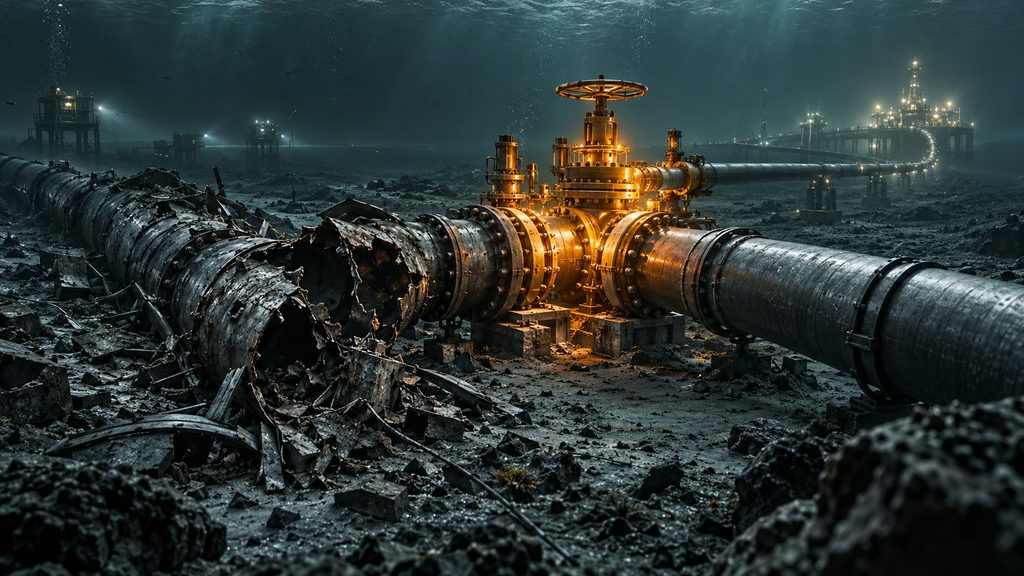
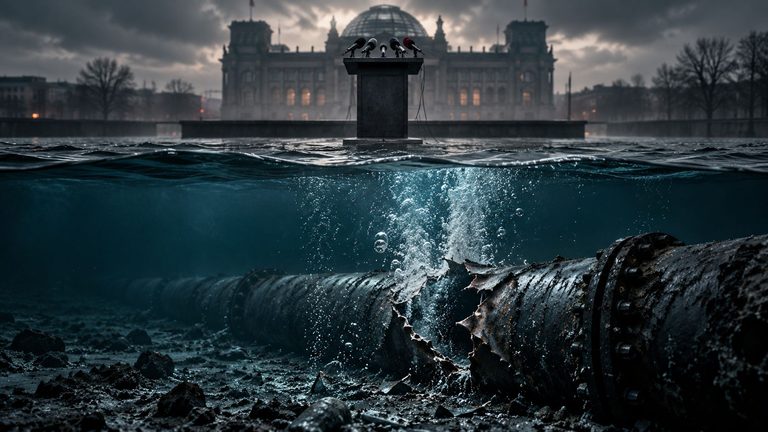
The same power whose president declared that the pipeline would never again carry Russian gas under his watch is now negotiating a stake in that very pipeline. On October 08, 2026, Reuters reported that senior American and Russian officials were discussing the involvement of a U.S. investor in the Nord Stream pipelines – the tubes beneath the Baltic Sea that, until Russia’s invasion of Ukraine, supplied more than half of Germany’s gas demand and that have lain on the seabed since September 2022, with 3 of the 4 strings destroyed. On the American side, the talks are being led by Jared Kushner, Trump’s son-in-law and special envoy; on the Russian side by Kirill Dmitriev, a close confidant of Vladimir Putin and head of the state investment fund. Reuters reported the U.S.-Russian discussions over a possible American investor in Nord Stream.
At first glance, the development is a contradiction that demands an explanation. A pipeline whose destruction some in the West openly celebrated is suddenly of interest again – and specifically to the very side that had the least difficulty with its disappearance. The question raised by this development is not whether Nord Stream will ever carry gas again; that remains uncertain. The question is a different and more uncomfortable one: Why, of all actors, does Washington want access to a pipeline that – if one follows the best-known theory of its destruction – it itself removed from play?
It is worth treating this not as material for outrage, but as a finding: What is documented, what is claimed, and what follows when the individual pieces are placed side by side? Because the truly remarkable point is not the Nord Stream report by itself. It is that the report fits into a sequence of other developments that, taken together, form a pattern – a pattern that a U.S. Secretary of State outlined with remarkable openness in Munich in February 2026.
What Is Documented: The Talks
Let us begin with what is documented. Reuters based its investigation on 5 people familiar with the matter. According to them, Kushner and Dmitriev met in Moscow and New York in recent weeks; how extensively they discussed Nord Stream remained unclear, but the subject remains on the agenda. The logic is obvious: An American stake would allow U.S. capital to earn money from the flow of Russian gas to Europe – once the war is over. Kushner, who is seeking to mediate a ceasefire between Moscow and Kyiv, explicitly views business deals as a means to peace. Dmitriev, for his part, has long advocated a resumption of Russian gas deliveries to Germany and met representatives of the U.S. Energy and Treasury Departments in September 2026 to discuss possible energy projects. Reuters, via Meduza, described the Kushner-Dmitriev channel and Nord Stream’s continued place on the agenda.
The official reaction from Washington is a lesson in itself. A White House representative said that any deal would have to go through the U.S. International Development Finance Corporation and the Treasury Department and would have to benefit U.S. taxpayers and businesses – only to add in the same breath that there had “recently been no Nord Stream talks.” A denial that confirms the structure while disputing only the timing; a non-denial that does more to acknowledge the existence of the talks than to dispel it. Fairness requires including the counterpoint: A U.S. official said a deal was unlikely in the medium term because of the obstacles. The obstacles are real, and they are substantial.
They begin with ownership. According to Reuters, the company controlling the Nord Stream pipelines is 51 percent owned by the Russian state corporation Gazprom; another 31 percent is shared by 2 German companies, with the remainder held by a French and a Dutch company. For a U.S. investor seeking a majority stake, the Russian share would be decisive – and, of all things, the 2 German shareholders reportedly want to retain their stakes in order to preserve German influence if Gazprom sells. That detail alone shows that not everyone on the German side is keeping the door as firmly shut as the official line suggests.
And it does not stop with Nord Stream. According to Reuters, Kushner and Dmitriev are simultaneously negotiating over the sale of an entire package of foreign assets belonging to the Russian oil company Lukoil – from refineries to filling stations in Europe and elsewhere, worth around $20 billion to $22 billion. A consortium involving the DFC and investors from Qatar and the United Arab Emirates would acquire the assets while the United States lifts the relevant sanctions. “Steve and Jared have negotiated a substantial upfront payment and profit participation for the United States with the DFC,” Reuters quoted a White House representative as saying with regard to Lukoil. Twice the same basic pattern: American capital gaining access to Russian energy infrastructure through the lifting of U.S. sanctions. Nord Stream is not an isolated case, but one of 2 parallel cases.
This Has Been Going On for More Than a Week
Anyone who sees this as a spontaneous idea born of this fall’s price pressure underestimates it. American interest in Nord Stream has been documented for years – and it did not come only from Washington; Moscow identified it early as well.
As early as March 27, 2026, Russian Foreign Minister Sergey Lavrov said in an interview with France Télévisions that the United States was seeking to take over the Nord Stream pipelines. What is notable is that Lavrov already placed Venezuela and Iran in the same context – precisely the theaters that, half a year later, would form a pattern together with Nord Stream. Lavrov’s statement is a Russian interpretation and should be read with corresponding caution; it disclosed neither a buyer nor terms. But it dates the issue long before it returned in a broader form in October. Il Foglio documented Lavrov’s March statement and his linkage of Nord Stream with Venezuela and Iran.
The trail goes back even further. As early as 2024, it became known that American investor Stephen P. Lynch, who had spent years doing business in Russia, was seeking U.S. authorization to bid in a possible sale of Nord Stream 2. In March 2025, the British Times reported contacts involving American investors around a possible revival of the pipeline; names mentioned included Matthias Warnig, the former managing director of Nord Stream 2’s operating company and a longtime associate of Putin, as well as U.S. diplomat Richard Grenell. Participants disputed parts of that account. What remains is the sequence: 2024, an interested private investor; March 2025, reports of informal talks; March 2026, Lavrov’s public attribution; October 2026, the concrete names Kushner and Dmitriev. This is not a whim of the moment. It is a persistent interest that has merely been waiting for its moment.
Responsibility for the Sabotage – Officially Unresolved
Here, care requires a clear boundary, and this article observes it. Who destroyed the Nord Stream pipelines in September 2022 has still not been conclusively established.
More precisely: It has not been officially established. That small qualification carries more weight than it may appear to at first glance – and, as it should, leaves the interpretation to the reader.
The official trail leads to Kyiv. Germany’s Federal Prosecutor’s Office is pursuing a Ukrainian-linked group of suspects. On August 19, 2026, it had Ukrainian diver Volodymyr Z. arrested in Pula, Croatia, on strong suspicion of involvement in the bombing; Germany is seeking his extradition. He would be the second defendant to face trial in Germany. The first, former Ukrainian officer Serhii K., was arrested in Italy in August 2025, transferred to Germany in November, and charged in Hamburg on June 30, 2026 – according to prosecutors, he acted on behalf of Ukrainian state authorities. He denies the allegations. In total, the Federal Prosecutor’s Office has obtained 6 arrest warrants; a seventh suspect, a Ukrainian soldier, is reported by media to have been killed at the front. Ukraine’s Prosecutor General’s Office says it has found no evidence of state involvement. One curious detail on the margins is too remarkable to ignore: Z. was arrested on the set of a Hollywood film about the Nord Stream sabotage, reportedly involving prominent actors. AFP reported the August 19, 2026 arrest in Croatia, while Militarnyi summarized the 6 arrest warrants and the Ukrainian prosecutor’s position.
Against that stands another interpretation, identified here for what it is: an attributed theory, not a finding. American investigative journalist Seymour Hersh, the Pulitzer Prize winner who exposed the My Lai massacre, published a report in February 2023 alleging that U.S. Navy divers, under cover of the NATO exercise BALTOPS 22, placed explosives on the pipelines that were remotely detonated 3 months later – on the orders of U.S. President Joe Biden. Hersh relies on an anonymous source; the United States has rejected the report. In interviews, Hersh described a motive that is central to the present context: The sabotage, he said, was intended to deprive Germany of the option of later explaining a return to Russian gas if the war dragged on and economic and public pressure from shortages increased. The Brussels Times published Hersh’s account and stated motive.
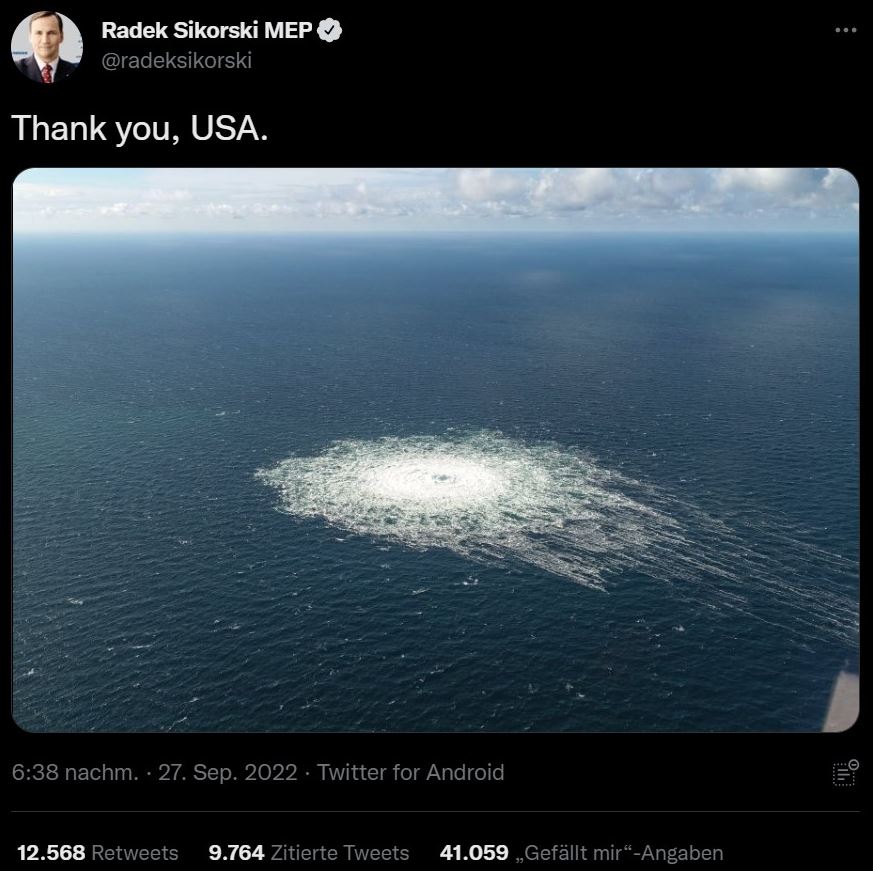
Whether one follows Hersh or not is left to the reader. Two documented events, however, belong beside it, and the reader may interpret them independently. On February 07, 2022, Joe Biden said beside German Chancellor Olaf Scholz that if Russia invaded, there would no longer be a Nord Stream 2: “We will bring an end to it.” Asked how that would be possible given that the project was under German control, he replied that the United States would be able to do it. And when the pipelines were destroyed, the Polish Foreign Minister Radosław Sikorski shared an aerial image of the gas plume over the Baltic Sea with the words “Thank you, USA” – a tweet he later deleted. Der Freitag documented both Biden’s February 07 statement and the Sikorski tweet. People were once visibly pleased that the pipeline had been removed from play. Now that it fits the concept, there is talk of bringing it back into operation. Whoever moved from one position to the other did so remarkably quietly.
The Key Lies in Munich
To understand why Nord Stream is not an isolated case, it is worth looking at a speech that attracted attention in February 2026. At the Munich Security Conference on February 14, 2026, U.S. Secretary of State Marco Rubio delivered an address that German media interpreted in different ways – some as reassurance, others as an undisguised rejection of the rules-based order. Rubio spoke of the United States being able to “once again become masters of our supply chains,” and accused competitors of using oil, coal, and gas not only to supply their own economies, but as leverage against those of the West. Berliner Zeitung documented Rubio’s supply-chain language.
The sentence that matters came when he turned to international law. The United States could not allow its adversaries, Rubio said, to “hide behind abstractions of international law that they themselves regularly violate.” Precision matters here: That statement was directed at U.S. adversaries – in the context of the speech, the powers challenging Washington. Legal Tribune Online, which documented the sentence, noted the cynicism embedded in it: The United States itself has invoked international law when convenient in the past and ignored it often enough when it was not. Rubio’s outlook, in sober summary: When it comes down to it, power and military strength count, not legal constraints. “It is the path we ask you here in Europe to join us on,” he concluded – a friendly invitation to his European listeners to follow the same path. Legal Tribune Online documented Rubio’s international-law passage and its context.
What matters is that Rubio supplied the actions alongside the speech. It was not the United Nations and its diplomats, he said, but U.S. bombers that had kept Iran’s nuclear program in check; and the United States had simply had to deal with Venezuela itself. This is not a theory about future conduct. It is a description of steps already taken, presented as a program. And whether the sentence about hiding behind international law was directed at Europe or not is secondary to what follows: What matters is that Europe, in the end, is treated according to the same logic the speech claimed for adversaries – through control of the energy flows on which the continent depends.
The Chain of Chokepoints
Place the developments of 2026 side by side and a logic emerges in which control over energy flows becomes a currency of power. Whoever controls the source, the route, or the chokepoint dictates the terms. Trump himself put this logic into words when he boasted of control over the world’s energy routes. Nord Stream is the newest link in this chain, not the first.

It began with Venezuela, home to the world’s largest proven oil reserves. A U.S. military operation removed President Nicolás Maduro at the beginning of January 2026 and took him out of the country. At the end of August 2026 came the economic side: An agreement signed by Defense Secretary Pete Hegseth and Secretary of State Rubio gives the Pentagon, through the newly created company North American Blue Energy Partners, a stake in around one-fifth of Venezuela’s oil reserves. The White House explicitly described the agreement as securing American “energy dominance for the next century.” Many of the oil fields concerned, the administration said, had previously been controlled by Russian or Chinese companies. Jack Reed, the ranking Democrat on the Senate Armed Services Committee, called it a blatant abuse of power to turn the military into an investor in a private oil deal. Al Jazeera reported the structure of the Venezuela oil agreement and the White House’s “energy dominance” language.
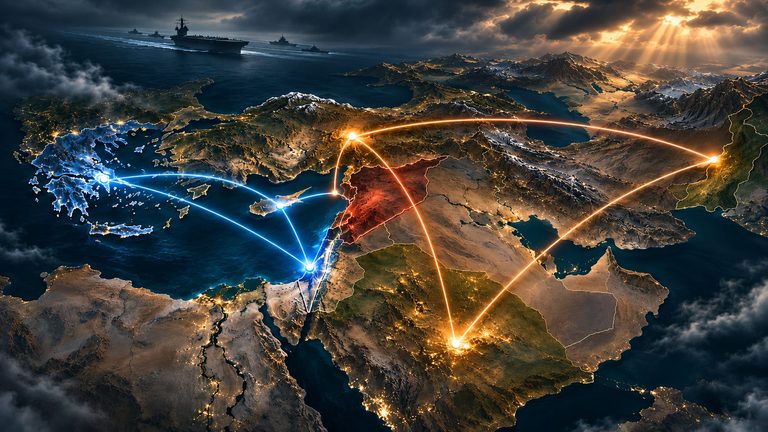
The second theater is the Strait of Hormuz, through which around one-fifth of global energy supply passed before the U.S.-Israeli war against Iran began at the end of February 2026. Since then, the strait has effectively been blocked; U.S. naval forces are militarily enforcing the blockade of Iranian ports while Iran, for its part, asserts its own claims of control. Whoever sits there has a hand on a valve through which a significant share of Asia’s energy demand – above all China’s – was previously supplied.
The third theater is Bab el-Mandeb, the second major chokepoint at the southern exit of the Red Sea. In September 2026, the Iran-aligned Houthis brought Yemen’s Red Sea coast and Mayyun Island under their control within a matter of days. Precision matters here: The Houthis are fighting primarily against Saudi Arabia, not the United States, and the offensive began in July 2026. Whether intentional or not, the result serves Washington’s interests. Together with Hormuz, a second critical energy chokepoint is now under pressure from Iran-aligned forces, and that pressure once again falls most heavily on those dependent on the sea route through Suez. AFP reported the Houthi takeover of the Bab el-Mandeb area in September 2026.
The fourth theater is Panama. On January 29, 2026, the country’s Supreme Court declared unconstitutional the concession for the Balboa and Cristóbal port terminals at both ends of the canal, operated by a subsidiary of Hong Kong conglomerate CK Hutchison; at the end of February, the operator was removed. Here, the neutral description is also the more effective one. The formal trigger for the judgment was an audit by Panama’s comptroller, which accused the operator of unpaid claims and irregularities. At the same time, the ruling came almost exactly 1 year after U.S. President Trump had threatened to “take back” the canal, which he claimed was controlled by China. Both facts stand side by side; the reader draws the conclusion. What remains is this: A Chinese-controlled operator lost the rights to 2 strategically located ports at a moment that aligned almost perfectly with the declared American interest. Malay Mail reported both the court ruling and Trump’s earlier threat over the canal.

Venezuela, Hormuz, Bab el-Mandeb, Panama – and now Nord Stream. Four of these 5 theaters are supported by documented developments; not every one of them is under American control, and Hormuz and Bab el-Mandeb are controlled by Iran and its allies, not Washington. But taken together, they indicate a direction, and the pipeline through the Baltic Sea fits seamlessly into it.
The Lever: How the Pipeline Could Return
One question remains hanging over everything: How could a pipeline ever carry gas again when it is sanctioned twice over – by both the United States and the EU? Under current law, a restart would be illegal. On July 20, 2025, the European Union imposed a comprehensive transaction ban on Nord Stream 1 and 2 through Article 5af of its sanctions regulation; any participation in completion, operation, maintenance, or use is prohibited. Gide Loyrette Nouel summarized the Nord Stream transaction ban under Article 5af. In addition, the EU adopted a phased exit from Russian gas: The full ban on liquefied natural gas takes effect in early 2027, and the ban on pipeline gas in the fall of 2027. The German government has stated that restarting the pipelines would require its approval and is not desired.
And yet there are paths, and they are not hypothetical. The first is domestic political and already documented: The AfD, currently the strongest force in German polling, explicitly supports reopening the pipelines – and Dmitriev, Putin’s man in these talks, is due to meet the AfD leadership in early 2027 to discuss reselling Russian gas. The second path runs through Brussels and time: mandates end, Commissions change, and a new leadership could set different priorities from the current one. Even today, the EU rule contains a small door – in a declared emergency, where security of supply is seriously threatened, the Commission may suspend the import ban for up to 4 weeks. Four-week windows have become permanent arrangements before. Gulf News reported the phased Russian-gas ban, the 4-week emergency clause, and the new origin-verification requirements.
The third path is pressure, and it can be studied in a development that unfolded in the same week as the Nord Stream report. With Russian diesel, Washington demonstrated how the mechanism works: first pressure on Europeans to open their strategic reserves, then – almost as soon as they began to do so – Washington’s own purchase from Moscow, whose energy the EU continues to sanction. Apply that mechanism to gas and a logic emerges, presented here as logic rather than fact: If a U.S. investor held a stake in Nord Stream, American capital would have an interest in the pipeline operating. Against a European “no,” the same lever used on diesel could be applied – no gas through Nord Stream, then perhaps, as the potential threat would run, no reliable replacement supply through other routes either, with Gulf states unable to fill the gap. How quickly such a “no” might soften is left to the imagination.
At this point, an irony forces itself into view and illuminates the entire issue. Imagine Europe actually demanded proof of origin all the way back to the source – to the very well from which the raw material came. Today the EU imports a substantial share of its petroleum products from India and pays high freight costs over long distances; that Indian refineries process Russian crude on a large scale is no secret – it was the core of Trump’s threat to impose tariffs on buyers of Russian oil. The same applies to gas: Europe would like to buy from Turkey but demands guarantees that the gas is not Russian – while Turkey has long since become an energy hub for precisely that Russian gas. The EU has recognized this loophole; it now requires importers to prove the origin of gas back to its actual source. Taken literally, that requirement would create a problem for Europe – it would drive and heat noticeably less in winter. And so the fiction of the final processing step remains: What was transshipped through a third country counts as that country’s product. Taken to its logical conclusion, a U.S. investor in Nord Stream would be nothing other than that final processing step – only for an entire pipeline.
What Remains in the End
Do not listen to what they say – watch what they do. What Washington says about Nord Stream has reversed within a few years, from declaring the pipeline finished to negotiating an entry into it. What it does is more consistent: It secures access – to Venezuelan oil, to passage through Hormuz, to Russian Lukoil assets, potentially to a German gas pipeline. The common thread is not the position toward Russia, which changes from one moment to the next. The common thread is control over the energy flows themselves.
That closes the arc Hersh drew – whether one follows him or not. If it were true that the pipeline was once destroyed to deny Germany a path back to Russian gas, then today’s reversal would consist of reopening precisely that path – only no longer as a German-Russian business, but as one in which American capital earns money from the transit and helps determine the terms. First destroy the option, then rebuild the option as one’s own business: That would not be a contradiction, but a method.
That an American stake will actually materialize is pure speculation; the obstacles are considerable, and Europe’s “no” still stands for now. That the development will be worth watching is not speculation. And so what remains at the end is less an answer than a question that reaches far beyond this one pipeline: If Nord Stream one day returns – with a U.S. investor as intermediary – how will a Commission sell that reversal to its citizens after having elevated the end of Russian gas into a moral principle for years?
About the Author
Michael Hollister
is a geopolitical analyst and investigative journalist. He served six years in the German military, including peacekeeping deployments in the Balkans (SFOR, KFOR), followed by 14 years in IT security management. His analysis draws on primary sources to examine European militarization, Western intervention policy, and shifting power dynamics across Asia. A particular focus of his work lies in Southeast Asia, where he investigates strategic dependencies, spheres of influence, and security architectures. Hollister combines operational insider perspective with uncompromising systemic critique – beyond opinion journalism. His work appears on his bilingual website (German/English) www.michael-hollister.com and in investigative outlets across the German-speaking world and the Anglosphere.
This analysis appears as part of Hollister’s Geopolitics. New deep-dive analyses weekly – subscribe free.
Sources
The Nord Stream Talks (Reuters Investigation, October 08, 2026)
- Reuters via Jerusalem Post – “American, Russian officials meet on bringing US investor into Nord Stream gas pipeline to Germany”
https://www.jpost.com/business-and-innovation/energy-and-infrastructure/article-910992 - Reuters via Meduza – “US, Russia discuss possibility of selling gas to Europe via Nord Stream”
https://meduza.io/en/news/2026/10/08/us-russia-discuss-possibility-of-selling-gas-to-europe-via-nord-stream - Kyiv Post – “Senior US and Russian authorities discuss American investor joining Nord Stream”
https://www.kyivpost.com/post/86500
Background to U.S. Interest (Lavrov, Lynch, Warnig/Grenell)
- Il Foglio – “The Kremlin is seeking partners in Washington” (October 09, 2026; with context on Lavrov/Venezuela/Iran)
https://www.ilfoglio.it/en/world/2026/10/09/news/the-kremlin-is-seeking-partners-in-washington–410009
The Sabotage – Status of the Investigation
- AFP via ARY News – “Ukrainian arrested in Croatia over Nord Stream sabotage” (August 19, 2026)
https://arynews.tv/ukrainian-arrested-croatia-nord-stream-sabotage - Offshore Magazine – “Second suspect arrested in Nord Stream pipeline sabotage case”
https://www.offshore-mag.com/special-reports/news/55399326/german-prosecutors-second-suspect-arrested-in-nord-stream-pipeline-sabotage-case - Euromaidan Press – “He was on the set of a Hollywood thriller about Nord Stream. Then Germany had him arrested.”
https://euromaidanpress.com/?p=422076 - Militarnyi – “Nord Stream Sabotage: Ukrainian National Detained in Croatia” (6 arrest warrants; Ukrainian Prosecutor General’s Office)
https://militarnyi.com/en/news/nord-stream-sabotage-ukrainian-national-detained-in-croatia-after-poland-refused-to-extradite-him-to-germany/
The Sabotage – Hersh Theory and Documented Statements
- Brussels Times – “Seymour Hersh on why the US blew up Nord Stream”
https://www.brusselstimes.com/politics/446104/deconstructing-the-obvious-seymour-hersh-on-why-the-us-blew-up-nord-stream/ - Stabroek News / Ralph Ramkarran – “The Blowing Up of the Nord Stream Pipelines” (Hersh’s stated motive: denying Germany a path back; Biden and Nuland quotations)
https://www.stabroeknews.com/?p=703177 - Der Freitag – “Cui bono: Wer profitiert von Seymour Hershs Enthüllung?” (Biden, February 07, 2022; Sikorski tweet)
https://www.freitag.de/autoren/sebastianpuschner/wer-profitiert-von-seymour-hershs-enthuellung-zu-den-nord-stream-anschlaegen
Rubio Speech, Munich Security Conference (February 14, 2026)
- Legal Tribune Online – “Freundliche Einladung zur Abschaffung des Völkerrechts” (international-law quotation, Iran, Venezuela)
https://www.lto.de/recht/hintergruende/h/muenchener-sicherheitskonferenz-voelkerrecht-rubio-rede-usa-europa-internationales-recht - Berliner Zeitung – “Marco Rubio über Beziehung zu Europa: ‘Wir wollen starke Verbündete’” (supply-chain quotation)
https://www.berliner-zeitung.de/article/10019027
Chokepoint Chain – Venezuela
- Al Jazeera – “White House unveils more details of Trump’s Venezuela oil deal” (NABEP, 100-year concessions, Hegseth/Rubio)
https://www.aljazeera.com/news/2026/9/1/white-house-unveils-more-details-of-trumps-venezuela-oil-deal - NPR via KUNC – “Days after Trump announces Venezuela oil deal, White House fills in some of the details” (Pentagon stake, Reed criticism)
https://www.kunc.org/npr-news/2026-09-01/days-after-trump-announces-venezuela-oil-deal-white-house-fills-in-some-of-the-details
Chokepoint Chain – Bab el-Mandeb
- AFP via Ahram Online – “Yemen’s Houthis complete takeover of Bab al-Mandab area” (September 11, 2026)
https://english.ahram.org.eg/News/576459.aspx - FDD’s Long War Journal – “Houthis take Yemen’s Red Sea coast and key Bab al Mandeb islands”
https://www.fdd.org/analysis/2026/09/14/houthis-take-yemens-red-sea-coast-and-key-bab-al-mandeb-islands/ - Northeast Times – “Houthis Take Control of Bab al-Mandeb” (Hormuz context; one-fifth of global energy supply)
https://northeasttimes.com/?p=163355
Chokepoint Chain – Panama
- Malay Mail – “CK Hutchison launches global legal fight after Panama tears up ‘unconstitutional’ port deal” (Trump threat, court ruling)
https://www.malaymail.com/amp/news/money/2026/02/04/ck-hutchison-launches-global-legal-fight-after-panama-tears-up-unconstitutional-port-deal/207975 - Container Management – “Panama Supreme Court Annuls CK Hutchison Port Concessions” (Comptroller audit)
https://container-mag.com/2026/02/01/panama-supreme-court-annuls-ck-hutchison-port-concessions/ - Seatrade Maritime – “Hutchison Panama ports concession formally terminated” (termination of port concession, February 23, 2026)
https://www.seatrade-maritime.com/ports-logistics/hutchison-panama-ports-concession-formally-terminated
EU Legal Position and Paths to Reactivation
- Gide Loyrette Nouel – “EU update: 18th package of sanctions” (Nord Stream transaction ban, Article 5af, July 20, 2025)
https://www.gide.com/news-insights/eu-update-18th-package-of-sanctions-in-reaction-to-russias-invasion-of-ukraine/ - European Commission FAQ via Czech Customs Administration – “Nord Stream and Nord Stream 2 Transaction Ban – Article 5af of Council Regulation 833/2014”
https://celnisprava.gov.cz/cz/Documents/2026-01-23–FAQs-Sanctions-Russia-Nord-Stream_en.pdf - Gulf News – “EU signs ban on Russian gas into law” (LNG phaseout in 2027 / pipeline gas in fall 2027, 4-week emergency clause, origin verification)
https://gulfnews.com/business/energy/eu-signs-ban-on-russian-gas-into-law-1.500421671
Context: Diesel Mechanism in the Same Week
- Michael Hollister – “Sanctioned, Bought, Blown Up, Negotiated: Trump’s Energy Week and the Break with Kyiv – Part 1” (author’s own article, research status October 13, 2026)
© Michael Hollister – All rights reserved. Redistribution, publication or reuse of this text requires express written permission from the author. For licensing inquiries, please contact the author via www.michael-hollister.com.