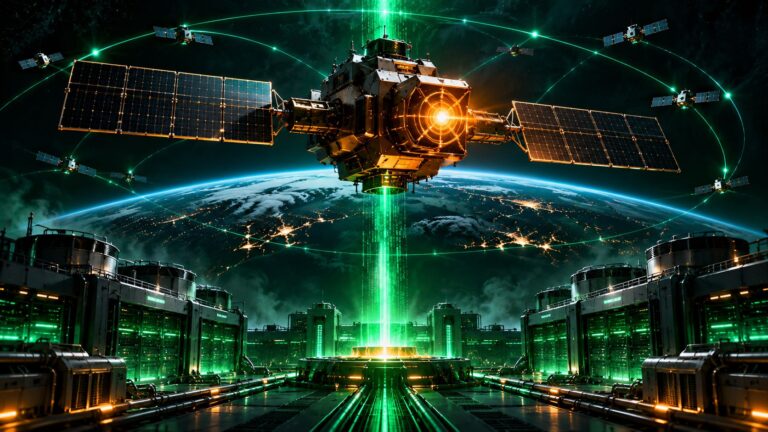
by Michael Hollister
Exclusive published at Michael Hollister on October 11, 2026
Part 1 read here:
Terafab – Part 1: The Factory for AI in Space
Part 3 read here:
Terafab – Part 3: Escape Upward
4.684 words * about 25 minutes readingtime

The answer lies in physics, not in the press release
Part one ended with two questions no reader could shake. The first: How on earth does Elon Musk intend to get these quantities into orbit – the chips, the energy, the cooling, the sheer number of launches? The second, and the bigger one: Why go into space at all? The obvious assumption – space is freezing cold, so it must be ideal for computers running hot – sounded compelling. But, as noted then, it contains a misconception on which the entire physics of this project turns.
This part answers both questions. It is the technical installment of the series, and at one point it becomes uncomfortable because the physics is uncomfortable. But it does not end where skeptics would like it to end – with a shake of the head at a billionaire who dreamed too big. It ends with a sober finding: The system Musk has in mind is not self-contradictory. The numbers fit together. What stands between vision and reality is not a chain of conceptual errors, but a single physical quantity. And over the past few weeks, something has happened with precisely that quantity that shifts the entire calculation.
Let us begin with the idea on which everything else rests.
The conceptual reversal: not bringing energy to the chip, but the chip to the energy
Anyone building a data center thinks first about electricity. A large data center on Earth consumes the output of a medium-sized power plant, and the struggle for that power has long since become the real bottleneck of the AI industry. It is not the chips that are scarce, but the electricity needed to run them, the transmission lines needed to deliver it, and the permits required for both. Microsoft, Amazon, Google – all of them are now lining up at utilities; in some places they are buying stakes in entire power plants, and still it is nowhere near enough.
Musk’s own explanation for moving into space starts exactly here. On Earth, he says, we are “power constrained on Earth.” That is why by far the largest share of computing capacity will ultimately have to be built where that constraint disappears. At first, this sounds like an evasive maneuver. In fact, it contains a reversal that one has to read twice to grasp its implications.
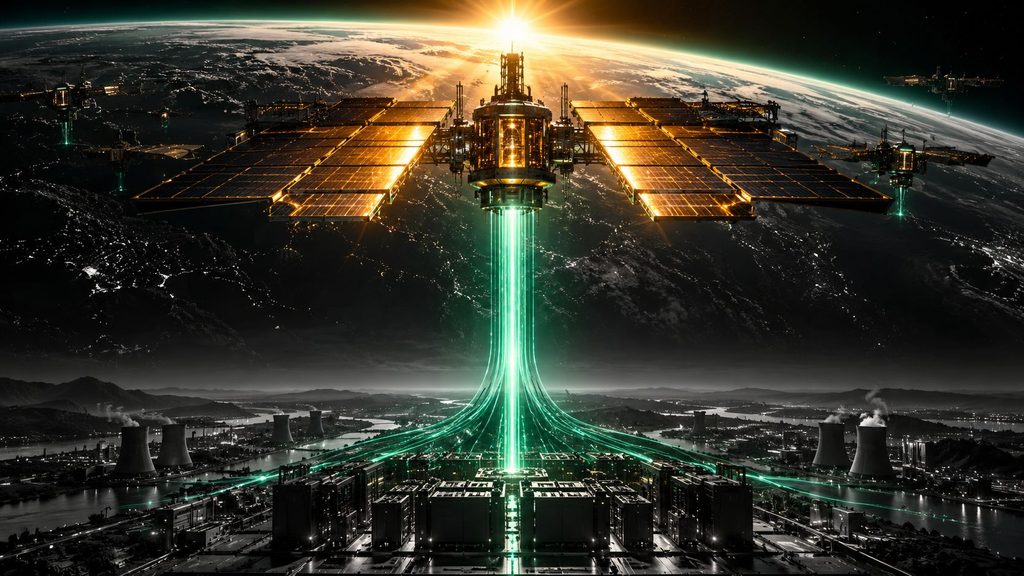
The familiar logic is this: You build the data center where people are and bring the energy to it. Cables, substations, power plants – an entire infrastructure serves one purpose: getting electricity to the place where computation happens. Musk reverses that sentence. He does not bring the energy to the computer. He brings the computer to the energy.
And the largest energy source in the solar system is not on Earth. It is above it. The Sun emits, in the words of Google’s own research paper on Project Suncatcher, more than 100 trillion times the power generated by all of humanity. Only a fraction of that reaches Earth – filtered by the atmosphere, interrupted by night and weather, spread across a rotating planet. In the right orbit, all of that disappears. There, the Sun shines almost continuously, and it shines at full intensity.
That is the key that unlocks every number that follows. Once you understand that Musk wants to move computation to the energy rather than the other way around, you understand why orbit is not some exotic destination for him, but the most obvious answer to the problem currently choking the entire industry.
Why orbit really does solve the energy question
The number that quantifies this advantage comes not from Musk, but from a competitor, which makes it more useful as a benchmark. As part of Project Suncatcher, Google calculated what a solar panel can deliver in the right orbit: It can be up to 8 times more productive than the same panel on Earth, while supplying power almost continuously.
Eight times. It is worth understanding where that factor comes from, because it is not a mathematical trick. A panel on Earth spends roughly half its time in darkness, loses output through the atmosphere, produces less in winter than in summer, and more at noon than in the morning. A panel in a sun-synchronous dawn-dusk orbit – a path that continually tracks the boundary between day and night – sees the Sun virtually nonstop, with no atmosphere in between and at a constant angle. It does not need heavy batteries for the night because there is no night. It does not need reserves for cloudy days because there is no weather.
On Earth, by contrast, expansion runs into limits that technology alone cannot remove. Building a new power plant takes years. Getting a high-voltage transmission line approved through populated areas often takes even longer. Large tracts of land for solar farms are finite, and they compete with agriculture, conservation, and the people who live there. Google research chief James Manyika has made exactly this point: The laborious business of arranging grid connections, negotiating power contracts, and planning around years of waiting remains on Earth. In orbit, it disappears. There, the chip sits directly next to the panel that powers it – no transmission line, no grid, no substation in between. NPR’s reporting on Project Suncatcher describes the same basic logic.
That leaves the obvious objection: If the computer is in space, how do the results get back to Earth? The answer is surprisingly reassuring, and it explains why the entire idea can make economic sense at all. You do not actually have to send much back. Enormous amounts of energy and computation flow into an AI data center – trillions of operations to train a model or answer a query. What comes out is tiny: a few kilobytes of text, an answer, a data packet. You do not send the electricity back to Earth, and you do not send the computation. You send only the finished result. The connection required for that – laser links between satellites and down to the ground – is demanding, but no longer a fundamental obstacle. The data can come down. That part is solved.
That gives us one half of the answer to the question “Why space?” Because that is where the energy is that Earth lacks, and because only the result has to make the trip back, not the energy itself. So far, it all sounds like a smart plan. Now comes the uncomfortable part.
The misconception on which everything turns
The second, tempting argument for going into space is this: It is freezing cold up there. Minus 454 degrees Fahrenheit, almost absolute zero. What could be better for cooling computers that become scorching hot under load? Just put the machines in cosmic cold, and the problem solves itself.
That idea is wrong. And not slightly wrong, but fundamentally wrong – it turns the physics on its head.
Space is not cold in the sense that a refrigerator is cold. Space is empty. And that is something entirely different. Heat leaves a hot object in 3 ways: by conduction, when the object touches something colder; by convection, when air or water carries the heat away; and by radiation, when the object emits it as invisible light. The first 2 mechanisms require matter – something that can absorb the heat and carry it away. In a vacuum, that matter does not exist. No material touches the chip, no air flows across it, no water removes the heat. Radiation is all that remains. And radiation is the slowest of the 3.
Anyone who owns a good insulated travel mug holds the proof in their hands every day. Why does the coffee inside stay hot for hours? Because there is a vacuum between the inner and outer walls. That vacuum does not conduct heat – which is precisely why the coffee’s heat cannot escape outward. The mug keeps things warm because vacuum insulates. The same vacuum that keeps the coffee hot surrounds every chip in orbit. Space does not cool a computer – it insulates it, just as the mug insulates the coffee. It is the same physics, only on a gigantic scale and with the sign reversed: What is desirable for coffee becomes a threat to a data center.
A chip in orbit therefore sits in about the worst possible environment for getting rid of its own waste heat. It cannot dump that heat into its surroundings because there are no surroundings capable of absorbing it. It can only radiate the heat away – slowly, laboriously, over large areas. And the more chips there are, the more computing power there is, the more heat has to go somewhere even though there is no real “somewhere” for it to go.
That is the misconception part one warned about. The supposedly simplest argument for going into space – the cold – is actually the biggest physical problem in the entire project. Not energy. Not radiation. The heat you cannot get rid of.
The first wall: cooling, and what it really costs
How serious this problem is cannot be guessed; it has to be calculated. Fortunately, there is a key witness that has been orbiting Earth for more than 2 decades, and NASA publishes its numbers: the International Space Station.

The ISS generates about 70 kilowatts of waste heat during operation – roughly as much electricity as 14 households consume. To get rid of this relatively modest amount of heat, the station requires a system impressive in its own right. Two separate loops pump liquid ammonia through pipes that absorb heat from the interior and carry it to large radiator surfaces on the exterior. These radiators – 6 deployable arrays, each consisting of 8 panels – provide a combined radiating area of more than 4,500 square feet. For 70 kilowatts. NASA’s overview of the ISS Active Thermal Control System documents the architecture, while the AIAA literature on space-radiator performance shows why radiative cooling becomes such a central design problem.
Scale that up for a moment. More than 4,500 square feet to radiate the waste heat of 14 households. A single large AI data center on Earth draws the power of more than 100,000 households. Musk’s stated target is around 1 terawatt – 1,000 gigawatts. If one naively extrapolates the ISS metric to that scale, radiator areas run into thousands of square miles, and the radiator mass becomes many times greater than the computing hardware itself. Rough estimates suggest that cooling hardware could weigh 10 times as much as the chips. Before the first data packet is even processed, you have saddled yourself with 10 times the transportation burden – just for the radiators.
These figures are back-of-the-envelope estimates, not measurements, and they should be labeled as such. They depend on assumptions about operating temperature, efficiency, and construction that can change. But the order of magnitude remains, and it is sobering. Cooling is not some detail you solve later. It can limit the entire project.
Musk knows this wall, and he has an answer that is physically elegant and at the same time constrained. The amount of heat a surface radiates does not increase linearly with its temperature, but with the fourth power. Double a radiator’s absolute temperature and it emits not twice, but 16 times as much heat. That creates leverage: If you allow chips to run hotter than you ever would on Earth, the radiators can emit dramatically more heat per unit area – which means you need correspondingly less area and less mass.
That is exactly what Musk has announced. The chips intended for space, he said when introducing Terafab, would deliberately be operated hotter than terrestrial chips, “to minimize the radiator mass.” The factory is supposed to build 2 different chips, and the one intended for space is designed from the ground up to tolerate temperatures an ordinary processor would not survive. CBS News’ overview of the Terafab project and Fox Business’ report on the planned Tesla-SpaceX chip facility both describe these plans.
The leverage helps. But it has a hard ceiling. A chip cannot simply be made arbitrarily hot – beyond a certain temperature it no longer operates reliably, then stops operating at all, and then destroys itself. The fourth-power relationship is a powerful ally as long as you are allowed to use it, but silicon’s material limits put an end to the game. Musk buys back radiator area by running hotter chips, but he cannot buy back an unlimited amount. Cooling remains the hardest physical constraint on the entire project.
The second wall that is not a wall: radiation
Alongside heat, cosmic radiation is often cited as an obstacle, and it is worth being honest rather than dramatic here. Radiation is a serious problem. But unlike cooling, it is manageable.
In orbit, high-energy particles hit electronics – ions, protons, charged particles from which the atmosphere shields us at ground level. They can trigger individual computational errors, flip memory cells, and over time damage materials. In the relevant orbit, the radiation dose over a year adds up to many times what reaches Earth’s surface. That sounds threatening, and for unprotected hardware it would be.

But this exact problem has recently been measured, and the results are reassuring. In tests, off-the-shelf graphics processors – the same general type of processor used in terrestrial AI data centers – were bombarded with radiation doses simulating several years in orbit. They survived multiples of the expected annual dose without permanent failure. There were temporary disruptions and required restarts, but no final breakdown. Google, meanwhile, has qualified its own computing chips for multiyear use in low Earth orbit. And there are designs in which the cooling loop – water-based and already present – also serves as radiation shielding, allowing the same mass to perform 2 functions. The tether-based orbital AI architecture study and a broader paper on spacecraft constraints and the economic viability of orbital data centers explore this class of design problem.
The honest finding, then, is this: Radiation is an engineering burden, not a show-stopper. It costs shielding, it costs robustness, and it may shorten service life. But it does not fundamentally block the project. Not every challenge in this project is a wall – and anyone examining it seriously has to say so, even if that makes the story less dramatic.
The escape route that changes the entire architecture
At this point, the attentive reader runs into a contradiction. If cooling for a huge centralized station weighs many times more than the chips and threatens to crush the project – why does Musk not simply build smaller? The answer both releases the cooling vise and begins an entirely new logic.
One must not imagine a data center in space as a single gigantic structure, an orbital cathedral of steel and silicon. That image is precisely what makes cooling fail. The larger and more compact the station becomes, the harder it is to move heat from the inside to the exterior and radiate it away – heat builds up in the center, radiator area becomes insufficient, and mass explodes. A single mega-station with the capacity Musk is targeting would be a thermal nightmare.
The solution reverses the picture. Instead of 1 large station, you build many small nodes. Not 1 data center, but a swarm of hundreds, thousands, perhaps millions of individual satellites, each small enough to radiate its own waste heat. What is impossible with a monolithic giant becomes solvable with many small units: Each node has its own panel, its own computing capacity, its own radiating surface in the proportion physics allows. The cooling vise opens the moment you stop thinking big and start thinking numerous.
Google has already sketched what that could look like in its Suncatcher paper. The computing satellites would fly in compact formations at short distances from one another – on the order of 300 to 650 feet, within a radius of roughly 0.6 miles – and would be linked by laser connections so tightly that together they operate like a single distributed data center. Many bodies flying separately in physical space, yet logically forming 1 machine. That architecture solves the heat problem that made the single-station model impossible.
Cooling has not disappeared, but it is no longer the wall it first appeared to be – provided one accepts that the data center of the future is not a building, but a cloud. That swarm brings consequences of its own that go far beyond thermodynamics – vulnerability to attack, maneuvering around debris, the question of what happens when an individual node fails. Those are substantial threads, and they deserve their own installment in this series. For now, 1 thought is enough: The way out of the cooling vise does not run through a larger power plant, but through division into many smaller units. That is the architectural shift on which everything else rests.
The real wall: how often a rocket launches
We have solved the energy problem and worked around cooling, while classifying radiation as manageable. What remains is the question part one asked first and that has run through everything up to this point: How does all of it get up there in the first place?
Here, and only here, stands the wall on which this installment rests. It is not a question of physics in the narrower sense – no law of nature forbids what Musk intends to do. It is a question of logistics, and it can be reduced to a single quantity: how often a rocket launches.
Let us run the numbers. Musk’s vision calls for as much as 10 million metric tons of material to be launched into orbit every year to build the computing capacity he is targeting. A fully loaded heavy-lift rocket carries, generously estimated, on the order of 100 to 200 metric tons per flight. Divide one figure by the other and you arrive at tens of thousands of launches per year – by a rough estimate, more than 100 launches every single day. Reality looks very different: Today, all of humanity combined puts only a few hundred rockets into orbit each year. Not each day. Each year.
Between those 2 numbers – a few hundred per year today and more than 100 per day as the target – lies no ordinary progression of technological improvement. What lies between them is something this article otherwise avoids saying and deliberately says here: a technological revolution. Not as a marketing term, but as a quantifiable gap. Global launch cadence would have to increase by a factor for which there is no historical precedent in spaceflight.
And it is precisely at this wall that something happened in recent weeks that shifts the calculation – it does not solve it, but it shifts it.
On September 28, 2026, Musk’s giant Starship rocket flew for the 14th time. It was a special flight. All 13 previous flights had been suborbital – the rocket climbed, demonstrated what it could do, and came back down without ever reaching a stable orbit. Flight 14 was the first to reach orbit, and once there it did something useful: It deployed 26 satellites, real hardware, not test mass. Together, those satellites weighed around 52 metric tons – the largest payload delivered to orbit in a single launch since the days of the Skylab space station, as Musk noted. And that was not even the full load: Because of an engine problem during ascent, SpaceX ended the mission early, while the payload bay is designed for considerably more. SpaceX documents the mission on its Starship Flight 14 page, while Space.com reported on the satellite deployment.
The sequence matters. Only a few months ago, the launch-cadence wall could have been dismissed with a single word: illusory. A rocket that could not even reach orbit reliably was supposed to become the launch fleet for entire data centers in space? That judgment is outdated. The first rung of the ladder has been climbed in reality. The rocket flies to orbit, deploys payloads weighing dozens of metric tons, and 2 more flights were already on the calendar for the weeks that followed. What yesterday could be dismissed as fantasy is today a documented event.
But none of that changes the steepness of the staircase that comes next. The satellites Starship deploys are huge – each one weighs around 2 metric tons. Flight 14 carried 26 of them; at full utilization, the payload bay can hold about 60. At that full capacity, the planned communications network of 100,000 satellites alone would require close to 1,700 launches – and at Flight 14’s reduced load, well over 3,000. And that is only the communications network, not the data centers. For Musk’s 10 million metric tons per year, the calculation of more than 100 launches a day remains. The first rung has been taken. The ladder still reaches farther upward than anything in current experience.
The finding at this wall is therefore double-edged. Launch cadence is the real bottleneck, not physics. And this bottleneck is not a law of nature, but an engineering problem on which visible work is now underway – with a first success that confirms the direction without making the scale any smaller.
The counterarguments that have to be heard
An article that merely retold Musk’s calculations would be a glossy brochure. An honest assessment has to acknowledge that intelligent people consider this project questionable or even absurd, and their objections are not mere grumbling. They identify real weak points.
The most serious objection concerns precisely the launch cadence. Aaron Boley, an astronomer and co-director of the Outer Space Institute, has pointed to a ratio that should dampen any orbital euphoria: Every metric ton placed into orbit requires roughly 10 to 30 times as much propellant at launch. Anything headed upward has to be lifted there through a burning column of chemistry, and that column carries a cost – environmentally, economically, physically. At 10 million metric tons of payload per year, the resulting quantity of propellant becomes dizzying. KALW’s coverage of Project Suncatcher reports Boley’s warning.
That objection is correct, and it applies – at today’s state of technology. But this is also exactly where the declared goal of the entire SpaceX logic comes in. The ratio of propellant to payload is not a natural constant, but a function of vehicle design, and full reusability is the lever intended to push it down. Boley’s factor describes the present; the company’s entire effort is aimed at reducing it. No one can seriously predict how far – anyone who gives a precise number is guessing. But the direction of travel is clear, and it is the real race behind the race.
The second objection comes from direct competition and carries weight because it comes from someone who should know. Sam Altman, head of OpenAI and therefore one of the world’s largest buyers of computing capacity, has called Musk’s plans for data centers in space “ridiculous” when measured against current demand. Measured against the present, the objection is hard to dismiss: Nobody currently needs 50 times the world’s production of computing capacity. It only loses force once the time horizon shifts to the one Musk explicitly uses – not today’s demand, but the demand of the day after tomorrow. Whether one calls that foresight or megalomania is a matter of perspective; that the 2 men are talking about different time horizons is a matter of accuracy. The report carrying Altman’s “ridiculous” characterization captures that divide.
The third objection is the quietest and perhaps the fairest. Even from the camp of competitors pursuing the same goal comes a warning to be patient. Google research chief Manyika has cautioned that no practically usable system should be expected in the next few years. He says this about his own project. It is the voice of someone who believes in the same future and at the same time knows how far away it remains. Anyone who thinks Musk’s Terafab is a project for the day after tomorrow should take that voice seriously: The direction may be right, but the timeline is the most open question of all.
Three objections, 3 truths. None disproves the concept. Together they draw the realistic picture: a project whose internal logic works and whose timetable remains open.
Findings
Let us summarize what this installment has established. The energy question is not merely solvable in orbit, but more easily solvable there than on Earth – that is where the sunlight exists without the constraints found here. The data can make its way back because only the result has to return, not the computation itself. Cooling is the hardest physical constraint, but it loosens once 1 massive installation is broken into a swarm of many small nodes. Radiation is an engineering burden, not a wall. And the real obstacle, launch cadence, is not a question of physics but of logistics – an engineering challenge on which work is now visibly underway with the first real orbital success.
The decisive point is the overall finding. The system is not self-contradictory. Put the individual numbers next to each other – energy, cooling, radiation, transport – and there is no calculation error, no point at which physics says no. What stands between Musk’s vision and its realization is not a chain of conceptual errors, but a single quantity that still has to increase by orders of magnitude: the number of launches. That does not make the project certain to happen. It makes it worth taking seriously. The difference between fantasy and a gigantic engineering project is exactly this: In fantasy, physics says no. Here physics says: It will be expensive, it will be difficult, it will require a revolution in launch cadence – but it is not forbidden.
Which leaves a new question, and it leads away from physics and toward power. Suppose the physical wall falls. Suppose the rockets fly often enough, the swarms cool themselves, the chips survive the radiation. Then there will be a computing infrastructure in orbit on a scale Earth has never seen – and it will exist in a place over which no state in the world has ever exercised sovereignty. Under whose law does a data center operate when it no longer touches the ground? Part three will examine that question.
Part 3 read here:
Terafab – Part 3: Escape Upward


About the Author
Michael Hollister
is a geopolitical analyst and investigative journalist. He served six years in the German military, including peacekeeping deployments in the Balkans (SFOR, KFOR), followed by 14 years in IT security management. His analysis draws on primary sources to examine European militarization, Western intervention policy, and shifting power dynamics across Asia. A particular focus of his work lies in Southeast Asia, where he investigates strategic dependencies, spheres of influence, and security architectures. Hollister combines operational insider perspective with uncompromising systemic critique – beyond opinion journalism. His work appears on his bilingual website (German/English) www.michael-hollister.com and in investigative outlets across the German-speaking world and the Anglosphere.
Stay informed without having to work through the daily flood of news – the most important developments and connections summarized for you.
Sources
Primary sources and specialist literature
Musk’s own statements on Terafab (T⁴ leverage, “run hotter,” 1-terawatt chip output, 80/20 split):
- CBS News – What is Elon Musk’s Terafab chip project?: https://www.cbsnews.com/news/terafab-elon-musk-chips-semiconductors-what-to-know/
- Fox Business – Musk says Tesla and SpaceX will build new AI chip facility in Austin: https://www.foxbusiness.com/technology/musk-says-tesla-spacex-build-advanced-chip-manufacturing-facility
Energy, 8× solar output, economic threshold, swarm geometry:
- Google Research – Exploring a space-based, scalable AI infrastructure system design: https://research.google/blog/exploring-a-space-based-scalable-ai-infrastructure-system-design/
- NPR / KVCR – Google wants to build solar-powered data centers in space: https://kvcr.org/news/npr-top-stories/2026-10-01/project-suncatcher-google-ai-data-center-space
Cooling, ISS thermal system (70 kW, radiator area):
- NASA – International Space Station Active Thermal Control System Overview: https://www.nasa.gov/pdf/473486main_iss_atcs_overview.pdf
- AIAA, Journal of Spacecraft and Rockets – Thermal Performance Evaluation of Space Radiator: https://arc.aiaa.org/doi/10.2514/1.A35030
Radiation, two-phase cooling, radiation shielding:
- arXiv 2512.09044 – Tether-Based Architecture for Solar-Powered Orbital AI Data Centers: https://arxiv.org/abs/2512.09044
- arXiv 2604.27197 – Orbital Data Centers: Spacecraft Constraints and Economic Viability: https://arxiv.org/html/2604.27197
Starship payload status, Flight 14 (first orbital flight, real payload):
- SpaceX – Starship Flight 14: https://www.spacex.com/launches/starship-flight-14
- Space.com – SpaceX Starship megarocket deploys satellites into orbit for 1st time ever: https://www.space.com/space-exploration/launches-spacecraft/wow-watch-spacexs-starship-megarocket-deploy-satellites-into-orbit-for-1st-time-ever-photos-video
Counterarguments
- KALW – Google’s Project Suncatcher (launch costs, Boley quote on propellant ratio): https://www.kalw.org/kalw-news/2026-10-02/googles-project-suncatcher-aims-to-put-data-centers-in-space
- AOL – Musk says Tesla, SpaceX to build advanced chip manufacturing facility (Altman: “ridiculous”): https://www.aol.com/articles/musk-says-tesla-spacex-build-120402701.html
© Michael Hollister – All rights reserved. Redistribution, publication or reuse of this text requires express written permission from the author. For licensing inquiries, please contact the author via www.michael-hollister.com.