by Michael Hollister
Exclusive published at Michael Hollister on October 04, 2026
3.076 words * 16 minutes readingtime
Part 2 read here:
The Omitted “If”: How a Response Was Turned into a Nuclear Threat – Part 2


In late September 2026, a report swept through Western news coverage that could hardly have been more reductive: Russia was threatening NATO with nuclear weapons. In many accounts, the statement appeared almost entirely on its own. Moscow, the prevailing narrative suggested, had once again played the nuclear card for no reason, out of nowhere – further evidence of the Kremlin’s unpredictability. What was almost completely absent from this framing was the subordinate clause that changes the entire meaning, as well as the events that preceded it.
This article reconstructs what actually happened. It places the steps taken by both sides next to one another, chronologically and on the basis of primary sources: official statements, defense ministries, flight data, and exercise reports. It does not judge who is right. It lays out the evidence and leaves the judgment to the reader.
Two Documents, Two Formulations
The first task is to clarify what is actually being discussed. There were 2 separate Russian statements that were regularly merged in news coverage.
On September 29, 2026, the Russian Embassy in Belgium, which handles diplomatic relations with NATO, published a statement on its Telegram channel. It said that Russia would use its entire arsenal if an attempt were made to cut the Kaliningrad exclave off from the rest of Russian territory. The word nuclear did not appear explicitly in this public statement.
One day later, on September 30, 2026, Reuters reported on a second, nonpublic document. Russia had sent NATO what is known as a “non-paper,” an informal diplomatic text. The document, which Reuters said it had reviewed, explicitly mentioned nuclear weapons. Its wording stated: “Russia will be ready to use the entire arsenal of forces and capabilities at its disposal, including nuclear weapons, in order to defend its territory should NATO countries undertake any attempt aimed at isolating the Kaliningrad region from the rest of the country.”
In the same document, Russia also stated the reason it gave for the warning. According to consistent news agency reports, Moscow said it possessed information that NATO was preparing an air and sea blockade of Kaliningrad. This is explicitly a Russian claim, not an independently confirmed finding; NATO denies having any such intention. The point is nevertheless central to understanding the Russian response because it identifies the perception from which Moscow says it is acting. The Kremlin itself played down the severity of the episode: Spokesman Dmitry Peskov described the statements as diplomatic reminders to “hotheads in Europe.”
The first widespread claim therefore already requires qualification. It would be wrong to say that Russia did not threaten the use of nuclear weapons at all – it clearly did so through the diplomatic channel. But it would be equally wrong to describe the threat as unconditional. The decisive element is the condition: If Kaliningrad is isolated, then the entire arsenal may be used. This if-then structure fundamentally distinguishes the statement from a sentence such as “We will use nuclear weapons against you.” What Russia issued was a conditional deterrence warning. The decisive journalistic questions are therefore: What does the “if” refer to? What would have to happen for the condition to be met? And why did this subordinate clause disappear from most Western accounts?
Answering those questions requires going back not merely to September 29, 2026, but to May.
The Geography of the Problem
Kaliningrad is a Russian exclave on the Baltic Sea wedged between the NATO members Poland and Lithuania. It has no direct land connection to Russia’s core territory. Anyone traveling overland from Russia to Kaliningrad must cross foreign territory – either Lithuania, or Russia’s ally Belarus and then a narrow strip of land between Poland and Lithuania.
That strip has a name that appears in every military assessment of the Baltic region: the Suwałki Corridor. Named after the Polish city of Suwałki, it is a land bridge roughly 40 to 62 miles wide, depending on the definition, along the Polish-Lithuanian border. It is the only land connection between Poland and the Baltic states. Kaliningrad lies to the west, Belarus to the east.
The corridor has a dual character, and that duality lies at the heart of the entire strategic problem. The same strip of land that connects the Baltic states with the rest of NATO territory also separates Kaliningrad from the Belarusian hinterland. Whoever controls it either connects the Baltic region or cuts off Kaliningrad, depending on the direction from which it is viewed. Military planners on both sides have described the area for years as one of Europe’s most dangerous flashpoints.
It is equally important to record what is not happening. Transit to Kaliningrad continues. Based on publicly available information, there is no blockade, no closure, and no military isolation. Nor should the corridor’s strategic significance be exaggerated: Chatham House considers the widespread alarmism surrounding Suwałki overstated and argues that seizing the area would offer Russia no apparent benefit in peacetime. Geography therefore explains nothing about intentions. It explains only why this particular location is so sensitive.
The Background: What Happened Before September 29, 2026
The Western narrative begins the causal chain on September 29, 2026, with the Russian statement. In reality, it begins several months earlier – and it does not begin in Moscow.
In May 2026, Lithuania’s foreign minister used remarkably forceful language. In substance, he said NATO had to show Moscow that it was capable of breaking through the small fortress Russia had built in Kaliningrad and leveling the air-defense systems and missile bases located there. Russia responded that the remark “bordered on madness.” This was not a statement by an anonymous backbencher, but by the chief diplomat of a NATO member that directly borders Kaliningrad.
The picture became more concentrated in August. Around August 17, 2026, the German newspaper Bild published details from a document it called the “NATO Land Warfighting Concept” – a plan for a land war in the event of a Russian attack on the Baltic states, developed under the direction of a US major. According to the available reports, the concept provides for a 3-phase approach. The first phase would neutralize the missile threat, with Kaliningrad identified as a priority target because Russia maintains a high concentration of air-defense and missile systems there. Later phases call for strikes against targets deep inside Russia: airfields, supply points, bridges, and railroad junctions. Significantly, NATO reportedly did not keep the concept secret but disclosed it deliberately, following the logic that deterrence works only when the adversary understands the scale of the response it would face. One point must be emphasized: This is explicitly a response scenario, not an attack plan. But Kaliningrad is demonstrably identified as a priority target within it.
Only one day after this publication, on August 18, 2026, an unusual military operation took place over precisely this area. A large US-led allied air package operated directly alongside Kaliningrad. According to matching reports from open-source flight-tracking services and a Polish military spokesperson, between 25 and 50 aircraft were airborne at various times: fighter jets, tankers, an E-3A AWACS early-warning aircraft, an ARTEMIS II surveillance plane, and – deployed in this region for the first time – an EA-37B Compass Call electronic-warfare aircraft, transferred from Greece to Poland specifically for the operation. Unlike normal exercises, the operation had not been announced in advance.
Interpretations of the operation differ, and both belong side by side. Reuters, citing a Western military source, reported that the operation demonstrated the ability to cut off Kaliningrad’s radio and radar communications and its air defenses in the event of conflict. A specialist analysis read the same event more cautiously: August 18 looked less like preparation for an attack than an attempt to ensure that Kaliningrad could not impose intolerable constraints on NATO during a defense of the Baltic states. What is documented are the aircraft and their capabilities. The interpretation of their purpose remains attributed to those making it. A Polish military official described the formation as a “specialized reconnaissance and electronic warfare flight package”, and the EA-37B’s role is particularly relevant because it provides stand-off jamming support against radar and communications systems.
Finally, on September 12, 2026, Polish Foreign Minister Radosław Sikorski spoke at the Yalta European Strategy Forum in Kyiv. His remarks are perhaps the most revealing element in the entire sequence, and they do not come from a Russian source; they were documented by the Kyiv Post and European Pravda. Sikorski proposed that NATO should deliberately conduct exercises near Kaliningrad so aggressively that Russia “is not sure what exactly we will do”. His stated objective was to force Moscow to redeploy some of its forces from Ukraine to Kaliningrad. When asked explicitly whether he was calling for the seizure of Kaliningrad, Sikorski said no. At the same time, he noted that the exclave currently held “practically no troops” because Moscow assumed NATO would not exploit that weakness. Military ambiguity toward Russian territory was thus proposed quite openly as an instrument of pressure.
The Russian statement of September 29, 2026, therefore did not emerge in a vacuum. It was preceded by fortress rhetoric from Lithuania, a disclosed NATO concept identifying Kaliningrad as a priority target, an unannounced air operation involving electronic warfare, and a Polish proposal for deliberately unsettling exercises. This is the sequence omitted from the abbreviated account.
The Airspace: A Side-by-Side Comparison
The one-sidedness of the usual account becomes particularly apparent when examining the airspace over the Baltic Sea. Western reports list Russian aircraft movements, while NATO flights in the same area at the same time generally do not appear. The result is an image in which only one side is flying.
First, some context is necessary to read the figures correctly. Russian reconnaissance flights over the Baltic are not a new phenomenon or a sudden outbreak. According to the Polish defense minister, the interception of a Russian reconnaissance aircraft on September 22, 2026, was already the 11th such incident in 2026. Documented interceptions by Polish fighter aircraft extend across the entire year: March, April, May, several incidents on consecutive days in July, and further incidents in August. Anyone portraying the flights during the final week of September as a sudden escalation omits the fact that they fit seamlessly into a pattern that had continued for months. These flights occurred throughout the year. Viewed soberly, they are routine – a constant process of mutual probing that does not, by itself, amount to escalation.
The type of aircraft frequently involved also matters. The Ilyushin Il-20, designated “Coot-A” by NATO, is not an aircraft sent out merely to show the flag. It is an electronic and signals-intelligence platform designed to map the electromagnetic battlespace: radar emissions, communications networks, air-defense systems, and command chains. Its counterpart on the other side is the AWACS, an airborne radar and battle-management system. Anyone observing one inevitably becomes interested in the other.
The most precise primary source for Russian activity during the decisive week is Lithuania’s Ministry of National Defence. For September 21-27, 2026, it documented 6 responses by NATO Baltic Air Policing. Five involved the interception and escort of Russian aircraft; the sixth was a NATO patrol over the Lithuanian-Belarusian border on September 21, with no Russian aircraft involved. The following table reproduces the 5 Russian incidents from the official data:
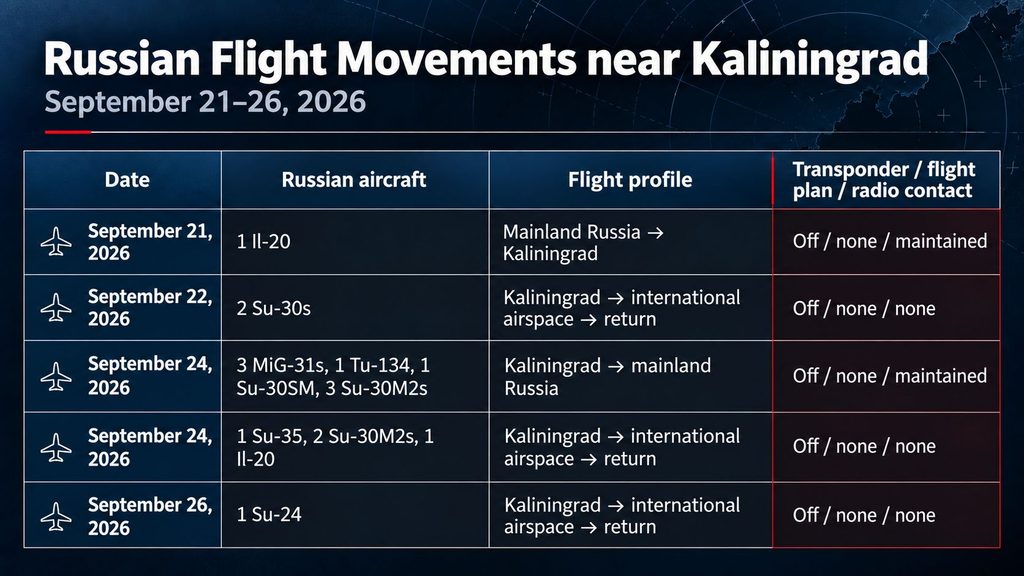
Separately, the Polish side reported the previously mentioned interception of an Il-20 about 25 miles off the Polish coast on September 22, 2026 – a separate incident not included in the Lithuanian list. The 2 sides were therefore recording events independently.
September 24, 2026, is decisive, and the NATO activity absent from the usual reports must be placed alongside the Russian flights. That day, a French E-3F AWACS flew from Poland across the Suwałki Corridor into Lithuania, made a loop there, and returned through Suwałki and Poland to France. On the same day, a Russian package took off from Kaliningrad: an Il-20 escorted by 1 Su-35 and 2 Su-30M2s, flying into international airspace and then returning. The sequence is revealing. The Russian reconnaissance aircraft did not appear first and provoke a NATO reaction. The AWACS was above the corridor, and the Il-20 and its escort took off to observe what the AWACS was doing there. This is precisely what a signals-intelligence platform does: It examines the electromagnetic picture the other side is generating. Whether both aircraft were simultaneously within sensor range of one another cannot be established conclusively from the public data. But the apparent direction of reaction is difficult to ignore: the AWACS first, the Il-20 afterward.
Another event that received considerable Western attention occurred during the same week. On September 23, 2026, a Russian Mi-8 helicopter from Kaliningrad entered Polish airspace by about 330 yards for 42 seconds. Poland scrambled fighter aircraft; the Polish Operational Command interpreted the incident as a test of its air-defense readiness. The figures should be considered soberly: 330 yards, 42 seconds. Each reader can decide what significance to assign them.
The result of this comparison is straightforward. On the days in question, it was not one side that was flying. Both sides were in the air, close together, at the same time, using reconnaissance and battle-management systems. A list containing only Russian movements presents half of the reality. The Lithuanian record meticulously lists every Russian aircraft by type, flight profile, and transponder status – and says nothing about NATO flights in the same airspace because those flights fall outside its reporting purpose. That partial perspective then migrates into the headlines, where half of the operational picture becomes the entire story. The fact that both sides are continuously conducting reconnaissance over the same sea disappears behind a list of Russian aircraft designations.
Interim Conclusion
One half of the story omitted from the abbreviated narrative is therefore now visible. Between May and late September 2026, a series of documented steps took place: fortress rhetoric from Lithuania, a disclosed NATO concept identifying Kaliningrad as a priority target, an unannounced electronic-warfare operation, Sikorski’s proposal for deliberately unsettling exercises, and an airspace in which both sides – not just one – were conducting reconnaissance at the same time. The Russian statement was issued against this background. Only in that context does its decisive subordinate clause make sense: Russia’s warning applied if Kaliningrad were isolated. That “if” and the events preceding it determine whether the reader sees an aggressor or a responding actor. Part 2 of this analysis will examine the basis for the condition: the exercises and their objectives, the permanent military buildup along the border, and Russia’s nuclear doctrine.
How dangerous is the situation when 2 heavily armed sides operate this close to one another without talking?
Part 2 read here:
The Omitted “If”: How a Response Was Turned into a Nuclear Threat – Part 2


About the Author
Michael Hollister
is a geopolitical analyst and investigative journalist. He served six years in the German military, including peacekeeping deployments in the Balkans (SFOR, KFOR), followed by 14 years in IT security management. His analysis draws on primary sources to examine European militarization, Western intervention policy, and shifting power dynamics across Asia. A particular focus of his work lies in Southeast Asia, where he investigates strategic dependencies, spheres of influence, and security architectures. Hollister combines operational insider perspective with uncompromising systemic critique – beyond opinion journalism. His work appears on his bilingual website (German/English) www.michael-hollister.com and in investigative outlets across the German-speaking world and the Anglosphere.
Stay informed without having to work through the daily flood of news – the most important developments and connections summarized for you.

Sources
- Russian Embassy in Belgium, statement of September 29, 2026, via RT DE: Russia Warns NATO of Risk of Conflict in the Event of a Blockade of Kaliningrad
- Reuters / US News, September 30, 2026: Russia Sends Nuclear Warning to NATO as Tensions Rise in the Baltic
- The Moscow Times (Reuters), September 30, 2026: Moscow Sends Nuclear Warning to NATO as Tensions Rise in the Baltic
- RTÉ, September 30, 2026: Russia Issues NATO Nuclear Warning Amid Baltic Tensions
- Reuters Explainer via US News, September 30, 2026: Why Russia’s Kaliningrad Is a Potential Flashpoint With NATO
- Kyiv Post, September 13, 2026: Sikorski Urges Aggressive NATO Drills Near Kaliningrad
- APA, September 13, 2026: Sikorski Calls on NATO to Intensify Military Drills Near Kaliningrad
- Lithuanian Ministry of National Defence, September 28, 2026: Data on Interceptions of Aircraft Near the Baltic States’ Borders, September 21-27, 2026
- TVP World, September 23, 2026: Polish Fighter Jets Intercept Russian Spy Plane Near Baltic Coast
- MILMAG, September 23, 2026: Poland: Eleventh Interception of Russian Il-20M Reconnaissance Aircraft This Year
- European Pravda, September 23, 2026: Russian Mi-8 Helicopter Violates Polish Airspace
- Itamilradar, August 18, 2026: NATO Massed a Large Air Package Near Kaliningrad in an Unusually Complex Baltic Operation
- The War Zone, August 19, 2026: EA-37B Flew Along Kaliningrad Border as Part of “Specialized” Recon, EW Flight Package
- Army Recognition, August 2026: US EA-37B Electronic Warfare Aircraft Takes Key Role in NATO’s High-End Baltic Air Package Near Kaliningrad
- TASS (Bild report), August 18, 2026: NATO Has Official Game Plan for War With Russia, Bild Reports
- LIGA (Bild report), August 2026: Bild: NATO Has Developed a Contingency Plan in Case of a Russian Attack
- TVP World, August 20, 2026: NATO Holds Air Exercise Over Northeastern Poland Near Kaliningrad
- DVIDS / US Navy, June 2025: Baltic Operations Exercise 2025 (BALTOPS 25)
- Forces News, June 2026: NATO Puts Baltic Sea Defense Under New Command as Exercise Baltops Begins
- Russia Matters, December 2024: New Principles of Russia’s Nuclear Deterrence Liberalize Conditions for Use
- Arms Control Association, December 2024: Russia Revises Nuclear Use Doctrine
- Reuters, October 1, 2026: Putin Says World Is Living Through Dangerous Moment, Warns West Not to Escalate
- Modern Diplomacy, October 3, 2026: Kaliningrad: Russia Has Drawn a Nuclear Red Line Around a Blockade That Doesn’t Exist
- CEPA: The Suwałki Corridor
- Chatham House, 2022: Myths and Misconceptions Around Russian Military Intent – Myth 2: The Suwałki Gap Matters
- Tagesschau, September 2026: Pistorius – Army Tests New Military Equipment / Drone Regiment
- NATO, October 1, 2026: Joint Press Conference With NATO Secretary General, the Federal Chancellor of Germany, and the Prime Minister of the Netherlands
- NATO: Strengthening NATO’s Eastern Flank
© Michael Hollister – All rights reserved. Redistribution, publication or reuse of this text requires express written permission from the author. For licensing inquiries, please contact the author via www.michael-hollister.com.