by Michael Hollister
Exclusive published at Michael Hollister on October 07, 2026
2.802 words * 15 minutes readingtime
Part 1 read here:
The Omitted “If”: How a Response Was Turned into a Nuclear Threat – Part 1


The Exercises: Not Just More, but Different
A common argument is that NATO has simply increased the scale of its exercises in the Baltic region dramatically. That is broadly true, but it requires an honest qualification because an argument based solely on numbers is vulnerable to challenge.
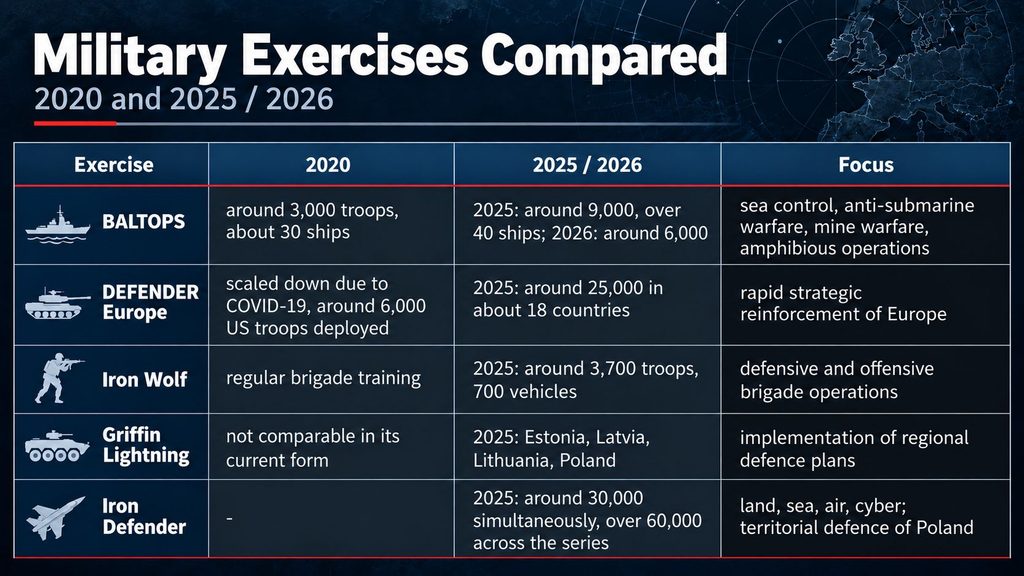
The major naval exercise BALTOPS illustrates the point. In 2020, approximately 3,000 military personnel took part, along with about 28 to 30 ships and a similar number of aircraft. In 2025, the exercise involved roughly 9,000 personnel and more than 40 ships, a clear threefold increase. Yet the development was not linear: 2024, with more than 50 ships and approximately 85 aircraft, was the largest BALTOPS in history, while the exercises in 2025 and 2026 were smaller again. Anyone claiming a constant, unchecked increase can be disproved by that year. The accurate conclusion is therefore not “ever more,” but rather that the overall level has shifted since 2022. The official US Navy material on BALTOPS 25 documents the scale and composition of the 2025 exercise, while the 2026 iteration also reflected a new command structure for Baltic Sea defense.
In any case, the real difference lies not in the head counts but in what is being practiced. Since 2024 and 2025, NATO has been putting into practice the regional defense plans developed after Russia’s invasion of Ukraine. Land, air, maritime, cyber, and electronic components are being integrated ever more closely. Exercises such as Griffin Lightning, Iron Wolf followed by a transition into Swift Response, and Lithuania’s Perkūno Griausmas series test precisely this level of integration. Poland’s Iron Defender exercise series brought together approximately 30,000 troops simultaneously in 2025 and more than 60,000 over the entire series – the largest mobilization of this force configuration – and was explicitly described as a response to the Russian-Belarusian Zapad exercise. Geographically, the exercise area encompasses Estonia, Latvia, Lithuania, and Poland, inevitably including the region surrounding Kaliningrad and the Suwałki Corridor. This development forms part of NATO’s broader program for strengthening its eastern flank. The following overview compares the situation in 2020 with that in 2025 and 2026:
This raises a legitimate question without presupposing an answer. If an armed force trains to isolate an exclave – controlling maritime connections, suppressing air defenses, and sealing it off electronically – it subsequently possesses that capability. Why acquire it if there is no conceivable need for it? NATO does not train to conquer France because no plausible reason exists for doing so. It does, however, demonstrably practice capabilities that could be applied to Kaliningrad in the event of a conflict. A Russian planner observing these exercises will draw conclusions from them.
A clear boundary must be drawn here, and it applies in both directions. There is no evidence of an exercise whose official objective is to seize Kaliningrad; no NATO primary source identifies that as an exercise goal. What can be established is that capabilities are being trained with which the territory could be isolated. These formations are also inherently multipurpose: Heavy forces can defend, but they can equally transition to a counterattack or offensive operations. Their composition alone proves neither offensive nor defensive intent.
The Material Buildup: Permanent Structures
Exercises are temporary. More significant for assessing the situation is what is being established permanently. In this respect, the structure has changed since 2020.
Germany is building Panzer Brigade 45 in Lithuania – not as a rotational force, but as a permanent deployment. Approximately 4,800 troops are expected to be fully operational by the end of 2027, equipped with Leopard 2 main battle tanks and Puma infantry fighting vehicles, among other systems, and supported by artillery, reconnaissance, engineers, air defense, and electronic warfare. The Bundeswehr explicitly identifies the defense of the Suwałki Corridor as one of the brigade’s missions. On September 14, 2026, it approved additional personnel measures because the formation was not yet fully staffed.
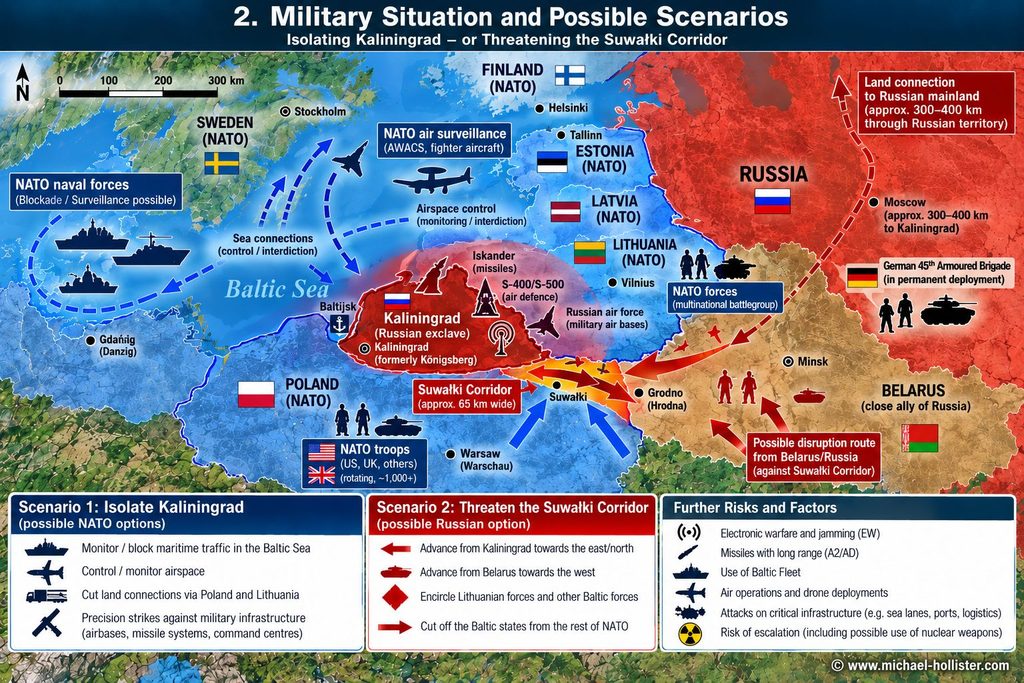
There is also a capability that extends beyond purely defensive operations. The Bundeswehr is planning a dedicated drone regiment of up to approximately 600 personnel, equipped with unmanned systems, loitering munitions, electronic warfare capabilities, and systems with ranges of up to 310 miles. The regiment is to be subordinated to the 10th Panzer Division – the same division to which the brigade in Lithuania belongs. A range of 310 miles enables strikes deep inside Russian territory. Soberly stated, this is not equipment required by a static border-defense force. The plans were publicly associated with the Bundeswehr’s effort to test new military equipment and establish the drone regiment.
At the same time, the command structure is becoming denser. On October 1, 2026, the 1st German-Netherlands Corps assumed responsibility for the defense of Estonia and Latvia. NATO describes it as a headquarters capable, in a crisis, of commanding a formation of up to 50,000 troops. This does not mean that 50,000 soldiers are stationed there, but it does mean that the command architecture for a force of that size is being established. The same NATO setting also produced a joint press conference on the alliance’s eastern defense arrangements. Additional developments include the deployment of Swedish Gripen fighter jets to Poland in late September 2026, an unannounced combat-readiness test of a US armored formation near Bemowo Piskie on September 30, 2026 – approximately 50 miles from Kaliningrad – and the continuing Eastern Sentry and Baltic Sentry operations.
Here, too, the 2 interpretations must stand side by side. NATO describes the official mission as defensive. The capabilities being assembled, however, are multipurpose and explicitly include offensive operations. Their composition alone proves neither intention. A Russian military planner, however, does not have to assess an intention he cannot know; he must assess the capability he can see. That capability is documented.

The Nuclear Doctrine: What the Threat Means
At this point, it is worth examining the document almost never mentioned amid the uproar over the word “nuclear”: Russia’s nuclear doctrine. Russia’s reference to its entire arsenal was not a spontaneous idea, but an invocation of a framework set down in writing.
On November 19, 2024, President Vladimir Putin signed Decree No. 991, revising the Basic Principles of State Policy of the Russian Federation on Nuclear Deterrence and replacing the 2020 version. The document specifies the conditions under which nuclear weapons may be used. They now include a conventional attack that creates a critical threat to the sovereignty or territorial integrity of Russia or its ally Belarus – a lowered threshold compared with 2020, when the language referred to a threat to the very existence of the state. It also explicitly states that aggression by one member of an alliance will be regarded as aggression by the alliance as a whole, a provision plainly aimed at NATO. Analyses of the revision found that the new principles broadened the conditions for nuclear use, while the Arms Control Association likewise concluded that Russia had revised and lowered important elements of its nuclear-use threshold.
Another point is important when assessing the current warning: Referring to the entire arsenal did not change the operational readiness of Russia’s nuclear forces. According to available reports, no change in alert status was announced. Security analysts who assess such language therefore classify it as a political signal intended to prevent a particular action by the adversary – not as an announcement of imminent use or the deployment of weapons systems. That is the function of deterrence: The adversary is meant to understand the price of an action before taking it. The contemporaneous Reuters report described the episode as a nuclear warning issued amid rising Baltic tensions, not as evidence of a change in operational nuclear posture.
The Kaliningrad statement fits precisely within this framework. Its structure is conditional: If the territory is militarily isolated, Russia reserves the right to use its entire arsenal, including nuclear weapons. Whether a blockade of Kaliningrad would actually fall under the doctrine is not clear. It would not do so automatically, but it could be subsumed under the deliberately vague concept of territorial integrity. That judgment remains open to interpretation – and this ambiguity is itself part of the logic of deterrence.
The accurate description is therefore neither “Russia threatened nuclear war without provocation” nor “there was no threat at all.” Both miss the point. It was a conditional nuclear threat, with an explicit reference to the entire arsenal, issued after a series of documented NATO steps and grounded in an existing doctrine. Putin personally confirmed this interpretation at the Valdai Forum on October 1, 2026. He said it was “not intimidation” but a response to an attempt at intimidation, while also emphasizing that Russia had no plans to attack European states. Reuters reported the remarks in the context of Putin’s warning that the world was passing through a dangerous moment and the West should not escalate. That same day, it became known that Putin had instructed the relevant authorities to take additional measures to secure Kaliningrad, although the specific measures were not disclosed. One subsequent analysis described this as a nuclear red line drawn around a blockade that did not yet exist. NATO, for its part, confirmed the diplomatic exchange, stated that none of its activities threatened Russian territory, and called on Moscow to end its nuclear rhetoric.
The Real Precipice
Amid the analysis of each individual step, there is a danger of overlooking a circumstance more hazardous than any single threat or exercise. Two heavily armed military systems are operating simultaneously in an extremely confined area of the Baltic region, with live military equipment – and the direct line of communication between them has largely disappeared. The NATO-Russia Council, once the institutional channel for precisely such situations, last met in January 2022.
A comparison shows how different the situation once was. During NATO’s major Trident Juncture exercise in 2018, Russian observers were demonstrably invited and present. They were permitted to speak with troops and were briefed on the scenario. No comparable presence of Russian observers could be established for the major exercises of 2025 and 2026 – BALTOPS, Iron Defender, Iron Wolf, and Perkūno Griausmas. This does not prove that Russia was excluded; if observers had been present, however, they would have been identified in the after-action reports. The question a Russian observer would ask is legitimate: If an alliance is exercising on its own border, the exercise is purely defensive, and it does not want to alarm its neighbor, why not invite that neighbor to observe?
The result is a textbook security dilemma. NATO reinforces its eastern flank and views that as a response to the Russian threat. Russia sees a growing operational architecture directly adjacent to Kaliningrad and reinforces the exclave. NATO interprets this as confirmation of its original threat assessment and reinforces once again. Each side continually supplies the other with new evidence for its own fears. The NATO exercise Able Archer 1983 demonstrated how close this mechanism can come to catastrophe when the Soviet side temporarily misinterpreted the exercise as possible preparation for a real first strike.
This is where the situation becomes genuinely dangerous. When 2 sides operating in such close proximity no longer have a fast, open channel of communication, a single mistake may be enough – a pilot misreading a course, a transponder incident, or a misunderstanding over the sea. There would be no practiced mechanism for containing the incident within hours. Given the nuclear component now explicitly set down in writing, this is not an abstract thought experiment. It is a walk along the edge.
Findings
What can ultimately be separated with precision? A sequence of events can be documented, and it does not begin on September 29, 2026, but in May: fortress rhetoric from Lithuania; a disclosed NATO concept identifying Kaliningrad as a priority target; an unannounced air operation involving electronic warfare; Sikorski’s proposal for deliberately unsettling exercises; the integration of individual exercises into an operational architecture around the exclave; the permanent material buildup, including a deep-strike capability – and only after those steps, the Russian statement, formulated as a conditional nuclear threat and grounded in an existing doctrine. The breakdown of direct communication between the 2 sides is equally well documented.
What cannot be established is a NATO intention to attack Kaliningrad. Nor is there evidence of concrete preparations for a blockade. And thus far, there is no visible Russian counter-deployment in response to the warning. What remains unresolved on both sides is what outside observers can never prove conclusively: intent.
This returns the article to its opening question. The Western headline reduced a complex series of events to 3 words: Russia threatens nuclear war. It omitted the “if” that carries the statement’s entire meaning, and it omitted the months during which that condition took shape. A conditional statement of response was transformed into an unconditional threat; a sequence of reciprocal steps became a unilateral provocation. Omitting the subordinate clause is not a minor matter. It changes who is acting and who is reacting in this story. Readers must determine the appropriate conclusion for themselves – but they can do so only if no one withholds the “if.” Russia’s initial September 29 statement explicitly tied its warning to an attempt to isolate Kaliningrad.


About the Author
Michael Hollister
is a geopolitical analyst and investigative journalist. He served six years in the German military, including peacekeeping deployments in the Balkans (SFOR, KFOR), followed by 14 years in IT security management. His analysis draws on primary sources to examine European militarization, Western intervention policy, and shifting power dynamics across Asia. A particular focus of his work lies in Southeast Asia, where he investigates strategic dependencies, spheres of influence, and security architectures. Hollister combines operational insider perspective with uncompromising systemic critique – beyond opinion journalism. His work appears on his bilingual website (German/English) www.michael-hollister.com and in investigative outlets across the German-speaking world and the Anglosphere.
Stay informed without having to work through the daily flood of news – the most important developments and connections summarized for you.

Sources
- Russian Embassy in Belgium, statement of September 29, 2026, via RT DE: Russia Warns NATO of Risk of Conflict in the Event of a Blockade of Kaliningrad
- Reuters / US News, September 30, 2026: Russia Sends Nuclear Warning to NATO as Tensions Rise in the Baltic
- The Moscow Times (Reuters), September 30, 2026: Moscow Sends Nuclear Warning to NATO as Tensions Rise in the Baltic
- RTÉ, September 30, 2026: Russia Issues NATO Nuclear Warning Amid Baltic Tensions
- Reuters Explainer via US News, September 30, 2026: Why Russia’s Kaliningrad Is a Potential Flashpoint With NATO
- Kyiv Post, September 13, 2026: Sikorski Urges Aggressive NATO Drills Near Kaliningrad
- APA, September 13, 2026: Sikorski Calls on NATO to Intensify Military Drills Near Kaliningrad
- Lithuanian Ministry of National Defence, September 28, 2026: Data on Interceptions of Aircraft Near the Baltic States’ Borders, September 21-27, 2026
- TVP World, September 23, 2026: Polish Fighter Jets Intercept Russian Spy Plane Near Baltic Coast
- MILMAG, September 23, 2026: Poland: Eleventh Interception of Russian Il-20M Reconnaissance Aircraft This Year
- European Pravda, September 23, 2026: Russian Mi-8 Helicopter Violates Polish Airspace
- Itamilradar, August 18, 2026: NATO Massed a Large Air Package Near Kaliningrad in an Unusually Complex Baltic Operation
- The War Zone, August 19, 2026: EA-37B Flew Along Kaliningrad Border as Part of “Specialized” Recon, EW Flight Package
- Army Recognition, August 2026: US EA-37B Electronic Warfare Aircraft Takes Key Role in NATO’s High-End Baltic Air Package Near Kaliningrad
- TASS (Bild report), August 18, 2026: NATO Has Official Game Plan for War With Russia, Bild Reports
- LIGA (Bild report), August 2026: Bild: NATO Has Developed a Contingency Plan in Case of a Russian Attack
- TVP World, August 20, 2026: NATO Holds Air Exercise Over Northeastern Poland Near Kaliningrad
- DVIDS / US Navy, June 2025: Baltic Operations Exercise 2025 (BALTOPS 25)
- Forces News, June 2026: NATO Puts Baltic Sea Defense Under New Command as Exercise Baltops Begins
- Russia Matters, December 2024: New Principles of Russia’s Nuclear Deterrence Liberalize Conditions for Use
- Arms Control Association, December 2024: Russia Revises Nuclear Use Doctrine
- Reuters, October 1, 2026: Putin Says World Is Living Through Dangerous Moment, Warns West Not to Escalate
- Modern Diplomacy, October 3, 2026: Kaliningrad: Russia Has Drawn a Nuclear Red Line Around a Blockade That Doesn’t Exist
- CEPA: The Suwałki Corridor
- Chatham House, 2022: Myths and Misconceptions Around Russian Military Intent – Myth 2: The Suwałki Gap Matters
- Tagesschau, September 2026: Pistorius – Army Tests New Military Equipment / Drone Regiment
- NATO, October 1, 2026: Joint Press Conference With NATO Secretary General, the Federal Chancellor of Germany, and the Prime Minister of the Netherlands
- NATO: Strengthening NATO’s Eastern Flank
© Michael Hollister – All rights reserved. Redistribution, publication or reuse of this text requires express written permission from the author. For licensing inquiries, please contact the author via www.michael-hollister.com.