by Michael Hollister
Exclusive published at Michael Hollister on September 19, 2026
4-856 words * about 26 minutes readingtime
This Part 1 builds on the analysis “The Pincers Are Closing.” I recommend reading it first. You can find the Analysis here:
The Pincers Are Closing: Why Saudi Arabia’s Oil Exports Are Being Choked Off on Three Fronts
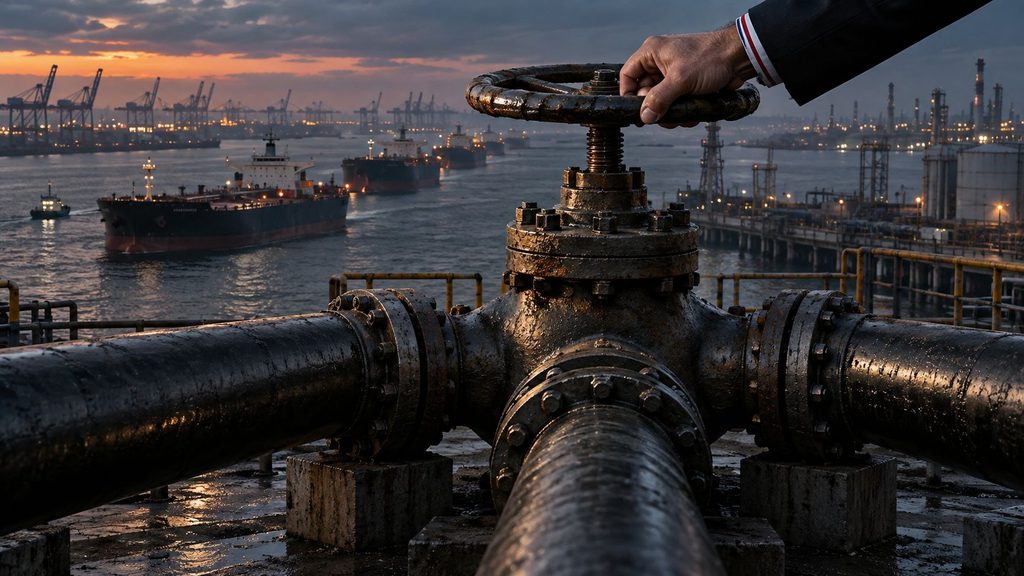
How the guarantor of open sea lanes became their controller – and why the war with Iran has one principal addressee: Beijing. Part 1 of a two-part analysis; Part 2 will follow.
On Sunday, September 13, 2026, a meeting disappeared from the calendar that was supposed to reopen the world’s most important oil chokepoint. Iran’s foreign minister and representatives of the Gulf states had planned to meet the following day in the Omani coastal city of Salalah to discuss reopening the Strait of Hormuz – an Omani initiative on which Tehran and Muscat had been working for weeks. The talks were to address maps, shipping lanes, and the technical question of how tankers would enter and leave the strait in the future. Then Oman’s foreign minister, Badr al-Busaidi, wrote on X that the meeting had been postponed “in the interest of consensus”. Indefinitely. One critical participant had been absent anyway: the United States.
It was not the first window to close. For months, diplomatic openings had appeared – a memorandum in June, Qatari and American mediation proposals in August, and repeated talks in Muscat – and each time, the passage ultimately remained sealed. Salalah was merely the latest of these openings, and it was removed before it could begin.
That same weekend, the American president spoke from California. Donald Trump said he now liked his position much better, with “almost total control” over the Strait of Hormuz and an Iranian economy that was collapsing. The United States was not pushing Iran to the negotiating table. It was in no hurry. Those are two sentences worth remembering when asking who wants out of this conflict – and who does not.
This is the tone of an actor who has obtained what he wanted – not that of a mediator watching peace slip away. And it is the starting point of this analysis. Between what Washington says about the Strait of Hormuz and what it does lies a gap that cannot be closed by the conventional image of a perplexed superpower. Anyone who examines the past seven months without that image will not see an entangled world power, but a transformation: The decades-long guarantor of open sea lanes has become their controller. The war with Iran is not the conflict in which this transformation is taking place. It is its catalyst.
From Guarantor to Controller
For half a century, America’s role on the world’s oceans rested on a simple, expensive promise: The sea lanes would remain open, for everyone, free of charge. The U.S. Navy kept clear the chokepoints through which the world’s oil flowed – Hormuz, Bab al-Mandab, Malacca – and whoever shipped cargo through them received a free ride at the American taxpayer’s expense. It was a global public good, subsidized by a superpower that gained influence from it but no revenue. Free seas for everyone, paid for by one.
This role was the quiet foundation of the global economy after 1945: The U.S. Navy guaranteed that oil from the Gulf, containers from Asia, and grain from around the world could cross the oceans unhindered. Friend and rival alike traveled under that protection, and that was precisely where the power lay – not in a fee, but in the indispensability of the actor that maintained the order.
That economic logic has now been reversed. Keeping the entire sea open is expensive; controlling only the few chokepoints through which everything must pass anyway is considerably cheaper – and it reverses the balance sheet. Whoever holds the chokepoint no longer has to pay for open seas. It can collect a fee there or deny passage. The guarantor who pays becomes the controller who extracts. This is not moral decay, but a cool business recalculation: The guarantor produces a good from which it cannot exclude others and bears the costs alone; the controller turns the same geographic point into a good it can indeed withhold – and therefore into leverage. The National Security Strategy of December 2025 provides the ideological superstructure: “America First,” a retreat from global hegemony, and the protection of energy chokepoints from adversarial control as an explicit core interest.
There is no need to infer this transformation from declarations of intent. It is visible in a single progression, in statements that follow one another like steps. In late June, Secretary of State Marco Rubio told the Gulf states that no country could charge fees on an international waterway; that, he said, was settled international law. Two weeks later, on July 13, 2026, Trump announced that the United States would henceforth be the “Guardian of the Hormuz Strait” and collect 20 percent on every cargo escorted through it. He withdrew the toll within a day; the claim to regulate and price passage remained. On August 14, 2026, he went further and announced that, after victory, the strait would be declared territory of the United States. In the Oval Office, he added that Washington already controlled it – “with the blockade.”
It is the same claim that Washington had spent months condemning as a violation of international law when Iran made it. When Tehran declared the strait closed and asserted authority over transit, Washington called it a breach of the international order. When Washington claimed the same control for itself – over a strait thousands of miles from its own coast, in Iranian territorial waters – it was strategy. The UN shipping agency, the International Maritime Organization, found that there was no legal basis for charging tolls on transit through an international strait – a finding that applied to both claims. International law recognizes no master here.
The new role becomes clearest where it turns against Washington’s own mediator. On August 17, 2026, Trump openly threatened to bomb Oman if the sultanate “got in the way” of American efforts concerning the strait – while Oman and Iran were working on precisely the reopening that would end the war over the valve. It was already the second threat of its kind; he had warned Oman in May as well. Anyone who threatens the mediator seeking to reopen the passage is not behaving like someone who wants it opened. He is behaving like someone who wants to keep the valve closed. The canceled Salalah meeting with which this analysis began is the logical continuation of that threat, not its contradiction.
The China Lever
Why would a superpower want to keep closed a valve through which roughly one-fifth of the world’s traded oil flows? The answer is not hidden; it is on the record. Its name is China.
Please log in here to read the full Analysis.
If you do not yet have a reader account, you can register here free of charge.
Access is activated immediately.