
by Michael Hollister
Exclusive published at Michael Hollister on June 06, 2026
4.843 words * 26 minutes readingtime
For a compact entry into the topic: the briefing accompanying this analysis summarizes the four central developments in ten minutes of reading time: Minab – What Really Happened
Why the Official Explanation Does Not Hold
On 28 February 2026 at 10:23 a.m. local time, the first cruise missile struck the Shajareh-Tayyebeh Girls’ School in the Iranian city of Minab. Two more followed within 22 minutes. It was the first day of the joint US-Israeli attacks on Iran – Operation Epic Fury, as it is designated in US military documents. Between 170 and 264 female students were on the school grounds at the time – girls between the ages of seven and twelve, waiting for their parents after the school administration had ended classes because of the attacks. According to Iranian figures, at least 156 of them were killed, along with teachers and parents who had come to collect their children. The figures vary by source between 156 and 175 dead. It is the most serious attack on civilians in this war to date – the worst single civilian casualty event since the conflict began on 28 February 2026.
In the weeks that followed, an investigation began that has to date reached no public conclusion. The official US explanation is: outdated target data. An error. Regrettable, but militarily explicable.
This explanation does not hold. What the available facts – debris evidence, satellite analyses, statements from Western weapons experts, the testimony of the CENTCOM commander before the US Congress, and the legal assessment of independent jurists – actually produce is a different picture. Not a picture of intent, but a picture of structural failure that gives rise to responsibility. And a picture of how a state that possesses the most precise weapons in the world and by its own account deploys AI-assisted real-time targeting has, 80 days after the attack, still not accepted responsibility.
The School
The Shajareh-Tayyebeh School – the name means “the good tree” in Persian – was a state primary school for girls in the Shahrak-e Al-Mahdi district of Minab, Hormozgan Province. The building had previously belonged to the adjacent IRGC naval complex. Between 2013 and 2016 it was physically separated: a fence was erected, watchtowers removed, public entrances opened. The exterior walls received colorful murals – blue and pink. A school yard was marked on the former asphalt. The school acquired its own website, which was active for years and showed photographs of school events, teachers, and pupils.
On the morning of 28 February 2026, the school had already stopped operating shortly after 10:00 a.m. following the start of the attacks. The school administration had decided to send the children home – but a nationwide school closure was not announced until 10:15 a.m., and many parents could not reach the school grounds in time because of the sudden traffic chaos. Parents later reported being stuck in traffic when they heard the explosion. The roof collapsed on the girls waiting inside the school building for their parents.
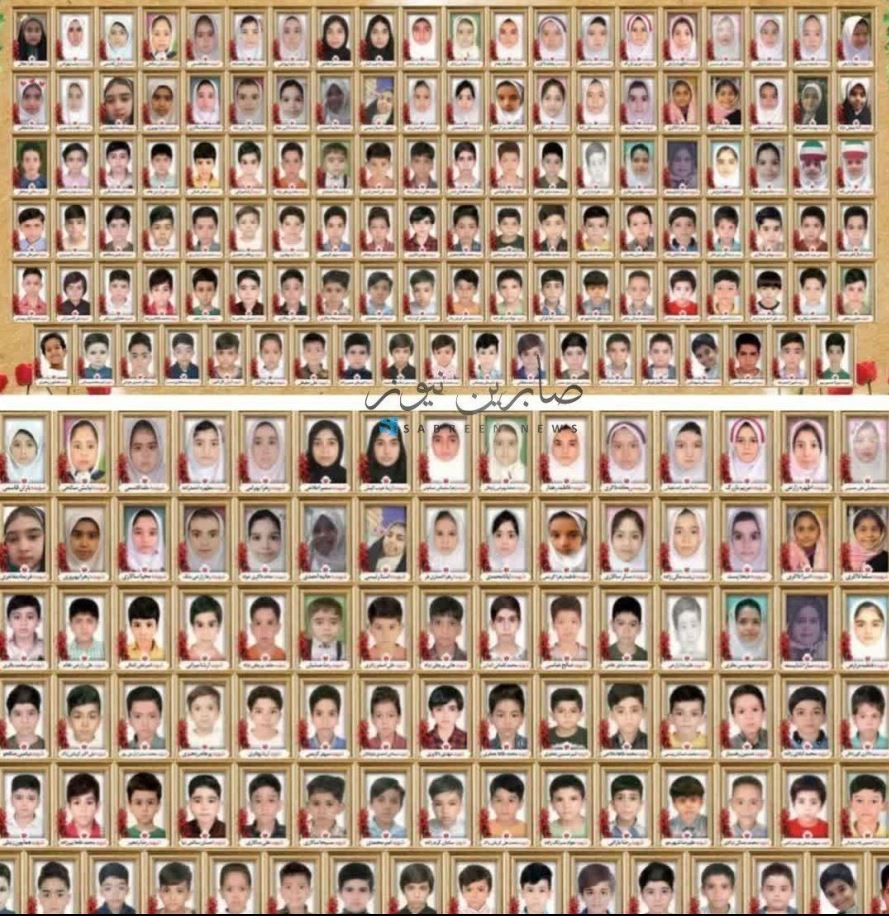
The Iranian government published passport photographs of the victims. Aerial photographs from the funeral ceremony, held a few days later, showed the scale: row upon row of freshly dug graves at the cemetery in Minab.
Minab: Neither Peripheral Nor Isolated
Whoever wishes to understand the geographic position of the Shajareh-Tayyebeh School must know where in Minab it stood. The coordinates are public: 27°6′35.4″N, 57°5′05.1″E. Satellite imagery from Planet Labs, analyzed among others by the New York Times and CBC News, shows unmistakably: the school grounds lie in the middle of a densely populated residential area. No buffer zone. No derelict industrial land. No isolated peripheral location. Residential buildings, streets, civilian infrastructure on all sides. Minab is a small city of around 70,000 inhabitants in southern Hormozgan, near the Strait of Hormuz. The school stood in the Shahrak-e Al-Mahdi district – an ordinary residential neighborhood, not a military site, not a restricted area.
Immediately adjacent lies an IRGC naval complex – a legitimate military target under international humanitarian law. There is no doubt about that. But the spatial proximity of two objects does not make the civilian one military. It raises, on the contrary, the duty of care: the more closely military and civilian populations are spatially interwoven, the higher the requirements for target verification.
Whoever served in an active war deployment in Europe knows this constellation. Barracks in German cities – Koblenz, Augusta, Mainz – have for decades stood on the edge of residential areas, in some cases directly adjacent to them. The training ground is outside town. The barracks is at the city’s outskirts, sometimes even closer in. No planning officer preparing a precision strike command post in such urban contexts would press the trigger without updated situational intelligence and a detailed no-strike review. This is not a moral demand. It is standard military procedure – and it exists for good reason. Precisely because modern weapon systems are technically capable of striking a single building from great distance, the attacker bears full responsibility for ensuring the building struck is actually the right one.
International humanitarian law draws a strict distinction between military objectives and civilian objects. This distinction does not depend on whether a building was once used for military purposes. It depends on what the building is at the time of the attack. A school that has been used as a school for a decade is not a military objective – even if it stands next to a military complex. And spatial proximity to a legitimate target does not increase the permissibility of striking the adjacent civilian object. It increases the duty of care.

The Shajareh-Tayyebeh School did not stand on the edge of an abandoned military site. It stood in the urban fabric of Minab, surrounded by residential buildings, streets, and the everyday life of an Iranian provincial city. In the middle of the city – and in the middle of the target package.
The Evidence from the Debris
On the day of the attack, video footage spread across social networks showing a cruise missile moments before impact. CBS News had the material assessed by Dr. N. R. Jenzen-Jones, Director of Armament Research Services (ARES), one of the leading independent arms analysis institutes. His finding was unambiguous: it is a US Tomahawk cruise missile. Jenzen-Jones added that, given the belligerents involved, no other actor in this conflict possesses or deploys Tomahawks – neither Iran, nor Israel, nor the Gulf states.
A few days later, Iranian state media showed debris fragments recovered at the strike site. Independent verification by Western experts and media organizations confirmed the authenticity and origin of the components. What the fragments show is remarkably precise:
A type plate from Ball Aerospace & Technologies Corp., Boulder, Colorado, bearing a legible Government Contract Number N00019-14-C-0075 – a US Navy contract format – identifying the fragment as an AN0779A SDL antenna: the Tomahawk’s satellite data-link antenna, responsible for real-time communication and precise guidance. Actuator motors from Globe Motors Inc., Dayton, Ohio, marked “Made in USA” with legible DoD contract numbers – these actuators move the control fins that keep a Tomahawk on course. A circuit board inscribed “Copyright RMI 1999 Raytheon Company,” Assembly 726460-801 – Raytheon is the Tomahawk’s manufacturer; this is the core of the guidance electronics. And a hydraulic component with a legible US contract number and serial number, also marked as manufactured in the USA.

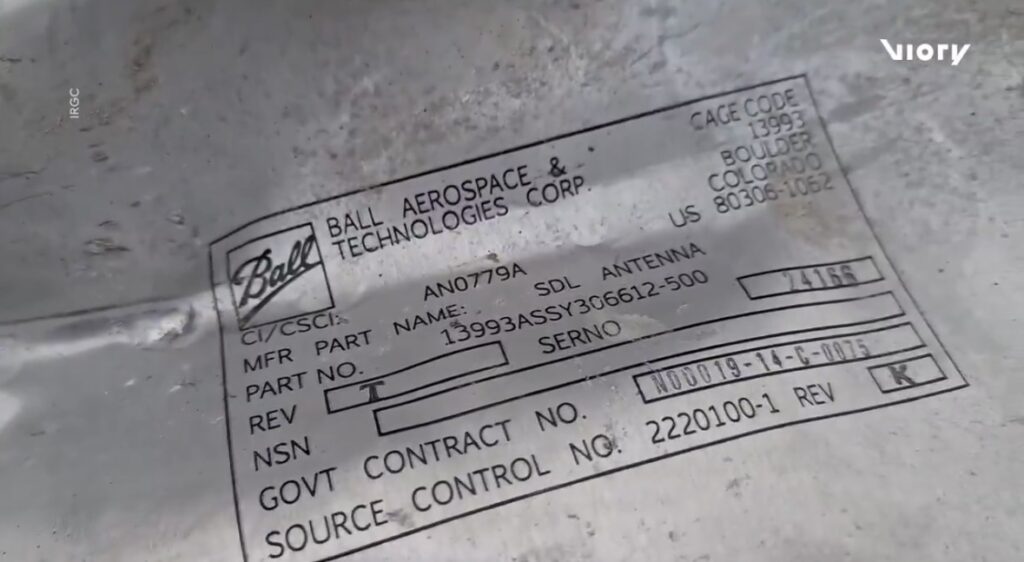
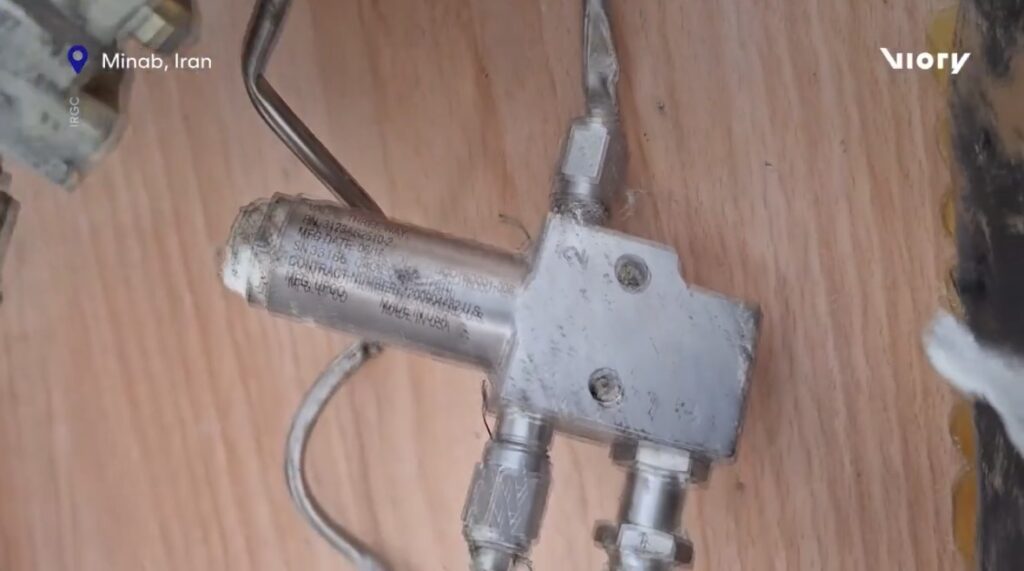

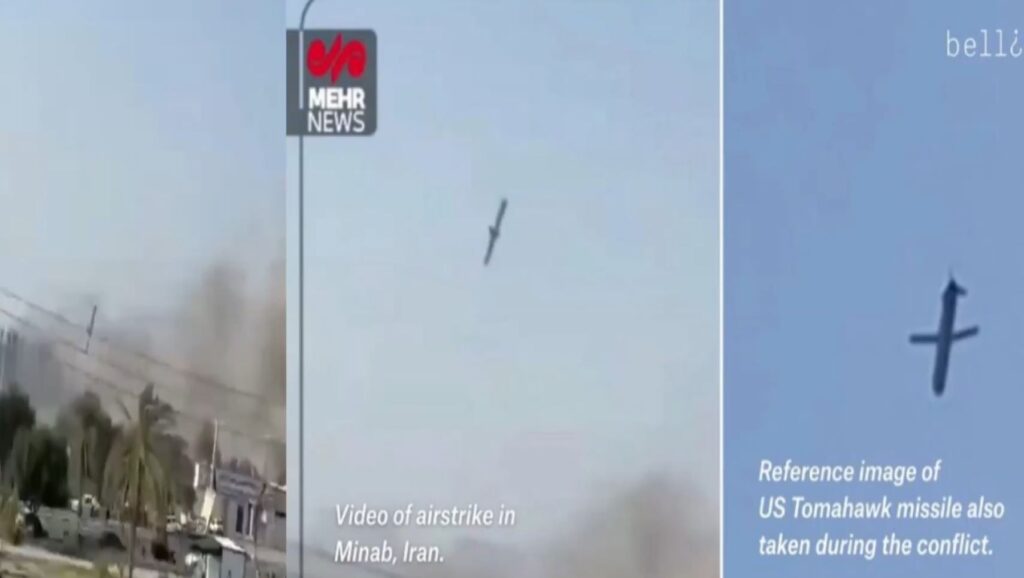
These fragments were not presented by Iranian authorities alone. The Washington Post analyzed a video showing a Tomahawk cruise missile at the moment of impact on the IRGC complex near the school. The Associated Press assessed further imagery. Dr. Jenzen-Jones of ARES summarized the finding: given the belligerents involved and the munition types deployed, there is no plausible alternative explanation to US authorship.
The New York Times reached the same conclusion in its own investigation, finding that the United States carried out the attack with high probability. RT.com reported the NYT finding directly. Each of these components individually is evidence. Together, verified by independent Western experts, they form an evidentiary chain that leaves no alternative interpretation open. A US Tomahawk struck the Shajareh-Tayyebeh School.
Precision as Argument – and as Problem
The US line of explanation is: outdated target data, a tragic error. But it is precisely the precision of the other strikes in Minab that turns this explanation into a problem.
The New York Times commissioned new satellite imagery from Planet Labs. What the images show: at least six buildings of the IRGC naval complex were struck by precision munitions – with impact points almost exactly on the center points of the rooftops. Four buildings were completely destroyed. Wes J. Bryant, a former US Air Force targeting specialist and former Senior Adviser on Civilian Harm at the Pentagon, analyzed the imagery and described the hits as “picture perfect”. He assessed the most probable explanation as a target identification error: the school had been struck without the attackers knowing it was being used by civilians.
Bryant’s formulation is important to read carefully. He does not say: it was a random stray round. He says: the system hit with precision – but the wrong target. Precision itself is not an exculpatory argument. It is the finding. A system that strikes six targets with impacts on rooftop centers has no technical problem. It has a data problem.
The question is not whether, but why the school appeared in the target package.
What the Satellite Sees – and What It Would Have Seen in 2016
Here lies the core of the question.
The US side explains that the Defense Intelligence Agency still classified the school building as part of the IRGC complex – a classification based on data at least ten years old. For the conversion of the building to a school demonstrably took place between 2013 and 2016. Satellite imagery, analyzed by the New York Times and Just Security, documents the changes in detail: a fence was erected, separating the building from the military base. Watchtowers were removed. Three public entrances were opened. A sports court was painted on the asphalt. The exterior walls received colorful murals in blue and pink. The school had its own website with years of online presence.
From 2016 onward, this building was no longer military. It was visible, public, unambiguously civilian.
Now for the decisive question: what can a military reconnaissance satellite see today?
The answer from public sources is sobering. Commercial satellites like those from Planet Labs – whose imagery is cited multiple times in this analysis – achieve ground resolutions of approximately 12 inches (30 cm). This means objects with a footprint of 12 by 12 inches (30 by 30 cm) are distinguishable. A school bag on a school yard is visible. A painted sports court is visible. Murals are visible. These are commercial systems any journalist can purchase – and which in this analysis were actually purchased by the NYT and CBC News to document the attack.
Military reconnaissance satellites are, by the consistent assessment of arms experts, substantially better – resolutions in the single-digit centimeter range are considered realistic for current US systems. This is not a secret: it is documented in the technical literature, and Western intelligence services have no reason to downplay this capability.

A comparison makes this tangible. Already in 2000 – a quarter century ago – Western reconnaissance over the Balkans achieved a level that captured persons and vehicles at identification quality. A combination of satellite-based and airborne reconnaissance – the latter via low-flying drone and aircraft sensors with far higher resolution – made it possible to track individual vehicles on known routes, cross-check license plates, and identify wanted persons. Reconnaissance personnel worked with imagery sufficient for personal identification. That was the technical state in a conflict environment that tied incomparably fewer resources than an active large-scale war with multiple aircraft carriers, continuous drone presence, and full SIGINT coverage.
In February 2026, during the densest ISR deployment US forces had conducted in years – two to three aircraft carriers in the Persian Gulf and Arabian Sea, reconnaissance drones over the entire Iranian operational area, full SIGINT coverage – the Hormozgan region was under permanent surveillance. Minab lies less than 50 miles (80 km) east of Bandar Abbas, the IRGC’s central naval base and one of the primary targets of US operations. The surveillance density in this corridor was not peripheral – it was maximal.
Whoever under these conditions claims not to have known the building was a school must explain why a system capable of guiding a Tomahawk at 620 miles (1,000 km) through a military rooftop was simultaneously unable to process colorful murals, a painted school yard, and a years-long active website as signals of civilian use.
This is not a rhetorical question. It is a systems question – and it remains unanswered.
The Time Factor: The Argument No One Makes
There is one circumstance under which an attack despite incomplete target verification might be militarily defensible: a time-critical threat. If intelligence establishes that weapons are being loaded at a target that will be fired within an hour and may then kill thousands – then a targeting dilemma arises. Then time for full verification may be absent.
This is not an abstract scenario. It is the reality of modern warfare, and no serious military analyst would deny that such constellations exist. In such a case, urgency would be an argument – and it would be one that would have to be seriously examined.
But: there is no documented evidence that a time-critical threat situation of this kind existed on the morning of 28 February 2026 for the IRGC complex in Minab. No known intelligence report, no congressional briefing, no internal investigation testimony suggests that cruise missiles ready to launch imminently were being loaded at the adjacent complex. Cooper made no mention of this aspect before the House Armed Services Committee. The public investigation line is: outdated data. Not: time pressure.
The IRGC naval complex in Minab had existed for years. The units and weapons stationed there were stationed there – and would have still been stationed there three hours later. Military installations of this type are by definition fixed targets. They do not run away. The military difference between a strike at 10:23 a.m. and one at 3:00 p.m. would have been negligible. The difference for target verification would have been considerable: time to cross-check against current satellite imagery. Time for a no-strike list review. Time for the simple question of what stands next to the target and who is present there between 8:00 a.m. and 1:00 p.m.
These verification steps do not exist without reason. They are part of the target validation procedure that US forces are required under their own rules to carry out before precision strikes in urban terrain. The DoD Law of War Manual, published by the United States itself, describes these obligations explicitly. It is not an external rulebook imposed on the US from outside. It is their own. And it applies even when the political will to be reminded of it is absent.
The time-critical threat argument – the only argument that under international humanitarian law could justify bypassing the precautionary obligation – is entirely absent from the public documentation. Whoever nonetheless wishes to advance it must establish what no one has established yet.
AI in the Cockpit: The Question Cooper Did Not Answer
On 11 March 2026, CENTCOM Commander Admiral Brad Cooper publicly confirmed that US forces in the Iran operation were using advanced AI systems to process large volumes of data for target acquisition. The statement was brief, but it carries weight – because it opens a question that has since gone unasked.

AI-assisted targeting systems are not future technology. They are in active use – not only by the United States, but also by Israel, whose AI-assisted targeting system “Lavender” had drawn considerable international criticism in the Gaza war. These systems promise faster processing of larger data volumes, higher hit rates, reduced collateral damage. The reality is more complicated.
If an AI-assisted targeting system is processing large volumes of data in real time – including open sources, satellite imagery, OSINT feeds, commercial imagery providers – how does it arrive at a target classification based on ten-year-old data? There are two possibilities. Either the system simply did not process the school’s public online presence, its website, its open-source visibility in commercial satellite imagery – because these data sources were not fed in, or because the system’s training profile did not weight them appropriately. Or it did process them and still listed the building as a military target, because the DIA’s historical classification was weighted higher in the system model than current OSINT signals.
Both are problematic from a legal standpoint. The first scenario would mean that a warfare system was operated on a deliberately or negligently incomplete data basis. The second – and this is the structurally more troubling one – would mean that a system marketed as a tool for reducing civilian casualties is internally calibrated to weigh historical military classifications against current civilian-use signals, and to let the historical classification win. In both cases the question of responsibility is the same: a system cannot be held responsible for a decision. But the people who programmed it, trained it, supplied it with data, and deployed it in an active war scenario can.
Amnesty International stated precisely in its investigation: the apparent US reliance on outdated information that did not reflect the building’s long-standing status as a civilian object would constitute a serious violation of the principle of precaution – specifically the obligation to do everything feasible to verify that a target is not a civilian object.
AI systems do not change this obligation. They shift it: from human analysts to the question of how the system was programmed, trained, and supplied with data. And to the question of who bears political and legal responsibility when the system is wrong.
Congress Asks – CENTCOM Does Not Answer
On 19 May 2026, almost three months after the attack, Admiral Brad Cooper, Commander of US Central Command, testified before the House Armed Services Committee. The hearing was public, the record accessible. It was the first time the highest-ranking US military officer in the Iranian operational theater addressed Minab directly.
Adam Smith, the ranking Democrat on the committee, pressed Cooper directly to acknowledge US responsibility for the attack. Cooper refused to make a clear public statement. He described the investigation as “complex,” pointed to the school’s location at an “active IRGC cruise missile complex,” and said the investigation was nearing its conclusion. He gave no timeline. On the direct question of publicly accepting responsibility, Cooper responded evasively.
Smith’s reaction was on the record: it was fairly clear what had happened – but 80 days after the attack, the United States had still not accepted responsibility.
Noteworthy is what Cooper said on the margins of the hearing: the investigation was complex because the school had been located on the grounds or in the immediate vicinity of an active IRGC missile base. That is the officially communicated reason for the complexity – not lack of evidence, not technical ambiguities, but the spatial proximity of the school to the military base. This is remarkable, because it is precisely this spatial proximity that constitutes the legal problem: a military target in a civilian environment raises the duty of care; it does not diminish it.
A further Reuters report confirmed the probe was nearing its conclusion as of May 2026 – without producing a public accountability statement. The communication strategy is recognizable: don’t deny, but delay. Use the complexity of the situation – school next to military base – as a buffer until public interest fades or a report appears that so technically dilutes responsibility as to make it legally difficult to grasp. 46 US senators had already demanded answers in a letter in March 2026. Rep. Sara Jacobs and other committee members had publicly called for clarity. The answers remain outstanding.
There is a systematic logic to this strategy that follows historical precedents. After the My Lai massacre in Vietnam, it took over a year for a first report to appear – and criminal accountability remained largely absent. After the Kunduz bombardment in 2009, in which the Bundeswehr had requested a US air strike on a fuel tanker and over 90 civilians died, the political accountability process dragged on for years. The pattern is familiar: an internal investigation runs, a final report appears that names procedural errors without naming those responsible, public interest ebbs. Formally, an inquiry took place. Materially, nothing was clarified.
The question that points beyond Minab is this: whether the US Congress, which in this case applied unusually early and bipartisan pressure, will this time compel a different answer. 46 senators, Rep. Adam Smith, Rep. Sara Jacobs – that is not a marginal protest. It is an institutional response. Whether it persists or dissolves in the next news cycle will determine whether Minab becomes a precedent for accountability – or a precedent for how to avoid one.
The Legal Finding
International humanitarian law – specifically Article 57 of Additional Protocol I to the Geneva Conventions – obliges all those who plan or order an attack to do everything feasible to verify that the planned target is neither civilians nor civilian objects. The feasibility standard is not absolute – it takes into account operational realities, available time, and available resources. But it requires at minimum that target data be adequately current. A classification based on the state of 2013 that continues to list a building physically converted since then and publicly used as a school as a military target is not defensible under this standard.
Orenstein identifies the entire authorization chain as responsible: targeting officers, operational law advisers, the commander who issued the final release authorization. Each step in this chain would have offered an opportunity to review the classification. The US military knows the instrument of the so-called no-strike list review – a database of civilian protected objects that must be checked before every precision strike. Whether the Shajareh-Tayyebeh School was recorded in it is not publicly known. Whether the review took place is not publicly known. None of the following questions has so far been answered publicly: Who compiled the target package? When were the coordinates last validated? What ISR assets were used or not used before the strike? Did a no-strike list review take place? Was the school registered in a civilian infrastructure protection database? Was a pattern-of-life analysis conducted that would have identified school operations and the presence of children?
Amnesty International, which interviewed three people with local knowledge in Minab and evaluated official statements and independent media reports, reached the following finding in March 2026: the attack was unlawful. The organization called for those responsible to be held accountable – including up through the chain of command to the political leadership.
The UN Human Rights Council also dealt with the incident. Volker Türk, UN High Commissioner for Human Rights, expressed public concern. The classification of the attack as a possible violation of international humanitarian law is thus attributable not to Iranian or Russian sources alone, but to Western legal institutions, US specialist publications, and international human rights bodies.
Strategic Conclusion
Minab is not an isolated case. It is a precedent – in both directions.
The facts, insofar as they are publicly accessible, are consistent: a US Tomahawk struck the Shajareh-Tayyebeh School. The weapon is independently identified by debris analysis from Western experts – ARES, CBS News, Reuters, BBC, Washington Post. The precision of the other strikes rules out a technical misfire: six picture-perfect impacts are not the pattern of a stray round. The building had been publicly visibly used as a school for at least ten years – documented through commercial satellite imagery, its own website, and public records. A time-critical threat situation that would have justified bypassing the precautionary obligation is not documented. The internal US investigation has produced no public acceptance of responsibility after nearly one hundred days.
The legal finding – developed by Just Security, Amnesty International, and the UN Human Rights Council, thus not by Iranian or Russian parties – is: the available facts suggest a serious violation of the duty of precaution. This does not automatically constitute a war crime in the criminal-law sense – proof of deliberate action is required for that, and this is not present. But it does mean that the questions a serious investigation must answer must be asked publicly and answered publicly. Who compiled the target package. When the coordinates were last validated. What ISR assets were used. Who issued the final release authorization. Whether a pattern-of-life analysis would have identified the school’s use. None of these questions has been answered publicly.
Modern Western warfare has made itself a precision promise: the more accurate the weapon, the smaller the collateral damage. The Tomahawk program is the expression of that promise – a weapon that produces an impact on rooftop center at 620 miles (1,000 km). But precision in the weapon does not replace precision in the data. A Tomahawk that strikes precisely the wrong target is precise and wrong simultaneously.
If modern warfare additionally relies on AI-assisted targeting systems that by their own account process large volumes of data in real time, and if simultaneously a school publicly visible for years remains in the target package – because the underlying classifications were not updated – then that is not a regrettable isolated error. It is a system characteristic. A system characteristic that in urban war theaters from Minab to Gaza to every future conflict zone produces the same consequence: civilian objects historically classified as military remain in the target package – regardless of what a satellite sees today, what a website documents, who is standing in the school yard.
On 28 February 2026, girls between the ages of seven and twelve were standing there. The question of who should have known that, and why it nonetheless did not change the decision, is not a technical one. It is one of law, of command responsibility, and – ultimately – of accountability.
Michael Hollister is a geopolitical analyst and investigative journalist. He served six years in the German military, including peacekeeping deployments in the Balkans (SFOR, KFOR), followed by 14 years in IT security management. His analysis draws on primary sources to examine European militarization, Western intervention policy, and shifting power dynamics across Asia. A particular focus of his work lies in Southeast Asia, where he investigates strategic dependencies, spheres of influence, and security architectures. Hollister combines operational insider perspective with uncompromising systemic critique – beyond opinion journalism. His work appears on his bilingual website (German/English) www.michael-hollister.com and in investigative outlets across the German-speaking world and the Anglosphere.
Sources
- Reuters – US Investigation Points to Likely US Responsibility in Iran School Strike: https://www.reuters.com/world/middle-east/us-investigation-points-likely-american-role-iran-school-bombing-2026-03-06/
- Reuters – US May Have Struck Iranian Girls’ School After Using Outdated Targeting Data: https://www.reuters.com/world/middle-east/us-may-have-struck-iranian-girls-school-after-using-outdated-targeting-data-2026-03-11/
- Reuters – Bombed Iranian Girls’ School Had Vivid Website and Yearslong Online Presence: https://www.reuters.com/world/middle-east/bombed-iranian-girls-school-had-vivid-website-yearslong-online-presence-2026-03-11/
- Reuters – Pentagon Elevates Investigation into Iran School Strike: https://www.reuters.com/world/middle-east/pentagon-elevates-investigation-into-iran-school-strike-2026-03-13/
- Reuters – US Probe into Strike on Iran Girls’ School Near Conclusion, US Admiral Says: https://www.reuters.com/world/middle-east/us-probe-into-strike-iran-girls-school-near-conclusion-us-admiral-says-2026-05-19/
- The New York Times – Evidence Suggests U.S. Struck Girls’ School in Minab, Iran: https://www.nytimes.com/2026/03/11/us/politics/iran-school-missile-strike.html
- CBS News – Iran Says a Girls’ School Was Hit by a Deadly Air Strike. Here’s What We Know: https://www.cbsnews.com/news/iran-girls-school-alleged-strike/
- CBC News – Who Bombed a Girls’ School in Iran? A Visual Investigation: https://www.cbc.ca/news/world/iran-school-bombing-investigation-9.7114994
- Channel 4 FactCheck – Iran School Satellite Imagery Shows Evidence of Targeted Strike, Says Expert: https://www.channel4.com/news/factcheck/factcheck-iran-school-satellite-imagery-shows-evidence-of-targeted-strike-says-expert
- Just Security – When Intelligence Fails: A Legal Targeting Analysis of the Minab School Strike: https://www.justsecurity.org/134350/legal-analysis-minab-school-strike/
- Amnesty International – USA/Iran: Those Responsible for Deadly and Unlawful US Strike on School Must Be Held Accountable: https://www.amnesty.org/en/latest/news/2026/03/usa-iran-those-responsible-for-deadly-and-unlawful-us-strike-on-school-that-killed-over-100-children-must-be-held-accountable/
- Middle East Monitor – US Lawmakers Press CENTCOM Chief on Deadly Iran School Strike: https://www.middleeastmonitor.com/20260519-us-lawmakers-press-centcom-chief-on-deadly-iran-school-strike/
- The Guardian – Minab School Bombing: How the Worst Mass-Casualty Event of the Iran War Unfolded: https://www.theguardian.com/global-development/2026/mar/03/minab-school-bombing-how-the-worst-mass-casualty-event-of-the-iran-war-unfolded-a-visual-guide
- RT.com – US Behind Strike on Iranian School – NYT: https://www.rt.com/news/633995-us-iran-school-strike/
© Michael Hollister – All rights reserved. Redistribution, publication or reuse of this text requires express written permission from the author. For licensing inquiries, please contact the author via www.michael-hollister.com.
Newsletter
🇩🇪 Deutsch: Verstehen Sie geopolitische Zusammenhänge durch Primärquellen, historische Parallelen und dokumentierte Machtstrukturen. Monatlich, zweisprachig (DE/EN).
🇬🇧 English: Understand geopolitical contexts through primary sources, historical patterns, and documented power structures. Monthly, bilingual (DE/EN).