
by Michael Hollister
Exclusive published at Michael Hollister on June 06, 2026
Readingtime approx. 9 minutes
The complete analysis – covering the role of AI-assisted targeting systems in US target selection, the detailed legal finding on the chain of command, and the historical pattern from My Lai to Kunduz – can be found here: Minab: What Really Happened

Why “Outdated Target Data” Does Not Explain the Deaths of 156 Children
The official American explanation for the deaths of at least 156 children consists, at its core, of two words: outdated target data. An error. Regrettable, but militarily explicable. On 28 February 2026, several cruise missiles struck the Shajareh-Tayyebeh Girls’ School in Minab in southern Iran, on the first day of the joint US-Israeli attacks on Iran. At least 156 deaths are confirmed, with Iranian figures reaching up to 175 – predominantly girls between seven and twelve years old, along with teachers and parents who had come to collect their children. The school administration had ended lessons after the attacks began and sent the children home; many parents were stuck in traffic when the first cruise missiles struck. Three days later, aerial photographs of Minab’s cemetery showed row upon row of freshly dug graves. Minab is a provincial city of around 70,000 inhabitants near the Strait of Hormuz; the school stood in an ordinary residential neighborhood, surrounded by houses and streets. It is the most serious civilian casualty incident of this war.
The explanation does not hold. Three findings from Western sources – not from Iranian or Russian ones – produce a different picture. A weapon that hits a single rooftop at 620 miles (1,000 km) does not have a technical problem. It has a data problem. And a data problem is not a force of nature, but a chain of decisions that someone made. Tracing that chain leads not to a faulty component, but to the question of why a school visibly civilian for years appeared in an American target package – and why, 80 days later, no one is answerable for it. This briefing presents the three pieces of evidence at which the official account breaks apart.
Break One: It Was an American Weapon
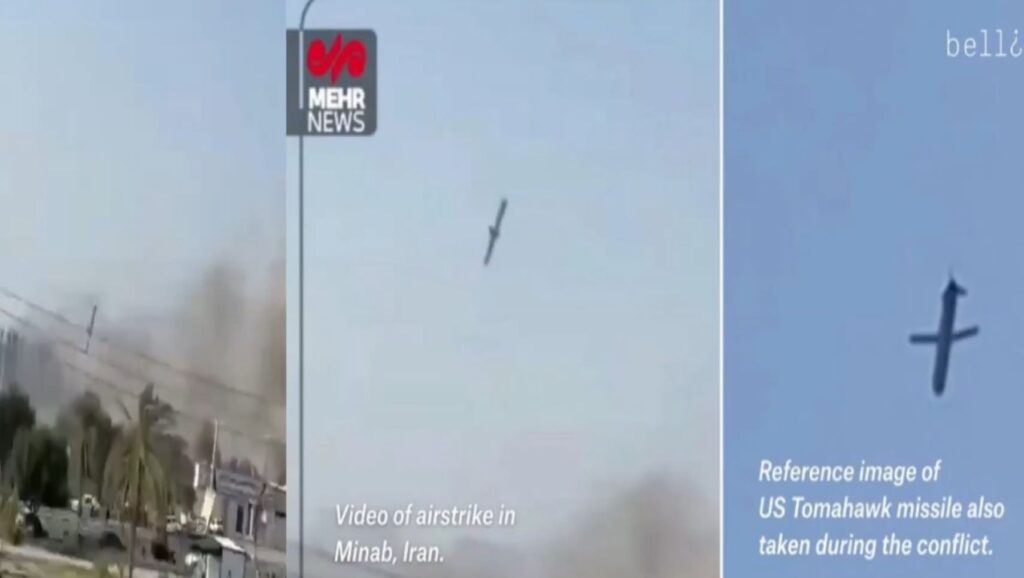
On the question of authorship there is no longer any dispute. On the day of the attack, video footage spread showing a cruise missile moments before impact. Dr. N. R. Jenzen-Jones, Director of the independent arms analysis institute Armament Research Services, identified it as a US Tomahawk – and established that no other actor in this conflict possesses or deploys Tomahawks, neither Iran nor Israel nor the Gulf states.
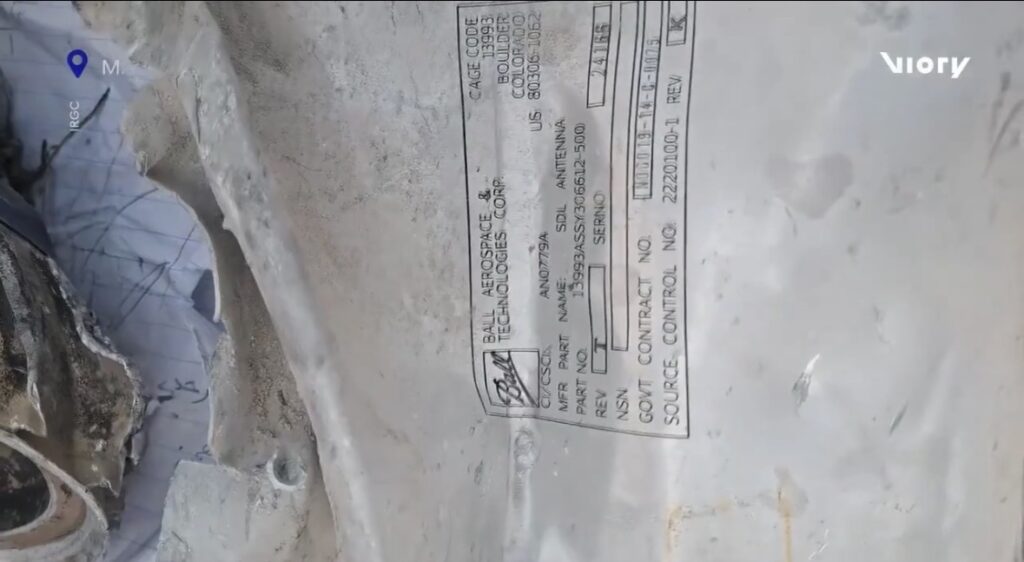
A few days later, Iranian authorities displayed debris fragments from the strike site. What can be read on them admits no second interpretation: a type plate from Ball Aerospace & Technologies, Boulder, Colorado, bearing a US Navy contract number, identified as the Tomahawk’s satellite data-link antenna that enables its real-time guidance. Actuator motors from Globe Motors of Dayton, Ohio, marked “Made in USA,” which move the Tomahawk’s control fins. A circuit board bearing the copyright notice of the Raytheon Company, the Tomahawk’s manufacturer – the core of its guidance electronics. These are not anonymous metal fragments: the pieces carry manufacturer names, contract and serial numbers, physical evidence that can be checked and that no authority can retrospectively place at a scene. Each part individually an indication; together a chain that leaves no gap. Such identifiable remains are the exception in modern aerial warfare – a cruise missile usually leaves little more than deformed sheet metal. That type plates, circuit boards, and actuators with legible identifiers survived here makes this case unusually well documented.


What is decisive is who confirms it. The fragments were not presented by Iranian authorities alone. The Washington Post analyzed a video showing a Tomahawk at the moment of impact. The Associated Press assessed further material. PBS NewsHour had the slowed-down footage reviewed by weapons experts who reached the same conclusion. The New York Times concluded in its own investigation that the United States carried out the attack with high probability. CBC, Channel 4, and the BBC also concluded, in independent visual investigations, that the attack was deliberate, not accidental.
Who else? Israel, the only other militarily active party in this war, denied any involvement – a spokesperson for the Israeli Defense Forces told NPR they were unaware of any Israeli operation in that area. Jenzen-Jones also described a pattern of multiple simultaneous or near-simultaneous impacts: not a single stray round, but a coordinated strike package. And the US side itself has never disputed the weapon’s origin – it contests the how, not the who. The first finding is therefore not an Iranian narrative. It is the concurring assessment of Western arms experts and leading media outlets.

Break Two: The Precision Rules Out Coincidence
It is precisely the precision with which the other targets in Minab were struck that turns the error explanation into a problem. The New York Times commissioned new satellite imagery from Planet Labs. The images show six precise impacts on the adjacent IRGC naval complex – the strikes lie almost exactly on the center points of the rooftops. The seventh strike was the school.
Wes J. Bryant, a former targeting specialist with the US Air Force and former Senior Adviser for Civilian Harm at the Pentagon, analyzed the imagery. Bryant served two decades in the US Air Force, where he himself directed air strikes and led targeting cells – he reads such images with the eye of someone who has planned strikes of that kind. His finding: textbook-precise hits – “picture perfect” in his own words. His conclusion is not an indictment but a technical reading: the system hit with precision, but the wrong target. The most probable explanation, he said, was a target misidentification – the school was struck without the attackers knowing that civilians were using it.
A second assessment supports this. NPR had commercial satellite imagery reviewed by several independent experts and found that not only the school but also an adjacent clinic and further buildings had been struck – a broad, planned strike package, not a single errant shot. And the US side itself indirectly confirms the location: General Dan Caine, Chairman of the Joint Chiefs of Staff, presented a map of the first phase of the operation on which the area around Minab was marked as a US target zone. The city was not named – but it lay within the marked strike corridor.
This is the core that undercuts the official line. A guidance failure, a scatter, a technical misfire leaves a different pattern: missed targets, divergent impacts, randomness. Here the opposite is documented. Had guidance failed, the Tomahawk would have landed somewhere in the urban area – on a market, a residential block, a field. Instead it lies on the school roof, a few dozen meters from six equally precise hits. Six impacts on rooftop centers are not a failure of technology. They are its success. A weapon that flies exactly where it is directed does not raise the question of why it missed – but why the school appeared in the target list at all. The error does not lie in the flight; it lies in the release authorization.
With that, the entire debate shifts. Precision is not an exculpatory argument. It is the finding. A Tomahawk that strikes precisely the wrong target is precise and wrong simultaneously – and the failure lies not in the weapon, but in the data and the decision that preceded it.
Break Three: The Excuse Does Not Hold
The question remains of how a civilly used building entered the target list. The US side points to a classification that still listed the building as part of the military complex – on the basis of data at least ten years old. Yet the building had visibly not been a barracks for years. Between 2013 and 2016 it was separated: a fence from the base, watchtowers removed, public entrances opened, a painted sports court, colorful murals on the exterior walls. The school operated its own website with years of online presence. These changes are documented through commercial satellite imagery – the same class of imagery any journalist can purchase and with which the New York Times, BBC, and NPR reconstructed the attack.
At the time of the strike, Minab was under maximum surveillance density. The city lies less than 50 miles (80 km) east of Bandar Abbas, the central IRGC naval base and one of the primary targets of the operation – a corridor under permanent observation by satellites, reconnaissance drones, and full electronic intelligence coverage. Commercial imagery alone resolves objects of around 12 inches (30 cm), fine enough to recognize a painted school yard and colorful wall murals. What a journalist sees on purchased images, a military intelligence apparatus with far higher resolution sees all the more readily. Whoever, under these conditions, claims not to have known the building was a school must explain why a system capable of guiding a Tomahawk through a military roof simultaneously remained blind to everything that identified that school as a school.
And there was no urgency. The only argument that, under international humanitarian law, could justify bypassing target verification would be a time-critical threat – a target about to disappear or kill within the hour. No documented evidence exists for this. No congressional briefing, no testimony from any investigation suggests that ready-to-launch weapons were being loaded at the complex. The IRGC naval facility in Minab had existed for years and would have still been there three hours later. Installations of this type do not run away. The military difference between a strike at 10:23 a.m. and one in the afternoon would have been negligible – but for target verification, decisive: time to cross-check against current imagery, time to ask the simple question of who is in the vicinity of the target on a weekday morning. “Outdated data” under these conditions is not an excuse. It is the description of a failure.
Assessment: Nearly One Hundred Days, No Answer
Three findings, one line: the weapon is American, the precision rules out coincidence, and the explanation of outdated data describes a neglected duty of care, not an unavoidable accident. What is missing is accountability.
Nearly one hundred days after the attack, the US side has publicly accepted no responsibility. On 19 May 2026, Admiral Brad Cooper, Commander of US Central Command, testified before the House Armed Services Committee. When directly called upon to acknowledge US responsibility, he evaded, called the investigation “complex,” and pointed to the school’s proximity to the military complex. Adam Smith, the ranking Democrat on the committee, pushed back: it was fairly clear what had happened – and yet no one was accepting responsibility. Already in March, 46 senators had demanded answers in a letter. They are still outstanding. The Pentagon has since elevated the internal investigation to a higher level and assigned a general from outside the regional command to it – a step against the charge that CENTCOM was investigating itself. No publicly accessible final report exists to this day.
Noteworthy is the stated reason for the complexity: not lack of evidence, not technical ambiguity, but the spatial proximity of school and base. Yet it is precisely this proximity that constitutes the problem, rather than resolving it. A military target in the middle of a civilian environment raises the duty of care – it does not diminish it.
The legal finding does not come from Tehran or Moscow. Just Security, a US specialist publication on security law, assessed the attack as incompatible with the duty to ensure the currency of target data. Amnesty International, after on-the-ground interviews, concluded the attack was unlawful and called for accountability up through the chain of command. The UN High Commissioner for Human Rights, Volker Türk, expressed public concern. This is not the advocacy of a party to the conflict. It is the judgment of Western legal institutions.
Modern warfare has made itself a promise: the more precise the weapon, the smaller the harm. Minab reveals the gap in that promise. Precision in the weapon does not replace precision in the data. On the morning of 28 February 2026, girls between seven and twelve years old were standing in the Shajareh-Tayyebeh School. The question of who should have known that, and why it did not change the decision, is not a technical one. It is one of accountability.
The complete analysis – covering the role of AI-assisted targeting systems in US target selection, the detailed legal finding on the chain of command, and the historical pattern from My Lai to Kunduz – can be found here: Minab: What Really Happened

About the Author
Michael Hollister served six years as a soldier in the German Bundeswehr (SFOR, KFOR) and looks behind the scenes of military strategies. After 14 years in the IT security field, he analyzes European militarization, Western interventionist policy and geopolitical power shifts on a primary-source basis. One focus of his work lies on the Asian region, particularly Southeast Asia, where he examines strategic dependencies, zones of influence and security architectures. Hollister combines an operational inside view with uncompromising systemic critique – beyond opinion journalism. His work appears bilingually at www.michael-hollister.com as well as in critical media across the German- and English-speaking world.
Sources
- Reuters – US May Have Struck Iranian Girls’ School After Using Outdated Targeting Data: https://www.reuters.com/world/middle-east/us-may-have-struck-iranian-girls-school-after-using-outdated-targeting-data-2026-03-11/
- The New York Times – Evidence Suggests U.S. Struck Girls’ School in Minab, Iran: https://www.nytimes.com/2026/03/11/us/politics/iran-school-missile-strike.html
- PBS NewsHour – A Look at Evidence Linking U.S. to Iranian School Strike: https://www.pbs.org/video/school-bombing-1773175842
- NPR – Satellite Imagery Shows Strike That Destroyed Iranian School Was More Extensive Than First Reported: https://www.npr.org/2026/03/04/nx-s1-5735801/satellite-imagery-shows-strike-that-destroyed-iranian-school-was-more-extensive-than-first-reported
- CBC News – Who Bombed a Girls’ School in Iran? A Visual Investigation: https://www.cbc.ca/news/world/iran-school-bombing-investigation-9.7114994
- Just Security – When Intelligence Fails: A Legal Targeting Analysis of the Minab School Strike: https://www.justsecurity.org/134350/legal-analysis-minab-school-strike/
- Amnesty International – USA/Iran: Those Responsible for Deadly and Unlawful US Strike on School Must Be Held Accountable: https://www.amnesty.org/en/latest/news/2026/03/usa-iran-those-responsible-for-deadly-and-unlawful-us-strike-on-school-that-killed-over-100-children-must-be-held-accountable/
- Middle East Monitor – US Lawmakers Press CENTCOM Chief on Deadly Iran School Strike: https://www.middleeastmonitor.com/20260519-us-lawmakers-press-centcom-chief-on-deadly-iran-school-strike/
- The Guardian – Minab School Bombing: How the Worst Mass-Casualty Event of the Iran War Unfolded: https://www.theguardian.com/global-development/2026/mar/03/minab-school-bombing-how-the-worst-mass-casualty-event-of-the-iran-war-unfolded-a-visual-guide
- RT.com – US Behind Strike on Iranian School – NYT: https://www.rt.com/news/633995-us-iran-school-strike/
Full source list and further documentation in the detailed analysis article.
© Michael Hollister – All rights reserved. The distribution, publication or use of this text requires the express written permission of the author. If interested in reuse, please contact the author via www.michael-hollister.com.
Newsletter
🇩🇪 Deutsch: Verstehen Sie geopolitische Zusammenhänge durch Primärquellen, historische Parallelen und dokumentierte Machtstrukturen. Monatlich, zweisprachig (DE/EN).
🇬🇧 English: Understand geopolitical contexts through primary sources, historical patterns, and documented power structures. Monthly, bilingual (DE/EN).