by Michael Hollister
Exclusive published at apolut media as a “Tagesdosis” on November 04, 2026
1.938 words * 10 minutes readingtime

Status: November 4, 2026, 7:33 a.m. CET. Vote counting remains underway; figures and projections for individual races may still change.
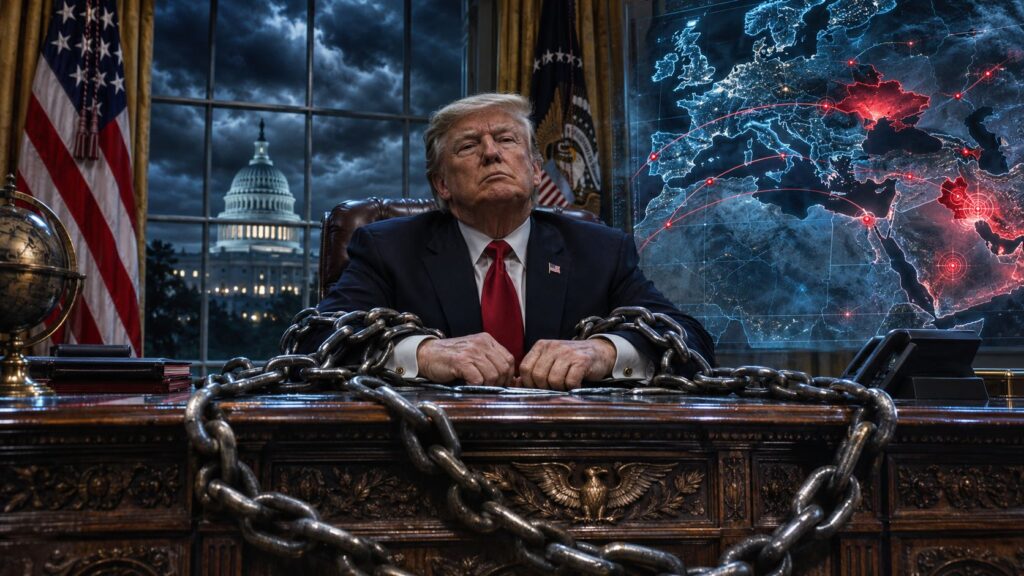
A president whose own party loses both chambers of Congress in the first midterm election of his second term-that is the headline of the night, and across Europe it will be reduced to a single sentence: Trump has been weakened. The more interesting question begins where that sentence ends.
On November 3, 2026, voters decided all 435 seats in the House of Representatives and 35 of the Senate’s 100 seats. The starting position was this: Republicans held a 53–47 advantage in the Senate and the narrowest of majorities in the House. According to consistent projections by NBC, CBS, CNN, and MS NOW, Democrats won both chambers overnight and will assume full control of Congress in January. CNN called the Senate majority at approximately 11:35 p.m. Eastern Time and projected Democrats to hold at least 51 seats. In the House, NBC projected a majority of approximately 255 seats-potentially the largest Democratic majority in almost two decades, according to the network, although that estimate could still shift as counting continued. The notably cautious Associated Press traditionally confirms such projections later; the overall trend, however, was unambiguous across the different election desks. CBS likewise projected Democratic control of the House and the Senate.
The change was driven by victories deep in Republican territory. In the Senate, Democrats flipped North Carolina with Roy Cooper, South Carolina with Annie Andrews, Ohio with Sherrod Brown, Iowa with Josh Turek, Kansas with Adam Hamilton, and-the symbol of the night-Texas, where James Talarico defeated Republican Ken Paxton to win the first Texas Senate seat for a Democrat since 1988. The Washington Post’s live results tracked the flips in Texas, Ohio, and Iowa. As the night progressed, Maine-where Democrats unseated longtime Republican Susan Collins-and Michigan also fell to the Democrats. Only Alaska, with its ranked-choice voting system, remained undecided at the editorial deadline, and it was no longer decisive for control of the chamber. NBC’s Senate results page continued to list the outstanding races, while PBS confirmed the change in Senate control and the Texas flip. The seat count, however, is not the real story. The real story is what such a constrained president does next.
Two Kinds of Power-and Only One Has Shrunk
What does this transfer of power change in practice? First, a point about timing that often gets lost in the excitement: The new Congress will not convene until January 3, 2027. Until then, the current majorities remain in place. Democrats do not take control of the levers immediately, but at the beginning of the new year.
When they do, however, their reach will be considerable. A Democratic House can block the president’s legislative agenda, controls subpoena and investigative powers through its committees, and holds leverage over the budget. Through the annual appropriations bills, the opposition gains an instrument of pressure that regularly brings Washington to the brink of a government shutdown. A Democratic Senate adds another layer: It decides on appointments and whether to consent to treaties. With the loss of the Senate majority, Republicans also lose control over the confirmation of cabinet officials and judges-a lever whose effects extend far beyond the current presidential term. This is more than a symbolic reprimand; it is the institutional capacity to slow Washington from within. Even before the election, Democrats had announced that a House majority would bring investigations and subpoenas directed at the administration.
The president’s party historically tends to lose seats in midterm elections, but the scale of this result exceeds the usual pattern. According to post-election surveys, the change was not accidental. An NBC exit poll found that only 38 percent approved of Trump’s performance in office. Forty-three percent said that a principal reason for their vote was opposition to the president-a larger share than in his first midterm election in 2018. Roughly seven in ten respondents wanted Congress to exercise greater control over him. The economy was the driving issue, named by approximately 39 percent; roughly two-thirds said Trump’s policies had made conditions worse, and 62 percent blamed him for high prices. The war against Iran also registered: In the NBC poll, 62 percent said the decision was wrong, linking it to higher gasoline prices. A CNN voter poll additionally found that approximately one-fifth of those who had voted for Trump in 2024 had now turned away from him.
This is where the decisive distinction begins-and where most analyses will skip ahead. The midterms change the president’s parliamentary power base. They do not curtail his independent foreign-policy powers to the same degree. Congress does hold foreign-policy levers: appropriations, trade legislation, sanctions, war authorizations, and, in the Senate, consent to treaties. Yet Congress cannot constrain a president in foreign policy to the same extent that it can paralyze him domestically. Where Congress can block new legislation, the president retains considerable independent room for action abroad. That is precisely why a domestic political defeat does not amount to an all-clear in foreign policy.

What This Means for the EU-and What It Does Not
For Europe, this is the actual test. The convenient interpretation is that a president weakened at home will also become tame abroad. That is possible-but by no means inevitable. Two paths are conceivable.
The first is foreign-policy compensation. A president whose legislative agenda is blocked shifts his weight to the field in which he can act without new laws: diplomacy, deals, and demonstrations of power. Foreign-policy action is comparatively inexpensive for a president under domestic pressure and is the area least constrained by the new Congress. That alone creates an incentive to demonstrate effectiveness precisely there. The second path is restraint. An election defeat increases domestic pressure; new conflicts and rising energy costs become less politically attractive, and the president becomes more cautious.
We do not predict which path will prevail. The finding is different, and it is robust: A parliamentary defeat does not compel moderation in foreign policy. Anyone in Brussels who assumes otherwise is confusing domestic power with external power. The Iran complex demonstrates the mechanism particularly clearly: The same foreign-policy decision that cost votes at the gas pump lay entirely in presidential hands. Congress could neither prevent it nor reverse it afterward. For Europe, this means that decisions affecting energy prices in the Middle East can continue to be made without Congress.
In concrete terms, this applies to three fields that directly affect Europe. First, aid to Ukraine: A distinction must be drawn among funding-the power of Congress to approve, refuse, or condition appropriations-implementation, for which the administration is responsible but remains bound by statutory requirements, and strategic direction, over which the president has extensive but not unlimited control. A Democratic-controlled House can create fiscal room for maneuver, but that does not guarantee more aid because appropriations are bargaining chips. Timing is another factor: Even when funds have been authorized, the executive branch can influence the pace and form of implementation. What reaches Kyiv therefore depends on more than what Congress approves. At the same time, committee control gives the opposition greater visibility into arms exports and military assistance-a transparency instrument that can obstruct an established course but can also force it forward. Second, tariffs: Under the Constitution, authority over trade policy fundamentally belongs to Congress. Presidents impose tariffs independently only on the basis of statutory delegations whose scope is legally limited. Operationally, however, those delegations currently give the president broad latitude. Tariff pressure on the EU therefore remains real in the short term, regardless of which party controls the House. Third, NATO burden-sharing: Pressure on Europe to spend more on its own defense is structural and bipartisan. A change in power in Washington will alter little in this respect.
The sober conclusion for the EU is therefore this: An opposition-controlled House can make Washington’s decisions more difficult in some fields while opening new negotiating windows in others. The relevant question for European decision-makers is not whether Trump’s majority is crumbling, but in which foreign-policy arena he will seek to compensate for the loss of domestic governing power. “Weakened at home” can lead in either direction-but it is no reason to stand down.
What Remains
What remains, then, is less an answer than a question. Will a president who has lost his domestic majority become more cautious abroad-or less constrained, because foreign policy is the arena in which voters have curtailed him the least? Europe should ask that question before treating a “weakened” Trump as good news. The midterms determine how much he can still accomplish at home. They do not, by themselves, determine how much power he can exercise abroad.
Exclusive published at apolut media as a “Tagesdosis” on November 04, 2026
No advertisers, no sponsors, no political patrons – this publication is funded by its readers. Support independent geopolitical analysis from $5 per month and unlock all member-only content.

You are also welcome to support my work with a one-time donation.

About the Author
Michael Hollister
is a geopolitical analyst and investigative journalist. He served six years in the German military, including peacekeeping deployments in the Balkans (SFOR, KFOR), followed by 14 years in IT security management. His analysis draws on primary sources to examine European militarization, Western intervention policy, and shifting power dynamics across Asia. A particular focus of his work lies in Southeast Asia, where he investigates strategic dependencies, spheres of influence, and security architectures. Hollister combines operational insider perspective with uncompromising systemic critique-beyond opinion journalism. His work appears on his bilingual website (German/English) www.michael-hollister.com and in investigative outlets across the German-speaking world and the Anglosphere.
Fewer headlines, more context: once a week, the developments that truly matter in geopolitics.

Sources
Election Results-Control of Both Chambers
- NBC News, “Democrats win control of the House of Representatives, with a vow to combat Trump” (House and Senate majorities, projection of approximately 255 seats, assumption of office in January 2027): https://www.nbcnews.com/politics/2026-election/democrats-house-control-midterm-election-wins-trump-check-rcna603397
- CBS News, “2026 House election live results” (Democrats win the House of Representatives): https://www.cbsnews.com/live-updates/house-election-results-2026/
- CBS News, “Live 2026 Senate election results” (Democrats take the Senate; flips in Texas, Ohio, Iowa, and Kansas): https://www.cbsnews.com/live-updates/senate-election-results-2026/
Senate-Individual Races and Outstanding States
- The Washington Post, “U.S. Senate election results 2026” (flips in Texas/Talarico, Ohio/Brown, and Iowa/Turek): https://www.washingtonpost.com/elections/results/2026/11/03/senate-live-updates/
- NBC News, “U.S. Senate Election 2026 Live Results” (races still outstanding at the editorial deadline: Maine, Michigan, and Alaska): https://www.nbcnews.com/politics/2026-elections/senate-results
- PBS NewsHour, “2026 Midterm Election Results” (Senate control, Texas flip): https://www.pbs.org/newshour/elections-2026/results
Exit Polls and Driving Issues
- NBC News, “Many voters saw midterm election as a rebuke of Trump, NBC News Exit Poll shows” (38 percent approval, economy as the leading issue, 62 percent on prices, Iran war): https://www.nbcnews.com/politics/2026-election/exit-poll-trump-midterms-voters-economy-disapproval-rcna607045
- CNN, “Early CNN Voter Poll results find an electorate deeply unhappy with Trump and the economy” (economic conditions, voters who supported Trump in 2024 but moved away from him): https://www.cnn.com/2026/11/03/politics/exit-polls-2026-midterms-vis
The projections are based on primary data from the Associated Press and the decision desks of the networks listed above. Live results pages are updated continuously; figures at the editorial deadline may differ from later totals.
© Michael Hollister – Redistribution expressly encouraged.
I am pleased when my articles, commentaries, and analyses attract interest and are shared. Reproduction, distribution, and publication of my texts, in whole or in part, on other websites, blogs, or in other publications is expressly permitted and encouraged. No prior permission is required.
<u>The sole requirement:</u> Michael Hollister must be clearly and prominently identified by name as the author. In addition, a clearly visible, clickable link to the original website, www.michael-hollister.com, must be included.
Reuse without author attribution and a link is not permitted.