by Michael Hollister
Exclusive published at apolut media as a “Tagesdosis” on September 29, 2026
2.526 words * 13 minutes readingtime

What the EU Council really decided on September 28, 2026
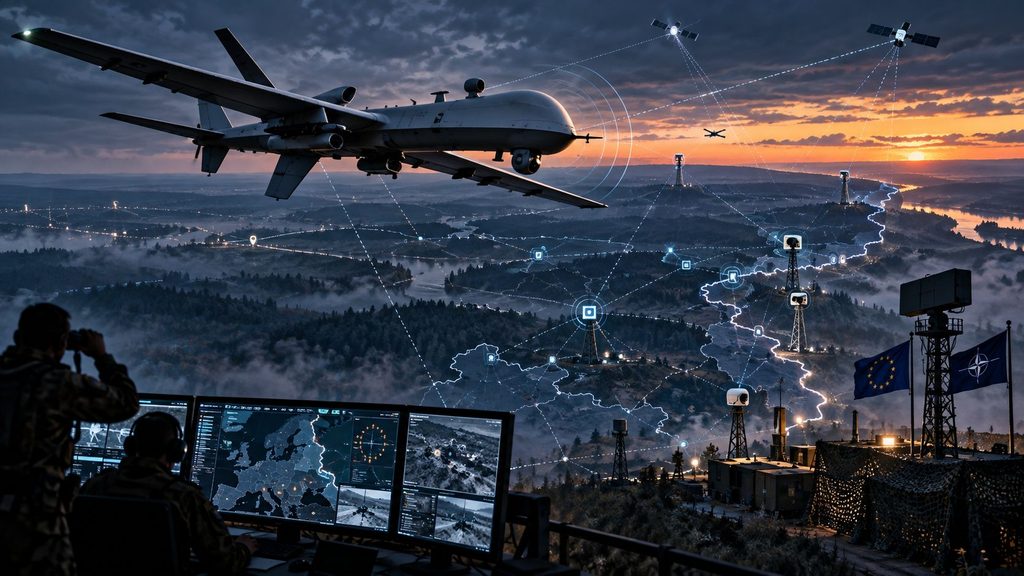
The term with which everything began a year ago is practically absent from the decisive document. When the Council of the European Union formally adopted 5 joint defense projects in Brussels on September 28, 2026, the phrase “drone wall” did not appear in the official communication. What began in the Baltic states as the idea of a defensive line against Russian drones, and what Ursula von der Leyen turned into a European headline in September 2025, has become something else today: the core of a defense architecture whose combined financing ambition the European Commission puts at around €190 billion by 2036. The catchy name has remained. What lies behind it has moved on. And that shift is the real news of the day – not the question of whether a wall can protect Europe from drones.
What Was Actually Decided
On September 28, the Council confirmed 5 so-called European Defence Projects of Common Interest, or EDPCIs. They carry the abbreviations DECODER (drones and counter-drone defense), IMSD (maritime and underwater defense), SPACE (satellites, early warning, reconnaissance), EU-FIAMD (integrated air and missile defense), and Eastern Flank Watch (defense of the eastern flank across land, air, sea, cyber, and additional domains). This makes the projects eligible for funding under the European Defence Industry Programme, or EDIP. The European Commission had proposed the 5 projects on July 03, 2026.
Important for context: The decision does not award any contracts. It identifies the projects, their objectives, the participating states, and the expected investment framework – and thereby makes them eligible to apply for funding. The actual decision was not a surprise that emerged on the day itself: Member-state ambassadors had already approved the list on September 16, 2026, while the Commission proposal dates to July 03, 2026. September 28 is the formal capstone, not the starting gun. Anyone trying to understand the scale should therefore look not at today’s headline, but at the numbers and the structure behind it. EUnews summarized the Council’s formal approval of the first 5 projects.
From a Defensive Line to the Evolution of Air Defense
The name “drone wall” suggests a wall – a fixed line of defensive systems along the border with Russia. That is misleading, and the EU itself now describes something different. What is emerging here is less a wall than an evolution of air defense.
The background is a cost problem the war in Ukraine has made visible. Defense Commissioner Andrius Kubilius described the imbalance openly: Whether one uses a $1 million interceptor missile to shoot down a $10,000 drone, he said, has to be “decided on the spot.” Traditional air defense was built for aircraft and large missiles. Against cheap, mass-produced small drones, it is economically disadvantaged. Kubilius’ cost comparison was reported in coverage of the EU’s counter-drone planning.
The existing systems remain useful against heavier threats – but the rest requires something cheaper, scalable, and networked.
That is exactly what the EU documents describe: a multilayered architecture of sensors, a shared operational picture, and different effectors, connected through a command-and-control and software layer involving artificial intelligence, encryption, and high-performance computing. The Commission explicitly speaks of a flexible, agile system and a 360-degree approach. Whether this becomes a stationary wall or a mobile, scalable system following something closer to an Iron Dome logic has not been publicly decided. The wording points toward the latter. That is not a minor detail: A fixed structure with permanently installed weapon systems would be technologically outdated within a few years and could not be moved to wherever the threat emerges. How Europe builds will determine effectiveness and cost at least as much as whether Europe builds at all.
The Dimensions Hidden by the Name
The numbers show how far the project has moved away from the original Baltic border concept. DECODER, the actual drone project, involves 26 EU states as well as Norway and Ukraine – practically the entire Union. Participants estimate investment of around €3.5 billion to €5 billion through 2033. Eastern Flank Watch, involving 13 EU states, Norway, and Ukraine, is estimated by the Commission at €60 billion to €100 billion through 2036. The integrated air-defense project EU-FIAMD is estimated at as much as €55 billion to €80 billion through 2040. The Commission’s Eastern Flank Watch factsheet sets out the scope, while Reuters reporting on the Commission proposal detailed DECODER’s investment range and participation.

Set against these dimensions is a very small immediate sum. EDIP has a total envelope of €1.5 billion, and initially €325 million is available for all 5 projects, with the first tranche amounting to around €60 million per project. That is not funding for the full undertaking, but seed money. The Commission itself explicitly calls the €190 billion figure a financing ambition, not an approved budget – most of the money would have to come from national budgets and industry. That is precisely why the finding is sober and robust at the same time: The public-sector initial contribution is small. The industrial scale that has been opened up is not. Reporting on the ambassadors’ approval described the roughly €60 million initial allocation per project.
Ukraine as the Blueprint
One part of the undertaking is rarely discussed alongside the rest, even though it shows the character of the restructuring most clearly. The EU does not only want to procure systems – it wants to adopt the way systems are developed and produced in Ukraine. To that end, the Commission has created an EU-Ukraine Drone Alliance, whose first council meeting took place on September 11, 2026. It is intended to link European and Ukrainian defense companies, scale drone production to an industrial level, and make the short development cycles proven in wartime usable for European procurement. The European Commission described the alliance at its first meeting, while the Kyiv Independent reported on participating EU and Ukrainian defense companies.
This establishes a structural interest that requires no insinuation. For an emerging defense architecture, an ongoing conflict is 2 things at once: a reliable sales market and a test field. Anyone able to test a weapon system in the field receives development data no training ground can provide – and the products are purchased at the same time. Viewed from the logic of the defense industry, that is an advantage, not an accusation. But it changes how one looks at political talk of imminent peace when the innovation strategy itself explicitly relies on learning from an ongoing war. The increasing use of returns from frozen Russian assets to finance Ukraine’s rearmament is a pattern whose legal controversy this publication has already examined.
Who Decides – and Where Authority Moves
Institutionally, several levels converge. The Commission provides industrial policy, funding instruments, and coordination, centrally through Kubilius. High Representative Kaja Kallas coordinates the security-policy side, the European Defence Agency steers capability development and joint procurement, while NATO remains responsible for military planning and interoperability. The armed forces themselves continue to be provided by the member states. That leads to the politically most sensitive question in the entire undertaking: Where does European industrial coordination end – and where does European defense planning begin in practice?
The question is not new, and it does not come from the political fringes. A European Parliament briefing notes that the initiative has divided national capitals: Frontline states such as Poland, the Baltic countries, and Finland regard it as urgently necessary, while France, Germany, Italy, and Greece have questioned the costs, technical feasibility, and the risk that Brussels could intrude into national defense sovereignty. French President Emmanuel Macron publicly doubted whether such a wall could be built along the roughly 1,864-mile border with Russia. The heads of government of Italy and Greece criticized the eastern bias of the project. The criticism therefore runs through the establishment itself – and at its core concerns not the threat, but the transfer of authority. The European Parliament briefing on Eastern Flank Watch and the European Drone Wall documents that debate, while netzpolitik.org summarized criticism from Macron, Meloni, and Mitsotakis.
At the same time, NATO is building its own response. In July 2026, the alliance announced that it would invest more than $40 billion over 5 years in counter-drone capabilities, create its own Counter-Drone Marketplace, and increase the number of trained drone operators fivefold by the end of 2027. The EU emphasizes complementarity; its roadmap explicitly requires interoperability with NATO command structures. Nevertheless, 2 procurement and financing tracks are emerging side by side, addressing the same capabilities – the EU through industry and subsidies, NATO through military planning and its own programs. Whether this is a division of labor or a duplicate structure in which 2 bureaucracies compete over the same task is one of the open questions raised by the build-up. NATO itself announced the $40 billion counter-drone investment and training expansion.
Cui Bono – and Pistorius’ Striking Timeline
Who benefits from this architecture can be stated more precisely than the usual polemics suggest. No concrete contract from DECODER or Eastern Flank Watch to prominent European defense companies such as Helsing – valued at $18 billion in July 2026 – or Quantum Systems, valued at around $8 billion, has been publicly documented. The decision, as noted, awards no contracts. The defensible finding lies one level deeper and is therefore stronger: The EU itself states that DECODER is intended to promote joint procurement, expand production capacity, and scale a European market for drones and counter-drone systems. Building a defense market is not an accusation made by the analysis; it is an explicit project objective. That such a market will produce winners follows from its design, not from speculation. The conversion of civilian industrial capacity toward military production, which I have already traced using EDIP as an example, continues here. EUalive explicitly noted that project identification is not the same as a signed procurement contract.
A second element stands out: the timetable. The Defence Readiness Roadmap calls for initial capabilities by the end of 2026, full operational capability of the European counter-drone initiative by the end of 2027, and operational capability of Eastern Flank Watch by the end of 2028. That fits a statement Defense Minister Boris Pistorius made in the Bundestag as early as June 05, 2024: “We must be kriegstüchtig by 2029.” The EU, in turn, sets its readiness target at 2030. This raises a question that is not merely journalistically permissible but necessary: Why does a defense build-up have such a specific target horizon at all? Whether a system is completed in 5, 6, or 8 years would be irrelevant for pure deterrence. A fixed deadline requires an explanation – and the official documents provide, with 2029 and 2030, at least a strikingly consistent corridor. The Bundestag record preserves Pistorius’ 2029 statement, while European Security & Defence has outlined the staged timetable for the initiative.
A Wall That Is No Longer a Wall
In the end, the question is not whether Europe has the right to protect itself against drones – no one disputes that right. The actual development is different: Within a single year, a catchy political image has evolved into a European defense architecture spanning 5 domains, with its own financing logic, its own institutional structure, and a timetable running through 2030. The name “drone wall” conceals this dimension more than it reveals it. Is European defense policy gradually shifting from national procurement toward a jointly coordinated defense architecture led from Brussels – and was a shift of this magnitude ever decided with the clarity it would require? On September 28, the Council placed a capstone. It left open what the building will ultimately become.
Exclusive published at apolut media as a “Tagesdosis” on September 29, 2026
No advertisers, no sponsors, no political patrons – this publication is funded by its readers. Support independent geopolitical analysis from $5 per month and unlock all member-only content.

You are also welcome to support my work with a one-time donation.

About the Author
Michael Hollister
is a geopolitical analyst and investigative journalist. He served six years in the German military, including peacekeeping deployments in the Balkans (SFOR, KFOR), followed by 14 years in IT security management. His analysis draws on primary sources to examine European militarization, Western intervention policy, and shifting power dynamics across Asia. A particular focus of his work lies in Southeast Asia, where he investigates strategic dependencies, spheres of influence, and security architectures. Hollister combines operational insider perspective with uncompromising systemic critique – beyond opinion journalism. His work appears on his bilingual website (German/English) www.michael-hollister.com and in investigative outlets across the German-speaking world and the Anglosphere.
Fewer headlines, more context: once a week, the developments that truly matter in geopolitics.
Sources
Primary Sources (EU Institutions, Parliament, Bundestag)
- European Commission – Defence Industry and Space: “Commission proposes five joint defence projects to strengthen Europe’s industrial capabilities” (July 03, 2026):
https://defence-industry-space.ec.europa.eu/commission-proposes-five-joint-defence-projects-strengthen-europes-industrial-capabilities-2026-07-03_en - European Commission – Factsheet: “European Defence Projects of Common Interest (EDPCI) on the Eastern Flank (Eastern Flank Watch)”:
https://defence-industry-space.ec.europa.eu/document/download/05bd2568-e209-4d99-be29-10eaed9e86c1_en?filename=Factsheet-Eastern-Flank-Watch.pdf - European Commission – Defence Industry and Space: “Commission hosts first meeting of EU-Ukraine Drone Alliance” (September 11, 2026):
https://defence-industry-space.ec.europa.eu/commission-hosts-first-meeting-eu-ukraine-drone-alliance-2026-09-11_en - European Parliament (EPRS) – Briefing: “Eastern Flank Watch and European Drone Wall”:
https://www.europarl.europa.eu/thinktank/en/document/EPRS_ATA(2025)777962 - German Bundestag – Government questioning, Boris Pistorius: “Wir müssen bis 2029 kriegstüchtig sein” (June 05, 2024):
https://www.bundestag.de/dokumente/textarchiv/2024/kw23-de-regierungsbefragung-1002264 - NATO – “NATO Allies invest 40 billion dollars in counter-drone capabilities and drone training” (July 07, 2026):
https://www.nato.int/en/news-and-events/articles/news/2026/07/07/nato-allies-invest-40-billion-dollars-in-counter-drone-capabilities-and-drone-training
Reporting on the Council Decision (September 28, 2026)
- EUnews – “Defence: EU countries clear the first five European projects”:
https://www.eunews.it/en/2026/09/28/defence-eu-countries-clear-the-first-five-european-projects-of-common-interest/ - Reuters via Global Banking & Finance – “EU members approve five big pan-European defence projects”:
https://www.globalbankingandfinance.com/eu-members-approve-five-big-pan-european-defence-projects/ - Report.az – “EU Council identifies first five projects of common interest”:
https://report.az/en/other-countries/eu-council-identifies-first-five-projects-of-common-interest
Background, Figures, and Context
- Reuters via U.S. News – “EU Commission proposes five major cross-border defence projects” (DECODER €3.5-5 billion; participant numbers):
https://www.usnews.com/news/world/articles/2026-07-03/eu-commission-proposes-five-major-cross-border-defence-projects - Balitangmarino (AP material) – “EU ambassadors advance major defense projects plan” (approx. €60 million initial funding per project; EU-FIAMD €55-80 billion; ambassadors’ approval September 16):
https://www.balitangmarino.com/post/eu-ambassadors-advance-major-defense-projects-plan-with-ukraine-featuring-prominently - Agence Europe – “Member States’ ambassadors to EU approve European Defence Projects of Common Interest” (September 16, 2026):
https://agenceurope.eu/en/bulletin/article/13939/33/member-states-ambassadors-to-eu-approve-european-defence-projects-of-common-interest - EUalive – “EU names first five joint defence projects as ministers lock in industrial flagships” (“Identification is not a signed procurement contract”):
https://eualive.net/eu-names-first-five-joint-defence-projects-as-ministers-lock-in-industrial-flagships/ - Censor.net – “Kubilius outlines key technologies needed for ‘Drone Wall’ in EU” (drone/interceptor cost calculation):
https://censor.net/en/news/3576400/drone-wall-kubilius-outlines-required-technologies - European Security & Defence – “Europe’s Drone Wall – Ready, EDDI, Go!” (timeline; Eastern Flank Watch by end of 2028):
https://euro-sd.com/2026/03/articles/exclusive/49854/europes-drone-wall-ready-eddi-go/ - aero-space.eu – “Training Five Times More Drone Operators by 2027: NATO’s Next Challenge Is Scale”:
https://aero-space.eu/2026/07/15/training-five-times-more-drone-operators-by-2027-natos-next-challenge-is-scale/ - netzpolitik.org – “EU rüstet auf: Drohnenverteidigung soll Menschen an Grenzen abwehren” (criticism by Macron, Meloni, Mitsotakis):
https://netzpolitik.org/2025/eu-ruestet-auf-drohnenverteidigung-soll-menschen-an-grenzen-abwehren/ - Kyiv Independent – “18 EU, Ukrainian defense companies join up to launch Drone Alliance”:
https://kyivindependent.com/eu-ukraine-launch-drone-alliance/ - GlobalSecurity, Romanian Ministry of Defence – “Defence Minister, at the EU Eastern Flank Watch Meeting” (origin of the “Drone Wall” concept):
https://www.globalsecurity.org/military/library/news/2025/09/mil-250929-ro-mnd03.htm - Swiss Aerospace Ventures – “Helsing’s 1.8 Billion Series E and What It Signals” (valuations of Helsing / Quantum Systems):
https://swissaerospace.ventures/articles/helsing-series-e-european-defence-founders
Further Analysis by the Author
- Michael Hollister – “EDIP – Wie die EU Europa zur Kriegswirtschaft umbaut” (November 16, 2025):
https://www.michael-hollister.com/de/2025/11/16/edip-wie-die-eu-europa-zur-kriegswirtschaft-umbaut/ - Michael Hollister – “Der 300-Milliarden-Bumerang” (January 11, 2026):
https://www.michael-hollister.com/de/2026/01/11/der-300-milliarden-bumerang/
© Michael Hollister – All rights reserved. Redistribution, publication or reuse of this text requires express written permission from the author. For licensing inquiries, please contact the author via www.michael-hollister.com.