by Michael Hollister
Published at apolut media on October 27, 2026
4.742 words * 25 minutes readingtime
Part 3A read here:
The Third Operating System of Power – Part 3A: The Foundational Layer
The First Operating System of Power read here:
BlackRock, Aladdin, and the Invisible Infrastructure
The Second Operating System of Power read here:
How Palantir Connects and Divides Germany’s Security Agencies

How the State Buys Sovereignty as a Surcharge on the Same Corporation’s Bill
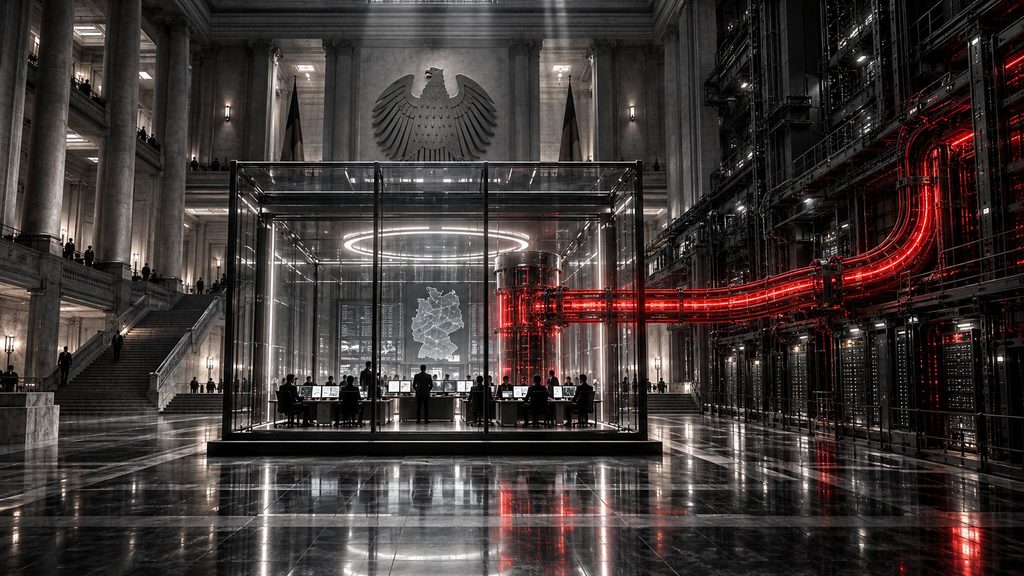
When a German public authority purchases Microsoft services through the so-called sovereign government cloud, it pays approximately 15 percent above Microsoft’s German list price. The surcharge applies to everything from basic Azure services to Office 365 and is, viewed soberly, the price of a promise: that this cloud is German, secure, and protected from American access. The underlying product is the same as before. What is being sold is the shell. It is a rare case in which the price reveals the nature of the product: If the sovereign cloud were a different, independent product, its price would stand on its own. The fact that it is calculated as a fixed premium on Microsoft’s own list price shows what constitutes the core and what constitutes the packaging, as the reported pricing structure for the Delos Cloud makes clear.
The first part of this third chapter exposed the foundational layer – the computing power on which the private operating systems of power run, approximately 70 percent of which belongs to 3 American corporations in Europe. This second part takes the step that turns private infrastructure into a matter of state. It asks what happens when a country that has elevated digital sovereignty into a guiding principle builds its own public administration on precisely this foundational layer – and calls the thin layer placed on top of it “sovereign.”
The answer is not a scandal with a clearly identifiable perpetrator. It is a finding about a word that promises more than the reality behind it delivers.
The Question Behind the Label
Sovereignty has become a seal of quality in Germany’s digital debate. Almost every offering now carries the label, from government clouds to defense IT. The question in this part is therefore not whether the word sovereignty appears on the packaging, but whether sovereignty is actually inside: Does the German government’s “sovereign cloud” provide the control its name claims – or is it another layer built over the same American foundation, whose legal reach no label can eliminate?
The answer leads through numbers, through a clause that can do less than its name suggests, through a corporation that refused to provide a guarantee under oath, and finally through a European path that repeats the same pattern described in the second part of this series in relation to another operating system. The rule that applies throughout this series applies here as well: The text documents facts and structures, not intentions. The existence of a dependency can be demonstrated; whether and when it will be used against German interests remains an open question that this text does not decide.
A Dependency That Is Growing and Becoming More Expensive
Let us begin with what is documented because it appears in official figures. Federal spending on Microsoft IT services and licenses rose from €74 million in 2017 to €198 million in 2023 and €204.5 million in 2024. For 2025, the German government reported €481.4 million for licenses alone – more than twice as much as it had spent on services and licenses combined in previous years. The figures come from the federal government’s response to a parliamentary inquiry by The Left dated March 26, 2026. Within 8 years, the bill multiplied, and it continues to rise: Microsoft announced a price increase effective July 01, 2026, whose additional cost the government was unable to quantify in December 2025.
The reason for this dynamic lies not in more users or greater performance, but in the depth of the dependency. According to the same response, 96 percent of federal administration employees use Microsoft products every day. An organization so completely dependent on a single vendor does not negotiate prices; it accepts them. There is also an operational vulnerability: 2 major Microsoft reseller agreements covering the entire federal administration expired on May 31, 2025, and little is known about the terms of the successor agreements. An administration that obtains its basic equipment from a source whose prices it does not control and whose contracts it must renegotiate has already surrendered part of its freedom of action before the question of data access even arises.
In February 2026, the Open Source Business Alliance, an association of open-source software providers, drew the same conclusion from another parliamentary inquiry: The rising costs resulted not from greater productivity but from the dependency itself, while the money was consequently unavailable elsewhere for modernizing the state. The association points to the government’s own coalition agreement, which stipulates a preference for open-source software – an objective from which procurement practices move farther away with every invoice. The association’s interests must be taken into account, since its own members operate in the market; the figures on which it relies, like those cited above, come from government responses.
That is the starting point, and it is undisputed because the government itself quantified it. Everything that follows builds on it.
What the No-Spy Clause Cannot Do
To guard against access by foreign agencies, the federal government has an instrument with a reassuring name: the technical no-spy clause in its model contracts. It obliges the provider not to install backdoors or transfer data to foreign intelligence services. In September 2024, the federal government gave a revealing answer to the question of what this clause actually accomplishes, in a parliamentary response on Microsoft and the federal administration submitted to an inquiry by the same political group.
According to the government, the clause cannot prevent a violation. In the event of a breach, it secures warranty claims – in other words, the possibility of seeking compensation afterward. To the government’s knowledge, contractual penalties have never been applied. A clause that does not prevent access but merely regulates subsequent compensation is not a lock on the door. It is an insurance policy for the event that the door was open anyway.
The same response also shows how little technical room for maneuver the administration has. The federal administration uses Office almost exclusively as locally installed software, it states; the government does not know whether Microsoft will offer those products only as cloud services in the future, while the continued development of services such as Exchange requires the Azure technology stack. The old reseller framework agreement could not be extended, and a new one had to be put out to tender, though preparations had not yet begun. In other words, even where work is still performed locally today, the technical path leads toward the Microsoft cloud – and thus to the question this part examines.
A second disclosure in the same response is also noteworthy. Asked about meetings between the federal government and Microsoft, the government provided a long list of discussions but acknowledged that no complete record existed; the Federal Intelligence Service refused to provide information, citing the welfare of the state. The same pattern described in the second part of this series in relation to Palantir appears again: At the most sensitive level, parliament learns the least. Alongside this stands the statutory declaration that, since July 24, 2024, the federal government must give preference to open-source software under Section 16a of the E-Government Act – an intention overtaken, as the figures show, by actual procurement practices.
How Far the Foreign Legal Order Reaches
The real question is not whether a contractual clause holds, but whether the data is subject exclusively to German law. It is not. Like Amazon and Google, Microsoft is subject to the American CLOUD Act, which can compel US providers to produce data regardless of where in the world that data is stored. This is not speculation but applicable law. The only question is whether it can be enforced against European data.

There is now sworn testimony on that point. On June 10, 2025, a French Senate inquiry commission asked Anton Carniaux, Microsoft’s director of public and legal affairs in France, whether he could guarantee that French data would never be transferred to the United States without the consent of French authorities. His answer was: “No, I cannot guarantee that.” He added that no such case had occurred to date. The company that markets its European clouds as sovereign could not provide the one guarantee that matters.
An episode that requires careful treatment because it is disputed demonstrates how concrete that reach can become. In May 2025, the Associated Press reported that Microsoft had blocked the email account of Karim Khan, the chief prosecutor of the International Criminal Court, following US sanctions. Microsoft disputes this. Appearing before a committee of the British House of Commons in February 2026, Microsoft executive Hugh Milward said the decision to remove Khan’s access had been made by the court, not Microsoft; the company later apologized for an inaccuracy in that statement and declared: “At no point did Microsoft cease or suspend its services to the ICC.” The Register documented Microsoft’s testimony and subsequent correction. A third account, based on Dutch reporting, states that Microsoft informed the court that the sanctions required Khan’s account to be blocked or service to the entire organization would be terminated – whereupon the court itself disabled Khan’s account. That version was also reported in connection with the broader debate over digital sovereignty. The court has not issued an official statement.
What cannot be determined from this case is who flipped the switch. What can be determined is the underlying structure: A US sanctions regime targeted an international institution, and access to its communications depended, one way or another, on an American provider and its obligations under American law. Whether the provider blocked the account or the customer did so, the reach of a foreign legal order into the inboxes of an international court was no longer theoretical at that moment. It is precisely this reach that hangs over every German public authority storing its data in a Microsoft environment.
The decisive point, often lost in the sovereignty debate, is that the CLOUD Act attaches to the nationality of the provider, not the location of the data. A data center in Frankfurt operated by an American corporation is physically located in Germany while simultaneously falling within the reach of American orders. The reassuring formula that the data is, after all, stored in Europe therefore misses the point. It is not the location that determines who can demand access, but the legal order governing the company that controls the keys.
The Sovereign Shell: Delos Cloud
At this point, the solution with which Germany intends to contain the problem enters the picture: the Delos Cloud. It is operated by Delos Cloud GmbH, which is owned by SAP; technically, it is built on Microsoft Azure. Microsoft supplies the technology, while Arvato Systems operates the platform in German data centers using security-cleared personnel. In September 2024, Microsoft promoted the project as a way to make its technology available “in a fully sovereign environment”. The promise is all the benefits of Azure and Office, but under German law and shielded from American access.
Operations began cautiously in the fall of 2026. Delos maintains 2 operating centers, one in Gütersloh since September 2025 and another in Leipzig since early 2026, providing geographic redundancy. The Federal Employment Agency and the Stuttgart State Theater are named as the first pilot customers. Before the market launch, Delos admitted 15 integration partners in June 2026, including Arvato Systems, Capgemini, and Materna; Cancom joined in October 2026. There is no fixed date for a broad market launch. A certification announced in February 2025 by Germany’s Federal Office for Information Security, or BSI, for processing classified material at the “For Official Use Only” level had not been reported as granted by October 2026.
The decisive finding, however, comes not from critics but from the state itself. In a statement to the state parliament dated August 15, 2025, Baden-Württemberg’s Ministry of the Interior spelled out what the sovereign shell can and cannot achieve. It stated that the infrastructure was sovereign and operated under German law. At the same time, the application layer remained Microsoft software – proprietary software belonging to the US corporation. Access to application data by third countries could not be ruled out, at least within a legal gray area. The risk posed by the US CLOUD Act remained. Then came the sentence that encapsulates the entire debate: Despite the sovereign infrastructure, “complete sovereignty cannot be said to exist in every respect.”
That is the shell, described in a single sentence by the administration itself. The basement is German, the house stands on German soil, but the machine in the apartment still belongs to Microsoft, and the legal order obeyed by its manufacturer reaches through the walls. Delos’s assertion that German law applies and that no obligation exists to disclose data to third countries stands against the assessment of the state that is expected to use the software. The 2 statements stand side by side, and the reader may decide which carries greater weight – that of the provider or that of the Interior Ministry.
The state is not alone in its assessment. As early as 2024, the Open Source Business Alliance warned that the Delos model threatened to undermine digital sovereignty rather than establish it. Frank Karlitschek of Nextcloud and representatives of the provider Plusserver criticized the close ties to Microsoft at the end of every Delos installation. Proponents counter that a German operating company with vetted personnel, German data centers, and BSI requirements represent real progress over the ordinary public cloud – and are better than a situation in which public authorities use Microsoft without any shell at all. Both positions can be defended. The sovereignty debate centers on possible access by third countries, not on the infrastructure, whose location in Germany is hardly contested, but on the application layer above it, which remains proprietary and American – and on whether a shell that does not change the core deserves to be called sovereign. The fact that the responsible ministries have been working on the Microsoft solution since 2020 through the interdepartmental MSSC assessment project shows how long and how seriously this path has been pursued.
For this sovereignty, whose scope the state itself regards as limited, a public authority pays approximately 15 percent above the ordinary Microsoft price. Accordingly, Baden-Württemberg had not decided to migrate by the fall of 2026; approximately 51,500 workstations in the state administration continued to run a local version of Office supported through 2029. Sovereignty as a premium on a product one already had – that is the business model, not its abuse.
The operational status also counsels restraint. The flagship has not yet reached full altitude: pilot customers rather than broad adoption, 15 integration partners only beginning to position themselves, no fixed market-launch date, and a BSI certification for classified material that was announced but had not been reported as issued by the fall of 2026. At the same time, the states and the federal government are openly examining other models. In the same statement, Baden-Württemberg’s Interior Ministry explicitly names the private cloud of the Federal Information Technology Center, STACKIT, the Ionos Sovereign Cloud, and the open-source Sovereign Cloud Stack as alternatives it is weighing against Delos, while also testing the open-source openDesk workplace in a dedicated strategy project. The sovereign shell is therefore not without competitors; it is merely the option that most conveniently perpetuates the existing Microsoft estate.
The calculation behind it has an irony of its own. In 2025, the federal government already spent €481.4 million on Microsoft licenses alone; wherever the sovereign version replaces the ordinary one, the surcharge of approximately 15 percent is added to that sum. Sovereignty built in this way does not reduce the cost of dependency; it increases it. The money that lawmakers intended to direct toward European and open-source solutions through the open-source preference in Section 16a instead flows into a more expensive version of the same dependency. The state pays more to remain where it intended to leave – and calls the higher price a step toward independence. There is no fraud or scandal in this; it contains the entire predicament of a sovereignty policy that does not change the provider but merely changes the packaging.

Anyone who has read the second part of this series will recognize the pattern. There, the French company ChapsVision and its German partner rola embodied the “European path” for the domestic intelligence service’s analytical software – and, on closer examination, reproduced the same operating model and the same lock-in as the American provider they were meant to replace. With the cloud, the rhyme repeats one layer deeper. The label changes; the underlying structure remains.
The European Path and Its Repetition
There are attempts to escape this logic, and they deserve a fair presentation because some are serious. The Schwarz Group, parent company of Lidl and Kaufland, announced in May 2026 that it was building its subsidiary Schwarz Digits and the cloud brand STACKIT into a “German hyperscaler.” SAP plans to offer its enterprise software on STACKIT, while the Schwarz Group is migrating its own IT there. This is a real offering and a serious attempt. It is also a self-description: The announcement names no major public-sector customers, capacity and certification evidence remains unclear, and it has not been demonstrated that STACKIT can match the breadth of services offered by American providers. The strongest argument for the project’s seriousness comes from the Schwarz Group itself: It is migrating its own corporate IT to STACKIT while SAP offers its software on the platform through the RISE with SAP program. A provider that stakes its own business on the platform is more credible than one that merely distributes a brochure. Whether this becomes an alternative for the state, however, depends not on technology alone but on whether public authorities are willing to abandon the convenient path to the familiar Microsoft shell.
The major state-backed European project intended to close precisely this gap is now widely regarded as a failure. Gaia-X, launched in 2019 as a European cloud initiative, was declared dead in early 2025 by Frank Karlitschek, head of the software company Nextcloud: “Gaia-X is dead.” What remained, he said, were data specifications but no marketplace and no reference implementation. The reasons for the failure are disputed within the industry, but several recur: an excessive bureaucratic apparatus that kept small providers away; the participation of corporations such as Alibaba, Huawei, and, of all companies, Palantir, which hollowed out the idea of a European alternative from within; and, according to Karlitschek, the decline in political will once the initial headlines had passed. The result was described as a promising idea diluted over years until only an industry consortium without a mandate remained.
Gaia-X has been replaced by a successor, the European IPCEI-CIS initiative and its umbrella structure 8ra, involving 12 member states, more than 150 partners, €750 million in funding from Germany alone, and a total investment volume of €3.5 billion cited by the European Commission. German participants include Bosch, Ionos, SAP, Siemens, and Deutsche Telekom. Whether it will become what Gaia-X did not remains open. The history calls for restraint.
The repetition is clearest where the state contracts out its most sensitive IT. In May 2025, the German military’s IT subsidiary BWI announced that it would expand its private cloud, pCloudBw, with a Google component: Google Cloud Air-Gapped, an environment physically separated from Google’s other systems whose updates are transferred not over a network but on physical media. BWI operates the stack in its own data centers with security-cleared personnel. The description calls it “explicitly sovereign” and states that “Google Cloud cannot access the information either.” Construction is scheduled to begin in 2026 and be completed by the end of 2027, at which point the system is also intended to handle classified information up to the German Geheim level. The selected architecture is Google’s Distributed Cloud Air-Gapped solution.
Here the circle closes with the first part of this series. The German military had rejected Palantir on principle because a US operator could potentially gain insight into the national data estate. Now the same military is building one of its clouds on the isolated technology of another US corporation – and calling it sovereign. The assurance that the manufacturer itself cannot gain access is exactly the same assurance at the heart of Delos. Whether it holds is a technical and legal question that cannot be conclusively assessed from the outside; the fact that it is the central sales argument shows how completely the debate revolves around this single point. Alongside it exist genuinely European or open-source approaches – the private cloud of the Federal Information Technology Center, the Ionos Sovereign Cloud, the Sovereign Cloud Stack, and the open-source openDesk workplace developed by the Center for Digital Sovereignty. They are real, but today they carry the smaller share of the burden.
Three Paths, an Open Outcome
Three paths can be imagined from the present situation, and they resemble those with which the second part of this series concluded. The first is American lock-in in a new form: The administration remains with Microsoft, the Delos Cloud becomes the standard shell, and sovereignty consists of a German operating company, a surcharge, and an assurance that the manufacturer cannot gain access – layered over an application environment that remains American. The second is European fragmentation: National champions such as STACKIT, successor projects such as 8ra, and providers such as ChapsVision divide the market under the banner of sovereignty. The governing legal order shifts from Washington to Berlin and Paris, but the model remains the same – a private provider, a shell, a commitment lasting years. The third is emancipation: open-source, state-controlled infrastructure; Section 16a taken seriously; openDesk and the Sovereign Cloud Stack treated not as a niche but as the foundation. The difference between the second and third paths is not technical but concerns control over the source code. A national shell over proprietary software merely changes whom the tenant pays rent to; an open-source foundation that the state itself can read, audit, and develop changes the ownership relationship. Only the third path reaches the core; the first 2 merely exchange labels.
Which path will prevail remains undecided. But the facts favor the first 2. License costs of €481.4 million in a single year, 96 percent of employees tied to Microsoft, and a Delos Cloud entering operation with a surcharge and certification process while open-source alternatives carry the smaller burden – this is not a departure toward emancipation. It is the management of a dependency under a better label. A declaration of allegiance to sovereignty does not decide the matter; procurement behavior does, and procurement behavior speaks a different language from political speeches.
Finding
The sovereign shell is a shell. The state has not left the foundational layer described in the first part; it has placed a German operating company, several data centers, and a surcharge on top of it and called the result sovereign. The state expected to use the software says itself that complete sovereignty cannot be claimed. The manufacturer says under oath that it cannot guarantee protection from foreign access. And the bill rises year after year. None of these 3 statements comes from a critic; all 3 come from those who support or sell the model. That is what gives the finding its edge.
This concludes the series. Whoever owns the operating system owns a switch within the state – that was the finding of the second part. Whoever provides the foundational layer owns the ground on which the operating systems stand – that was the finding of the first part of this third chapter. And a state that builds its administration on this foreign ground and allows the same corporation from which it intended to break free to sell sovereignty back to it as a line item on the bill ultimately possesses, above all, one thing: the word. Whether it becomes more than that will be decided not by a label, but by who builds the basement in which Germany’s public administration will compute in the years ahead.
Published at apolut media on October 27, 2026
No advertisers, no sponsors, no political patrons – this publication is funded by its readers. Support independent geopolitical analysis from $5 per month and unlock all member-only content.

You are also welcome to support my work with a one-time donation.
About the Author
Michael Hollister
is a geopolitical analyst and investigative journalist. He served six years in the German military, including peacekeeping deployments in the Balkans (SFOR, KFOR), followed by 14 years in IT security management. His analysis draws on primary sources to examine European militarization, Western intervention policy, and shifting power dynamics across Asia. A particular focus of his work lies in Southeast Asia, where he investigates strategic dependencies, spheres of influence, and security architectures. Hollister combines operational insider perspective with uncompromising systemic critique – beyond opinion journalism. His work appears on his bilingual website (German/English) www.michael-hollister.com and in investigative outlets across the German-speaking world and the Anglosphere.
The crucial question is often not what happened, but why. That is where my analysis begins.
Sources
Legislative and Parliamentary Documents
German Bundestag, Printed Paper 21/5006 – Federal government response to a parliamentary inquiry by The Left parliamentary group, Federal administration licensing costs for products from Microsoft and other US technology corporations (March 26, 2026): https://dserver.bundestag.de/btd/21/050/2105006.pdf
German Bundestag, Printed Paper 20/12864 – Federal government response to a parliamentary inquiry by The Left group, Microsoft and the federal administration – dependencies, costs, lobbying, IT security, the no-spy clause, and the Delos Cloud (September 06, 2024): https://dserver.bundestag.de/btd/20/128/2012864.pdf
State Parliament of Baden-Württemberg, Printed Paper 17/9179 – Statement by the Ministry of the Interior, Digitalization and Local Government, Introduction of the Delos Cloud in the Baden-Württemberg state administration (August 15, 2025): https://www.landtag-bw.de/resource/blob/584956/7b9fcaf1f4775f0b2f4658dc01232e61/17_9179_D.pdf
Microsoft, Delos Cloud, and Licensing Costs
Microsoft, press release, First sovereign cloud platform for the German public administration on the home stretch (September 23, 2024): https://news.microsoft.com/de-de/erste-souveraene-cloud-plattform-fuer-die-deutsche-verwaltung-auf-der-zielgeraden/
Dr. Web, Cancom becomes a Delos Cloud partner: Public authorities pay 15 percent above Microsoft’s list price (October 16, 2026): https://www.drweb.de/cancom-delos-cloud-behoerden-microsoft/
eGovernment, Delos government cloud: Sovereignty debate over possible third-country access (October 27, 2025): https://www.egovernment.de/delos-verwaltungscloud-soveranitatsdebatte-drittstaatenzugriffe-a-3fc2bdd6c73c35ec0aee951536281a85/
Open Source Business Alliance, Almost half a billion euros for Microsoft licenses (February 19, 2026): https://osb-alliance.de/pressemitteilungen/fast-eine-halbe-milliarde-euro-fuer-microsoft-lizenzen-geld-fehlt-fuer-die-modernisierung-des-staates
The CLOUD Act and US Access
ITmagazine, Under oath: Microsoft cannot guarantee protection from the CLOUD Act (Anton Carniaux’s testimony before the French Senate, June 2025): https://www.itmagazine.ch/artikel/85137/Unter_Eid_Microsoft_kann_Schutz_vor_Cloud_Act_nicht_garantieren.html
The Register, Microsoft throws spox under the bus after Parliament testimony on ICC email flap (Hugh Milward’s testimony and Microsoft’s denial, February 18, 2026): https://www.theregister.com/off-prem/2026/02/18/microsoft-throws-spox-under-the-bus-in-icc-email-flap/4890338
Heise, International Criminal Court: Microsoft’s email block as a wake-up call for digital sovereignty (English version; accessible in a browser): https://www.heise.de/en/news/Criminal-Court-Microsoft-s-email-block-a-wake-up-call-for-digital-sovereignty-10387383.html
European Alternatives and Defense IT
Schwarz Digits, TECH Conference 2025: Schwarz Digits expands own sovereign cloud STACKIT into a German hyperscaler (May 26, 2026): https://schwarz-digits.de/en/presse/archive/2025/tech-conference-2025-schwarz-digits-expands-own-sovereign-cloud-stackit-into-a-german-hyperscaler
CIO, Gaia-X is dead, long live 8ra? (Frank Karlitschek, IPCEI-CIS / 8ra): https://www.cio.de/article/3828495/gaia-x-ist-tot-lang-lebe-8ra-2.html
Bundeswehr / BWI, Partnership: Google Cloud and BWI build their own cloud (pCloudBw, Google Cloud Air-Gapped, June 05, 2025): https://www.bundeswehr.de/de/meldungen/partnerschaft-bwi-google-bundeswehr-eigene-cloud-5952950
DatacenterDynamics, German armed forces to use Google Distributed Cloud Air-Gapped solution (June 06, 2025): https://www.datacenterdynamics.com/en/news/german-armed-forces-to-use-google-distributed-cloud-air-gapped-solution/
My Previous Analyses in This Series
Michael Hollister, The Third Operating System of Power – Part 3A: The Foundational Layer (Cloud/hyperscalers, Part 3A)
Michael Hollister, The Second Operating System of Power – How Palantir Connects and Divides Germany’s Security Agencies (Palantir, Part 1)
Michael Hollister, The Second Operating System of Power – Part 2 – Who Owns the Operating System (Palantir, Part 2)
Michael Hollister, The Operating System of Global Financial Markets – How BlackRock’s Aladdin Became Private Infrastructure (BlackRock/Aladdin, Part 1): https://www.michael-hollister.com/de/2026/07/31/das-betriebssystem-der-globalen-finanzmaerkte-wie-blackrocks-aladdin-zur-privaten-infrastruktur-wurde/
© Michael Hollister – Redistribution expressly encouraged.
I am pleased when my articles, commentaries, and analyses attract interest and are shared. Reproduction, distribution, and publication of my texts, in whole or in part, on other websites, blogs, or in other publications is expressly permitted and encouraged. No prior permission is required.
The sole requirement: Michael Hollister must be clearly and prominently identified by name as the author. In addition, a clearly visible, clickable link to the original website, www.michael-hollister.com, must be included.
Reuse without author attribution and a link is not permitted.
If this work helps you understand what lies behind the headlines, consider supporting it. Membership starts at $5 per month, includes access to all supporter-only analyses, and can be cancelled at any time.