UPDATE Report – Updated: September 27, 2026 – Building on my Update from September 20, 2026
by Michael Hollister
Exclusive published at Michael Hollister on September 27, 2026
4.6763 words * 25 minutes readingtime

From Promise to Implementation: When Pledges Are Honored, Implementation Itself Becomes the Driver
WEEKLY SITUATION OVERVIEW
Active theaters: Gulf and Yemen • Ukraine and NATO airspace • Sudan/Kordofan • Aegean and Eastern Mediterranean • Pakistan–Afghanistan • Levant.
Last week, the promises of protection were laid out openly. This week, they are being honored. The Mecca Pact is moving from declaration to practice: the chiefs of staff of Saudi Arabia, Turkey, and Pakistan scheduled an emergency meeting as Houthi missiles once again reached Saudi cities. Over Eastern Europe, NATO air policing was no longer responding to just a single incident, but across Moldova, Romania, and the Baltic Sea. Pakistan launched retaliatory strikes on Afghan territory after the Kohat attack. In Sudan, the army shifted a front for the first time in weeks.
The conflict parties in brief: in the Gulf, Saudi Arabia with Turkey and Pakistan against Yemen’s Houthis, with Iran in the background; in Eastern Europe, Russia and Ukraine, with an ever-narrower buffer zone separating the war from NATO; in Sudan, the armed forces against the Rapid Support Forces; in the Aegean, Turkey against Greece amid bloc formation involving Cyprus, Egypt, and Israel; on the Afghan border, Pakistan against the Pakistani Taliban and their suspected rear areas; in the Levant, Israel facing Gaza, Lebanon, and Syria.
This week’s interpretive lens is therefore not the announcement, but the implementation. Commitments and claims are being physically tested – some with weapons, others through the law of the sea. Where last week the question was whether the alliances would hold, this week they are delivering: a meeting of chiefs of staff, a drone shootdown, a cross-border strike, a shift in the front line. And every act of implementation narrows the space in which a situation might still de-escalate quietly.
Two secondary theaters deserve a brief note at the outset because they reinforce the pattern: in the Levant, a ceasefire is being managed while the shooting continues; in the Sahel and Central Africa, siege warfare and resource diplomacy continue without shifting the front map this week. Where there was movement, it was implementation – not decision.
GULF, HORMUZ, AND YEMEN: THE PACT REACHES THE GENERAL STAFF
CHIEFS OF STAFF SUMMONED TO RIYADH
Following a meeting of foreign and defense ministers in New York on September 24, Saudi Arabia, Turkey, and Pakistan scheduled an emergency meeting of their chiefs of staff. According to Turkish officials, General Selçuk Bayraktaroğlu was traveling to Riyadh, and Field Marshal Asim Munir was also expected. The meeting continues a sequence: a committee operating under the agreement had already convened in Istanbul on August 31. Turkish Foreign Minister Hakan Fidan said the agreement contained a mutual-assistance commitment; Ankara would honor its word and could meet Saudi military needs “in certain technical areas.” The shelling of Saudi cities thus puts the trilateral agreement, only a few weeks old, to its first practical test. The Mecca Pact is entering the phase for which it was concluded – for a detailed examination of the treaty text and its unresolved provisions, see “The Mecca Pact: What Three States Really Signed – Part 1,” and for Egypt, Qatar, and the periphery, “Part 2.”
SIX MISSILES TARGET TAIF AND YANBU
On Thursday, the Houthis fired six ballistic missiles toward Taif and Yanbu; according to Saudi Arabia, its air defenses intercepted them. The Houthis said they had struck a “sensitive target” in Riyadh and Aramco facilities in Yanbu. They provided no independent evidence of those hits; the launches are confirmed, but the outcome is not. A member of the Houthi political bureau warned Pakistan and Turkey that, if they entered the war, they would encounter an “iron fist.” Turki al-Malki, spokesman for the Saudi-led coalition, said any further escalation would be met “decisively.”
150 DEAD ON THE GROUND FRONT
According to reports from the region, about 150 fighters were killed on Yemen’s ground front within 24 hours – 98 from pro-government forces and 52 from the Houthi side. Fighting centered on the Kahboub Mountains and the area between Lahj and Taiz. More than 230,000 people have been displaced since early September. The Houthis captured the port city of Mocha and strategic islands, consolidating their position at Bab el-Mandeb, through which roughly 12 percent of global trade normally passes. Yemeni Vice President Abdullah Al Alimi accused the Houthis of holding “the entire global economy hostage.”
HORMUZ REMAINS THROTTLED
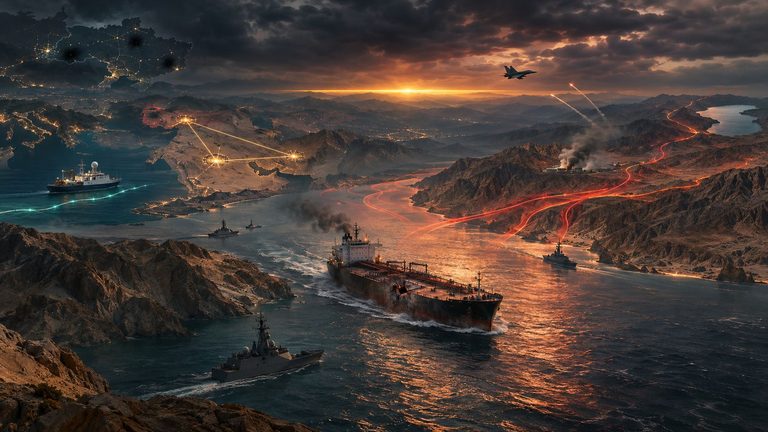
Traffic through the Strait of Hormuz did not recover. According to data reviewed by Reuters, 10 commodity vessels passed through the strait on Wednesday and seven on Tuesday; the ten-day average was about 17. Before the war began in late February, the figure was around 125 a day. Since the war began, 84 incidents involving commercial vessels and the deaths of 23 seafarers have been recorded in the Persian Gulf, the Strait of Hormuz, and the Gulf of Oman. On the mechanics of this throttling, “The Valve – Part 1” describes how the US role has shifted from guarantor of open sea lanes to controller of the chokepoint.
ANALYSIS: WHAT “ASSISTANCE” MEANS IN PRACTICE
A formula of solidarity is becoming an operational question. The pact treats an armed attack on one member as an attack on all. What follows from that remains open: interceptor systems and ammunition, intelligence, protection of Saudi facilities – or direct operations against the Houthis. Fidan deliberately spoke of “technical areas,” not troops. Pakistan has maintained personnel and aircraft at a Saudi air base since April, but announced no new deployment. The range between visible assistance and open entry into the war is the real news. Too little would damage the deterrence for which the pact was concluded. Too much would draw Ankara and Islamabad into the Yemen war and into a sharper confrontation with Iran, which Riyadh believes is behind the Houthis. Convening a meeting of chiefs of staff before a specific operation has been determined shows the direction of travel: the partners are seeking a form of assistance below the threshold of open entry into the war, yet visible enough to generate deterrence. The test has come earlier than planned. A pact whose treaty text has not been published and whose triggering mechanisms remain unresolved is now being measured against a real attack – and every response, whether technical assistance or restraint, will retroactively define what “assistance” means in this alliance. A second constraint is operating simultaneously: Pakistan is tied down by the escalation on the Afghan border, Turkey by Syria and the Aegean. The pact therefore faces its first serious test at a moment when both assistance partners are occupied elsewhere.
ANALYSIS: THE ECONOMIC PINCER REMAINS IN PLACE
The shelling is hitting a country whose oil exports are already under pressure on three fronts – the effectively blocked Strait of Hormuz in the east, the damaged East–West Pipeline in the center, and Bab el-Mandeb in the west. “The Pincer Is Closing” analyzes this constriction in detail. For the weekly picture, what matters is the mechanism: less Saudi oil and disrupted sea lanes tighten the market, producers protect domestic supply, and the effects reach beyond the region – to European refineries and into the Sahel, where landlocked states at the end of the supply chain come under pressure first. The channel to Salalah, where the Gulf states, Iran, and Iraq were supposed to hold talks, remains blocked. Thus, in the very week the pact becomes militarily concrete, the diplomatic alternative is missing.
STRATEGIC ASSESSMENT
The chokepoint crisis is becoming an alliance test conducted before an audience. Saudi Arabia can defend its cities, but it cannot rule out every hit. Turkey and Pakistan must now give the pact substance while the diplomatic channel remains closed. The danger lies not in any single decision, but in the chain of limited responses: more Saudi airstrikes, more Houthi missiles, external support, Iranian countermeasures. Each step appears limited on its own; together, they lead toward a regional war.
UKRAINE–RUSSIA: THE AIR POLICE OPEN FIRE
KYIV HIT, TEENAGER KILLED
During the night of September 25, a Russian drone struck an apartment building in Kyiv’s Pechersk district; a 14-year-old was killed and seven people were injured. One person was killed and another injured in Odesa. In one of the week’s larger waves, Russia used 161 drones – 82 of them jet-powered – as well as Banderol cruise missiles, according to Ukraine; air defenses intercepted 119 drones and three cruise missiles. Impacts were recorded at 18 locations. Two people were killed and 41 injured in Kyiv, with additional injuries in Zaporizhzhia, Zhytomyr Oblast, and Kharkiv Oblast.
POLAND AND ROMANIA SCRAMBLE JETS
Poland scrambled fighter aircraft during the night into Wednesday, while Romania deployed F-16s to the border area near Vylkove. Neither country reported a confirmed airspace violation; the alerts ended after about an hour. Four Russian drones entered Moldova on September 24 and 25, at least one of which exploded in the north of the country; a drone crashed near a village in Romania on September 24. Finnish and Swedish jets intercepted Russian military aircraft over the Gulf of Finland. The Polish armed forces attributed the scramble to Russian “attacks by jet-powered unmanned aerial vehicles on targets in western Ukraine.”
KYIV HITS REFINERIES, MOSCOW REPORTS INTERCEPTIONS
Ukraine attacked Russian energy and defense facilities. In Rostov Oblast, the Novoshakhtinsk refinery was damaged and operations were suspended; eight people were injured in Ulyanovsk Oblast, a train was struck in Samara Oblast, and two people were killed in an attack on a vehicle in Belgorod Oblast. Russia said it had intercepted 514 Ukrainian drones over 17 regions – a claim by the Russian side that has not been independently verified. President Volodymyr Zelenskyy said Ukraine was receiving licenses to produce Patriot missiles. These developments were reported amid mounting “spillover concerns.”
ANALYSIS: IMPLEMENTATION WITHOUT PROVEN INTENT
The decisive finding is not intent, but response. Across three NATO states, scramble and interception routines were triggered within a single week – not by a political decision, but automatically because weapons entered or approached alliance airspace. There is no evidence that individual drones were deliberately directed at Moldova or the Baltic region. For the risk of escalation, that is secondary: a misdirected system can cause the same damage as one intentionally deployed. The Polish and Romanian scrambles ended this time after about an hour, without a hit. That routine is precisely the point: the more often it is triggered, the greater the danger that a single incident will produce the first death on alliance territory or be misread as a deliberate test. The accumulation is measurable: of 81 airspace incidents recorded in 2026, 44 involved Russian and Iranian missiles or drones, and civilian airspace was closed because of danger in more than ten cases. The war is therefore producing a steady stream of near-contacts with alliance territory, not only at the front but along its periphery.
ANALYSIS: THE ENERGY WAR HITS THE SAME MARKET AS THE GULF
Russia seeks to weaken Ukraine’s energy supply before winter; Ukraine targets Russian refineries and export revenues. Militarily, both follow a clear logic: reducing an adversary’s fuel, electricity, and money impairs its ability to fight. Economically, the same logic reaches beyond the war and tightens supplies of diesel and petroleum products – in the same strained market already burdened by Hormuz, Yemen, and the Saudi pipeline. This week’s two leading conflicts are completely separate militarily and converge exactly in economic terms. Because refineries, rail lines, and power grids serve both civilian and military purposes, the energy war remains effective and politically contradictory at the same time.
STRATEGIC ASSESSMENT
The shift is taking place in depth: the war now regularly touches NATO airspace and international trade routes. A verifiable, mutual halt to attacks on energy infrastructure would not be peace, but it would test whether limited agreements can hold at all. If it does not happen, winter will once again become an instrument – and the likelihood will rise that an act of implementation at the alliance border will no longer end after an hour.
SUDAN/KORDOFAN: A FRONTLINE BREAKTHROUGH AND A DRONE WAR
ARMY RECAPTURES SODARI
On September 25, the Sudanese Armed Forces and allied formations recaptured the strategically important town of Sodari in North Kordofan from the Rapid Support Forces. Since late July, the army has been conducting an offensive that brought several locations in the region under its control – including Bara, Jibrah al-Sheikh, Um Qirfa, Jurayjikh, and Um Sayyala; about ten more localities were added over the course of September. Sodari had been considered a key RSF base in the state; after its loss, the RSF was left primarily with the areas around Al-Mazroub and Um Badr. An army spokesman said the armed forces had inflicted “significant losses in personnel and equipment” on the RSF. That is the military’s account; the town’s capture is established, but not every individual claim of losses.
RSF SHIFTS TO DRONES
As the RSF loses ground, it is intensifying its drone war against frontline cities. Earlier attacks of this kind illustrate the pattern now continuing: a drone strike on a courtroom in Umm Ruwaba that killed about ten people on September 8, and a hit on a college in El-Obeid on September 9 that killed a guard and destroyed eight lecture halls. The targets are administrative and educational institutions deep behind the front. According to the UN, drone attacks by both sides killed more than 1,000 civilians in the first half of 2026. The RSF says it does not intentionally target civilians. Its “deadly drone attacks on frontline cities” are nevertheless increasing.

On September 24, the army shot down an FH-95 long-range drone northeast of Al-Kawkiti – the second such interception in Kordofan within a week. At the same time, RSF formations advancing from West Kordofan and Darfur triggered new displacement from Hamrat al-Sheikh, Al-Mazroub, and Umm Badr; food supplies collapsed in several West Kordofan communities, and arrests for ransom were reported from Wad Abu Saq amid “escalating abuses.”
ANALYSIS: TWO WARS IN ONE
Two wars are running in parallel in Sudan. On the ground, the army is gaining territory in North Kordofan and pushing the RSF into residual areas. In the air, the RSF is offsetting those losses with drones that cannot seize territory but can terrorize cities and paralyze administration. The frontline breakthrough at Sodari is real, but it does not end the war – it relocates it. Those who lose territory turn to means that no longer require territory. That explains why a military success for the army and a worsening threat to civilians can coexist in the same week. It also means that recapturing a place such as Sodari is a robust finding, but says little about the course of the war as a whole so long as the RSF retains its reach through drones and holds the Al-Mazroub and Um Badr areas.
ANALYSIS: SUPPLY COLLAPSES, WEAPONS KEEP ARRIVING
The humanitarian situation is not tipping because of what the front map shows, but because of what it does not. Aid supplies are shrinking while weapons and drone technology continue to arrive – some of them from abroad, as a UN investigation found for both sides. Responsibility for individual deliveries must be established in each case; what is beyond dispute is that the war has long ceased to be sustained solely by Sudanese resources. That precise combination – open supply routes for weapons and narrowing ones for aid – makes the army’s gains at Sodari fragile.
STRATEGIC ASSESSMENT
Sodari elevates Sudan again this week, not as a footnote, but as an example of the common thread: here, too, a claim is being enforced – the army’s claim to Kordofan – and the losing side is responding with its own form of implementation, drone terror. El-Obeid and the displacement camps around Tawila remain the points at which it will be decided whether the territorial gain holds or a new RSF offensive follows.
AEGEAN AND EASTERN MEDITERRANEAN: THE EXERCISE DOES NOT BECOME AN OPERATION
TICKER – Turkey’s large-scale “Sea Wolf” exercise (Denizkurdu) ran from September 20 to 25 with about 100 vessels, 50 aircraft, and 14,000 troops across the Black Sea, Aegean, and Eastern Mediterranean. The principal observers’ day took place aboard the carrier TCG Anadolu off Aksaz – not off the Greek islands. The exercise began amid tensions between Greece and Turkey. In parallel, Ankara issued a NOTAM covering five areas and six flight routes across the Aegean, valid from September 25 to October 27 and justified on search-and-rescue and environmental-protection grounds; Athens responded with a counter-NOTAM and disputes Turkish jurisdiction. Greece reported further Turkish air activity and violations of the Athens Flight Information Region on September 22 in what it described as a “new Turkish provocation.”

ASSESSMENT – What did not happen is noteworthy. Despite the exercise’s scale, there was no unusual concentration of amphibious forces opposite Samos, Chios, or Kastellorizo, nor an armed incident with Greek units. The friction is shifting from the military to the legal sphere: NOTAM versus counter-NOTAM, the dispute over jurisdiction in maritime areas, search-and-rescue zones, and the continental shelf claimed by Ankara. The next concrete test is expected to be the Great Sea Interconnector power cable, whose survey work is to be undertaken by a French-flagged vessel – Athens informs Ankara, but does not seek permission. At the same time, bloc formation is intensifying: on September 23, the defense ministers of Greece, Cyprus, and Egypt agreed to “strengthen the protection of Eastern Mediterranean energy infrastructure.” And on the sidelines of the UN General Assembly, President Recep Tayyip Erdoğan adopted a conciliatory tone: Turkey was “not Greece’s enemy, but its neighbor and ally under the NATO umbrella.”
OUTLOOK – The object to watch is not the rhetoric, but the cable-laying vessel. If it enters the disputed maritime area, NAVTEX and counter-NAVTEX notices will follow, and only an encounter between armed naval units would turn it back into a confrontation like that of 2024. Equally revealing would be whether Turkish units remain in the eastern Aegean after the exercise ends, contrary to the usual pattern. Until then, the assessment is: heightened tension, but no transition to operational preparation.
PAKISTAN–AFGHANISTAN: RETALIATION ACROSS THE BORDER
TICKER – On September 21, following the September 18 attack in Kohat that killed at least 31 people, Pakistan launched airstrikes in the Afghan provinces of Kunar and Paktika. According to Afghan officials, homes and a shop were hit; Pakistan’s military reported 28 militants killed, while the Afghan side reported three civilian deaths. None of the figures has been independently confirmed. Deputy Taliban spokesman Hamdullah Fitrat confirmed that a house had been destroyed and civilians killed; the government in Kabul rejected Pakistan’s accusations and said the country’s security problems were “an internal matter.”
TICKER – Within days, the incident widened. Following what Islamabad described as a drone incursion from Afghanistan on September 23, Pakistani forces killed several Afghan Taliban fighters in border clashes around Gulistan on September 24 and, according to Afghan officials, attacked ten locations in Kandahar, Paktia, and Khost provinces. Information Minister Attaullah Tarar said the strikes had hit “terrorist hideouts and support infrastructure, including drone launch and storage sites.” Taliban spokesman Zabihullah Mujahid denied that the government had used drones against Pakistan; Kabul announced an “appropriate response.”
ASSESSMENT – Pakistan holds fighters affiliated with Tehrik-i-Taliban Pakistan responsible and says they operate from Afghan territory; Kabul denies providing them with safe havens. Direction of the specific attack from Afghanistan has not been established, while the dispute over safe havens is longstanding. What is new is the implementation: Islamabad is enforcing its doctrine across the border, breaking a roughly three-month lull following the clashes in February. Within one week, a single retaliatory strike became a reciprocal escalation with deaths on both sides. This ties down forces at the very moment the Mecca Pact may require assistance for Saudi Arabia. Islamabad must simultaneously fight a domestic insurgency, manage deterrence toward India, and fulfill external alliance obligations.
OUTLOOK – The announced Afghan response is the next test; according to the states involved, the escalation also endangers mediation efforts involving China, Turkey, Qatar, and Saudi Arabia. Every additional front narrows Islamabad’s room for maneuver – and makes every foreign-policy commitment more costly.
LEVANT: CEASEFIRE UNDER CONSTANT FIRE
TICKER – The October 2025 ceasefire in Gaza formally remains in effect, but the attacks continue. At least five Palestinians were killed on September 23: two in a strike on a vehicle west of Khan Younis, one each in Gaza City and Deir al-Balah, and one by gunfire near Khan Younis. Israel said, without presenting evidence, that one of those killed was a Hamas “finance chief.” Since the ceasefire began, the other side – citing Gaza’s Health Ministry – has counted 1,402 dead and 4,881 injured. The latest “Israeli attacks killed five Palestinians across Gaza.” Friction also persists in Lebanon: on September 25, the Israeli military fired an interceptor in the south and later attributed the incident to the “false identification” of an aerial target. Israel continues to hold a buffer strip in the south of the country and demands Hezbollah’s disarmament, while Beirut demands Israel’s withdrawal.
ASSESSMENT – In the Levant, no new claim is being enforced; instead, an existing condition is being managed. Diplomacy organizes distances, withdrawals, and oversight while the shooting continues. That can contain wars, but it also risks entrenching a permanent buffer zone and a partially disarmed adversary as a provisional normal. According to the other side, each individual strike – whether or not it hits a named official – violates the October 2025 agreement. Talks planned for October in Rome are intended to prepare a security agreement even though the fundamental questions – withdrawal, disarmament, and control of the territory – remain unresolved.
OUTLOOK – The success of the Rome talks will not be measured by a joint declaration, but by whether troop positions disappear and attacks decline. Until both happen, the ceasefire remains a word for a war kept at a low simmer.
ON THE MARGINS: BRIEFLY NOTED
Mali: The jihadist fuel blockade around Bamako continues. No confirmed new front movement occurred during the reporting period; the siege remains a sustained pressure on the landlocked country’s supply system and connects, through the tight fuel market, to the Gulf and energy crisis.
DR Congo: There was no documented shift this week on the front against the M23. The linkage between security commitments and access to Congolese raw materials remains the real lever through which external actors exert influence.
Iran/IAEA: The nuclear dossier is dormant this week. The Gulf conflict is currently playing out through the alliance test and maritime routes, not the enrichment question – an example of how the spotlight shifts within the same theater.
Syria: President Ahmed al-Sharaa said direct talks with Israel had already been underway for nearly a year and called for a return to the lines established by the 1974 agreement. No new Israeli attack on a military facility of relevance to Turkey was confirmed during the reporting period.
WEEKLY CONCLUSION: OVERALL STRATEGIC ASSESSMENT
The week of September 21–27 was the week in which the previous week’s promises were honored. The situation was driven not by intent, but by implementation – and implementation had two faces.
One is kinetic. Houthi missiles reached Saudi cities, NATO air policing opened fire across several states, Pakistan bombed Afghan territory, and the Sudanese army took Sodari. The other face is legal and administrative. In the Aegean, the year’s largest exercise notably did not become an operation; instead, Ankara is asserting NOTAMs and continental-shelf claims against a cable project while Erdoğan lowers the rhetorical temperature. Both forms are implementation: one fulfills commitments with weapons, the other with legal acts. Both narrow the scope for action because they create a position from which it is harder to retreat than from a mere declaration.
Who gained room for maneuver? The Houthis, because they are forcing Saudi Arabia to make alliance-policy decisions. Turkey, because it is acting simultaneously as Saudi Arabia’s assistance partner, an actor in Syria, and the determining force in the Aegean – while rhetorically defusing direct confrontation with Athens. Who lost it? Above all, the mechanisms that quietly limit escalation: the blocked channel to Salalah, the air-defense routine on NATO’s border, and the maritime rules of conduct in the Eastern Mediterranean.
Four thresholds will matter in the coming week. Will the Turkish-Pakistani assistance pledge become visible support for Saudi Arabia? Will the scrambles on NATO’s border continue to end after an hour, or will the first hit follow? Will the French cable-laying vessel enter the disputed maritime area? And will Sudan’s territorial gain hold, or will the RSF respond with a new offensive? This week’s alliances have not expanded the war. But from now on, they are worth only as much as their next act of implementation proves.
This publication answers to its readers – and no one else. Become a member for $5 or a patron for $15 per month, support genuinely independent journalism, and receive full access to all published analyses.

You are also welcome to support my work with a one-time donation.

About the Author
Michael Hollister
is a geopolitical analyst and investigative journalist. He served six years in the German military, including peacekeeping deployments in the Balkans (SFOR, KFOR), followed by 14 years in IT security management. His analysis draws on primary sources to examine European militarization, Western intervention policy, and shifting power dynamics across Asia. A particular focus of his work lies in Southeast Asia, where he investigates strategic dependencies, spheres of influence, and security architectures. Hollister combines operational insider perspective with uncompromising systemic critique – beyond opinion journalism. His work appears on his bilingual website (German/English) www.michael-hollister.com and in investigative outlets across the German-speaking world and the Anglosphere.
Stay informed without having to work through the daily flood of news – the most important developments and connections summarized for you.
Sources
Gulf, Hormuz, and Yemen
[1] “Pakistan, Turkiye Edge Closer Towards Joining Saudi War Against Houthis.” Al Jazeera, September 25, 2026. https://www.aljazeera.com/news/2026/9/25/pakistan-turkiye-edge-closer-towards-joining-saudi-war-against-houthis
[2] “Saudi, Turkish, Pakistani Chiefs Plan Urgent Talks amid Yemen Fighting.” Al Jazeera, September 25, 2026. https://www.aljazeera.com/news/2026/9/25/saudi-turkish-pakistani-chiefs-plan-urgent-talks-amid-yemen-fighting
[3] “Hormuz Shipping Traffic Remains Well Below Recent Average.” Reuters, via MarineLink, September 24, 2026. https://www.marinelink.com/news/hormuz-shipping-traffic-remains-below-543233
[4] “Iran Shipping Update – September 23, 2026.” United Against Nuclear Iran, September 23, 2026. https://www.unitedagainstnucleariran.com/analysis/iran-shipping-update-september-23-2026
Ukraine–Russia
[5] “NATO Jets Scrambled in Poland, Romania as Russia Strikes Ukraine.” ABC News, September 23, 2026. https://abcnews.com/International/nato-jets-scrambled-poland-romania-russia-strikes-ukraine/story?id=136675492
[6] “Deadly New Strikes in Russia’s War on Ukraine as Spillover Concerns Mount.” RFE/RL, September 25, 2026. https://www.rferl.org/a/ukraie-russia-attacks-civilians-killed-drone-threats/33864157.html
Sudan/Kordofan
[7] “Sudanese Army Recaptures Strategic North Kordofan Town of Sodari.” Sudan Tribune, September 25, 2026. https://sudantribune.com/article/319247
[8] “Sudan’s RSF Steps Up Deadly Drone Attacks on Frontline Cities.” TimesLIVE, September 25, 2026. https://www.timeslive.co.za/news/africa/2026-09-25-sudans-rsf-steps-up-deadly-drone-attacks-on-frontline-cities/
[16] “Sudan Army Downs Drone in North Kordofan as RSF Steps Up Abuses.” Sudan Tribune, September 24, 2026. https://sudantribune.com/article/319198
Aegean and Eastern Mediterranean
[9] “Sea Wolf Maritime Drill Begins amid Tensions between Greece, Türkiye.” Daily Sabah, September 2026. https://www.dailysabah.com/politics/sea-wolf-maritime-drill-begins-amid-tensions-between-greece-turkiye/news
[10] “New Turkish Provocation Violates Greek Airspace” (NOTAM and Counter-NOTAM). Greek City Times, September 23, 2026. https://greekcitytimes.com/2026/09/23/new-turkish-provocation-violates-greek-airspace
[11] “Erdogan: Greece Is Turkey’s Neighbor, NATO Ally – Not an Enemy.” To Vima, September 24, 2026. https://www.tovima.com/world/erdogan-greece-is-turkeys-neighbor-nato-ally-not-an-enemy/
[12] “Cyprus, Greece and Egypt to Strengthen Protection of East Med Energy Infrastructure.” Cyprus Mail, September 23, 2026. https://cyprus-mail.com/2026/09/23/cyprus-greece-and-egypt-to-strengthen-protection-of-east-med-energy-infrastructure
Pakistan–Afghanistan
[13] “Pakistan Carries Out Strikes in Afghanistan’s Paktika, Kunar after Kohat Bombing.” Daily Pakistan, September 21, 2026. https://en.dailypakistan.com.pk/21-Sep-2026/pakistan-carries-out-strikes-in-afghanistans-paktika-kunar-after-kohat-bombing
[17] “Pakistani Forces Kill Afghan Taliban Fighters in Border Escalation.” Al Jazeera, September 25, 2026. https://www.aljazeera.com/news/2026/9/25/pakistani-forces-kill-afghan-taliban-fighters-in-border-escalation
Levant
[14] “Israeli Attacks Kill Five Palestinians across Gaza.” Antiwar.com, September 23, 2026. https://news.antiwar.com/2026/09/23/israeli-attacks-kill-five-palestinians-across-gaza/
[15] “Liveblog September 25, 2026” (IDF Interceptor in Southern Lebanon, “False Identification”). The Times of Israel, September 25, 2026. https://www.timesofisrael.com/liveblog-september-25-2026/
Further Reading (Author’s Own Articles)
“The Mecca Pact: What Three States Really Signed – Part 1.” August 23, 2026. https://www.michael-hollister.com/de/2026/08/23/der-mekka-pakt-was-drei-staaten-wirklich-unterschrieben-haben-teil-1/
“The Mecca Pact: Who Is Moving around It – Part 2.” August 30, 2026. https://www.michael-hollister.com/de/2026/08/30/der-mekka-pakt-wer-sich-um-ihn-herum-bewegt-teil-2/
“The Pincer Is Closing: Why Saudi Arabia’s Oil Exports Are Now Being Strangled on Three Fronts.” September 20, 2026. https://www.michael-hollister.com/de/2026/09/20/die-zange-schliesst-sich-warum-saudi-arabiens-oelexport-jetzt-an-drei-fronten-erstickt/
“The Valve – Part 1.” September 20, 2026. https://www.michael-hollister.com/de/2026/09/20/das-ventil-teil-1/
© Michael Hollister – All rights reserved. Redistribution, publication or reuse of this text requires express written permission from the author. For licensing inquiries, please contact the author via www.michael-hollister.com.