UPDATE Report – Updated: September 20, 2026 – Building on my Update from September 14, 2026
by Michael Hollister
Exclusive published at Michael Hollister on September 20, 2026
5.743 words * 30 minutes readingtime

Between Collective Defense and Incident: Security Commitments Under Pressure
THE WEEKLY SITUATION
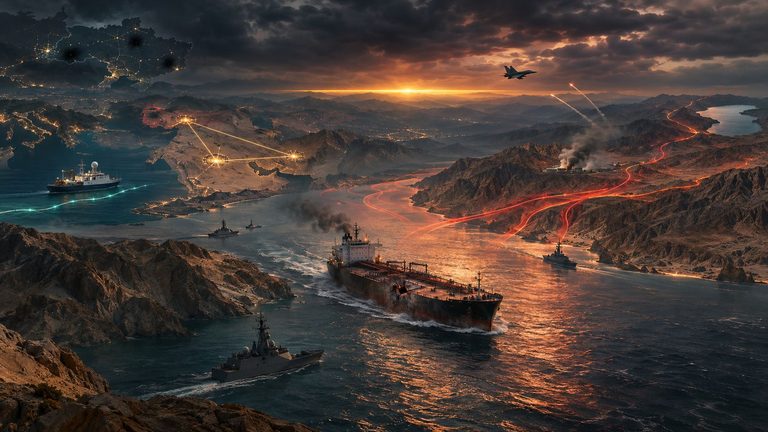
Last week, the focus was on chokepoints: Hormuz, Bab al-Mandab, the fuel routes to Bamako, and the energy arteries between Russia and Ukraine. This week shows what happens when the pressure on those arteries does not ease. The chokepoint crisis is becoming a stress test for alliances, security guarantees, and military deconfliction mechanisms.
In the Gulf, the threat to Saudi infrastructure became a direct attack on the capital, Riyadh. Talks between Iran, Iraq, and the Gulf states scheduled for September 14 were postponed, while shipping through the Strait of Hormuz remained far below its previous level. Ankara publicly declared for the first time that it could provide military support to Saudi Arabia under the Mecca Pact. Whether that pledge of assistance will lead to a concrete operation remains open. The pact must now prove itself in precisely the situation for which it was concluded.
In Eastern Europe, a Russian drone entered Lithuanian airspace and was shot down by an Italian NATO fighter jet. There is no evidence that it was deliberately aimed at Lithuania; Lithuanian officials assessed that it was probably intended for a target in Ukraine and had strayed off course. The incident is relevant nonetheless: It shows how little distance now remains between the war and direct contact with NATO.
Two additional conflict lines have emerged. Turkey relocated its 51st Commando Brigade to the Aegean coast opposite Samos. At the same time, Israel and Turkey took their dispute over Syria’s military order to the UN Security Council. And in the Arabian Sea, an Indian destroyer and a Pakistani patrol vessel collided – an incident between two nuclear powers in which each side blamed the other.
The common thread is therefore no longer supply alone, but reliability. Will a defense pact hold when its first member is attacked? Does military deconfliction work when drones cross borders and air forces bomb bases to prevent a third country from deploying there? And what is a security commitment worth if it is tested in practice only after an incident occurs?
THE GULF, HORMUZ, AND YEMEN
BALLISTIC MISSILE TARGETING RIYADH INTERCEPTED
Saudi Arabia confirmed on September 19 that Yemen’s Houthis had launched a ballistic missile at Riyadh. According to the Saudi-led coalition, the projectile was intercepted; no deaths or major damage were reported. Residents heard explosions, while flames and black smoke rose near the international airport. The Houthis said they had attacked “sensitive targets” in the capital as well as facilities belonging to the oil company Aramco in Yanbu. They provided no independent evidence for all the strikes they claimed. Saudi Arabia also reported thwarted attacks on civilian infrastructure in Yanbu, Taif, Baysh, and the Farasan Islands. The attack on Riyadh marked a direct escalation against the Saudi capital.
During the previous week, the strikes had primarily targeted the East-West Pipeline and energy facilities; now the capital itself was once again within the target area. Saudi Arabia is simultaneously carrying out attacks on Houthi positions. On September 17, local sources reported that at least five people were killed, including three children. Both sides use the other’s actions to justify the next stage of escalation.
SALALAH TALKS POSTPONED
The talks between the Gulf states, Iran, and Iraq scheduled for September 14 in Salalah were postponed amid a lack of unity on the Arab side and Saudi accusations that Tehran was supporting the Houthis. This does not mean the channel has been closed. The postponement does show, however, that Hormuz and Yemen can no longer be negotiated as separate political issues.
HORMUZ REMAINS THROTTLED
Shipping through the Strait of Hormuz failed to recover this week. On Thursday, only four cargo vessels passed through the strait, according to analyzed vessel-movement data; the average over the preceding 10 days was about 16. Iran also stated that the Revolutionary Guards had attacked the Togo-flagged tanker Trend because it had allegedly attempted to pass without Iranian authorization. That justification is Iran’s account. The attack has been independently confirmed, but no internationally recognized Iranian right to approve or deny transit at its discretion has been established.
Hormuz therefore remains a controlled risk corridor. The strait is not completely closed; uncertainty surrounding passage, insurance, and permits is nevertheless sufficient to delay shipping and increase its cost.
ARAMCO CANCELS DELIVERIES TO EUROPE
The damage to Saudi Arabia’s East-West Pipeline is now having direct consequences beyond the region. Saudi Aramco suspended October crude deliveries to at least two European refineries. Three pumping stations on the pipeline were damaged. Partial operations could resume after several days, but current estimates suggest that complete repairs could take several weeks. The pipeline was built as a bypass around Hormuz. Its failure therefore affects not just any pipeline, but Saudi Arabia’s most important means of circumventing the strait.
According to the United Nations, the latest fighting has displaced about 112,000 people within Yemen, while almost 3,000 have fled to Djibouti. The Houthi advance along the west coast is therefore not merely a tactical territorial gain, but the cause of a new wave of displacement.
ANALYSIS – THE MECCA PACT MEETS REALITY
The new question is whether a defense pact will translate into military assistance. The Mecca Pact between Saudi Arabia, Pakistan, and Turkey treats an armed attack on one member as an attack on all. Following the missile attack on Riyadh, Turkish Foreign Minister Hakan Fidan said that Ankara could help meet Saudi Arabia’s military needs. Pakistan reaffirmed its commitment to the agreement but has not yet announced any immediate military operation.
This is not yet a joint entry into the war, but it is more than a formula of solidarity. The decisive issue will be what the partners understand assistance to mean: interceptor systems and ammunition, intelligence, protection of Saudi facilities, or direct operations against the Houthis. Too little visible assistance would damage deterrence; an intervention could draw Turkey and Pakistan into the war in Yemen and into a sharper confrontation with Iran.
ANALYSIS – THE COLLAPSE ON THE WEST COAST
More than 15 anti-Houthi brigades with an estimated 30,000 fighters abandoned large parts of the west coast. The National Resistance describes the move as a tactical withdrawal after heavy losses; other actors have alleged betrayal and bribery. What is established above all is the outcome: A front built over years collapsed and surrendered strategic coastal locations to the Houthis. Competing forces, foreign sponsors, and command structures explain why nominal troop strength does not automatically translate into combat power.
BEYOND THE THEATER
The effects now extend from European refineries to the Sahel. Ghana reduced fuel exports to Burkina Faso and Mali to protect its own supply. Mali had requested 50,000 metric tons and initially received only 10,000. The energy crisis is thus hitting a country whose capital is already under pressure from a jihadist fuel blockade. The conflicts are not militarily coordinated. Their economic consequences nevertheless reinforce one another: Less Saudi oil and disrupted sea lanes tighten the market; producers then protect domestic demand; landlocked countries at the end of the supply chain come under pressure first.
STRATEGIC ASSESSMENT
The chokepoint crisis is becoming an alliance crisis. Saudi Arabia can defend its capital, but cannot prevent every strike. Turkey and Pakistan must give practical meaning to the Mecca Pact while the diplomatic channel through Salalah remains blocked. The danger lies in the chain of limited responses: more Saudi airstrikes, more Houthi missiles, external support, and Iranian countermeasures. Each step may appear limited, yet together they could lead to a regional war.
UKRAINE – RUSSIA
NATO JET SHOOTS DOWN DRONE OVER LITHUANIA
On September 15, an Italian fighter jet assigned to NATO air policing shot down a Russian Gerbera drone over Lithuania. An explosive device was found in the wreckage. According to Lithuanian President Gitanas Nausėda, the drone was probably intended for a target in Ukraine and may have been diverted from its course by Ukrainian electronic warfare. Analysis of its electronics has not yet been completed; a deliberate Russian attack on Lithuania has therefore not been established. Lithuanian officials said the drone was likely aimed at Ukraine.
It was the first known shootdown of such a drone by the NATO mission over the Baltic region since the Baltic states joined the alliance. Not every alert proves genuine – a report over Vilnius on September 13 turned out to be a flock of birds. The combination of real intrusions, false alarms, and incomplete data increases the risk of a mistaken decision.
On the same day, a Russian frigate deployed warning measures against a Danish military helicopter in international waters. Denmark described the incident as dangerous; Russia presented it differently. Both events show how often local decisions now determine whether escalation continues or is halted.
EIGHT REGIONS HIT, POLAND SCRAMBLES FIGHTER JETS
On September 17, Russia attacked targets in at least eight Ukrainian regions. Ukrainian authorities reported more than 20 people injured as well as strikes on energy, port, and telecommunications infrastructure. In Odesa, the captain of a Tanzanian-flagged vessel was killed. Poland scrambled fighter jets and temporarily closed airports; no violation of Polish airspace was subsequently detected.
Ukraine simultaneously attacked Russian energy and defense facilities, including a refinery in Yaroslavl and sites in Taganrog, Samara, and Rostov. Kyiv said it had struck eight refineries within one week and temporarily disabled about 30 percent of processing capacity. That figure is a Ukrainian estimate that has not been fully independently verified; repeated strikes, by contrast, have been confirmed.
WASHINGTON RESTRAINS AND SANCTIONS AT THE SAME TIME
President Trump called on Volodymyr Zelenskyy to halt attacks on Russian diesel production because the disruptions were affecting prices and supplies. Zelenskyy said he was prepared for a mutual, U.S.-verified halt to attacks on energy infrastructure. At the same time, the United States enacted sanctions against Russian banks, officials, and the shadow fleet, along with possible tariffs of up to 100 percent against major energy buyers. Washington wants to reduce Russian revenues without causing another price shock – an almost irreconcilable conflict of objectives.
ANALYSIS – THE NATO INCIDENT WITHOUT PROVEN INTENT
The shootdown over Lithuania should be neither minimized nor overinterpreted. An armed Russian drone was in the airspace of a NATO member and was destroyed by a NATO aircraft. That is the established finding. What has not been established is that Moscow intended to attack Lithuania. Diversion by electronic warfare is plausible, but remains part of the investigation.
Intent is only one factor in the risk of escalation: A misdirected system can cause the same damage as one deployed deliberately. NATO must intercept incoming weapons without automatically treating every incident as a collective-defense case. The more frequently such events occur, the greater the danger of fatalities or of an incident being misread as a deliberate test.
ANALYSIS – THE ENERGY WAR CONSUMES ITS OWN STRATEGY
Russia is trying to weaken Ukraine’s energy supply and industry before winter. Ukraine, in turn, is trying to hit Russian refineries, export routes, and war revenues. Militarily, both follow a comprehensible logic: Reducing the enemy’s fuel, electricity, and money diminishes its ability to fight. Economically, the same logic extends beyond the war and tightens global supplies of diesel, petroleum products, and transportation capacity.
The American demand to Kyiv reveals a limit of Western support: Ukraine is expected to hurt Russia economically, but preferably not where doing so raises prices for its allies. Because refineries, rail lines, and power grids serve both civilian and military purposes, the energy war remains strategically effective and politically contradictory.

BEYOND THE THEATER
Tariffs on buyers of Russian energy would directly affect third countries. At the same time, refinery outages feed into the same strained market already burdened by Hormuz, Yemen, and damage to Saudi pipelines. The principal conflicts are militarily separate, but they affect the same energy market.
Moscow also allowed residents of the annexed Ukrainian regions of Donetsk, Luhansk, Kherson, and Zaporizhzhia to participate in the parliamentary election. Kyiv and the European Union view this as an attempt to normalize the annexation; human rights groups reported pressure on voters. Establishing an administration and holding elections in occupied territory do not create internationally recognized sovereignty.
STRATEGIC ASSESSMENT
The larger shift is taking place in depth: The war is reaching NATO airspace, international shipping, refineries, and the trade policies of third countries. A verifiable halt to reciprocal energy attacks would not yet constitute peace, but it could show whether limited agreements are possible. If even this approach fails, winter will once again become a military instrument.
TURKEY – GREECE
THE 51ST COMMANDO BRIGADE MOVES OPPOSITE SAMOS
The Turkish Defense Ministry confirmed the relocation of the 51st Commando Brigade from Hozat in the eastern Turkish province of Tunceli to Söke in Aydın Province. The new base is on the Aegean coast opposite the Greek island of Samos. The brigade reportedly comprises more than 2,000 troops and received a new commander in August. The transfer places a combat-experienced formation closer to the eastern Aegean.
The timing matters. According to Turkish officials, the relocation was decided in June following a review of force structure and operational requirements. It should therefore not be interpreted as a spontaneous reaction to a single Greek action this week. Nor is the unit an amphibious brigade; it is a land-based commando formation. Its stationing alone does not indicate an imminent attack on Samos.
Nevertheless, the transfer changes the military geography. A combat-experienced formation is being moved closer to an area in which Ankara and Athens dispute territorial waters, airspace, the armament of islands, and maritime boundaries. Turkey cites treaties requiring the demilitarization of certain eastern Aegean islands and describes Greek military activity as a treaty violation. Greece justifies its defensive measures by citing the Turkish threat and its right to self-defense.
ANALYSIS – NO EVIDENCE OF AN ATTACK, BUT A STRUCTURAL SIGNAL
The brigade is not evidence of an operational plan. Nor is it meaningless. Military capabilities are relocated long before a crisis precisely because their political value lies in being available when one occurs. Söke shortens response and deployment routes toward the eastern Aegean. At the same time, the stationing increases the number of situations in which exercises, alert launches, or troop movements could be misread by the other side as preparations.
The appropriate assessment therefore lies between alarmism and reassurance: There is no reliable evidence of an imminent Turkish attack. There is, however, a lasting shift of forces into a disputed area. Combined with Greek-Israeli defense cooperation, Turkey’s role in Syria, and the Mecca Pact, a new regional constellation is emerging in which the Aegean can no longer be viewed in isolation.
OUTLOOK
What matters is not public statements alone, but follow-on movements: additional air defenses, naval units, amphibious assets, ammunition depots, larger exercises, or permanent infrastructure. Only their combination would turn the brigade’s relocation into acute operational preparation. Until then, it remains a long-term risk factor – not the beginning of a war.
ISRAEL – TURKEY / SYRIA
THE DISPUTE REACHES THE UN SECURITY COUNCIL
On September 17, Israel and Turkey brought their dispute over Syria’s military order before the UN Security Council. Israeli Ambassador Danny Danon accused Ankara of maintaining more than 100 bases with about 20,000 troops and controlling roughly five percent of Syria. Those are Israeli figures that have not been fully independently confirmed. Danon compared Turkish policy with Iran’s former development of allied structures.
Turkish Ambassador Ahmet Yıldız replied that the cooperation was taking place with the consent of the Syrian government. Syrian Ambassador Ibrahim Olabi described Israel as the greatest threat to regional stability because of its attacks, troop movements, and occupation of Syrian territory.
The legal starting points are not symmetrical. Turkish-Syrian cooperation is based on a request from the Syrian government and an agreement covering training, advice, weapons, logistics, and technical assistance. The presence of Turkish forces with the consent of the territorial state does not constitute an occupation.

ABU AL-DUHUR: ISRAEL DRAWS A RED LINE ON SYRIAN TERRITORY
In August, Israel repeatedly attacked the Syrian air base at Abu al-Duhur, saying it sought to prevent a Turkish takeover and the development of military capabilities. Syria stated that the work was under Syrian control and that no Turkish presence was planned. Turkey described Israel’s claims as untenable and the attacks as unlawful.
Israel is thereby asserting, in practice, a militarily enforceable veto over which capabilities Syria may develop together with Turkey. Security concerns do not automatically create a legal basis for an attack. Turkish radar, air-defense, or training systems would not constitute an armed attack merely because they restricted Israel’s freedom of operation.
The United States is working on a deconfliction mechanism. It may prevent unintended clashes, but it does not resolve the contradiction between Israeli demands for exclusion and Damascus’s claimed sovereign right to decide.
OCCUPIED SINCE 1967, ANNEXED SINCE 1981
Israel has occupied most of the Syrian Golan Heights since 1967. In 1981, through the Golan Heights Law, it extended Israeli law, administration, and jurisdiction to the territory and annexed it. In Resolution 497, the UN Security Council unanimously declared that unlawful annexation null and void and without international legal effect, and demanded its immediate rescission. Israel has not rescinded it; the United Nations continues to treat the area as the occupied Syrian Golan.
Since the fall of the Assad government, Israel has additionally advanced into the UN-monitored separation zone and further Syrian territory where no military forces other than UNDOF may be stationed. A UN commission of inquiry stated that certain actions – including arrests and the transfer of Syrian civilians – could amount to war crimes. Israel rejects this and describes its presence as a temporary security measure.
ANALYSIS – THE LEGAL ASYMMETRY
Israel is thus complaining before the same Security Council about a Turkish military presence authorized by Damascus, while that council unanimously rejected Israel’s own annexation of the Golan Heights in 1981. Turkey is cooperating with Syria at the invitation of the Syrian government. Israel, by contrast, has occupied Syrian territory for 59 years, unlawfully annexed the Golan Heights, ignored the resulting resolution, and is simultaneously attacking Syrian military facilities to prevent cooperation that Damascus itself seeks with Ankara.
This does not give Turkey carte blanche. Earlier Turkish incursions against the will of the Assad government must be assessed separately. Today’s cooperation, however, rests on consent that Israel does not possess for its occupation, annexation, additional troop positions, and airstrikes.
OUTLOOK
Syria is becoming an overlap zone for three military powers: Turkey is building Syrian capabilities, Israel is trying to prevent certain capabilities preemptively, and Russia remains present in Tartus and Hmeimim under a new agreement. If another Israeli attack hits Turkish personnel, the indirect power struggle could become a direct interstate conflict.
ISRAEL – LEBANON / GAZA
NEGOTIATIONS UNDER CONTINUED FIRE
Israel and Lebanon are expected to meet in Rome in October to discuss a U.S.-mediated security agreement. Before then, the two countries’ ambassadors plan to meet in Washington. Seven previous rounds of talks produced no breakthrough. Israel continues to hold a buffer strip roughly six miles (10 kilometers) deep inside Lebanon and demands that Hezbollah disarm; Beirut demands an Israeli withdrawal and the restoration of its territorial control. Since open warfare resumed in March, more than 4,300 people have been killed in Israeli attacks, according to the Lebanese Health Ministry. The planned Rome talks are intended to address withdrawal, disarmament, and security arrangements.
In parallel, European and Arab military representatives are discussing the period after a possible withdrawal of the UNIFIL mission beginning in January 2027. Options under discussion include training, equipment, intelligence, and an international support mission for the Lebanese army. The approach illustrates the basic problem: A security agreement requires an actor capable of actually controlling the south. Neither Hezbollah, nor Israel, nor a weak Lebanese army can alone guarantee an order acceptable to all sides.
Israeli attacks in Gaza are continuing despite the existing ceasefire. Palestinians were again killed on September 19; Israel said that two of those killed were fighters. At the same time, according to the United Nations, about 280,000 children returned to provisionally reopened schools, many of them heavily damaged. Both facts belong to the situation: limited civilian normalization and continued lethal violence coexist.
ANALYSIS – DIPLOMACY MANAGES THE WAR
The new talks are not a peace process in the classical sense. Their initial purpose is to organize distance, withdrawals, disarmament, and control while the shooting continues. That can be useful, because wars are often contained through technical agreements. But it also risks cementing a permanent Israeli buffer zone and a partially disarmed Hezbollah as a provisional normality. The success of the Rome talks should therefore be measured not by a joint declaration, but by whether troop positions disappear and attacks actually decline.
PAKISTAN: DOMESTIC WAR AND AN INCIDENT WITH INDIA
31 KILLED IN ATTACK ON SECURITY COMPLEX IN KOHAT
A coordinated attack on a police and counterterrorism complex with an adjoining mosque in Kohat, northwestern Pakistan, killed at least 31 people and injured more than 100. The attackers opened the operation with a vehicle-borne suicide bombing and then entered the complex. The fighting lasted about 20 hours; Pakistani forces said they killed eight attackers. The death toll rose to 31 by September 19.
Responsibility has not been conclusively established. Initial reports linked the attack to the orbit of the Pakistani Taliban; Tehrik-i-Taliban Pakistan denied involvement. That denial must be reported alongside the broader context: The TTP and associated groups have carried out attacks against Pakistani security forces for years. Islamabad accuses Afghanistan of providing them with safe havens; Kabul denies the allegation. Direction from Afghanistan has not been established for this specific attack.
The assault follows further military losses and shows that Pakistan’s domestic security crisis is not limited to Balochistan. Pakistan is thus heavily engaged at home at precisely the moment when the Mecca Pact may require assistance for Saudi Arabia. This does not mean Islamabad is militarily incapable of acting. It does, however, raise the cost of every external commitment.
INDIAN AND PAKISTANI WARSHIPS COLLIDE
On September 16, the Indian destroyer INS Kolkata and the Pakistani patrol vessel PNS Hunain collided in the northern Arabian Sea. No major casualties were reported. India said the Pakistani vessel had rammed the destroyer during a dangerous overtaking maneuver; Pakistan claimed that the Kolkata had entered Pakistan’s exclusive economic zone during an announced exercise and caused the collision. Both countries summoned diplomatic representatives of the other side. India and Pakistan publicly blamed each other for the collision.
The location and exact sequence of events are disputed. What can be said independently of those accounts is important: Two warships belonging to nuclear powers made physical contact; existing communication and conduct rules did not prevent the incident; and both governments subsequently used it to assign public blame. No shots were fired, but the event came closer to military escalation than many of the verbal crises of recent months.
ANALYSIS – TWO SEPARATE CONFLICTS, ONE CONSTRAINED MARGIN FOR ACTION
The attack in Kohat and the ship collision are not connected. They do, however, reveal the same state-level constraint: Pakistan must simultaneously fight a domestic insurgency, manage fragile deterrence against India, and meet foreign-policy commitments to Saudi Arabia. Every additional front narrows the room for decision-making available to its political and military leadership.
The maritime incident in particular demonstrates the value of unspectacular crisis mechanisms. Direct communication channels, clearly defined exercise areas, shared navigation rules, and rapid investigation are not romantic notions of peace, but risk controls between nuclear powers. When each side publishes only its own account, a navigation or command error becomes a symbol of national humiliation. The next incident could then unfold under greater domestic political pressure.
SUDAN / KORDOFAN
NO MAJOR FRONTLINE SHIFT, BUT A FURTHER COLLAPSE IN AID
There was no territorial shift in Sudan this week that would justify once again classifying it as a principal conflict. The situation in Kordofan nevertheless remains tense, and humanitarian supplies continue to collapse. The World Food Programme received only $206 million for its work in Sudan this year, compared with $645 million the previous year, and says it needs almost $300 million more. About 20 million people face hunger and roughly 14 million have been displaced. The program now concentrates its scarce resources on approximately five million of the most vulnerable people.
UN Secretary-General António Guterres called for states prolonging the war with weapons, technology, personnel, and logistics to be held accountable. A UN fact-finding mission pointed in particular to foreign support enabling both sides to conduct long-range drone attacks. Responsibility for individual deliveries must be established in each case; what is undisputed is that the war has long since ceased to be sustained solely by Sudanese resources.
STRATEGIC ASSESSMENT
The situation has not stabilized merely because the front line barely moved this week. A war can also reach a tipping point when aid disappears while weapons continue to arrive. That is precisely what is happening in Sudan: Military supply routes remain open while humanitarian routes are narrowing. El Obeid and the displacement camps in Tawila therefore remain under observation. A new offensive against either of these nodes would immediately elevate the conflict again.
ON THE PERIPHERY
Mali: The jihadist fuel blockade is receiving additional pressure from outside. Ghana reduced exports to Mali and Burkina Faso because it wants to protect its own supplies amid the global shortage. The development does not change the front, but it intensifies the blockade’s effect on Bamako.
DR Congo: Kinshasa established a task force to accelerate its strategic minerals partnership with the United States. This is not yet a military turning point. Politically, however, it shows how closely security commitments, the fight against M23, and access to Congolese minerals are being linked.
Haiti: A new human rights report documents at least 164 deaths and more than 70 abductions in the Kenscoff massacre. Armed groups used roadblocks and drones; security forces are accused of failing to send reinforcements and withdrawing prematurely. The attack took place earlier, but the report provides new evidence of institutional failure.
WATCHLIST
Myanmar: Malaysia plans to invite junta leader Min Aung Hlaing to talks on the return of the Rohingya. Without security guarantees and the consent of those affected, this does not yet constitute a viable repatriation process.
North Korea: Following a new IAEA resolution, Pyongyang again described its status as a nuclear power as irreversible. The statement sharpens the political confrontation but does not yet open a new immediate path toward armed conflict.
Cuba: The sixth nationwide collapse of the power grid since January demonstrates how severely fuel shortages and external economic measures are straining state infrastructure. The situation remains geopolitically relevant, but without a concrete path toward military escalation, it belongs more appropriately in the Global Update.
STRATEGIC WEEKLY ASSESSMENT
The week of September 14-20 was not a week of a single major breakthrough. It was a week in which existing security mechanisms came under real pressure. A Houthi missile flew toward Riyadh, turning the Mecca Pact into a practical question. A Russian drone reached Lithuania, turning NATO air policing into an actual shootdown. An Indian and a Pakistani warship collided, even though both states have known for decades what consequences a military misunderstanding can have.
The two Turkish conflict lines also fit this pattern. Opposite Greece, Ankara is changing its force posture without that change yet indicating an intention to attack. In Syria, by contrast, an indirect military clash already exists: Israel bombed a Syrian base to prevent its possible use by Turkey. Before the Security Council, Israel subsequently demanded, in effect, limits on Turkish-Syrian cooperation while itself occupying Syrian territory since 1967 and having unlawfully annexed the Golan Heights in 1981. This contradiction is not a side issue, but the legal core of the conflict.
Who gained room for action? The Houthis, because they are forcing Saudi Arabia to make military and alliance decisions. Turkey, because it is simultaneously acting as a potential assistance partner for Saudi Arabia, Syria’s military partner, and a determining actor in the Aegean. Who lost it? Above all, the mechanisms intended to contain escalation quietly: diplomatic meetings, maritime codes of conduct, air-defense routines, and UN disengagement zones.
Four thresholds will be decisive in the coming week. First: Will Turkey’s pledge of assistance be followed by concrete support for Saudi Arabia? Second: Will Russia and NATO respond to the drone shootdown with technical arrangements or an additional military presence? Third: Will the 51st Turkish Commando Brigade remain an isolated relocation, or will further forces follow? Fourth: Will Israel again attack Syrian facilities it associates with Turkish military cooperation?
This week’s security commitments have not ended the wars. Nor have they automatically expanded them. But they are now openly on the table. From this point forward, every hesitation, every limited contribution, and every further incident will be measured against whether the announced alliances actually hold – or only apply as long as no one needs them.
This publication answers to its readers – and no one else. Become a member for $5 or a patron for $15 per month, support genuinely independent journalism, and receive full access to all published analyses.

You are also welcome to support my work with a one-time donation.

About the Author
Michael Hollister
is a geopolitical analyst and investigative journalist. He served six years in the German military, including peacekeeping deployments in the Balkans (SFOR, KFOR), followed by 14 years in IT security management. His analysis draws on primary sources to examine European militarization, Western intervention policy, and shifting power dynamics across Asia. A particular focus of his work lies in Southeast Asia, where he investigates strategic dependencies, spheres of influence, and security architectures. Hollister combines operational insider perspective with uncompromising systemic critique – beyond opinion journalism. His work appears on his bilingual website (German/English) www.michael-hollister.com and in investigative outlets across the German-speaking world and the Anglosphere.
Understanding international politics takes more than following the news: independent analysis and background delivered directly by email.
Sources
The Gulf, Hormuz, and Yemen
[1] Saudi Arabia confirms Yemen’s Houthi rebels tried to attack its capital with a ballistic missile – AP, September 19, 2026.
https://apnews.com/article/b1286cad816dd3e553f50f6dd5205972
[2] Five killed as Saudi Arabia and Yemen’s Houthis trade attacks – Al Jazeera, September 17, 2026.
https://www.aljazeera.com/news/2026/9/17/five-killed-as-saudi-arabia-and-yemens-houthis-trade-attacks
[3] Gulf states postpone Strait of Hormuz talks with Iran – The Guardian, September 14, 2026.
https://www.theguardian.com/world/2026/sep/14/gulf-states-postpone-strait-of-hormuz-talks-iran-yemen-houthi-saudi-arabia-airbase-pipeline
[4] Shipping traffic via Strait of Hormuz stays below 10-day average – Reuters, September 18, 2026.
https://www.reuters.com/world/middle-east/shipping-traffic-via-strait-hormuz-stays-below-10-day-average-data-shows-2026-09-18/
[5] Iran claims it struck an oil tanker in the Strait of Hormuz – AP, September 18, 2026.
https://apnews.com/article/024350a0820dfc5dd433b4e13445fab5
[6] Aramco halts October crude deliveries to some European refiners after pipeline attack – Reuters, September 18, 2026.
https://www.reuters.com/business/energy/aramco-halts-october-crude-deliveries-some-european-refiners-after-pipeline-2026-09-18/
[7] Yemen conflict displaces 112,000 people inside country, thousands flee to Djibouti – Reuters, September 18, 2026.
https://www.reuters.com/world/middle-east/yemen-conflict-displaces-112000-people-inside-country-thousands-flee-djibouti-un-2026-09-18/
[8] Turkey says it could help meet Saudi military needs under defence pact – Reuters, September 19, 2026.
https://www.reuters.com/business/aerospace-defense/turkey-says-it-could-help-meet-saudi-military-needs-under-defence-pact-2026-09-19/
[9] Yemen anti-Houthi forces launch inquest into military collapse – The Guardian, September 18, 2026.
https://www.theguardian.com/world/2026/sep/18/yemen-anti-houthi-forces-inquest-military-collapse
[10] Ghana’s BOST cuts fuel exports to Burkina Faso and Mali to protect local supply – Reuters, September 16, 2026.
https://www.reuters.com/business/energy/ghanas-bost-cuts-fuel-exports-burkina-faso-mali-protect-local-supply-2026-09-16/
Ukraine – Russia
[11] Drone shot down in Lithuania was likely aimed at Ukraine, Lithuanian president says – Reuters, September 16, 2026.
https://www.reuters.com/business/aerospace-defense/drone-shot-down-lithuania-was-likely-aimed-ukraine-lithuanian-president-says-2026-09-16/
[12] Russian frigate fires flares at Danish military helicopter – AP, September 2026.
https://apnews.com/article/9671662649ebed2eca41879982f366ad
[13] Russia strikes Ukraine across eight regions; Poland scrambles jets – Reuters, September 17, 2026.
https://www.reuters.com/world/europe/russia-strikes-ukraines-kyiv-injures-three-odesa-officials-say-2026-09-17/
[14] Russia targets Ukraine’s borders as Kyiv steps up refinery campaign – Al Jazeera, September 18, 2026.
https://www.aljazeera.com/news/2026/9/18/russia-targets-ukraines-peaceful-borders
[15] Trump tells Ukraine’s Zelenskiy to stop hitting Russian diesel – Reuters, September 13, 2026.
https://www.reuters.com/business/energy/trump-tells-ukraines-zelenskiy-stop-hitting-russian-diesel-2026-09-13/
[16] Ukraine wants specifics from partners on halting strikes, Zelenskiy says – Reuters, September 14, 2026.
https://www.reuters.com/world/europe/ukraine-wants-specifics-partners-halting-strikes-zelenskiy-says-2026-09-14/
[17] Trump signs Russia sanctions bill targeting banks, shadow fleet and energy buyers – AP, September 18, 2026.
https://apnews.com/article/d1715ad5e8feccba76bfae51c5f28c45
[18] Kyiv denounces Russia’s inclusion of annexed regions in parliamentary elections – The Guardian, September 20, 2026.
https://www.theguardian.com/world/2026/sep/20/ukraine-war-briefing-kyiv-denounces-russias-inclusion-of-annexed-regions-in-parliamentary-elections
Turkey – Greece
[19] Commando deployment to Türkiye’s Aegean coast may irk Greece – Daily Sabah, September 17, 2026.
https://www.dailysabah.com/politics/commando-deployment-to-turkiyes-aegean-coast-may-irk-greece/news
[20] What is Turkey’s 51st Commando Brigade being transferred opposite Samos? – Proto Thema, September 17, 2026.
https://en.protothema.gr/2026/09/17/analysis-what-is-turkeys-51st-commando-brigade-being-transferred-opposite-samos-its-field-experience-hulusi-akars-time-with-the-unit/
Israel – Turkey / Syria
[21] Syria warns Israel poses the greatest threat to Middle East stability – Al Jazeera, September 18, 2026.
https://www.aljazeera.com/news/2026/9/18/syria-warns-israel-poses-the-greatest-threat-to-middle-east-stability
[22] Turkey to provide weapons and support to Syria under defence agreement – AP.
https://apnews.com/article/eb0f17f99c15b413cafdac997bbdf346
[23] Eight Israeli airstrikes hit Syria’s Abu al-Duhur airbase – Reuters, August 18, 2026.
https://www.reuters.com/world/middle-east/eight-israeli-airstrikes-hit-syrias-abu-al-duhur-airbase-no-casualties-state-tv-2026-08-18/
[24] Turkey slams Israel’s claims after strikes on Syrian base – Reuters, August 19, 2026.
https://www.reuters.com/world/middle-east/turkey-slams-israels-untenable-claims-after-strikes-syrian-base-2026-08-19/
[25] US working on deconfliction mechanism among Turkey, Israel and Syria – Reuters, August 18, 2026.
https://www.reuters.com/world/middle-east/us-working-deconfliction-mechanism-among-turkey-israel-syria-us-envoy-says-2026-08-18/
[26] UN Security Council Resolution 497 – December 17, 1981.
https://digitallibrary.un.org/record/26751?ln=en
[27] Some Israeli actions in Syria may amount to war crimes, UN probe says – Reuters, September 08, 2026.
https://www.reuters.com/world/middle-east/some-israeli-actions-syria-may-amount-war-crimes-un-probe-says-2026-09-08/
[28] Russian convoy resupplies Syria coastal facilities for first time since Moscow-Damascus deal – Reuters, September 14, 2026.
https://www.reuters.com/world/russian-convoy-resupplies-syria-coastal-facilities-first-time-since-moscow-2026-09-14/
Israel – Lebanon / Gaza
[29] Israel and Lebanon to meet in Rome in October – Reuters, September 13, 2026.
https://www.reuters.com/world/middle-east/israel-lebanon-meet-rome-october-us-state-department-official-says-2026-09-13/
[30] Military leaders meet in Paris to consider post-UNIFIL mission – Reuters, September 17, 2026.
https://www.reuters.com/world/europe/military-leaders-meet-paris-mull-post-un-mission-plans-2026-09-17/
[31] Mideast developments: Saudi-Houthi escalation, Gaza strikes and schools – AP, September 19, 2026.
https://apnews.com/article/24211a3b34731a669f3e7ab93314afdf
Pakistan / India – Pakistan
[32] Death toll rises to 31 in Pakistan police compound attack – Reuters, September 19, 2026.
https://www.reuters.com/world/asia-pacific/death-toll-31-pakistan-police-compound-attack-afp-reports-2026-09-19/
[33] Attack on police complex and mosque in Pakistan kills dozens – AP, September 18, 2026.
https://apnews.com/article/b63e9cf30e8b871616b7d0f94cbaff6d
[34] India and Pakistan blame each other for collision between warships – AP, September 17, 2026.
https://apnews.com/article/494234c16afbd84ee06032785db43c93
[35] India summons Pakistani envoy over collision involving INS Kolkata – Indian Express, September 17, 2026.
https://indianexpress.com/article/india/pakistani-envoy-delhi-summoned-collision-navy-ships-sea-10880130/
Sudan / Kordofan
[36] World Food Programme funding for Sudan plummets as more go hungry – Reuters, September 14, 2026.
https://www.reuters.com/world/africa/world-food-programme-funding-sudan-plummets-more-go-hungry-head-says-2026-09-14/
[37] Guterres calls for countries fuelling Sudan’s war to be held accountable – Reuters, September 16, 2026.
https://www.reuters.com/world/africa/un-chief-guterres-calls-countries-fueling-sudans-war-be-held-accountable-2026-09-16/
On the Periphery and Watchlist
[38] Congo creates task force for US minerals deal – Reuters, September 15, 2026.
https://www.reuters.com/world/china/congo-creates-task-force-us-minerals-deal-cabinet-minutes-say-2026-09-15/
[39] New report details massacre, kidnappings and security failures in Kenscoff – AP, September 2026.
https://apnews.com/article/40d9166cea8386acd8f211569badaba1
[40] Malaysia PM offers to host Myanmar’s Min Aung Hlaing for Rohingya return talks – Reuters, September 16, 2026.
https://www.reuters.com/world/asia-pacific/malaysia-pm-offer-host-myanmars-min-aung-hlaing-deal-for-rohingya-return-2026-09-16/
[41] North Korea rejects IAEA resolution and calls nuclear status irreversible – Reuters, September 18, 2026.
https://www.reuters.com/world/asia-pacific/north-korea-rejects-iaea-resolution-doubles-down-nuclear-status-kim-jong-un-2026-09-18/
[42] Cuba’s national grid collapses for sixth time since January – Reuters, September 18, 2026.
https://www.reuters.com/business/energy/cuba-energy-grid-suffers-nationwide-collapse-2026-09-18/
© Michael Hollister – All rights reserved. Redistribution, publication or reuse of this text requires express written permission from the author. For licensing inquiries, please contact the author via www.michael-hollister.com.