UPDATE Report – Updated: November 08, 2026 – Building on my Update from November 01, 2026
by Michael Hollister
Exclusive published at Michael Hollister on November 08, 2026
4.764 words * 25 minutes readingtime
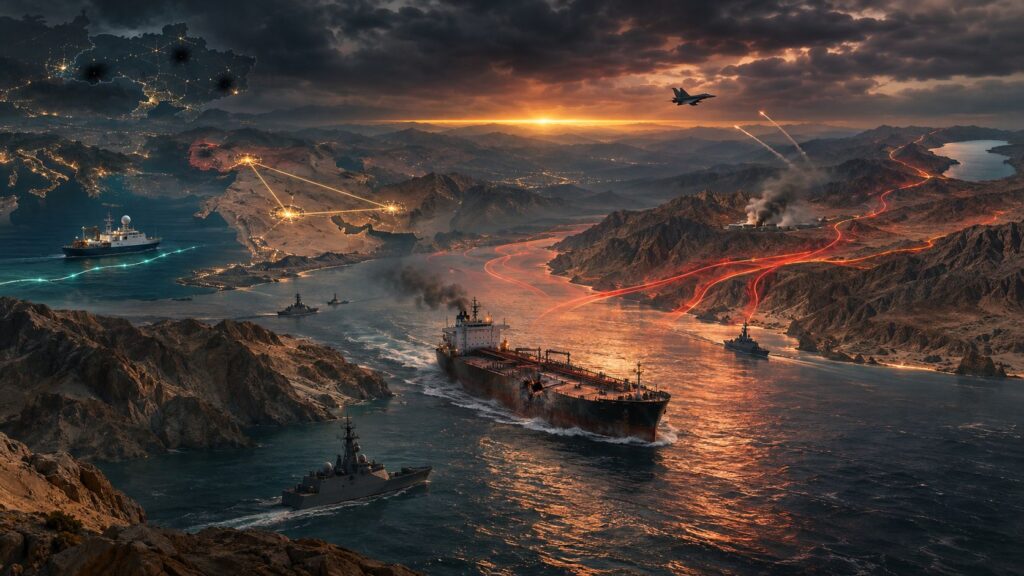
As Qatar Negotiates, Washington Expands the Blockade: Qeshm, Hormuz, and the War Over Supply Routes
THE WEEK’S SITUATION
The most dangerous development this week was not a single major attack but the simultaneous use of military force and continuation of negotiations. Within 5 days, the United States twice attacked Iranian air-defense positions on Qeshm Island. Washington described the first round of strikes as a defensive response to Iranian fire against U.S. aircraft; President Donald Trump confirmed the second and called it limited. Further explosions were reported on Qeshm and near Jask, Sirik, and Bandar Abbas on Saturday evening. Their cause remained unclear at press time. A third U.S. attack has therefore not been confirmed. The first round of strikes was officially presented as defensive action.
At the same time, Washington is expanding the blockade. A U.S. military aircraft disabled the merchant vessel M/V Huda in the Gulf of Oman. According to the U.S. account, the ship had called at an Iranian port and disregarded blockade instructions. The newly created Task Force Iron Gate is also intended to disrupt Iranian flows of weapons, technology, and revenue across land borders and the Caspian Sea. The use of force against the cargo vessel marked a further expansion of enforcement. A naval blockade is thus becoming an attempt at comprehensive logistical isolation.
Tehran continues to link its capacity for a military response with a channel for negotiations. Qatar is transmitting proposals between Washington and Tehran. One bridging model envisages ending or easing the blockade and releasing frozen Iranian funds. In return, Iran would grant International Atomic Energy Agency inspectors access to bombed facilities and temporarily open the Strait of Hormuz. No agreement exists. Qatar, however, rejects reports that the talks have failed.
Conflict lines are also converging outside the Gulf. Turkey ratified the Mecca Pact with Saudi Arabia and Pakistan. Syria concluded a defense agreement with Riyadh and deployed a limited number of military advisers. Russia and Ukraine intensified attacks on energy and transportation infrastructure immediately before the talks scheduled for November 10 and 11 in Abu Dhabi. In the eastern Mediterranean, Greek, Cypriot, and Turkish navigational notices are in opposition. The French survey vessel Abeille Marengo, however, was still in Heraklion at press time.
The editorial deadline for this edition was November 08, 2026.
IN MOTION – THE WEEK’S CONFLICT DEVELOPMENTS
QESHM – 2 CONFIRMED ROUNDS OF U.S. STRIKES, FURTHER EXPLOSIONS UNEXPLAINED
The United States attacked Qeshm on November 02 and again on November 06. U.S. officials justified the first round by citing Iranian anti-aircraft fire; Trump said of the second that a newly built Iranian air-defense position had been eliminated. Iranian media reported 2 missile impacts near Suza while also claiming that U.S. drones had been shot down. They had provided no independently verifiable evidence for that claim by press time. Further explosions on Saturday evening must not automatically be attributed to the United States. Neither Tehran nor Washington had conclusively identified their cause.
HORMUZ AND THE GULF OF OMAN – ATTACKS ON SHIPS, 2 DEAD, AND U.S. GUNFIRE
UKMTO published incident reports 192 through 197 during the week and report 198 on November 07 concerning an incident between a cargo vessel and military forces. Tankers, an Indian merchant vessel, and other cargo ships between Ras al-Khafji, Qatar, Limah, and Khasab were affected. An Indian seafarer was killed in the attack on the MSV Al Jusufi; 13 crew members were rescued. Another crew member was found dead aboard the tanker Velos Sapphire after a suspected missile detonation. U.S. forces also fired on the M/V Huda. Attribution has not been firmly established for every individual attack on shipping.
IRAN – NEW TASK FORCE AND REMOVAL OF THE MISSILE-RANGE LIMIT
The U.S. Task Force Iron Gate, staffed by approximately 20 civilian and military specialists, is intended to coordinate government action against Iranian supply chains from Tampa. Its targets include weapons, dual-use technology, sanctioned goods, and sources of revenue moving overland and across the Caspian Sea. It remains unclear what means the United States intends to use in practice to stop shipments beyond its sovereign jurisdiction. Iran responded politically by declaring that its self-imposed 2,000-kilometer limit on missile ranges no longer applied. There is no evidence that Tehran already possesses operational systems with ranges exceeding that limit.
SAUDI ARABIA AND YEMEN – ATTACK ON RIYADH, 33 REPORTED DEAD NEAR SANA’A
The Saudi-led coalition reported intercepting a Houthi cruise missile headed toward the Riyadh region. Ballistic missiles had previously been reported over Najran and drones over Mecca Province; this does not mean that the holy city itself was the target. Houthi authorities said Saudi airstrikes on Al-Shariya, east of Sana’a, killed 33 people and injured 39. Saudi Arabia announced a review; no independent confirmation was available. The Houthis and the Yemeni government side accuse each other of responsibility for the market attack in Taiz that killed approximately 30 people.
MECCA PACT – TURKISH PARLIAMENT RATIFIES THE TREATY
The Turkish parliament approved the Mecca Agreement on November 05. The official voting record shows 277 votes in favor and 118 against. The 10-year treaty treats an attack on one partner as an attack on all and provides for intelligence sharing, military coordination, and cooperation between the defense industries. Any actual deployment of Turkish soldiers to Saudi Arabia still requires a separate parliamentary mandate. The secretariat is to be based in Saudi Arabia; former Pakistani general Nauman Mahmood will become its first secretary-general.
SYRIA AND SAUDI ARABIA – DEFENSE AGREEMENT AND MILITARY ADVISERS
The Syrian and Saudi defense ministries signed a cooperation agreement on November 04. A limited number of Syrian military personnel are already in Saudi Arabia to assist with training, capacity building, and advising. Damascus, however, rejected reports that a troop deployment to Yemen had been decided and called broader accounts premature. An operational connection has therefore been established, but not Syrian entry into the war. A later Syrian accession to the Mecca Pact remains the subject of political talks.
BERLIN – €200 MILLION IN WINTER AID FOR UKRAINE
Chancellor Friedrich Merz announced an additional €200 million package during President Volodymyr Zelenskyy’s visit. According to the published information, it is intended primarily for humanitarian aid, energy supplies, and winter resilience. The Bundestag must still approve the funds. The package must therefore not be equated with an immediate €200 million arms delivery. Germany also announced a meeting of the so-called Coalition of the Willing for November 19, at which further assistance and possible security guarantees following a ceasefire are to be discussed.
UKRAINE – ATTACKS ON THE ENERGY SUPPLY INTENSIFY
According to Ukrainian officials, Russia used 172 drones and 36 ballistic missiles in its latest major wave of attacks. Energy facilities, residential buildings, and an important bridge in Kyiv were hit; power and water supplies failed in several regions. Russia said it had attacked energy, transportation, and industrial targets used by the military. Ukraine, for its part, continued extensive drone attacks against Russian regions, refineries, and infrastructure. The death toll from the attack on a former school and aid shelter in Komyshuvakha rose to 55. The attacks came as the country prepared for negotiations.
ABU DHABI – RUSSIA, UKRAINE, AND THE UNITED STATES TO NEGOTIATE ON NOVEMBER 10 AND 11
The Kremlin and the United States confirmed direct trilateral talks in Abu Dhabi. The agenda includes security arrangements after a possible end to the war, de-escalation, humanitarian measures, prisoner exchanges, and a possible ceasefire covering energy facilities and the Black Sea. The delegations remain far apart on territorial questions and security guarantees. The talks are therefore not a peace agreement, but they are the first confirmed joint negotiating session of this kind in months.
ISRAEL – EISENKOT RECEIVES THE MANDATE TO FORM A GOVERNMENT
President Isaac Herzog tasked Gadi Eisenkot with forming a government. Sixty-seven members of the Knesset recommended Eisenkot and 46 recommended Benjamin Netanyahu; the 7 members of United Torah Judaism made no recommendation. The 67 recommendations do not yet constitute a viable coalition. Some came from Arab-led parties whose participation or parliamentary support is disputed within the potential governing alliance. Eisenkot initially has 28 days; an extension of up to 14 days is possible. Netanyahu remains in office as caretaker prime minister until a new government is formed. The presidential consultations established the formal basis for Eisenkot’s mandate.
HEBRON AND LEBANON – ONE OPERATION ENDS, OTHER ATTACKS CONTINUE
Israeli forces concluded their 10-day operation in Hebron on November 02. Approximately 3,000 displaced Palestinians returned to neighborhoods that had been partially damaged. At the same time, UN OCHA documented 377 harvest-related attacks by Israeli settlers since the olive harvest began in September – already more than in any previously documented full season. In southern Lebanon, an Israeli drone strike near Qabrikha killed 1 person and injured another. Israel said 2 people had been observing soldiers; further locations in the country’s south were subsequently attacked.
KALININGRAD – POLAND ENDS SPECIAL OPERATION WITHOUT EVIDENCE OF A BORDER BREACH
From November 02 through 08, Poland reinforced its borders with Kaliningrad and Belarus with police, border guards, intelligence services, counterterrorism units, and special forces. The deployment followed warnings of sabotage and a possible armed provocation. During the night of November 03, people carrying flashlights and suspicious movement were observed near the border. Prime Minister Donald Tusk said that a possible attempt had been prevented but acknowledged that neither the intent nor Russian responsibility could be established with certainty. No armed border violation was confirmed. The Polish government framed the operation as a precautionary security measure.
PAKISTAN AND AFGHANISTAN – BORDER CLASHES CLOSE TORKHAM
Pakistani and Afghan forces clashed near Torkham and Angoor Adda on November 01 and 02. The Torkham border crossing remained closed for approximately 5 hours. The dispute once again concerned construction of a checkpoint in the immediate vicinity of the border; both sides agreed to halt construction. According to local reports, a civilian was killed by mortar fire near Angoor Adda. Islamabad subsequently intensified its threats against Kabul over groups allegedly operating from Afghan territory. Kabul rejects responsibility.
TAIWAN AND PRATAS – THE COAST GUARD AS AN INSTRUMENT OF GRAY-ZONE PRESSURE
According to Taiwan, a Chinese Coast Guard vessel entered the restricted waters of the Taiwan-controlled Pratas Islands. At the closest point, the Chinese and Taiwanese vessels were less than 1 nautical mile apart. Taipei has counted 13 such incursions this year; Beijing describes its operations as lawful patrols in its own waters. From November 06 to 07, Taiwan also recorded 11 Chinese military aircraft, 10 naval vessels, and 3 other official ships. According to Taiwan, 9 aircraft crossed the median line of the Taiwan Strait. Taiwan’s Ministry of National Defense published the associated activity report.
SUDAN AND ETHIOPIA – DRONE WARFARE AGAINST THE POWER GRID BECOMES AN INTERSTATE CONFLICT
At least 15 Sudanese substations have been attacked since the beginning of October. According to the Associated Press, national generating capacity fell from approximately 4,400 to about 1,100 megawatts; the Merowe Dam now supplies more than 70 percent of the electricity available. Sudan’s power grid is approaching collapse under the cumulative drone strikes. Sudan blames the Rapid Support Forces and claims that their drones are being launched from Ethiopian territory. Ethiopia denies this. The 2 countries have now closed each other’s consulates and expelled diplomats. The infrastructure war is established; the alleged Ethiopian involvement has not been independently proven.
MYANMAR – AIRSTRIKES HIT A MATERNITY WARD AND A SCHOOL
At least 15 people were killed in airstrikes in Myanmar. In Mrauk-U, a strike hit a temporary clinic with a maternity ward; a newborn and medical personnel were among the dead. In Loikaw, 3 students were killed in an attack during class. The information came from an ethnic armed group, aid workers, and human rights monitors; UNICEF confirmed corresponding reports and called for civilian facilities to be protected. The military government did not comment on the specific attacks and generally describes its campaign as an operation against terrorists. The reported death toll and locations were documented by Reuters.

ANALYSIS I – QESHM AND HORMUZ: AMERICA STRIKES WHILE QATAR NEGOTIATES
The 2 confirmed rounds of U.S. strikes have remained limited, but they are by no means politically insignificant. Washington distinguishes them rhetorically from a resumption of the large-scale air war and describes them as isolated defensive measures. That distinction has little binding force for Iran: U.S. aircraft are attacking Iranian territory while the United States simultaneously blockades Iranian ports and now targets supply routes over land and across the Caspian Sea.
Task Force Iron Gate therefore changes the strategic situation more than its small staff might suggest. The unit is not intended to occupy borders militarily itself, but to combine financial, customs, intelligence, and sanctions instruments. Its targets are the Russian-Iranian connection across the Caspian Sea, Chinese supply routes through Central Asia, and the transportation of dual-use goods. Political pressure on transit states is likely to be its most important instrument. Military intervention on foreign territory, by contrast, would constitute an additional step up the escalation ladder.
The firing on the M/V Huda shows that the blockade is already being enforced with armed force against civilian vessels. At the same time, the UKMTO reports demonstrate that commercial shipping is endangered from several directions. Responsibility for many attacks remains unknown; the casualties are nonetheless real.
Qatar is trying to interrupt this chain of escalation through a tightly sequenced exchange: easing the blockade and releasing assets in return for IAEA access, opening the Strait of Hormuz, and subsequent nuclear negotiations. Iran is additionally demanding sanctions relief, compensation, and an end to regional attacks. Washington wants nuclear issues addressed earlier. The 2 sides are therefore not negotiating over the same initial package.
STRATEGICALLY: The situation is more dangerous than it was 1 week ago because military pressure and diplomacy are not occurring sequentially but simultaneously. That creates bargaining leverage, but it also increases the probability that an attack on a ship, a wrongly attributed explosion, or a shootdown will destroy the negotiating channel within hours.
ANALYSIS II – THE MECCA PACT: FROM TREATY TO REGIONAL MILITARY NETWORK
With Turkish ratification, the Mecca Pact has crossed the threshold from a political promise to a binding defense framework. It does not yet possess a headquarters comparable to NATO’s, publicly known operational plans, or permanently assigned formations. But its institutions are already functioning, its members are linking intelligence services and defense industries, and a secretary-general has been selected.
Syria’s cooperation with Saudi Arabia expands this network without Damascus having formally joined it. Military advisers, training, and capacity building can be arranged more quickly than accession to an alliance. The same applies to possible Turkish assistance in air defense, electronic warfare, and counter-drone operations. The separate parliamentary mandate required for Turkish troop deployments remains a genuine legal obstacle.
Iran is likewise not a member. Its inclusion would be militarily valuable because Tehran possesses missiles, drones, combat experience, and direct access to the Strait of Hormuz. It would also be politically difficult for as long as the war with the United States continues and Iran remains connected to Saudi Arabia through the Houthi front. Mediation by Pakistan and Qatar keeps this option open but does not replace a decision to admit Iran.
STRATEGICALLY: The decisive development is not the sudden emergence of an “Islamic NATO,” but a flexible security network. Formal members provide the treaty; partners such as Syria can contribute training, personnel, and infrastructure. The alliance can therefore grow operationally before it expands politically.
ANALYSIS III – UKRAINE: THE ENERGY WAR ESCALATES AHEAD OF ABU DHABI
The attacks immediately before the meeting in Abu Dhabi form part of the negotiating positions. Russia is demonstrating that it can continue damaging Ukraine’s electricity, heating, and water supplies before winter. Through attacks on refineries, industrial facilities, and infrastructure with potential military use in Russia, Ukraine is showing that Moscow must also bear costs. Both sides are trying to convert military pressure into diplomatic leverage.
For that very reason, a limited agreement is more likely than a comprehensive peace. A ceasefire covering energy facilities, safe navigation in the Black Sea, prisoner exchanges, and the return of abducted children can be separated into discrete issues. Territory, NATO affiliation, security guarantees, and sanctions, by contrast, are fundamental questions on which the positions remain far apart.
The Berlin package is important in this context, but it must be classified correctly. The €200 million is intended primarily to support winter resilience and energy supplies; it replaces neither missing Patriot interceptor missiles nor a political agreement. Europe is financing Ukrainian resilience while Washington leads the negotiations and continues to hold the greatest leverage over crucial air-defense systems.
STRATEGICALLY: Abu Dhabi should not be judged by whether the war ends on November 11. The meaningful test is narrower: Will a verifiable partial mechanism emerge for energy facilities, the Black Sea, and humanitarian issues – or will the talks merely serve to assign responsibility for their failure to the other side?
ANALYSIS IV – GREAT SEA INTERCONNECTOR: 3 NAVTEX NOTICES, TURKISH RECONNAISSANCE, BUT NO NAVAL CONFRONTATION YET
Through NAVTEX 1411/26, Greece authorized survey work by the Abeille Marengo between Crete and the Cypriot exclusive economic zone. Cyprus issued NAVTEX 345/26 for its section. Turkey responded with a counter-notice and stated that part of the route crossed the continental shelf it claims. Ankara therefore demands coordination and authorization. The Greek notice identifies the vessel and survey area.
The Turkish position is based on coordinates submitted to the United Nations in 2020. Their deposit, however, does not settle the dispute. Greece and Cyprus do not recognize the Turkish delimitation and consider the work lawful. Turkish drone reconnaissance was reported over the future work area. The deployment of Turkish warships to block the survey vessel had not been confirmed by press time.

The dual political track is notable. The Turkish Foreign Ministry formulated its legal claim in sharp terms. Foreign Minister Hakan Fidan later said the dispute had been resolved and that “everything is normal,” without disclosing the substance of any understanding. At the same time, the ship remained in Heraklion; its departure was postponed until Monday.
STRATEGICALLY: For now, the interconnector remains a legal and diplomatic conflict. The operational test will begin only when the Abeille Marengo leaves port and starts working in disputed waters. The decisive question will be whether Ankara documents its claims through observation or attempts to enforce them physically with ships.
ANALYSIS V – ISRAEL AFTER THE ELECTION: A MANDATE IS NOT YET A GOVERNMENT
Eisenkot’s 67 recommendations are politically significant: Netanyahu’s previous bloc no longer holds a majority. But they are not equivalent to 67 secure coalition votes. Eisenkot must either include Arab-led parties or accept their outside support, reconcile contradictory partners, or win over elements of Likud for a broad government. Every option requires concessions that could alienate other supporters.
Meanwhile, the outgoing government retains the ability to act in a caretaker capacity. The operation in Hebron has ended, but its material and humanitarian consequences remain. Attacks in Lebanon continued. Israel’s military confrontations in Gaza and Syria will likewise not be interrupted automatically by the mandate to form a government.
The legal situation in Syria is also unchanged by the election: Israel has occupied the Syrian Golan Heights since 1967 and extended Israeli law, administration, and jurisdiction to the territory in 1981. The UN Security Council unanimously declared this annexation null and void in Resolution 497. Turkish or other military cooperation undertaken at the invitation of the Syrian government has a different legal basis from an uninvited Israeli military presence.
STRATEGICALLY: Eisenkot has the first opportunity to end Netanyahu’s tenure as prime minister. Whether this produces a change in foreign and security policy remains open. Until a new coalition is in place, the defensible finding is this: parliamentary transition amid military continuity.
BRIEF ANALYSIS – KALININGRAD: HEIGHTENED READINESS WITHOUT A PROVEN PROVOCATION
Poland’s actions were not groundless: Intelligence warnings, acts of sabotage in Europe, and the strategic location between Kaliningrad, Belarus, and the Suwałki Gap justify heightened vigilance. The deployment of police, border guards, intelligence services, and special forces shows that Warsaw is also preparing for a small armed provocation or one deliberately designed to be difficult to attribute.
The observed flashlight signals, however, prove neither a Russian operational order nor an attempted border breach. Tusk himself spoke of a possible provocation and acknowledged that the intent could not be fully confirmed. This distinction is essential: The preparation was real; the alleged adversary behind the specific incident was not proven.
STRATEGICALLY: Kaliningrad remains an area with high escalation potential. This week, however, provided no evidence of a new Russian buildup or an armed operation against Poland.
WEEKLY CONCLUSION – OVERALL STRATEGIC ASSESSMENT
This week was shaped by 3 interconnected developments.
First, economic pressure is being linked ever more directly to military force. The United States is blockading Iranian ports, firing on a merchant vessel, and building a structure aimed at overland and Caspian routes. Iran is threatening longer-range missiles and retains leverage over world trade through the Strait of Hormuz. Unknown or disputed attacks on civilian shipping multiply the risk because not every strike can be attributed unambiguously at once.
Second, regional security networks are emerging faster than the terminology of traditional alliances can capture. The Mecca Pact has now secured Turkish ratification. Syria is not yet a member but is cooperating militarily with Saudi Arabia. Iran has neither joined nor been excluded. The decisive question for now is not the formal number of members, but which air-defense systems, intelligence capabilities, training structures, defense industries, and logistical networks are actually being connected.
Third, negotiations are being prepared through continuing attacks. Russia and Ukraine are striking energy facilities before Abu Dhabi. Washington is attacking Iran while Qatar transmits proposals. Greece and Turkey are publishing opposing legal positions while apparently seeking a working formula for the interconnector behind the scenes. Eisenkot has received the mandate to form an Israeli government while the existing military chain of command continues to operate.
The common finding is not that a major war has been imminently decided. It is that military and economic coercion has once again become a normal companion to diplomacy. That can accelerate negotiations for as long as both sides see a controllable lever. It can destroy them just as quickly if an attack is misattributed, civilian casualties make political retreat impossible, or one side no longer views the other’s pressure as a negotiating instrument but as preparation for the next major offensive.
For the coming week, 4 concrete tests therefore matter: Can Qatar bring Washington and Tehran to take the first reciprocal steps? Will Abu Dhabi produce at least a limited ceasefire covering energy or humanitarian matters? Can the Abeille Marengo work without a military blockade? And can Eisenkot convert 67 recommendations into an actual governing majority?
About the Author
Michael Hollister
is a geopolitical analyst and investigative journalist. He served six years in the German military, including peacekeeping deployments in the Balkans (SFOR, KFOR), followed by 14 years in IT security management. His analysis draws on primary sources to examine European militarization, Western intervention policy, and shifting power dynamics across Asia. A particular focus of his work lies in Southeast Asia, where he investigates strategic dependencies, spheres of influence, and security architectures. Hollister combines operational insider perspective with uncompromising systemic critique – beyond opinion journalism. His work appears on his bilingual website (German/English) www.michael-hollister.com and in investigative outlets across the German-speaking world and the Anglosphere.
Stay informed without having to work through the daily flood of news – the most important developments and connections summarized for you.
Sources
Iran, Qeshm, Hormuz, and the Gulf of Oman
1. ABC News: US Carries Out Defensive Airstrikes on Iran’s Qeshm Island: Officials, November 02, 2026.
https://abcnews.com/amp/International/us-carries-defensive-airstrikes-irans-qeshm-island-officials/story?id=137792518
2. Associated Press: US Military Carries Out New Targeted Strike on Iran as Tehran’s Leaders Weigh Mediator’s Proposals, November 06, 2026.
https://www.click2houston.com/news/politics/2026/11/06/us-military-carries-out-new-targeted-strike-on-iran-as-tehrans-leaders-weigh-mediators-proposals/
3. Reuters: Two Missiles Strike Iran’s Qeshm Island, Tasnim News Agency Says, November 06, 2026.
https://www.reuters.com/world/middle-east/two-missiles-strike-irans-qeshm-island-tasnim-news-agency-says-2026-11-06/
4. Reuters: US Military Says It Disabled Cargo Vessel in Gulf of Oman, November 07, 2026.
https://www.reuters.com/world/middle-east/us-military-says-it-disabled-cargo-vessel-gulf-oman-2026-11-07/
5. United Kingdom Maritime Trade Operations: Recent Incidents – Reports 192 Through 198, November 02–07, 2026.
https://www.ukmto.org/recent-incidents
6. Reuters: One Indian Killed in Attack on Ship Near Oman, Indian Foreign Ministry Says, November 03, 2026.
https://www.reuters.com/world/india/one-indian-killed-attack-ship-near-oman-indian-foreign-ministry-says-2026-11-03/
7. Reuters: Seafarer Killed in Suspected Missile Attack on Tanker in Gulf, November 06, 2026.
https://www.reuters.com/world/one-seafarer-killed-missile-attack-tanker-gulf-2026-11-06/
8. Ministry of Foreign Affairs of Qatar: Qatar Continues Its Efforts to Bridge Gap Between Washington, Tehran, November 03, 2026.
https://mofa.gov.qa/en/qatar/latest-articles/latest-news/details/2026/11/03/advisor-to-prime-minister–official-spokesperson-for-ministry-of-foreign-affairs–qatar-continues-its-efforts-to-bridge-gap-between-washington–tehran
9. Reuters: Iran Sent Nuclear Proposal to the US via Qatar, Senior Iranian Official Tells Reuters, November 05, 2026.
https://www.investing.com/news/commodities-news/iran-sent-nuclear-proposal-to-the-us-via-qatar-senior-iranian-official-tells-reuters-5006492
10. Associated Press: Iran Is Reviewing Proposals Focusing on Tehran’s Nuclear Program, Officials Say, November 06, 2026.
https://www.local10.com/news/politics/2026/11/06/iran-is-reviewing-proposals-focusing-on-tehrans-nuclear-program-officials-say/
11. Associated Press: Iran Says It Has Lifted Its Self-Imposed Limit on Missile Ranges, November 07, 2026.
https://apnews.com/article/c26759ac66e6c022a3256adeae40c965
Saudi Arabia, Yemen, and the Mecca Pact
12. Saudi Press Agency: Cruise Missile Launched by Houthi Militia Toward Riyadh Region Intercepted and Destroyed, November 07, 2026.
https://www.spa.gov.sa/en/N2720055
13. Reuters: Houthi-Run Health Ministry Says Airstrikes Kill 33 Near Yemen Capital, November 08, 2026.
https://www.reuters.com/world/middle-east/houthi-run-health-ministry-says-airstrikes-it-blames-saudi-arabia-kill-27-near-2026-11-07/
14. Grand National Assembly of Turkey: Voting Result on the Mecca Agreement, November 05, 2026.
https://cdn.tbmm.gov.tr/TbmmWeb/Tutanak/28/5/14/AcikOylamaSonuc/cbfb34cb-f290-4c39-a3b3-b902717425ea.html
15. Associated Press: Turkish Lawmakers Approve a 3-Nation Defense Pact With Saudi Arabia and Pakistan, November 05, 2026.
https://www.washingtonpost.com/world/2026/11/05/turkish-parliament-debate-defense-pact-pakistan-saudi/618d7532-d960-11f1-930a-e08f8086f5ac_story.html
16. Reuters: Saudi, Syrian Defence Ministries Sign Cooperation Agreement, November 04, 2026.
https://www.reuters.com/world/middle-east/saudi-syrian-defence-ministries-sign-cooperation-agreement-spa-reports-2026-11-04/
17. Reuters: Syria Denies Plans to Send Troops to Yemen as Saudi Military Ties Deepen, November 07, 2026.
https://www.reuters.com/world/asia-pacific/syria-denies-plans-send-troops-yemen-saudi-military-ties-deepen-2026-11-07/
Ukraine, Germany, and Abu Dhabi
18. Federal Government of Germany: Press Conference With Chancellor Merz and President Zelenskyy in Berlin, November 03, 2026.
https://www.bundesregierung.de/breg-en/news/merz-zelenskyy-pc-in-berlin-2459734
19. President of Ukraine: Germany Will Provide a Winter Support Package for Ukraine, November 03, 2026.
https://www.president.gov.ua/en/news/nimechchina-nadast-ukrayini-zimovij-paket-pidtrimki-volodimi-107125
20. Associated Press: Drone and Missile Attacks Wound 9 in Ukraine as Country Prepares for Talks, November 07, 2026.
https://apnews.com/article/b042adf1f95848f5d233da866a72e312
21. Reuters: Kremlin Confirms Trilateral Ukraine Peace Talks in Abu Dhabi Next Week, November 03, 2026.
https://www.reuters.com/world/europe/kremlin-confirms-trilateral-ukraine-peace-talks-abu-dhabi-next-week-2026-11-03/
Israel, the West Bank, and Lebanon
22. President of the State of Israel: President Herzog Concludes Round of Consultations With Knesset Factions, November 05, 2026.
https://www.president.gov.il/en/president-herzog-concludes-round-of-consultations-with-knesset-factions-at-the-presidents-residence/
23. Associated Press: Israel’s President Taps Opposition Candidate Eisenkot to Form a Government, November 08, 2026.
https://apnews.com/article/75934bfce1f2f2e43e1823de3761b12d
24. UN OCHA: Humanitarian Situation Report – 5 November 2026, November 05, 2026.
https://www.ochaopt.org/content/humanitarian-situation-report-5-november-2026
25. L’Orient Today: Israeli Strike on Motorcycle Kills One in Southern Lebanon, November 04, 2026.
https://today.lorientlejour.com/article/1553238/israeli-stun-grenade-targets-olive-pickers-near-kfar-shuba-after-overnight-escalation-in-south-lebanon.html
Great Sea Interconnector
26. Hellenic Navy Hydrographic Service: NAVWARN 1411/26 – Abeille Marengo, November 06, 2026.
https://hnhs.gr/zczc-ha15-061413-utc-nov-26-irakleio-radio-navwarn-1411-26/
27. Ministry of Foreign Affairs of the Republic of Türkiye: Regarding the Attempt by a French-Flagged Vessel to Conduct an Unauthorized Marine Scientific Research Activity, November 06, 2026.
https://www.mfa.gov.tr/no_-214_-fransiz-bayrakli-bir-geminin-dogu-akdeniz-deki-kita-sahanligimizda-izinsiz-deniz-bilimsel-arastirma-faaliyeti-yurutme-girisimi-hk.en.mfa
28. Kathimerini: Fidan Says Dispute Over NAVTEX for Greece-Cyprus Power Cable Has Been Resolved, November 07, 2026.
https://www.ekathimerini.com/politics/foreign-policy/1320603/fidan-says-dispute-over-navtex-for-greece-cyprus-power-cable-has-been-resolved/
Kaliningrad, Pakistan, Taiwan, Sudan, and Myanmar
29. Office of the Prime Minister of Poland: Bezpieczeństwo Polski nie może być przedmiotem politycznej gry, November 03, 2026.
https://www.gov.pl/web/premier/bezpieczenstwo-polski-nie-moze-byc-przedmiotem-politycznej-gry
30. Dawn: Kabul Warned of Unbearable Punishment as Clashes Persist Along Border, November 02, 2026.
https://www.dawn.com/news/2041542
31. Associated Press: Taiwan Accuses China of Harassment After Standoff Between Coast Guard Ships, November 01, 2026.
https://apnews.com/article/dfc441591994cb435e55eb8f3dc6aeda
32. Ministry of National Defense of the Republic of China: PLA Activities in the Waters and Airspace Around Taiwan, November 07, 2026.
https://www.mnd.gov.tw/en/News/PLAAct/88166
33. Associated Press: Sudan’s Power Grid Nears Collapse as Drone Strikes Target Electric Stations, November 02, 2026.
https://apnews.com/article/3d8369aa7479b594a72bc8439d08a0a2
34. Reuters: Ethiopia and Sudan Close Each Other’s Consulates After Allegations of Meddling, November 04, 2026.
https://www.reuters.com/world/africa/ethiopia-expels-sudanese-diplomats-after-fresh-allegations-support-rsf-2026-11-04/
35. Reuters: Newborn Among 15 Killed as Myanmar Military Strikes Maternity Clinic and School, November 02, 2026.
https://www.reuters.com/world/asia-pacific/newborn-among-15-killed-myanmar-military-strikes-maternity-clinic-school-sources-2026-11-02/
36. UNICEF: Statement on Reports of Children Killed and Injured in Airstrikes in Myanmar, November 03, 2026.
https://www.unicef.org/asia-pacific/press-releases/unicef-statement-children-killed-and-injured-airstrikes-rakhine-myanmar
37. United Nations Security Council: Resolution 497 (1981) – Occupied Syrian Golan Heights, December 17, 1981.
https://www.un.org/unispal/document/auto-insert-180751/
© Michael Hollister – Redistribution expressly encouraged.
I am pleased when my articles, commentaries, and analyses attract interest and are shared. Reproduction, distribution, and publication of my texts, in whole or in part, on other websites, blogs, or in other publications is expressly permitted and encouraged. No prior permission is required.
<u>The sole requirement:</u> Michael Hollister must be clearly and prominently identified by name as the author. In addition, a clearly visible, clickable link to the original website, www.michael-hollister.com, must be included.
Reuse without author attribution and a link is not permitted.
If this work helps you understand what lies behind the headlines, consider supporting it. Membership starts at $5 per month, includes access to all supporter-only analyses, and can be cancelled at any time.