UPDATE Report – Updated: October 25, 2026 – Building on my Update from October 18, 2026
by Michael Hollister
Exclusive published at Michael Hollister on October 25, 2026
4.437 words * 24 minutes readingtime


Preparations Become Visible: Alliances Train, Blockades Take Hold, and Protection Systems Become Instruments of Pressure
SITUATION REPORT FOR THE WEEK
The most dangerous development this week is not any single attack. It is the simultaneity of military preparations that are turning previously separate conflicts into interconnected theaters of operation.
Israel and Greece conducted live-fire missile drills north of Crete. Greece, Cyprus, France, and Italy concluded another air and naval exercise in the eastern Mediterranean at almost the same time. Turkey responded to the navigational warnings issued for the exercise with a counter-NAVTEX. In parallel, eastern Libya’s House of Representatives ratified the Turkish-Libyan maritime boundary agreement. A war between Israel and Turkey has neither been decided nor is it imminent. But Israel, Greece, and Cyprus are no longer limiting themselves to political coordination and theoretical scenarios. They are intensifying their military cooperation, expanding their capabilities, and creating the industrial and operational prerequisites for a possible confrontation.
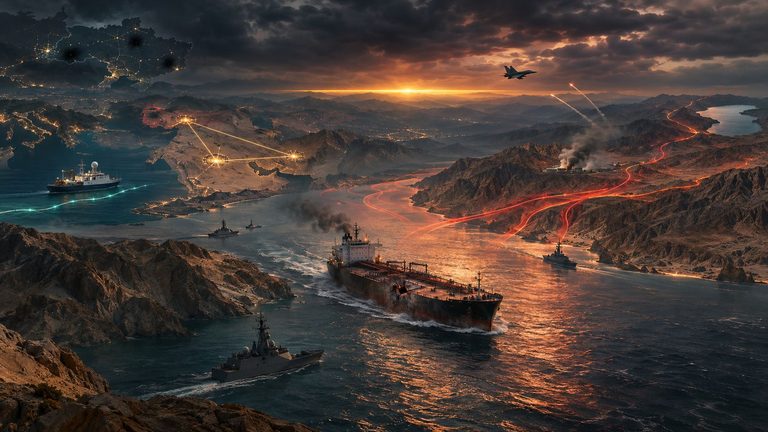
In the Gulf and the Red Sea, that threshold has already been crossed. A Houthi attack killed 73 members of Yemen’s security forces in Shabwa. Additional missiles struck facilities in Aden, while Saudi Arabia intercepted projectiles headed toward Yanbu and Taif. The Houthis once again declared Saudi airports and energy facilities to be targets. At least 28 attacks on ships were recorded in and around the Strait of Hormuz in October.
In the war in Ukraine, protection systems themselves are becoming bargaining tools. Washington is withholding approval for the transfer of already-financed Patriot interceptor missiles. Starshield returned to normal operation after more than a week of restrictions, but the dispute over American control of the system remains unresolved. Russia is signaling a willingness to negotiate while continuing to attack Ukrainian cities and energy facilities.
This issue closed on October 25, 2026.
ISRAEL, TURKEY, AND THE EASTERN MEDITERRANEAN – RIVALRY BECOMES MILITARY PREPARATION
LIVE FIRE NORTH OF CRETE
The Greek and Israeli navies conducted a joint live-fire exercise in the northern Cretan Sea on October 21, 2026. According to the Hellenic Navy, Greek units fired SPIKE-NLOS and SPIKE-ER guided missiles. Frigates, submarines, fast attack craft, patrol vessels, special forces, helicopters, air force units, and 2 Israeli missile boats took part. The chiefs of the 2 navies and the chief of the Hellenic National Defence General Staff observed the exercise on site.
Greece, Cyprus, France, and Italy also concluded the EUNOMIA 7-2026 air and naval exercise. Its scenarios included air defense and anti-submarine warfare. Turkey disputed Greek jurisdiction over parts of the exercise area and issued a counter-NAVTEX. No military incident was reported.
The exercises do not stand alone. Israel, Greece, and Cyprus signed a joint military work program for 2026 in late 2025. Greece is purchasing Israeli rocket artillery and negotiating the multi-layered “Achilles Shield” air-defense system. Cyprus is discussing additional Israeli naval and weapons systems. Not every contract has been finalized. The direction of the cooperation, however, is clear.
THE MARITIME AGREEMENT WITH LIBYA INTENSIFIES THE DISPUTE
On October 20, eastern Libya’s House of Representatives ratified the maritime boundary agreement concluded in 2019 between Turkey and the internationally recognized government in Tripoli. Greece, Cyprus, Egypt, and Israel reject the boundary it draws. They believe it infringes on their own claims and potential energy corridors. Israel accused Ankara of destabilizing the eastern Mediterranean. Turkish Foreign Minister Hakan Fidan, by contrast, described the agreement as lawful and the Libyan ratification as an overdue formality.
Military cooperation and disputes over maritime territory are therefore converging on the same maps. The issues include exploration rights, gas fields, cable routes, and which state is entitled to issue navigational warnings for particular waters. These legal positions are not being advanced only in government ministries. They are being put into practice through warships, exercises, and survey missions.
The rhetoric has changed as well. Prime Minister Benjamin Netanyahu said on October 18 that he wanted to avoid a direct confrontation with Turkey, but that Israel was considering every possibility. Finance Minister Bezalel Smotrich spoke of the capabilities required for a major, long, and intense war, the production of “enormous quantities,” and the need to strengthen the Greek alliance in view of Turkey’s large navy. Turkey’s National Intelligence Academy, for its part, published a study on Israeli expansionism and possible counterstrategies. The study is not a formal operational doctrine of the Turkish government, but it shows the threat perception being examined within a state strategic institution.
SYRIA REMAINS THE DIRECT POINT OF CONTACT
The rivalry has already acquired a kinetic dimension on Syrian soil. Israel attacked Syria’s Abu al-Duhur air base in August. The Israeli leadership said it wanted to prevent the possible deployment of Turkish radar, air-defense systems, and drones. US Special Envoy for Syria Tom Barrack contradicted that account: He said no Turkish military systems were present and Ankara had not planned such a deployment. He raised the possibility that the strike had been intended to provoke a Turkish response. Israel rejected the suggestion.
The legal positions are not symmetrical. Turkey bases its cooperation on an invitation from the Syrian government. Israel has neither such an invitation nor a UN Security Council mandate to conduct attacks on Syrian territory. At the same time, Israel has occupied the Syrian Golan Heights since 1967 and extended its law, administration, and jurisdiction to the territory in 1981. In Resolution 497, the UN Security Council unanimously declared that step null and void and without international legal effect. Israel has not reversed it to this day.
Israel’s naval expansion extends beyond the current week but forms part of its underlying capabilities. On September 01, Germany delivered the INS Drakon, the 6th Dolphin-family submarine built for Israel. Germany subsidized the vessel with €135 million from the federal budget. Foreign specialist reports describe the Dolphin fleet as a potential sea-based nuclear second-strike capability; Israel neither confirms that it possesses nuclear weapons nor that the Drakon carries them. The suspected vertical missile-launch system has not been officially confirmed either. TKMS is already building the 3 submarines of the succeeding Dakar class.
BEYOND THE THEATER
Israel, Greece, and Cyprus are linking air defense, naval power, energy infrastructure, and Syrian security issues into a common strategic axis. Turkey is responding through its presence in Syria, its maritime agreement with Libya, and its own legal claims at sea. France and Italy are also operating in the theater through EUNOMIA. A bilateral dispute is becoming a network in which NATO members stand on different sides.
STRATEGIC ASSESSMENT: A Turkish-Israeli war is not a settled outcome. Preparations for one, however, have moved beyond a mere thought experiment. Joint live-fire exercises, armament programs, naval expansion, and the forcible prevention of potential Turkish capabilities in Syria are creating real prerequisites. That is the change visible this week.
YEMEN, SAUDI ARABIA, AND HORMUZ – THE WAR SPREADS TO AIRPORTS AND OIL ROUTES
73 DEAD IN SHABWA, MISSILES STRIKE ADEN
Three ballistic missiles struck a training camp for government security forces in Yemen’s Shabwa province on October 19. According to the provincial media office, the death toll rose to 73; more than 200 people were wounded and 14 remained missing. Reuters verified footage from the site but could not independently confirm every casualty figure. The Houthis said they had attacked Saudi-backed forces.
A new wave of attacks followed on October 24. The Houthis named Riyadh International Airport, an Aramco facility in Yanbu, the Rabigh refinery, pumping stations along the East-West Pipeline, and additional airports and military facilities as targets. Saudi Arabia did not confirm hits on those facilities. The Saudi-led coalition, however, reported intercepting 2 ballistic missiles headed toward Yanbu and Taif. Debris fell in the Mecca and Medina regions as well as near Jeddah, Taif, and Rabigh. The Houthis denied targeting the holy cities.
According to Yemen’s internationally recognized government, 3 additional ballistic missiles struck coast guard facilities in the southern city of Aden. Two projectiles hit a headquarters, while another struck a building in the Tawahi district. The Houthis said they had attacked a depot and a naval base housing Saudi-supervised forces. That claim was not independently confirmed.
On October 25, the Houthis renewed their warning to airlines and travelers not to use Riyadh airport. The airport was preparing to reopen terminals for domestic and international flights after an interruption. The Houthis are therefore explicitly treating civilian aviation infrastructure as part of their theater of operations.
HORMUZ: 28 ATTACKS IN ONE MONTH
At least 28 confirmed or reported attacks on ships were recorded in the Strait of Hormuz and adjacent waters in October. A Reuters analysis based on data from the Washington Institute, the International Maritime Organization, and MarineTraffic estimated that approximately 3.5 percent of the global supertanker fleet had been damaged in the conflict. Eleven Very Large Crude Carriers were damaged in October alone.
A new attack on October 25 had not been confirmed by the time this issue closed. The consequences of earlier strikes, however, are becoming visible. Oil leaked from the damaged tanker Gem No. 2, prompting the closure of beaches near Umm al-Quwain in the United Arab Emirates. The vessel had been attacked on October 09 or 10. The oil slick turns a security problem for shipowners into an environmental and drinking-water risk for coastal states that depend heavily on seawater desalination.
Iran stated again on October 24 that it was prepared to open Hormuz if Washington ended its blockade of Iranian ports. Iran’s ambassador to Pakistan said the proposal had been conveyed through Islamabad. According to the Iranian account, Donald Trump rejected the linkage. There is no American confirmation of that account and no new agreement.
THE PROTECTING POWERS REMAIN DEFENSIVE
Saudi Arabia receives early-warning intelligence and technical support. Britain and France are offering defensive deployments and air defense, respectively. The Mecca Pact with Pakistan and Turkey provides for collective defense, intelligence sharing, exercises, and the possible rapid deployment of agreed capabilities. Ankara rules out a Turkish operation to attack the Houthis in Yemen; Pakistan also describes its role as defensive.
A US intelligence memorandum, meanwhile, warns of Iranian planning against American personnel that had reached “advanced stages.” Reuters reviewed the document; the underlying intelligence cannot be independently assessed from publicly available information. Washington reduced staffing at diplomatic missions and tightened travel advisories for several countries in the region.
BEYOND THE THEATER
Shabwa, Aden, Saudi airports, the East-West Pipeline, Bab el-Mandeb, and Hormuz now form part of a single chain of escalation. Attacks on one section alter insurance costs, flight routes, and energy prices elsewhere. States that do not declare their entry into the war nevertheless become part of the system through air defense, intelligence, and protection missions.
STRATEGIC ASSESSMENT: The Houthis are combining military attacks with economic pressure on Saudi Arabia. Iran is linking the opening of Hormuz to an end to the American blockade. Both conflict lines are treating freedom of movement as a bargaining chip. As long as airports and straits remain targets, a defensive alliance commitment can quickly become operational participation.
UKRAINE, RUSSIA, AND THE UNITED STATES – NEGOTIATIONS UNDER CONTROLLED DEPENDENCE
PATRIOT REMAINS ON HEGSETH’S DESK
The Pentagon has still not approved the transfer of American Patriot interceptor missiles from European inventories to Ukraine. The missiles were financed by European partners through the PURL program; because they are American systems, their transfer requires Washington’s consent. Defense Secretary Pete Hegseth has neither rejected nor completed the applications. Secretary of State Marco Rubio conceded that a delivery may not have taken place but denied that the delay was politically motivated. The decision remains with the Trump administration.
The dispute coincides with renewed Russian attacks. According to Ukrainian authorities, more than 10 energy facilities were hit on October 19, temporarily disconnecting roughly 550,000 households from the power grid. Ten people were killed. Kyiv said it had received no American early warning before the first wave of attacks. Washington cited a technical problem and said intelligence sharing had not been suspended for political reasons.
STARSHIELD WORKS AGAIN – THE LEVER REMAINS
Ukraine reported on October 24 that Starlink and its military variant, Starshield, were once again operating at the required speed after more than a week of restrictions. According to Ukrainian officials, the 160-kilometer-per-hour limit had impeded defenses against Russian drones and forced the cancellation of individual operations. Reuters reported that the throttling order had come from the White House. Starshield has returned to normal operation, but the power to restrict it remains.
Elon Musk subsequently accused the Ukrainian military of violating the terms of service through offensive drone strikes. A Ukrainian government adviser denied that Starlink was technically being used for long-range attacks. Whatever the outcome of that dispute, the operational reality remains: A communications system developed by a private company but controlled by the US government can alter the range and employment options of Ukrainian systems within days.
WASHINGTON OPENS A CHANNEL TO MOSCOW
Donald Trump urged Ukraine to end the war and said that perhaps someone else should negotiate on the country’s behalf. This is not the same as formally demanding the removal of Volodymyr Zelenskyy, but it increases the personal pressure on him. At the same time, US Special Envoy Steve Witkoff met Zelenskyy in Oslo and then Vladimir Putin in St. Petersburg. Russia declared itself open in principle to a new round of talks; Abu Dhabi in mid-November has been discussed as a possible venue and timeframe.

Military operations continued. According to Ukrainian authorities, Russia fired 21 ballistic missiles at Kyiv on October 22. Russia said on the same day that it had destroyed more than 800 Ukrainian drones en route to Russian cities. Both accounts come from parties to the conflict. The talks have so far produced neither a general ceasefire nor any convergence on territory, neutrality, and security guarantees.
A limited exception is Oleshky, in the Russian-controlled part of the Kherson region. Russia and Ukraine agreed to a local ceasefire beginning October 27 in order to clear mines from access routes, deliver relief supplies, and evacuate civilians. The 2 sides also exchanged 270 prisoners each on October 23, including 9 Ukrainian civilians.
BEYOND THE THEATER
Patriot, early-warning intelligence, and Starshield demonstrate the extent of American control over capabilities that are formally financed by Europe or provided by private companies. Washington can use them not only to pressure Russia, but also to restrict Kyiv’s freedom of action. Europe finances a growing share of the support but cannot replace American authorization, intelligence, and satellite infrastructure at short notice.
STRATEGIC ASSESSMENT: Russia is negotiating without reducing its military pressure. Washington is mediating while simultaneously withholding individual protective capabilities from Ukraine. Kyiv faces no formal demand for capitulation, but it is receiving several signals that American support can be tied to political conduct.
IN MOTION
WEST BANK – HEBRON SEALED OFF, TOTAL CLOSURE FOR ELECTION DAY
Two armed Palestinians killed 2 Israeli soldiers and wounded 3 others at a checkpoint near Hebron on October 23. Both attackers were killed in the firefight. The Israeli military said it had found weapons and large quantities of ammunition in their vehicle and suspected that an attack on civilians had been planned. No involvement by the Palestinian Authority was established.
Israel sealed off Hebron and surrounding communities, conducted house searches and arrests, and began demolitions. According to Defense Minister Israel Katz, approximately 2,000 people were removed from their homes; Hebron’s mayor put the figure at 2,200. AP reported that 200 to 300 families were affected. The Palestinian Prisoners Society reported more than 70 arrests across the West Bank.
For Sunday and Monday, the military largely prohibited Palestinian workers from entering Israeli settlements. On Israel’s election day, October 27, all land crossings between the occupied West Bank and Israel are to be closed to Palestinians. Exceptions and the duration of the closure will be determined by Israeli security decisions.
OUTLOOK: The decisive question is whether the election-day closure will be lifted after October 27 or become a longer-term lockdown. It will also matter whether the operation expands to additional cities.
SUDAN AND ABYEI – THE WAR STRIKES ITS FUEL ARTERY
A drone strike on the Amiet market in the disputed Abyei region killed more than 150 people, according to local reports. Five diplomats and conflict observers described the market to Reuters as part of a fuel network supplying the Rapid Support Forces. The strike hit storage facilities and fuel tankers. Eyewitnesses also reported that no RSF fighters were present at the market when the attack occurred.
South Sudanese officials initially blamed the Sudanese military and summoned Sudan’s ambassador. The Sudanese government denied any involvement. South Sudan’s Foreign Ministry later said that the circumstances and any possible connection to the RSF had not been conclusively established. Responsibility remains unresolved.
OUTLOOK: The attack shows that the Sudan war is supplied through Abyei, drawing disputed territory between Sudan and South Sudan into the theater of operations. A confirmed repetition could transform the internal war into a direct cross-border conflict.
ETHIOPIA, TIGRAY, AND ERITREA – CALL FOR DISARMAMENT AND RESISTANCE
The transitional administration installed by Addis Ababa in Tigray called on the remaining fighters to disarm. At almost the same time, a TPLF commander called for further attacks on government positions. Four civilians were reportedly killed and approximately 6 wounded in a suspected drone strike south of Mekelle. AP could not independently confirm either the casualty figures or responsibility for the strike.

No new direct clash between the regular armies of Ethiopia and Eritrea was confirmed during the reporting period. Earlier Eritrean advances into Tigray and Ethiopian drone attacks on Eritrean vehicles are documented, but the 2 governments deny or attribute central elements of those accounts differently. In the southern Ethiopian town of Moyale, meanwhile, hundreds of people fled across the border into Kenya following fighting. The cause and the groups involved initially remained unclear.
OUTLOOK: Control of Mekelle does not end the war. The next threshold remains a confirmed, sustained Eritrean troop deployment or direct fire across the international border.
KALININGRAD AND SUWAŁKI – DRONE, INFRASTRUCTURE PROTECTION, AND NEW RULES OF ENGAGEMENT
On October 18, an unidentified aircraft entered Lithuania from the direction of Poland. NATO jets were scrambled, and Kaunas Airport was temporarily closed. After debris was recovered, Lithuanian officials said it could have been a Ukrainian FPV-1 drone diverted from its course by Russian electronic warfare. The investigation remains ongoing.
Lithuania subsequently strengthened security at more than 15 critical facilities and is considering revised rules of engagement that would allow drones to be engaged in certain cases without prior visual identification. The “Perkūno bastionas/Juodas vanagas 2026” exercise also took place in western Lithuania from October 22 to 25, involving approximately 2,000 participants. It rehearsed the protection of critical infrastructure, military control, and civilian support.
No Russian troop buildup or blockade of the Suwałki Corridor was detected. The significance lies in the shortened reaction time: A misdirected unmanned system can already trigger fighter scrambles, airport closures, and debate over more aggressive engagement rules on NATO territory.
ON THE MARGINS – IN BRIEF
Pakistan and Afghanistan: After hours of border fighting in Kurram, Islamabad called on Kabul to take verifiable action against the TTP and BLA. The Taliban government rejects the accusation that Afghan territory is being used for attacks on Pakistan. No new major fighting was confirmed on October 25.
South China Sea and Taiwan: Taiwan accuses China of using militia boats, coast guard vessels, and research ships together in preparation for a possible blockade. The Philippines is considering closer cooperation with Taiwan to protect undersea cables. No concrete joint patrols have yet been agreed.
Mali and the Sahel: According to a member of Mali’s transitional council, 48 civilians were killed in an attack in the Ménaka region. Islamic State in the Sahel Province was blamed but did not initially claim responsibility.
WEEKLY CONCLUSION – OVERALL STRATEGIC ASSESSMENT
This week reveals 2 lines of effect.
The first is military preparation before open war. Israel, Greece, and Cyprus are building capabilities, training with live weapons, and linking their security policies to maritime boundaries, energy projects, and Syria. Turkey is responding with its own presence, the agreement with Libya, and competing claims in the eastern Mediterranean. The armed forces involved are not yet fighting one another. The operational distance between them, however, is shrinking.
The second line is control over protection and movement. The Houthis threaten airports and energy facilities. Iran makes the opening of Hormuz contingent on an end to the American blockade. Washington decides over Patriot missiles, early-warning intelligence, and Starshield speed. Israel closes crossings in the West Bank. Lithuania considers faster engagement decisions against drones. In every case, access becomes leverage: access to sea routes, airspace, data, interceptor missiles, or roads.
This shifts power even without a major breakthrough on the front. Whoever controls protection systems can impose conditions. Whoever threatens transportation arteries forces other states into alliances and operational decisions. Whoever links exercises with procurement creates options that will not have to be built from scratch later.
For the coming week, concrete implementation steps will therefore matter: Will the West Bank lockdown be lifted after the Israeli election? Will Washington authorize the Patriot transfer? Will new confirmed strikes follow the Houthi threats? Will talks on Hormuz actually begin? And will the military concentration in the eastern Mediterranean remain below the threshold of a direct incident?


About the Author
Michael Hollister
is a geopolitical analyst and investigative journalist. He served six years in the German military, including peacekeeping deployments in the Balkans (SFOR, KFOR), followed by 14 years in IT security management. His analysis draws on primary sources to examine European militarization, Western intervention policy, and shifting power dynamics across Asia. A particular focus of his work lies in Southeast Asia, where he investigates strategic dependencies, spheres of influence, and security architectures. Hollister combines operational insider perspective with uncompromising systemic critique – beyond opinion journalism. His work appears on his bilingual website (German/English) www.michael-hollister.com and in investigative outlets across the German-speaking world and the Anglosphere.
Stay informed without having to work through the daily flood of news – the most important developments and connections summarized for you.
Sources
Israel, Turkey, and the Eastern Mediterranean
[1] Hellenic Navy. “Operational Joint Training between the Hellenic Navy and the Israeli Navy.” October 21, 2026.
https://hellenicnavy.gr/en/epicheirisiaki-synekpaidefsi-polemikou-naftikou-kai-israilinou-naftikou-me-voles-katefthynomenon-vlimaton-epifaneias-epifaneias-kai-dimeris-synantisi-archigon/
[2] Ministry of Defence of the Republic of Cyprus. “Final Phase of the Quadrilateral Aeronautical Exercise EUNOMIA 7-2026.” October 24, 2026.
https://www.gov.cy/army/mi-katigoriopoiimeno/teliki-fasi-kai-imera-diakekrimenon-episkepton-dv-day-tis-tetrameroys-aeronaytikis-askisis-eunomia-7-2026/
[3] Reuters. “Egypt Rejects Libyan Approval of Maritime Deal with Turkey.” October 21, 2026.
https://www.reuters.com/world/middle-east/israel-strongly-condemns-libyan-approval-maritime-deal-with-turkey-2026-10-21/
[4] The Jerusalem Post. “Benjamin Netanyahu Warns Israel Could Face a Hostile US after Donald Trump Leaves Office.” October 18, 2026.
https://www.jpost.com/israel-election-2026/article-912075
[5] Geopolitiki. “Smotrich: Strengthening the Greek Alliance Is Necessary against Turkey and Pakistan.” October 20, 2026.
https://geopolitiki.com/politics-diplomacy/smotrich-strengthening-greek-alliance-necessary-turkey-pakistan-very-large-navy-erdogan-successor/
[6] Daily Sabah. “Anatomy of Israeli Expansionism Exposes Tel Aviv’s Hawkish Agenda.” October 23, 2026.
https://www.dailysabah.com/politics/anatomy-of-israeli-expansionism-exposes-tel-avivs-hawkish-agenda/news
[7] Financial Times. “Israel’s Syria Strike May Have Been Bid to Provoke Turkey Conflict, US Envoy Says.” August 22, 2026.
https://www.ft.com/content/d770cdbf-46b1-4928-9ec7-e1155db679d2
[8] United Nations. “Security Council Resolution 497 (1981) – Occupied Syrian Golan Heights.” December 17, 1981.
https://www.un.org/unispal/document/auto-insert-180751/
[9] TKMS. “TKMS Successfully Delivers the Submarine INS DRAKON to the Israeli Navy.” September 01, 2026.
https://www.tkmsgroup.com/news/article/tkms-successfully-delivers-the-submarine-ins-drakon-to-the-israeli-navy-and-continues-its-long-standing-partnership
[10] NDR/Panorama. “Corruption: German Submarines for Israel.” July 11, 2025.
https://www.ndr.de/fernsehen/sendungen/panorama/archiv/2025/korruption-deutsche-uboote-fuer-israel,israel-uboote-korruption-100.html
[11] Nuclear Threat Initiative. “Israel Submarine Capabilities.” Accessed October 24, 2026.
https://www.nti.org/analysis/articles/israel-submarine-capabilities/
Yemen, Saudi Arabia, and Hormuz
[12] Reuters. “Death Toll from Houthi Attack on Yemen Training Camp Rises to 73.” October 20, 2026; updated October 21, 2026.
https://www.reuters.com/world/middle-east/death-toll-houthi-attack-yemen-training-camp-rises-73-2026-10-20/
[13] Reuters. “Houthis Say They Targeted Saudi Oil Sites; Attacks Reported in Aden.” October 24, 2026.
https://www.reuters.com/world/middle-east/saudi-civil-defense-says-danger-passed-after-brief-alerts-mecca-jeddah-taif-2026-10-24/
[14] Reuters. “Yemen’s Houthis Renew Warning against Using Riyadh Airport.” October 25, 2026.
https://www.reuters.com/world/middle-east/yemens-houthis-renew-warning-against-using-riyadh-airport-2026-10-24/
[15] Reuters. “Ship Attacks in Strait of Hormuz Hit Record High in October.” October 23, 2026.
https://www.reuters.com/business/energy/ship-attacks-strait-hormuz-hit-record-high-october-2026-10-23/
[16] Associated Press. “Iran Still Open to Talks with US, Envoy Says.” October 24, 2026.
https://apnews.com/article/pakistan-iran-us-talks-hormuz-45161652890bf4f3d570347b8aae6b22
[17] Associated Press. “How the Mecca Defense Agreement between Turkey, Pakistan and Saudi Arabia Will Work.” October 22, 2026.
https://apnews.com/article/b96277475d9332672104d223a91eb3db
[18] Reuters. “Iran Has Ramped Up Efforts to Target US Personnel, Intelligence Memo Warns.” October 24, 2026.
https://www.reuters.com/world/middle-east/iran-has-ramped-up-efforts-target-us-personnel-intelligence-memo-warns-2026-10-24/
Ukraine, Russia, and the United States
[19] The Washington Post. “Trump Administration Holds Up Patriot Missiles for Ukraine.” October 19, 2026.
https://www.washingtonpost.com/politics/2026/10/19/amid-deteriorating-relations-washington-holds-up-patriots-kyiv/
[20] Reuters. “Key Dates in the Latest Slump in US-Ukrainian Ties.” October 24, 2026.
https://www.reuters.com/legal/government/key-dates-latest-slump-us-ukrainian-ties-2026-10-24/
[21] Reuters. “Ukraine Says Starshield Back to Normal, Musk Says Kyiv Violated Terms.” October 24, 2026.
https://www.reuters.com/world/europe/ukraine-says-starlink-starshield-operating-400-kph-after-week-throttling-2026-10-24/
[22] Associated Press. “Potential Russia-Ukraine Talks Face Steep Obstacles to Peace.” October 24, 2026.
https://apnews.com/article/russia-ukraine-war-putin-zelenskyy-trump-witkoff-94e0aee5d56bcd164f8cbae0918ed1f8
Developing Situations and Watchlist
[23] Associated Press. “Israel Presses Ahead with West Bank Army Operation Days before Election.” October 24, 2026.
https://apnews.com/article/israel-west-bank-military-operation-election-5995f6958ff503686ad68a8d547daf4d
[24] Times of Israel. “IDF to Impose Lockdown on West Bank, Bar Palestinians from Settlements until after Election Day.” October 24, 2026.
https://www.timesofisrael.com/liveblog_entry/idf-to-impose-lockdown-on-west-bank-bar-palestinians-from-settlements-until-after-election-day/
[25] Reuters. “Drone Strike on Market Town Exposes Reach of Trade Fueling Sudan War.” October 23, 2026.
https://www.reuters.com/world/africa/drone-strike-market-town-exposes-reach-trade-fuelling-sudan-war-2026-10-23/
[26] Associated Press. “Ethiopia’s Tigray Rebels Urged to Disarm as Commander Vows to Fight On.” October 24, 2026.
https://apnews.com/article/ethiopia-tigray-mekelle-rebels-disarmament-drone-strike-abiy-ahmed-tplf-64ef30aae97ed3bea93481875f8de45c
[27] Reuters. “Hundreds of Ethiopians Flee into Kenya after Border Town Fighting.” October 22, 2026.
https://www.reuters.com/world/africa/hundreds-ethiopians-flee-into-kenya-after-border-town-fighting-2026-10-22/
[28] LRT. “Robertas Kaunas: The Fallen Drone Was a Consequence of Ukraine’s Attack on St. Petersburg.” October 19, 2026.
https://www.lrt.lt/naujienos/lietuvoje/2/3086130/robertas-kaunas-nukrites-dronas-ukrainos-atakos-pries-sankt-peterburga-pasekme
[29] Reuters. “Lithuania to Increase Security at Critical Infrastructure, Prime Minister Says.” October 19, 2026.
https://www.reuters.com/business/media-telecom/lithuania-increase-security-critical-infrastructure-prime-minister-says-2026-10-19/
[30] Lithuanian Armed Forces. “Perkūno Bastionas/Juodas Vanagas 2026 Exercise in Western Lithuania.” October 21, 2026.
https://www.kariuomene.lt/naujienos/vakaru-lietuvoje-vyks-didziausios-komendantines-pratybos-perkuno-bastionas-juodas-vanagas-2026/27210
[31] Associated Press. “Pakistan Urges Afghanistan to Act against Cross-Border Militants.” October 24, 2026.
https://apnews.com/article/pakistan-afghanistan-taliban-militants-arms-border-khalilzad-d272bc5e5647190476b051a650c8f8a7
[32] Reuters. “Taiwan Says China Using Militia Boats to Expand Battlefield Preparation in Western Pacific.” October 23, 2026.
https://www.reuters.com/world/china/taiwan-says-china-using-militia-boats-expand-battlefield-preparation-western-2026-10-23/
[33] Reuters. “Philippines Exploring Deeper Cooperation with Taiwan to Protect Undersea Cables.” October 21, 2026.
https://www.reuters.com/world/china/philippines-exploring-deeper-cooperation-with-taiwan-protect-cables-2026-10-21/
[34] Associated Press. “Attack by Islamic State-Affiliated Group in Mali Kills 48 People, Official Says.” October 20, 2026.
https://apnews.com/article/mali-attack-menaka-deaths-sahel-tuareg-issp-b65482e0b8f3b814e2465ab61c41ee1f
© Michael Hollister – Republishing Expressly Encouraged.
I am pleased when my articles, contributions, and analyses generate interest and are shared with a wider audience. The reproduction, distribution, and republication of my texts, either in full or in part, on other websites, blogs, or in any other publications is expressly permitted and encouraged. No prior permission is required.
The only requirements: Michael Hollister must be clearly and visibly credited by name as the author. In addition, a prominent, clickable link to the original website, www.michael-hollister.com, must be included.
Any reuse without proper author attribution and a link to the original website is prohibited.
If this work helps you understand what lies behind the headlines, consider supporting it. Membership starts at $5 per month, includes access to all supporter-only analyses, and can be cancelled at any time.