UPDATE Report – September 14, 2026
First Issue of the New Format
by Michael Hollister
Exclusive published at Michael Hollister on September 14, 2026
5.118 words * 27 minutes readingtime

Chokepoint Warfare: Cut the Artery, and You Do Not Have to Win
WEEKLY SITUATION REPORT
This is the first issue of a new format. Beginning today, the separate updates on Iran and Ukraine are being replaced by a weekly overview of the world’s ongoing armed conflicts – organized, interconnected, and followed by an overall strategic assessment. The reason is simple: Anyone who retells the same war every week loses sight of the larger picture. Not every theater will receive equal space here. The spotlight will move to wherever something has actually changed; 1 week, Hormuz will be the defining conflict, while the next it may receive 2 lines because Sudan or Mali has moved to the foreground. What matters is not completeness, but relevance: where the balance of power has shifted, where escalation has become tangible, and where a way out may be emerging.
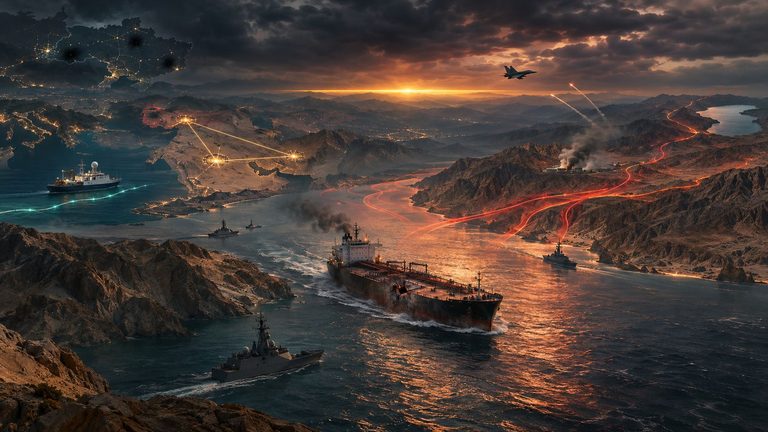
This week, the weight falls on the straits. Active theaters: the Gulf and the Strait of Hormuz · the Red Sea and Bab al-Mandab · eastern Ukraine and the Black Sea · Kordofan in Sudan · the fuel routes to Bamako · the Levant and the eastern Democratic Republic of the Congo. The parties in brief: At Hormuz, Iran, the United States, and Israel confront one another; in the Red Sea, Yemen’s Houthis face Saudi Arabia and the internationally recognized government; in Ukraine, Russia faces Kyiv and its NATO supporters; in Sudan, the army faces the Rapid Support Forces; in Mali, the junta faces the al-Qaeda-affiliated JNIM; in Gaza, Israel faces Hamas; and in the eastern Congo, the government faces M23 and Rwanda.
The connecting thread this week is siege warfare. At 6 places around the world, the objective is not to conquer territory, but to sever the supply artery: oil, fuel, grain, materiel. This is the economic logic of the chokepoint – whoever cuts the artery does not have to win a battle, but merely has to bleed the opponent dry. Besieging is cheaper than conquering and ties down fewer forces. A second theme runs beneath it: The same weapons are appearing on widely separated fronts. Turkish drones have surfaced this week in Mali, Sudan, and the Congo; the Emirates back 1 belligerent in Sudan, Iran backs 1 in Yemen, and Russia’s Africa Corps secures convoys in Bamako. What looks separate in separate countries is fed through the same channels. Together, the chokepoint logic and the arms flows form the lens through which to read this issue.
GULF & HORMUZ / RED SEA & BAB AL-MANDAB
HOUTHIS TAKE MOKHA – AND AN ISLAND AT THE STRAIT
On September 10, the Houthis captured the port city of Mokha on Yemen’s Red Sea coast, around 50 miles north of Bab al-Mandab. Following the withdrawal of government troops, the fighters advanced down the coast, took the town of Dhubab, and reportedly reached Perim Island at the southern entrance to the Red Sea – an advance several media outlets described as the movement’s largest territorial gain in years. Whoever holds Perim sits directly at the narrowest point of Bab al-Mandab, the passage between the Arabian Peninsula and the Horn of Africa that narrows to just 16 miles. Saudi Arabia subsequently struck Mokha airport, but failed to prevent the capture. An officer from the recognized government said Riyadh had apparently not received a green light from Washington for a large-scale air campaign. The Houthis are not an artificial Iranian creation: They control Yemen’s most populous region and, according to international estimates, govern about 66 percent of the country’s population. Readers seeking a closer understanding of the movement will find the background here: The Houthis.
PIPELINE HIT IN SAUDI ARABIA – RIYADH SHUTS IT DOWN
At almost the same time, drones launched from Iraq struck the East-West Pipeline, which carries crude oil from Saudi Arabia’s Eastern Province roughly 745 miles to the Red Sea port of Yanbu. A satellite image from September 11 shows fire damage along the route southeast of Medina. Riyadh said it shut the pipeline as a precaution. The incident is bitter for the kingdom in 2 respects: This pipeline is the very bypass intended to carry Saudi oil to the sea without relying on the Strait of Hormuz. Its shutdown constricts the only alternative route at the precise moment when the main route is already blocked – and shows that the war has long since spread beyond Yemen into the Saudi heartland.
OIL PRICE RISES, SAUDI SUPPLY FALLS
Brent crude climbed over the course of the week: close to 100 dollars on September 08 after Houthi strikes on Saudi oil facilities, above 108 dollars on September 10, and just over 107 dollars on September 11 following the fall of Mokha. The International Energy Agency reported that Saudi crude supply had fallen to its lowest level in more than 3 decades after the attacks. The connection is obvious, and for the attackers it is the entire point: Put the export routes of the world’s largest exporter under fire, and oil becomes more expensive for everyone – increasing the pressure on Washington, which fears the effect of higher prices at American gas pumps.
MBS ASKS, TRUMP REFUSES
Saudi Crown Prince Mohammed bin Salman pressed President Trump to order U.S. airstrikes against the Houthis. Trump declined direct military action. That refusal is the week’s central finding: The security guarantor on which Riyadh has relied for decades is holding back while the Houthis put 1 strait after another under pressure. For the Gulf monarchies, this sends a signal – the American umbrella cannot be taken for granted. The restraint also follows a calculation: A rising oil price benefits Gulf producers in the short term, while an American war against the Houthis would be expensive, domestically unpopular, and uncertain in outcome.
ANALYSIS – The Double Lock Tightens Further
The situation at the 2 straits is not a coincidence, but a mechanism. The Strait of Hormuz has been contested since the end of February; the United States struck tankers allegedly linked to the IRGC, while Iran redirected traffic onto routes it designated. Ships that took other routes came under fire, insurance premiums rose, and traffic thinned. The National described Hormuz and Bab al-Mandab as “sequential chokepoints along the same energy artery.” Bab al-Mandab is the second strait on that same artery. Around 12 percent of seaborne oil trade and approximately 30 percent of container traffic between Asia and Europe passes through the Red Sea-Suez Canal corridor; ships forced to divert must sail around the Cape of Good Hope, adding 10 to 15 days and substantially higher costs. If both chokepoints are threatened at once, the route breaks down from end to end. This interlocking system – Hormuz in the east, Bab al-Mandab in the west – was described here months ago as a scenario: Ground Troops and the Double Lock. This week, the scenario became reality.
The scale of a complete shutdown is difficult to overstate. The Federal Reserve Bank of Dallas estimated the net loss from a closure of Hormuz alone – after all pipeline alternatives are deducted – at 14.5 to 16.5 million barrels per day, 3 to 5 times the volume lost during the most severe oil shocks of the 1970s and 1990s. Japan, South Korea, and Taiwan depend on Middle Eastern oil for 90 to 95 percent of their supply; if Bab al-Mandab were lost, Europe would lose its only rapid maritime route to Asia. What is happening at the straits this week is therefore not a regional incident, but a test of the resilience of the global energy supply.
ANALYSIS – Direction or Independent Momentum?
How closely Tehran directs the Houthi advances is disputed, and we do not decide the question. Yemeni, Iranian, and regional sources told Reuters that the coastal advance had taken place under direct guidance from Iran’s Islamic Revolutionary Guard Corps; a U.S. representative at the United Nations called the Houthis tools of Iran. Houthi spokesman Mohammed Abdulsalam, by contrast, described the operations as defensive and said they would end when the attacks on Yemen ended. Other observers note that the movement has its own revenue, leadership, and interests and is not remotely controlled from Tehran. Coordination is probable; sole command from Tehran is not established. What is established is the effect: An actor at the edge of the world market is moving the oil price without possessing a fleet – asymmetric warfare hardly gets more asymmetric than that.
STRATEGIC OUTLOOK
On Monday, September 14, the foreign ministers of the Gulf states will meet with Iran and Iraq in Salalah, Oman – the first meeting in this format since the war began at the end of February. Oman and Iran had previously negotiated a preliminary arrangement for passage through Hormuz under which inbound ships use Iranian waters and outbound ships use Omani waters. The Gulf states, whose economies depend on the same artery, are apparently turning to direct talks after American pressure failed to end the crisis. Iran reportedly demands that ships obtain an Iranian transit permit and has tied the full reopening of the Strait of Hormuz to concessions from Washington – lifting the naval blockade, permitting oil exports, and granting access to frozen assets. A purely military outcome has therefore become less likely; the strait is becoming a bargaining chip. Until then, it remains a risk to the world economy, reflected in every tank of gasoline. The week demonstrates the limits of coercive logic: As long as the shooting continues, the price rises – and ultimately that price also reaches those who authorize the shooting. A separate, detailed analysis of the Yemeni-Saudi theater will appear shortly.

UKRAINE – RUSSIA
POKROVSK REMAINS THE HOTTEST SECTOR
The Ukrainian military reported 237 clashes along the front over the previous day, most of them in the Pokrovsk sector. In its September 07 assessment, the Institute for the Study of War recorded continuing Russian pressure toward Pokrovsk, but no confirmed major territorial gains. The front is grinding: considerable movement, little change. For months, this sector has tied down the largest concentrations of forces on both sides without producing a decisive shift in the line.
MASSIVE BOMBARDMENT, ODESA AT THE CENTER
During the night of September 12, a wave of missiles and drones struck several regions. Ukrainian authorities reported at least 11 dead and 96 wounded nationwide, with the Odesa region hit hardest – around 35 people were wounded there, including an infant. Additional deaths were reported in the Donetsk, Zaporizhzhia, and Dnipropetrovsk regions. According to the Ukrainian Air Force, Russia deployed 129 drones, 8 Kalibr cruise missiles, 6 Kh-59/69 guided missiles, and Iskander-M ballistic missiles that night. Residential buildings, industrial facilities, and port infrastructure were hit; according to its operator, the Zaporizhstal steel plant was struck by ballistic missiles for the third time within a month. In the Zaporizhzhia region alone, authorities recorded more than 1,000 attacks on 45 localities in a single day, including 5 missile strikes on the city itself.
KYIV ATTACKS THE “SHADOW FLEET”
At the same time, Ukraine is conducting a campaign against Russia’s so-called shadow fleet – the tankers Moscow uses to circumvent sanctions and secure oil revenues that help finance the war. Both sides now systematically target the other’s shipping and energy sector. For Kyiv, the shadow fleet is Moscow’s economic nerve: Every disabled tanker raises the cost of evading sanctions and reduces the revenue used to pay for missiles and drones.
ANALYSIS – 2 Accounts of the Same Attack
The night illustrates how differently the same event can be narrated. Kyiv describes civilian casualties and strikes on residential districts. The Russian Defense Ministry said its forces had hit the Zaporizhstal steel plant, ore-processing and metallurgical facilities in Kryvyi Rih, the Interpipe plant in Dnipro, and 2 cargo ships in the port of Chornomorsk that had allegedly delivered weapons to Ukraine. The plant operators Metinvest and ArcelorMittal rejected that account, saying the sites were civilian facilities with no military use. Neither account can be independently verified. We place them side by side and leave the judgment to the reader – the language of either side is not itself the finding.
ANALYSIS – The War Over the Artery
The direction in which the war is shifting is notable. The fight is no longer confined to villages along the front, but extends to energy, industry, and shipping. Russia strikes Ukrainian power plants and steelworks; Ukraine strikes Russian tankers and energy facilities deep in the rear. The Black Sea has therefore become this week’s fourth chokepoint at which supply itself is the battlefield – Ukraine’s grain and supply routes on 1 side, Russia’s oil revenues on the other. Striking the shadow fleet severs a financial artery; striking a steel plant severs an industrial one. It is the same logic as at Bab al-Mandab, applied with different means.
STRATEGIC OUTLOOK
As long as the front at Pokrovsk remains static, the center of gravity shifts into the rear – toward whatever keeps the opponent running. For civilians, that means rising casualties far from the actual line of contact. The shift toward energy, industry, and shipping hits civilians harder than the grinding positional war at the front because the targets lie amid populated areas. There is no prospect of negotiations in sight; both sides are trying to wear the other down economically before anything can be gained at the negotiating table. Winter, when energy infrastructure becomes the decisive target, has yet to begin.
SUDAN / KORDOFAN
EL-OBEID – THE CONTESTED GATEWAY TO KHARTOUM
This week, the focus is on el-Obeid, the capital of North Kordofan. The city connects the capital, Khartoum, around 340 miles to the northeast, with the vast Darfur region; it is home to the army’s 5th Infantry Division, an air base, an oil pipeline, and 1 of the country’s largest gum arabic markets. The army has now partially broken the months-long RSF siege, but the paramilitaries are waging a sustained drone campaign against the city and massing forces for another assault. If el-Obeid fell, it would open a direct RSF corridor to the capital and connect the group’s strongholds in the west with the center of the country.
FEAR OF A SECOND EL-FASHER
In July, the UN Human Rights Office warned of an impending “catastrophe” and said 500,000 people were trapped in el-Obeid. That figure dates from the summer; since then, the situation has shifted from a full siege to attrition from the air, but the source of the fear remains the same: el-Fasher. After the city fell in October 2025, an independent UN fact-finding mission concluded that the RSF had committed genocide there – UN documentation recorded more than 6,000 people killed in the first 72 hours alone, and the mission estimated that the true figure was substantially higher. Since April 2023, the war has killed an estimated 150,000 people and displaced more than 14 million – the world’s largest displacement crisis, described by the United Nations as the worst humanitarian crisis on Earth. The RSF is the institutional successor to the Janjaweed militias, which committed the first Darfur genocide between 2003 and 2005 – against the same ethnic groups, in the same region. Amnesty International called it “a stain on the conscience of humanity.” Readers seeking to understand the system behind Sudan’s war – who supplies, who buys, and who profits – will find the analysis here: Sudan – The Forgotten Massacre.
ANALYSIS – The Corridor Will Decide the War
Since the loss of Khartoum in spring 2025, Kordofan has become the decisive theater. The region is the land bridge between the RSF’s western strongholds and the country’s populous center. Whoever holds it can move supplies; whoever blocks it cuts the opponent off. Under this logic, el-Obeid is not merely a target, but a switch: If it falls, the geography of the war changes. That is precisely why the RSF does more than besiege the city; it strangles it – its supply routes, water, and electricity. Starving a city avoids a costly assault and often breaks resistance before the first storming operation begins. In el-Fasher, the massacre followed an 18-month siege – the same sequence now threatens farther east. It is the same method used in el-Fasher, where the massacre followed an 18-month siege. The United Nations’ warning that el-Obeid could become the next el-Fasher is therefore not rhetoric, but a description of the pattern.

ANALYSIS – The Flows from Outside
Sudan’s war cannot be understood without its external financiers. According to UN expert reports, human rights organizations, and Western intelligence services, the United Arab Emirates supplies weapons to the RSF – Abu Dhabi denies the allegation; Sudan has filed a case before the International Court of Justice alleging complicity in genocide. In 2023, the Emirates bought more than 99 percent of Sudan’s gold exports, and when the European Parliament sought to name the UAE as an arms supplier in a resolution, the reference was removed under pressure. Iran, Turkey, and Egypt support the army on the opposing side. The evidence and the logic of interests are set out in the analysis linked above. The key point for this update is that supply is once again being turned into a weapon, and arms move through the same channels that feed other fronts – Turkish technology appears in Sudan just as it does in Mali and the Congo. At the same time, the Emirates themselves sit at the table in the U.S.-led mediation format, the so-called Quad of the United States, the UAE, Saudi Arabia, and Egypt – as mediators, not as accused parties. Russia, meanwhile, is pursuing an objective of its own in Sudan: a naval base on the Red Sea coast that only the army-led government can grant. The war is therefore not merely a conflict over resources, but a stage on which several major powers secure their interests.
STRATEGIC OUTLOOK
The United Nations Security Council is once again addressing Sudan in its September forecast. No breakthrough is in sight. Every mediation process so far – Jeddah, Juba, and the Quad roadmap – has failed because none of the participants had a genuine incentive to comply. As long as no external actor pays a real price for its supplies – as long as gold flows unhindered and cargo flights land undisturbed – there is no structural incentive for peace. el-Obeid will show whether warnings of a second el-Fasher have consequences this time or whether what has already repeated itself once will repeat itself again.
SAHEL / MALI
THE BLOCKADE WITHOUT A FRONT CONTINUES
Since September 03, 2025, the al-Qaeda-affiliated JNIM has maintained a fuel blockade against southern Mali; open-source surveys report more than 300 tanker trucks destroyed. Mali is landlocked and imports around 95 percent of its fuel by road from Senegal and Côte d’Ivoire – whoever cuts those routes strangles the capital without firing a shot inside it. JNIM is not storming Bamako; it is demonstrating that it can dictate conditions around the city without holding territory. It is the same chokepoint logic as in the Red Sea, except that the burning tanker truck replaces the captured oil tanker. The blockade eased in early 2026, but on April 28 JNIM imposed a total blockade of Bamako that has remained in place ever since. Negotiations between intermediaries and the jihadists have made no progress.
The junta is keeping the city alive with armed convoys, supported by Russia’s Africa Corps and Turkish drones; since the end of October, open sources say more than 1,000 tanker trucks have made it through in convoys, a general was appointed specifically to command the “fuel war,” and schools were temporarily closed – yet the blockade has not been broken. A convoy attack in early February reportedly killed at least 15 people. Western governments have urged their citizens to leave. The entire Alliance of Sahel States – Mali, Burkina Faso, and Niger – is affected because its economic backbone depends on the same routes. Mali is therefore the third siege of the week following the same pattern: a front without a front line. Outlook: Without a political solution, Bamako will remain dependent on convoys; every disrupted route can tip the supply situation again.
LEVANT / GAZA
CEASEFIRE ONLY ON PAPER
On September 13, an Israeli strike on a vehicle in Gaza City’s Tal al-Hawa neighborhood killed 2 people and wounded 13. The Israeli military said it had targeted 2 members of a Hamas weapons-production unit, whose activities constituted a “systematic violation of the ceasefire.” The ceasefire brokered by the United States in October 2025 therefore exists in name only. According to Gaza’s Health Ministry, more than 1,000 people have been killed since it took effect; Israel has extended its control over around 11 percent of the territory beyond the agreed “Yellow Line.” Dozens of families have already been forced to leave their homes near that line; UN agencies warn that the continuing expansion endangers civilians and aid deliveries.
Strikes hit the Gaza Strip almost daily; according to Palestinian sources, around 2 million people are displaced, with much of the population crowded into the south. Gaza’s Health Ministry puts the total number of deaths in the war since October 2023 at more than 73,000. Israel says the attacks target Hamas; Palestinian authorities and aid organizations describe continuing attacks on civilians. Human rights organizations and UN bodies characterize Israel’s conduct as genocide – a characterization Israel rejects. We identify the positions and leave the judgment to the reader. Outlook: As long as Hamas remains armed and Israel continues its strikes, the underlying plan will remain blocked; the “ceasefire” is more label than reality.
DEMOCRATIC REPUBLIC OF THE CONGO
TURKISH DRONE STRIKES COALITION POSITION IN FIZI
In the country’s east, the fragile ceasefire between the government and M23 is barely holding. According to a report by the Critical Threats Project, M23 and Rwanda used a Turkish medium-range drone against a government-coalition position in Fizi Territory, South Kivu – striking a hotel where Congolese and Burundian officers were preparing an operation against the town of Minembwe. The Congolese military, for its part, said it had shot down a drone belonging to M23 and the Rwandan armed forces over the Fizi highlands on August 20. In early September, local media also reported that the continuing attacks had prevented thousands of children in Fizi from starting school.
On August 24, an international ceasefire-monitoring mission arrived in the country after the government and M23 agreed on a roadmap for peace talks the previous day. The process is based on a framework negotiated in November 2025, which both sides recently attempted to revive in Switzerland. Whether the ceasefire will hold remains open – the drone strikes of recent weeks suggest otherwise. M23 still holds the cities of Goma and Bukavu, each home to millions, after capturing them in early 2025; international observers say around 5 million people have been displaced. Whether Rwanda supports M23 is disputed between Kinshasa, the United Nations, and Western states on 1 side and Kigali on the other – Rwanda denies doing so. We state both positions. Outlook: The Turkish drone over Fizi is also the third appearance of the same weapon system on an African front within 1 week – after Mali and Sudan.
ON THE MARGINS – BRIEFLY NOTED
Myanmar. The civil war is deadlocked: The military controls only around 21 percent of the country, while resistance and ethnic forces control about 42 percent; more than 100,000 people have been killed and over 5 million displaced. After a multiphase election held between December 2025 and January 2026 that the United Nations and Western states criticized as a façade, junta leader Min Aung Hlaing became president in April 2026.
Haiti. The UN-mandated force fighting gangs in Port-au-Prince has deployed only around 1,000 of its planned 5,550 personnel; full strength is not expected before October, while the Security Council conducts its regular review this month.
WEEKLY CONCLUSION – OVERALL STRATEGIC ASSESSMENT
The week’s common denominator is found not along the front lines, but at the chokepoints. The same principle is being applied in 6 theaters: Territory matters less than the artery that supplies it. The Houthis are strangling shipping at Bab al-Mandab, Iran is constricting exports at Hormuz, JNIM is cutting Mali’s fuel supply on the roads from Senegal, the RSF is choking the corridor from Kordofan to Khartoum, and Russia and Ukraine are striking each other’s energy and supply routes around the Black Sea. An oil price above 108 dollars is the receipt proving that this logic works – siege warfare is effective, and it costs less than conquest.
The second observation is interconnection. Follow the threads and the same suppliers appear on widely separated fronts: Turkish drones in Mali, Sudan, and the Congo; the Emirates behind the RSF; Iran behind the Houthis; Russia’s Africa Corps in Bamako. What appears separate in separate countries belongs to a single market for influence and weapons. This interconnection is precisely what makes the individual conflicts harder to resolve: Whoever yields on 1 front weakens their position on another. It also explains why international mediation so often goes nowhere – the party expected to mediate is itself a belligerent elsewhere.
Who gains room to maneuver? This week, it is the actors who control a strait, road, or corridor without having to hold a state – the besiegers. Who loses? The powers whose security guarantees are reaching their limits: Washington, which refuses Riyadh the airstrikes it requested, and the international mechanisms managing ceasefires in Sudan, the Congo, and Gaza that exist on paper but fail in the field. In the coming weeks, attention should focus less on the shifting front lines than on the arteries behind them – which port, pipeline, or road will come under fire next. The outlook is sober: As long as cutting the artery remains cheaper than holding territory, wars will be fought through siege rather than conquest – and the next chokepoint is already in sight.
This publication answers to its readers – and no one else. Become a member for $5 or a patron for $15 per month, support genuinely independent journalism, and receive full access to all published analyses.

You are also welcome to support my work with a one-time donation.

About the Author
Michael Hollister
is a geopolitical analyst and investigative journalist. He served six years in the German military, including peacekeeping deployments in the Balkans (SFOR, KFOR), followed by 14 years in IT security management. His analysis draws on primary sources to examine European militarization, Western intervention policy, and shifting power dynamics across Asia. A particular focus of his work lies in Southeast Asia, where he investigates strategic dependencies, spheres of influence, and security architectures. Hollister combines operational insider perspective with uncompromising systemic critique – beyond opinion journalism. His work appears on his bilingual website (German/English) www.michael-hollister.com and in investigative outlets across the German-speaking world and the Anglosphere.
Independent geopolitical analysis requires time, sources and context. Receive the results regularly, directly in your inbox.
Sources
Gulf & Hormuz / Red Sea & Bab al-Mandab
- UPI, September 10, 2026 – “Iran-backed Houthis seize the port of Mokha on Yemen’s Red Sea coast”: https://www.upi.com/Top_News/World-News/2026/09/10/yemen-iran-houthis-seize-mokha-red-sea-port-city/4111789057598
- NPR, September 11, 2026 – “Iran-backed Houthi rebels seize a strategic port and island, opening a new battlefront”: https://www.npr.org/2026/09/11/g-s1-142822/houthis-red-sea-port
- The Times of Israel, September 12, 2026 – “Saudi Arabia shutters major oil pipeline struck by drones from Iraq”: https://www.timesofisrael.com/saudi-arabia-shutters-major-oil-pipeline-struck-by-drones-from-iraq/
- Al Jazeera, September 11, 2026 – “Saudi Arabia says East-West pipeline hit by drones launched from Iraq”: https://www.aljazeera.com/news/2026/9/11/saudi-arabia-says-east-west-pipeline-hit-by-drones-launched-from-iraq
- Al Jazeera, September 12, 2026 – “Saudi Arabia shuts critical oil pipeline after drone attack: What it means”: https://www.aljazeera.com/news/2026/9/12/saudi-arabia-shuts-critical-oil-pipeline-after-drone-attack-what-happened
- CNN Business, September 10, 2026 – “Global oil hits $108 per barrel while bond yields surge”: https://www.cnn.com/2026/09/10/investing/oil-iran-war-diesel
- Gulf News, September 11, 2026 – “Brent Crude Tops $107 as Houthis Seize Yemen’s Mokha Port”: https://gulfnews.com/business/energy/brent-crude-tops-107-after-houthis-seizure-of-mokha-near-bab-al-mandab-strait-1.500670457
- Quartz, September 08, 2026 – “Brent crude nears $100 as Houthi strikes hit Saudi oil sites”: https://qz.com/brent-crude-oil-prices-houthi-saudi-aramco-iran-090826
- Axios, September 11, 2026 – “Saudi crown prince urged Trump to strike Houthis amid Red Sea threat”: https://www.axios.com/2026/09/11/houthis-yemen-saudi-trump-mbs-strikes
- The Jerusalem Post, September 11, 2026 – “Donald Trump declines Saudi crown prince’s call for US strikes on Houthis”: https://www.jpost.com/middle-east/article-908366
- International Energy Agency, September 2026 – “Oil Market Report – September 2026”: https://www.iea.org/reports/oil-market-report-september-2026
- BOE Report, September 11, 2026 – “Saudi oil supply hits more than three-decade low after Houthi attacks, IEA says”: https://boereport.com/2026/09/11/saudi-oil-supply-hits-more-than-three-decade-low-after-houthi-attacks-iea-says/
- CBS News – “U.S. forces hit IRGC-linked oil tankers as oil nears $100”: https://www.cbsnews.com/live-updates/iran-war-us-strait-of-hormuz-oil-gas-price-strikes/
- Al Jazeera, September 11, 2026 – “Iran and Gulf states to discuss Strait of Hormuz in Oman on Monday”: https://www.aljazeera.com/news/2026/9/11/iran-says-will-discuss-strait-of-hormuz-with-gulf-states-on-monday
- Michael Hollister, July 03, 2026 – “The Houthis”: https://www.michael-hollister.com/de/2026/07/03/die-huthis/?utm_source=newsletter&utm_medium=konflikt-update&utm_campaign=KU-kw37
- Michael Hollister, July 18, 2026 – “Iran Insight: Ground Troops and the Double Lock”: https://www.michael-hollister.com/de/2026/07/18/iran-insight-bodentruppen-und-das-doppelschloss-2/?utm_source=newsletter&utm_medium=konflikt-update&utm_campaign=KU-kw37
Ukraine – Russia
- Ukrinform, September 12, 2026 – “War update: 237 clashes on front lines, enemy most active in Pokrovsk sector”: https://www.ukrinform.net/rubric-ato/4163385-war-update-237-clashes-on-front-lines-over-past-day-enemy-most-active-in-pokrovsk-sector.html
- Institute for the Study of War / Critical Threats, September 07, 2026 – “Russian Offensive Campaign Assessment, September 7, 2026”: https://www.criticalthreats.org/analysis/russian-offensive-campaign-assessment-september-7-2026
- Kyiv Independent, September 12, 2026 – “Russian attacks kill 11, injure 96 across Ukraine as Odesa comes under mass overnight strike”: https://kyivindependent.com/russian-attacks-kill-11-injure-96-across-ukraine-as-odesa-comes-under-mass-overnight-strike/
- Euronews, September 12, 2026 – “At least 11 killed in Russian attacks on Ukraine as Kyiv strikes Russia’s ‘shadow fleet’”: https://www.euronews.com/my-europe/2026/09/12/at-least-11-killed-in-russian-attacks-on-ukraine-as-kyiv-strikes-russias-shadow-fleet
- Bloomberg / The Spokesman-Review, September 12, 2026 – “Russia hits Odesa again as Black Sea shipping disrupted”: https://www.spokesman.com/stories/2026/sep/12/russia-hits-odesa-again-as-black-sea-shipping-disr/
Sudan / Kordofan
- Middle East Eye, September 2026 – “RSF drone strikes shatter sense of optimism in Sudan’s el-Obeid”: https://www.middleeasteye.net/news/rsf-drone-strikes-shatter-sense-optimism-sudans-el-obeid
- Al Jazeera, July 06, 2026 – “El-Obeid under siege by RSF: Could this be Sudan’s next el-Fasher?”: https://www.aljazeera.com/news/2026/7/6/el-obeid-under-siege-by-rsf-could-this-be-sudans-next-el-fasher
- Security Council Report, September 2026 – “Sudan, September 2026 Monthly Forecast”: https://www.securitycouncilreport.org/monthly-forecast/2026-09/sudan-41.php
- Amnesty International, July 2026 – “Sudan: RSF atrocities in El Fasher ‘a stain on the conscience of humanity’”: https://www.amnesty.org/en/latest/news/2026/07/sudan-rsf-atrocities-in-el-fasher-a-stain-on-the-conscience-of-humanity-new-report/
- Council on Foreign Relations, Global Conflict Tracker – “Civil War in Sudan”: https://www.cfr.org/global-conflict-tracker/conflict/power-struggle-sudan
- Michael Hollister, April 19, 2026 – “Sudan – The Forgotten Massacre”: https://www.michael-hollister.com/de/2026/04/19/sudan-das-vergessene-massaker/?utm_source=newsletter&utm_medium=konflikt-update&utm_campaign=KU-kw37
Sahel / Mali
- RFI / AllAfrica – “Mali Under Pressure to End Fuel Crisis As Negotiations With Jihadists Stall”: https://allafrica.com/stories/202510100237.html
- Bellingcat / ACLED – “Mali under siege: Tracking the fuel blockade crippling Bamako”: https://acleddata.com/media-citation/mali-under-siege-tracking-fuel-blockade-crippling-bamako-bellingcat
- The Ops Con, July 25, 2026 – “Mali: Bamako still moves on escorted fuel convoys as JNIM keeps the blockade on”: https://theopscon.com/intelligence/threat-level-mali-bamako-fuel-siege-convoys-2026-07-19
Levant / Gaza
- Haaretz, September 13, 2026 – “Two Killed, 13 Wounded in Israeli Strike in Gaza City, Palestinian Medics Say” (live coverage): https://www.haaretz.com/israel-news/israel-security/2026-09-13/ty-article-live/saudi-arabia-says-houthi-attack-wounds-two-damages-mosque/000001a0-9785-dfa9-ada3-dfc708db0004
- Al Jazeera, September 13, 2026 – “Israeli attack on Gaza kills two Palestinians”: https://www.aljazeera.com/news/2026/9/13/israeli-attack-on-gaza-kills-two-palestinians
- Al Jazeera, July 08, 2026 – “Israeli air strikes in Gaza kill eight, including two children”: https://www.aljazeera.com/news/2026/7/8/israeli-air-strikes-in-gaza-kill-eight-including-two-children
- WAFA, September 08, 2026 – “Israeli strikes kill Palestinian, injure 15 others across Gaza Strip”: https://english.wafa.ps/Pages/Details/174561
Democratic Republic of the Congo
- Critical Threats, September 04, 2026 – “Congo War Security Review”: https://www.criticalthreats.org/briefs/congo-war-security-review
- Radio Okapi, August 20, 2026 – “Un drone de l’AFC/M23 abattu par les FARDC à Fizi”: https://www.radiookapi.net/2026/08/20/actualite/securite/un-drone-de-lafc-m23-abattu-par-les-fardc-fizi
- Al Jazeera, August 24, 2026 – “Ceasefire monitoring mission arrives in DRC”: https://www.aljazeera.com/news/2026/8/24/ceasefire-monitoring-mission-arrives-in-democratic-republic-of-congo
- Al Jazeera, August 23, 2026 – “DR Congo, M23 rebels agree on roadmap for peace talks”: https://www.aljazeera.com/news/2026/8/23/dr-congo-m23-rebels-agree-on-roadmap-for-peace-talks
- Council on Foreign Relations, Global Conflict Tracker – “Conflict in the DRC”: https://www.cfr.org/global-conflict-tracker/conflict/violence-democratic-republic-congo
On the Margins
- Council on Foreign Relations, Global Conflict Tracker – “Civil War in Myanmar”: https://www.cfr.org/global-conflict-tracker/conflict/rohingya-crisis-myanmar
© Michael Hollister – All rights reserved. Redistribution, publication or reuse of this text requires express written permission from the author. For licensing inquiries, please contact the author via www.michael-hollister.com.