by Michael Hollister
Published at GlobalBridge on August 28, 2026
4.314 words * 23 minutes readingtime
Briefing Format of the In-Depth Analysis – 10 minutes readingtime:
What Washington Is Really Doing About China’s Oil Clearing Market – and Where It Looks Away
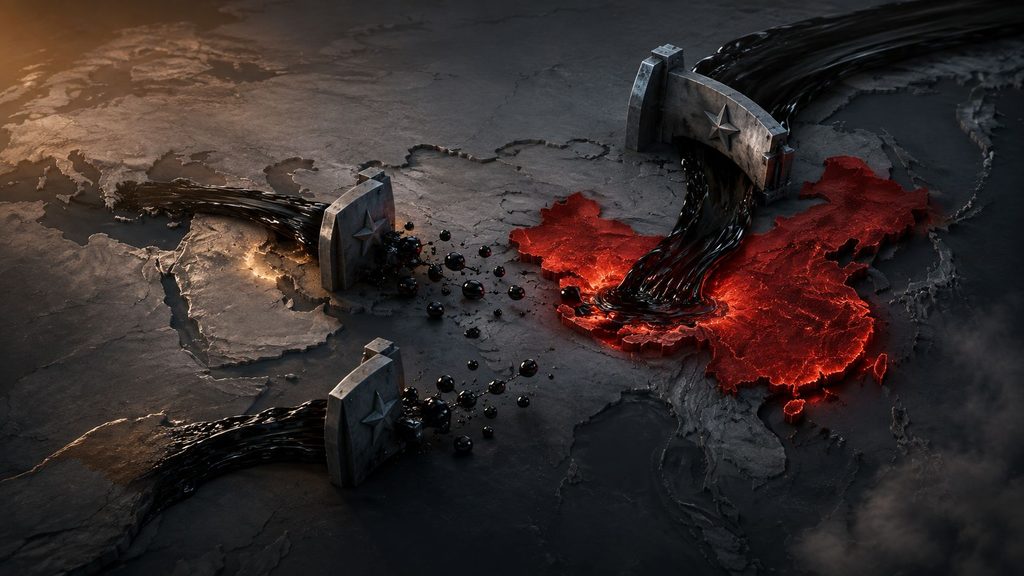
Understand what lies behind the headlines.


Article status: August 19, 2026. The volume data used here reflect conditions in July / early August 2026. The “Lindsey O. Graham Sanctioning Russia and Iran Act of 2026” passed the U.S. Senate on August 7, 2026; as of publication, a House vote remains pending (Congress returns on August 31), as does presidential signature. The U.S. naval blockade of Iranian ports has been back in force since mid-July. This is a moving field – the House vote at the end of August will sharpen the picture, and an update will be added here.
Off Kharg Island in the northern Persian Gulf, ships have been sitting at anchor for weeks without loading. From July 31 through August 11, analytics firm Vortexa recorded no departures at all from the terminal through which roughly 90 percent of Iran’s crude exports are shipped. The western loading berth stood empty for 25 days, beginning July 18; the liquefied-gas terminal and eastern jet were idle for almost as long. Sixteen to seventeen “dark” tankers waited offshore with their transponders switched off. Only on August 12 did a single crude carrier, roughly 1,093 feet long, berth at the western jetty and begin loading – the first such loading after 25 days of standstill (Windward; Windward; The National).
That image – a single ship loading against a forest of waiting tankers – is the exact counterpoint to a thesis a U.S. congressional investigation put into circulation in the spring: China had become the world’s “clearing market” for sanctioned oil, the central destination for crude from Iran, Russia, and Venezuela. Four months later, the data show a different picture. Of the three inflows feeding that clearing market, two have been badly damaged – and the largest of the three is still running at a multibillion-dollar scale. Enforcement does not follow outrage. It follows power.
The report and its direction
The source of the clearing-market thesis is the investigation Crude Intentions: How China Became the Clearing Market for Sanctioned Oil, published on March 31, 2026, by the House Select Committee on the Chinese Communist Party under Republican Chairman John Moolenaar; the committee’s ranking member is Democrat Raja Krishnamoorthi. The report’s tone leaves little doubt about its direction: its executive summary speaks of “mass graves,” “torture chambers,” and governments it portrays as dangerous adversaries – this is a document with a clear political purpose, not a neutral assessment. Alongside it sits a second congressional text that reinforces the same case: the staff report China’s Facilitation of Sanctions and Export Control Evasion by the U.S.-China Economic and Security Review Commission, dated November 14, 2025, which explicitly states that publication does not necessarily imply endorsement by the Commission itself. Both are positions from a party to the conflict, not from an arbiter – and they are treated here accordingly.
The logic behind the trade is stated openly in the report, and it is more sober than the rhetoric surrounding it: oil-exporting authoritarian states depend on export revenue. Russia’s energy exports generated roughly $120.5 billion in 2024, around 30 percent of government revenue; Iran’s oil income is projected at $50.56 billion for 2025, nearly 35 percent of the national budget; Venezuela was similarly dependent on crude as its principal source of hard currency. That is precisely the dependency the United States and its allies sought to target by trying to make every sanctioned barrel impossible to finance. Yet the revenue continued to flow, the report argues, because at the far end of nearly every chain stood a single buyer: China.
The headline figure in the report requires precision. Seized shadow-fleet tankers had delivered 69.3 million barrels of sanctioned crude worth nearly $4 billion to China before U.S. intervention. But that figure comes from exactly nine ships seized by U.S. forces between December 2025 and February 2026, and it aggregates their cargoes over the entire period from 2013 through 2025. The report itself calculates that China imported roughly 8.16 billion barrels from the three countries over those twelve years – meaning the nine vessels accounted for “less than one percent” of the trade. The $4 billion figure is a sample, not a current flow. The more useful order of magnitude appears elsewhere in the report: sanctioned crude from Iran, Russia, and Venezuela had recently accounted for roughly one-fifth of China’s total oil imports.
Two breakpoints, not one
The mechanism described by both reports is familiar – the Atlantic Council, Middle East Institute, and U.S. Treasury alerts have all mapped it in detail. What the congressional report does unusually clearly, however, is identify two breakpoints at which Western enforcement is meant to bite: the origin of the cargo and the settlement of value.
On the cargo side, origin is erased. Tankers in a parallel “shadow” or “dark” fleet conduct ship-to-ship transfers at sea, with major clusters off the Malaysian coast. Certificates of origin, bills of lading, and cargo manifests are then reissued to remove the sanctioned provenance; Iranian oil loaded at Kharg becomes “Oman Blend” or “Malaysian Light” on paper. Transponders go dark, flags change, ship identities are manipulated. According to Kpler figures cited in the report, the fleet numbered roughly 2,291 tankers in March 2026, about 16.8 percent of all active commercial wet-cargo vessels above 5,000 gross tons. The destination region is Shandong Province.

China’s connection to the fleet extends beyond demand alone. The committee points to the so-called Protean Fleet, a network of 56 supertankers that, according to the Center for Advanced Defense Studies cited in the report, is controlled by a single China-based ownership group through 117 shell companies and 74 proxy directors. Between July 2019 and 2024, those vessels shipped more than 400 million barrels of sanctioned crude to China and India. Among the nine tankers interdicted between December 2025 and February 2026 – names including Skipper, Centuries, and Veronica III – the committee counted nearly 200 separate evasion incidents: transponders switched off, spoofed location signals, covert transfers at sea, and calls at sanctioned ports. Seven of the nine were owned or operated by firms based in Hong Kong, mainland China, or Russia. The pattern, the report argues, was not a series of isolated lapses but a coordinated ownership and management architecture.
On the value side, payment is obscured. The buyers are the “teapots,” small independent refineries in Shandong optimized for the heavy, high-sulfur grades from Iran, Venezuela, and Russia – precisely the barrels sanctions have made untouchable for many buyers and therefore especially cheap. Payment is made largely in renminbi, outside the dollar-based banking system. The USCC report names the Bank of Kunlun, already sanctioned by the United States in 2012, as one node through which part of Iran’s proceeds move, alongside a web of provincial banks, money exchanges, and front companies, many based in Hong Kong. Both reports also stress that the system is not airtight: where counterparties need hard currency, dollar dependence reappears at the margins.
Why Beijing built it: reserve and backbone
Before the flows split apart, it is worth looking at the motive, because it explains why Beijing accepts the risk of this trade in the first place. China’s strategic vulnerability is that of an importer: roughly 70 percent of its oil comes from abroad, much of it along sea routes on which U.S. and allied navies could exert pressure in a crisis – a weakness highlighted by Russia’s invasion of Ukraine and one Beijing fears could be exposed in a Taiwan scenario. Chinese leaders have therefore declared energy security “an urgent requirement in great-power competition”; Xi Jinping has instructed the country to keep its “energy rice bowl” firmly in its own hands.
In that calculation, the clearing market becomes a stockroom. According to Kpler estimates cited by the committee, China held roughly 1.2 billion barrels of onshore crude in early 2026 – a record equivalent to about 109 days of seaborne import cover, built to a significant extent from the discounted barrels Western sanctions were designed to strand. The report puts the discount alone at $12 billion to $15 billion in 2024, flowing directly into Chinese refiners’ balance sheets. The U.S. Energy Information Administration described China’s 2025 stockbuilding as a “secondary source of demand” that absorbed a substantial share of additional OPEC+ supply. Unlike the United States, China publishes little data on the size or purpose of its reserves – an opacity that makes any turn in Chinese purchasing difficult for the global market to anticipate.
The Russian case at the end of 2025 showed in fast motion how Beijing pushes down the price. Rather than stepping in immediately, China allowed unsold cargoes to accumulate in floating storage and the discount on Russia’s Urals grade to widen to almost $20 a barrel; only when Russia had little bargaining room left did Chinese volumes rise again. The seller’s predicament becomes China’s discount – and the narrower Western enforcement makes the circle of available buyers, the greater Beijing’s leverage.
The dependency also has a technical layer. In Finding 6, the report argues that China built the shadow fleet its own navigational backbone: BeiDou, China’s global satellite navigation system, integrated with Russia’s GLONASS – one component of the “no limits” partnership announced in February 2022. Iran signed a comparable BeiDou agreement in 2021 and expanded military access after severe GPS interference during the Twelve-Day War in June 2025. Anyone moving sanctioned oil has reason not to depend on Western-controlled navigation. Step by step, an infrastructure emerges in which Iran and Russia outsource not only part of their revenue stream, but also navigation and coordination, to Beijing.
The split: three flows, three findings
The real insight lies not in the mechanics but in the present. The three inflows that the congressional report groups together are running very differently in the summer of 2026 – and that divergence is the central finding.
Iran. Before the war, China bought roughly 1.4 million barrels of Iranian crude per day. For Iran, that customer is existential: China takes about 90 percent of Iranian oil exports and, according to the USCC report’s estimate, thereby finances roughly 45 percent of Iran’s government budget. After the blockade was reinstated in mid-July, China’s Iranian imports had fallen in early July to 556,000 barrels per day, the lowest level since January 2023. Then Kharg stopped loading. What was still being transferred off Malaysia and discharged in Shandong during this period largely came from cargoes that had escaped the Gulf before the renewed blockade. The defensible formulation is therefore this: continuous new Iranian-Chinese trade has been broken for now and reduced to isolated attempts to get cargoes through. Richard Bronze, head of geopolitics at Energy Aspects, described the blockade as “effective” in the narrow sense of leaving almost no tanker traffic, while expecting no immediate pressure on Tehran because the Iranian leadership viewed itself as holding the advantage in the Gulf (The Jerusalem Post, citing the Financial Times). Iran is also adapting: through the North Larak anchorage and increasingly through the Caspian route, where Russian wet-cargo deliveries to Iran nearly tripled after the February blockade. The circumvention architecture still exists – but the flow has been throttled.
Venezuela. In 2025, according to internal PDVSA documents, an average of 642,000 barrels per day still went to China, three-quarters of all Venezuelan oil exports. In July 2026 Venezuela was again exporting 1.16 million barrels per day – but under a new order. Some 786,000 barrels went to the United States, the highest level since early 2019; the country that imposed the blockade had become Venezuela’s biggest customer (BOE Report / Reuters; The Rio Times). About 293,000 barrels of that volume came from Chevron’s joint venture with PDVSA; the rest was shipped by trading houses including Vitol, Trafigura, and Novum Energy. The flow has operated under a different framework since Washington, following the January naval blockade and the detention of President Nicolás Maduro, struck a production arrangement with the interim government under Delcy Rodríguez that redirected Venezuelan oil through trading firms to the United States, Europe, and India (Reuters via Yahoo Finance). Traders most recently disguised older China-bound cargoes as Brazilian “mixed bitumen,” in some cases using spoofed tanker signals to simulate loading in Brazil – so that less than 10 percent of the Venezuelan oil actually arriving in China appears as Venezuelan in Chinese customs data. For China and all other destinations combined, no more than roughly 114,000 barrels per day remained in July on a simple arithmetic basis. The Chinese channel has fallen by at least four-fifths. Washington did not stop the flow – it took it over.
Russia. Here the opposite is true. The July report from the independent Centre for Research on Energy and Clean Air identifies China as the world’s largest buyer of Russian fossil energy: 43 percent (€7.7 billion) of Russian export revenue from the five largest buyers, including €5.4 billion from crude oil alone. Chinese landings of seaborne Russian crude rose 28 percent from June; Russia’s share of China’s seaborne crude imports climbed to 25 percent, from 13 percent a year earlier (CREA). That works out to roughly 1.74 million barrels per day – about a quarter of China’s total seaborne oil supply. China is therefore by far Russia’s largest crude customer: after the price cap was introduced, Russian oil overtook Saudi crude in 2023 as China’s largest source, and in 2024 averaged 2.2 million barrels per day, or 21.5 percent of Chinese imports. Sixty-two percent of Russian crude moved in July aboard already sanctioned shadow tankers; Russia is also diverting cargoes through the Arctic Northern Sea Route (KSE Institute). A legal qualification matters here: not every Russian barrel is illegal. Under the Western price-cap framework, Russian oil can legally be transported using Western services if it is sold and documented at or below the cap. Crude Intentions itself acknowledges in a footnote that “sanctioned” in this context is an origin-based tracking category, not a single uniform legal designation. The clean term is therefore Russian oil subject to the Western sanctions and price-cap framework. But it is flowing, at a multibillion-dollar scale, and adapting its routes.
The asymmetry: two instruments, one blind spot
That raises the question muted by the report’s three-part framing: Why do two flows break while the third does not? The answer lies in two different enforcement instruments – and in where Washington applies them.
Against Iran and Venezuela, physical interdiction works. A naval blockade shuts down Kharg; tanker seizures and a U.S.-controlled sales framework displace China from the Venezuelan market. Both work where China is not the load-bearing wall: Iranian terminals and Venezuelan ports can be controlled off their own coasts without directly confronting China.
Russian oil is different because China is the principal buyer – and the instrument is not a warship but a tariff. This is where the blind spot opens. India, the second-largest buyer of Russian oil, was hit: by presidential order, the United States imposed an additional 25 percent tariff in August 2025, bringing the combined rate to 50 percent, explicitly because of India’s Russian oil purchases (Associated Press via Barchart). India is vulnerable to that pressure: it imports more than 88 percent of its crude needs, more than half now from Russia – and despite the tariffs, Indian imports from Russia rose in June and July 2026 to a record of roughly 2.7 million barrels per day. China, by contrast, was explicitly spared on this track; the order excluded it. Beijing remains under the U.S.-China trade truce extended in November 2025 through November 10, 2026, with a baseline tariff rate of roughly 30 percent – and without India’s Russia surcharge (Congressional Research Service). The USCC report puts the core point unambiguously: “To date, the United States has refrained from sanctioning any Chinese banks or financial institutions for facilitating payments for Russia.” When the EU sanctioned two small Chinese regional banks in July 2025, Beijing retaliated with sanctions on two small Lithuanian banks – a largely symbolic move that nevertheless showed China’s willingness to strike back.
The instrument that would target the Russian-Chinese flow is stuck in the legislative process. The “Lindsey O. Graham Sanctioning Russia and Iran Act of 2026” passed the Senate on August 7, 2026, by 86 votes to 11. It authorizes the president to impose tariffs of up to 100 percent on the five largest buyers of Russian energy – China, India, Azerbaijan, Hungary, and Slovakia – with a presidential waiver provision (CSIS; Al Jazeera). It is not yet in force: the House will not vote until after August 31, and the bill would then require the president’s signature. As of August 18, 2026, it is authority waiting to be granted, not a measure already imposed.
Why the buyer that can be pressured is hit while the one that cannot be pressured as easily is spared is a question of interests, not an allegation about motives. China holds leverage India does not: dominance in rare earths, interdependence under the trade truce, and its own willingness to retaliate. The price cap is also largely ineffective on the China route – ESPO crude sold into China consistently trades above the cap, supported by Pacific demand. Those adopting the U.S. government’s perspective will interpret the restraint as graduated pressure: weaker links first, the truce with Beijing as de-escalation, the Graham Act as a threat held in reserve. The finding remains the same: Washington interdicts where China is weak and hesitates where China is strong.
The tool bites – where it is applied
The proposition that tougher pressure on China would have an effect is not theoretical; the record shows it. When OFAC sanctioned Gazprom Neft and Surgutneftegas on January 10, 2025, together with 183 shadow-fleet tankers, China’s Russian oil imports fell by a little over 9 percent in the following months, and Chinese state-owned companies pulled back for fear of secondary sanctions – until state-owned Sinopec returned in April 2025 and volumes rose again. When OFAC sanctioned Russia’s two largest oil companies, Rosneft and Lukoil, on October 22, 2025, China’s major state firms immediately suspended seaborne purchases from Russia; consultancy Rystad estimated the decline at roughly 400,000 barrels per day, as much as 45 percent of Chinese imports from Russia.
On the Iranian track, Washington has already taken the next step and targeted the Chinese buyer itself. In 2025 OFAC sanctioned individual teapot refineries directly for the first time – among them Shandong Shengxing Chemical, accused of purchasing more than $1 billion in Iranian crude, following an earlier designation of Shandong Shouguang Luqing Petrochemical. The agency also moved against an Iranian front network centered on the Sepehr Energy Jahan Group, described as a front company for Iran’s General Staff with shipping and buyer structures in China and Hong Kong. For Iranian oil, then, Washington reaches into the Chinese refinery and into the Chinese payment chain; for Russian oil, enforcement has so far stopped at the Chinese border. The asymmetry repeats itself on a smaller scale: the same agency, the same instruments, but a very different willingness to use them against China depending on which oil is in the tank. Economically, that is explicable. Secondary sanctions on Chinese banks handling Russia-related trade would immediately hit the fragile trade truce and China’s control over rare-earth supply chains; the Iranian trade offers smaller, more isolatable targets without a comparable escalation risk.
Yet the same limitation appeared both times: state-owned companies retreated, teapots kept buying, and within months the networks had reorganized. The USCC report draws two lessons that restrain each other. First: secondary measures bite when they are applied – the curve falls measurably each time. Second: against an actor as deeply integrated into trade and the financial system as China, isolated pinpricks dissipate unless followed by sustained, broad enforcement. That is precisely why the tariff track – a broad and durable lever – is decisive. And that is the track Washington has not yet used against China.
The yuan trap: lifeline or leash?
The remaining question is what the surviving Russian flow means for the parties involved. This is the geopolitical core – and it turns the clearing-market narrative on its head. Selling sanctioned oil to China does not simply rescue the seller; it binds the seller to China.
The Iranian case shows the mechanism most clearly because both congressional reports spell it out. A substantial share of Iranian proceeds never leaves China at all. Chinese buyers route payments through a financial institution called Chuxin, which in turn pays Chinese construction companies to build airports, refineries, and roads in Iran – backed by state credit insurer Sinosure, administered by China’s Ministry of Finance. Roughly $8.4 billion moved through this barter-like arrangement in 2024. Put plainly: Iranian oil revenue becomes Chinese-built infrastructure on Iranian soil, financed with Chinese state insurance. That is not a lifeline. It is a leash.
The rest of the Iranian proceeds moves through a shadow banking system mapped in a USCC report graphic: teapot refineries pay renminbi to front companies affiliated with Iran’s Ministry of Defense; from small provincial banks, the money moves to larger institutions with Hong Kong subsidiaries. In 2023 Iran imported $10 billion worth of goods from China while accumulating an estimated $43 billion in renminbi that it sought to convert through the system into dollars or euros – funds that, according to the report, help finance the Islamic Revolutionary Guard Corps, Hezbollah, and Hamas, among others. Whether Iran can actually use those balances freely is the key question: because the renminbi is subject to capital controls and is not freely convertible, part of the balance accumulates as “fenced-in” money that can in practice be spent only back in China.
Russia’s situation is similar, though more recent. More than 90 percent of Russia-China trade, now worth $245 billion, is settled in rubles and renminbi; sanctioned Russian banks built the “China Track” netting system to offset payments in both directions through third countries without SWIFT. The other side of the dependency extends beyond money: China is also Russia’s crucial supplier of dual-use technology – according to the USCC, it exported more than $300 million per month in “high-priority” goods in 2024 that help sustain Russian military production. The surviving oil channel therefore finances trade that also binds Russia technologically more tightly to Beijing. Economist Elina Ribakova of the Peterson Institute summarized the logic in testimony: accepting a major role for a foreign, capital-controlled currency “indicates a position of weakness.” The one strand of the clearing market that still holds is binding the supplier more tightly to Beijing.
Whether China centrally directs this structure is the point at which caution is required. Finding 5 of Crude Intentions notes that two cities roughly 1,240 miles apart – Wenling in Zhejiang and Suifenhe in Heilongjiang – issued nearly identical instructions in the summer of 2025 on “new trade settlement methods” for trade with Iran and Russia, including matching references to Sinosure. From this, the committee infers central coordination. In the same breath, however, it acknowledges that “no corresponding central directive has surfaced in the public record.” Anyone familiar with China’s cadre system may regard the inference as plausible: provincial leaders do not operate autonomously; they are measured against concrete results and closely monitored by the center. What is documented is provincial facilitation; knowing central tolerance is a plausible inference; a central directive is not documented. China tolerates and enables, the provinces facilitate – central direction remains a reasoned inference, not proof.
What the report proves – and what it does not
An article built on two congressional sources has to expose their limits or it simply inherits their direction. Three points matter.
First, the numbers. The 69.3 million barrels came from nine ships over twelve years and, by the report’s own calculation, account for less than one percent of the trade. The report explicitly examines oil flows before February 28, 2026, and itself acknowledges that the value of China’s shadow-fleet infrastructure has sharply diminished since the Iran war. Reading the $4 billion figure as a current flow misreads the source.
Second, the crews. Finding 8 says shadow-fleet tankers carry Chinese and Russian military and intelligence personnel. The Russian side is concretely documented – not only by the committee but by independent investigations by OCCRP, the Dossier Center, and AFP: named vessels such as the Phoenix and Qendil, with former Wagner fighters or suspected members of Russia’s GRU military intelligence service aboard. The report itself offers two interpretations: protection against piracy and interdiction in dangerous waters such as the Gulf of Aden and the Strait of Malacca, on the one hand, and an instrument of state power on the other. On the Chinese half of the claim, however, the committee explicitly concedes that “Chinese personnel have not been identified with comparable specificity.” We adopt neither interpretation – and treat the Chinese attribution for what it is in the report: unproven.
Third, perspective. Both reports are products of one side in the conflict. Crude Intentions speaks the language of its mandate; the USCC text is a staff report without Commission endorsement. Their current diagnosis carries weight not because of institutional authority, but because independent data providers – CREA, Kpler, Vortexa, and Windward – measure the same flows. Remarkably, the congressional report also documents the collapse itself in its final section. After Maduro’s detention on January 3 and the U.S.-Israeli strikes on Iran on February 28, 2026, Brent surged from $71 to nearly $120 a barrel, according to the report; the International Energy Agency released 400 million barrels from emergency reserves – the largest coordinated draw in its history – while China banned fuel exports and cut Sinopec refinery runs by 10 percent. In that squeeze, India moved faster: after Washington issued a 30-day waiver, Indian refiners bought almost 30 million barrels within days and overtook China with a record 2.07 million barrels per day. Our finding therefore does not contradict the report – it carries the report forward with the July data.
Finding
Washington has not destroyed China’s clearing market for sanctioned oil, but it has knocked down two of its three pillars – precisely where China is not the load-bearing wall. Venezuela now ships predominantly under a U.S.-controlled sales framework, and its largest customer is the United States itself. Iran’s export terminals stood idle for weeks, and new outbound flows have been reduced to isolated attempts to break through. Only the Russian stream continues at a multibillion-dollar scale – because the instrument that would hit it is a tariff still pending in Congress, because that tariff has so far struck the more pressure-sensitive buyer, India, rather than China, and because the price cap largely bounces off Pacific demand for ESPO crude.
The map of enforcement overlaps with the map of Chinese power. The finding is that the United States can break flows where China is weak and hesitates where China is strong. Whether that reflects a deliberate strategy or simply the physics of what is feasible remains an open question – and one the reader can answer. At the end of August, when the House votes on the Graham Act, it will become clearer whether Washington is prepared to touch the last flow where doing so is uncomfortable. Until then, the simplest sentence about this trade remains: Do not listen to what they say – watch what they do.
Published at GlobalBridge on August 28, 2026
Keep independent analysis independent. Your membership helps finance careful research, primary-source work, and journalism free from advertisers and institutional influence. Join from $5 per month – cancel anytime.

About the Author
Michael Hollister
is a geopolitical analyst and investigative journalist. He served six years in the German military, including peacekeeping deployments in the Balkans (SFOR, KFOR), followed by 14 years in IT security management. His analysis draws on primary sources to examine European militarization, Western intervention policy, and shifting power dynamics across Asia. A particular focus of his work lies in Southeast Asia, where he investigates strategic dependencies, spheres of influence, and security architectures. Hollister combines operational insider perspective with uncompromising systemic critique – beyond opinion journalism. His work appears on his bilingual website (German/English) www.michael-hollister.com and in investigative outlets across the German-speaking world and the Anglosphere.
Sources
Primary Sources – U.S. Congress
- House Select Committee on the Chinese Communist Party, March 31, 2026 – Crude Intentions: How China Became the Clearing Market for Sanctioned Oil (full report): https://chinaselectcommittee.house.gov/sites/evo-subsites/selectcommitteeontheccp.house.gov/files/evo-media-document/crude-intentions_final.pdf
- House Select Committee on the CCP, March 31, 2026 – Select Committee Investigation Uncovers How China Evades Sanctions to Buy Crude from Iran, Venezuela, and Russia (press release): https://chinaselectcommittee.house.gov/media/press-releases/select-committee-investigation-uncovers-how-china-evades-sanctions-to-buy-crude-from-iran-venezuela-and-russia
- U.S.-China Economic and Security Review Commission (Ayres/Tsering), November 14, 2025 – China’s Facilitation of Sanctions and Export Control Evasion (staff report): https://www.uscc.gov/sites/default/files/2025-11/Chinas_Facilitation_of_Sanctions_and_Export_Control_Evasion.pdf
Independent Data and Maritime Intelligence
- Centre for Research on Energy and Clean Air (CREA), August 13, 2026 – July 2026 – Monthly Analysis of Russian Fossil Fuel Exports and Sanctions: https://energyandcleanair.org/july-2026-monthly-analysis-of-russian-fossil-fuel-exports-and-sanctions/
- Windward, August 2026 – Kharg Is at a Standstill, and a Russian Shadow Fleet Convoy Runs the Arctic: https://windward.ai/blog/kharg-standstill-and-a-russian-convoy-on-the-arctic-route/
- Windward, August 2026 – Kharg Reactivates as Iran’s Caspian Corridor Expands: https://windward.ai/blog/kharg-reactivates-as-irans-caspian-corridor-expands/
- The National, August 16, 2026 – Iran reroutes oil flow as loading resumes at Kharg Island terminal: https://www.thenationalnews.com/business/energy/2026/08/16/iran-reroutes-oil-flow-as-loading-resumes-at-kharg-island-terminal/
- The Jerusalem Post (citing Financial Times), August 2026 – No tankers loaded at Kharg Island for a week amid US blockade, FT says: https://www.jpost.com/middle-east/iran-news/article-904867
- Kyiv School of Economics Institute, August 2026 – Russian Shadow Fleet Tracker – July 2026: https://kse.ua/about-the-school/news/russian-shadow-fleet-tracker-july-2026-chinese-and-russian-ship-managers-handled-56-of-shadow-fleet-exports/
- BOE Report (citing Reuters / Marianna Parraga), August 3, 2026 – Venezuela’s oil exports fell slightly in July, cargoes to US rose: https://boereport.com/2026/08/03/venezuelas-oil-exports-fell-slightly-in-july-cargoes-to-us-rose/
- The Rio Times (citing Reuters tracking data), August 2026 – Venezuela Oil Exports to the US Hit a Seven-Year High: https://www.riotimesonline.com/venezuela-oil-key-facts-on-us-supply-sanctions-and-chevron-2/
Legislation and Tariffs – U.S. Side
- Center for Strategic and International Studies (CSIS), August 2026 – What Happens if Congress Codifies Russia Sanctions?: https://www.csis.org/analysis/what-happens-if-congress-codifies-russia-sanctions
- Al Jazeera, July 31, 2026 – How US Senate Russia sanctions could spell 100% tariffs for India, China: https://www.aljazeera.com/news/2026/7/31/how-us-senate-russia-sanctions-could-spell-100-tariffs-for-india-china
- Barchart (citing Associated Press) – Trump to put additional 25% import taxes on India, bringing combined tariffs to 50%: https://www.barchart.com/story/news/33926368/trump-to-put-additional-25-import-taxes-on-india-bringing-combined-tariffs-to-50
- Congressional Research Service / Congress.gov – Presidential 2025 Tariff Actions: Timeline and Status (U.S.-China trade truce extended through November 10, 2026): https://www.congress.gov/crs-product/R48549
Context
- Middle East Eye, 2026 – War on Iran: What is Tehran’s ‘shadow fleet’ really and how does it work?: https://www.middleeasteye.net/explainers/war-iran-china-oil-sanctions-shadow-fleet
- Reuters via Yahoo Finance (Marianna Parraga), January 2026 – Venezuela oil exports rise sharply (Maduro detention, China share): https://finance.yahoo.com/news/venezuela-oil-exports-rise-sharply-180732130.html
© Michael Hollister – All rights reserved. Redistribution, publication or reuse of this text requires express written permission from the author. For licensing inquiries, please contact the author via www.michael-hollister.com.