by Michael Hollister
Exclusive published at Michael Hollister on August 23, 2026
5.094 words * about 27 minutes readingtime
Part 2 read here:
The Mecca Pact – Who Is Moving Around It – Part 2
Briefing Format of the In-Depth Analysis – 10 minutes readingtime:
The Mecca Pact: What Three States Promise-and What They Do

Independent geopolitical analysis – weekly delivered to your inbox.

Part 1: The Pact. Between a mutual-defense clause and an unpublished treaty text-the anatomy of an alliance that says more than it reveals. As of August 20, 2026
On Sunday morning, August 9, 2026, a refinery burned in Jizan, Saudi Arabia. Yahya Saree, military spokesperson for Yemen’s Houthis, said his forces had struck the Saudi Aramco facility with a drone in retaliation for Saudi attacks over the Yemeni provinces of Saada and Hajjah. The Saudi Energy Ministry confirmed the fire and reported shortly afterward that it had been extinguished. Less than 48 hours earlier, Saudi Crown Prince Mohammed bin Salman, Turkish President Recep Tayyip Erdoğan, and Pakistani Prime Minister Shehbaz Sharif had signed an agreement in Mecca whose central sentence states that an armed attack on any one of the three countries will be considered an attack on all three. When Jizan burned, Ankara remained silent. Islamabad remained silent.
The finding of this analysis lies precisely in that distance-between what stands on paper and what happens in reality. The Mecca Pact is real. It is not a rumor, a mere declaration of intent, or a communiqué. And at the same time, it is something other than what its loudest observers make of it. In the days after the signing, labels proliferated: an Islamic NATO, a Sunni axis, a nuclear umbrella over the Gulf, the return of Ottoman ambition. Anyone seeking to understand what three influential Muslim states actually signed on August 7, 2026, must carefully separate two questions that reporting continually conflates: What does the pact obligate its signatories to do-and what does its symbolism promise? One is contained in a treaty that no one has yet read in full. The other appears in the headlines.
Military Alliance or Political Signal?
The central question of this analysis is not whether an Islamic NATO is emerging. It is more sober: Is the Mecca Pact a military alliance with a credible, practically effective mutual-defense obligation-or a political architecture that sounds military while its actual military substance remains unresolved?

Let us begin with what has been established. The agreement was signed on August 7, 2026, at Al-Safa Palace in Mecca, during a summit the three governments called the “Makkah Al-Mukarramah Summit for Joint Defence.” The three heads of state and government attended, accompanied by their foreign and defense ministers. The prevailing official name is the Mecca Joint Defence Agreement, known in German as the Mekka-Pakt; some reports referred to a “Joint Deterrence Agreement,” a variant rather than the official name. Analysts described the event as a significant shift in Middle Eastern geopolitics and the first institutional arrangement of its kind in the region.
The three governments’ joint statement is brief, but it contains a substantive commitment. The pact is intended to strengthen collective deterrence against any aggression; an armed attack on any one of the three states will be considered an attack on all three. It also promises to deepen defense cooperation more broadly. That is the entirety of the publicly confirmed substance at the treaty’s core.
That core has a history without which it cannot be understood. Its foundation is the bilateral Strategic Mutual Defence Agreement that Saudi Arabia and Pakistan signed at Al-Yamamah Palace in Riyadh on September 17, 2025-only days after an Israeli attack on Doha had alarmed the Gulf states. That text already contained the formula that an attack on one country would be considered an attack on the other. The Mecca Pact extends this formula to a third partner: Turkey. It therefore formalizes cooperation that, in the case of Saudi Arabia and Pakistan, is decades old-Pakistani instructors and technicians have worked with Saudi forces for generations-and that, in the case of Turkey and Pakistan, has grown over years.
The pact was signed in the middle of a war. On February 28, 2026, the United States and Israel launched a campaign of attacks against Iran that quickly spread across the Gulf and disrupted shipping through the Strait of Hormuz and the Red Sea. Iran, for its part, restricted commercial transit through the Strait of Hormuz-the waterway through which a significant share of global oil exports passes. For more than five months, Saudi Arabia absorbed missile and drone attacks from several directions at once: from Yemen by the Iran-aligned Houthis and from Iraq by Shiite militias whose attacks on Saudi interests prompted joint U.S.-Saudi strikes against Popular Mobilization Forces targets. The kingdom’s oil exports and ambitious development agenda came under pressure.
What happened during those months to a quiet assumption that had underpinned Saudi security policy for three decades is crucial to understanding the pact: confidence that Washington would defend the Gulf in real time when it truly mattered. That confidence visibly eroded. It is no coincidence that Riyadh sought additional sources of security outside Washington at precisely this moment. In that environment, three states put their signatures on a document that sounds like collective defense. The question is whether it delivers collective defense as well.
The Three Gears
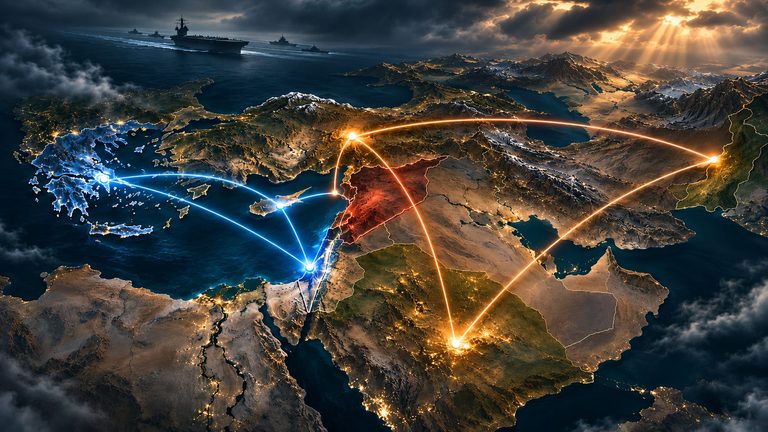
Anyone seeking to understand the pact’s substance must first see what each of the three partners contributes-because its real weight lies here, not in the terse treaty language. Al Jazeera correspondent Osama Bin Javaid reduced the division of labor to a simple formula: Pakistan provides a battle-tested military, ammunition, and a nuclear arsenal-the only one in a majority-Muslim country; Turkey provides NATO membership, world-class drone technology, and sophisticated defense manufacturing; Saudi Arabia provides the financial power that sustains the whole structure.
Saudi Arabia contributes capital and a modern, Western-equipped air force. Turkey provides NATO’s second-largest standing army and a defense industry that has long since moved beyond mere symbolism: Turkish-made drones and air-defense systems are already being delivered to the kingdom, and in 2023 Riyadh placed an order for Turkish drones in Ankara that Turkey at the time called its largest-ever defense export contract. Pakistan, finally, contributes large numbers of battle-tested personnel-and, left unspoken in the treaty but consistently read into it by analysts, its status as the Islamic world’s sole nuclear power, with an estimated arsenal of 170 warheads. Security researcher Mansoor Ahmed summarizes the division of labor this way: Pakistan and Turkey provide defense-industrial and personnel depth, while Saudi Arabia supplies the capital that supports them.
This relationship rests on a long history that Western analyses often overlook. Pakistan was a member of the 1955 Baghdad Pact, helped suppress the “Black September” uprising in Jordan in 1970, was reportedly involved in retaking Mecca’s Grand Mosque from extremists in 1979, and supplied the commander of the Riyadh-based Islamic Military Counter Terrorism Coalition in the person of former army chief Raheel Sharif. Ankara and Islamabad, meanwhile, exchanged warships and training aircraft over a period of years. What was signed on August 7, 2026, therefore codifies not the beginning of cooperation, but its provisional culmination.
Behind the formula of capital, army, and nuclear arsenal lies tangible hardware, and examining it clarifies what the pact brings together. Turkey’s defense base ranges from combat-tested Bayraktar TB2 and Akıncı drones to missile production at Roketsan and avionics and electronic-warfare systems made by Aselsan; Turkish defense exports exceeded $7 billion in 2024, placing the country among the world’s leading exporters. This industry is NATO-compatible but can operate outside Western supply chains-a feature that is essential for an architecture seeking distance from Washington. Pakistan contributes JF-17 fighter production in cooperation with China, along with experience operating Chinese, Western, and domestically produced weapons systems in parallel; its nuclear arsenal ranges from Nasr tactical short-range missiles with a range of roughly 37 miles to Shaheen-III medium-range missiles capable of reaching about 1,710 miles. Saudi Arabia, meanwhile, is advancing the localization of its defense sector under the crown prince through the state-owned Saudi Arabian Military Industries; Vision 2030 calls for increasing the domestic share of defense production to more than 50 percent. Cooperation between Turkey and Pakistan is steadily intensifying: Bloomberg reported in late 2025 that preparations were underway for a Turkish drone assembly plant in Pakistan, while a joint program to develop a fifth-generation fighter aircraft is proceeding in the background, with both armed forces viewing it as a possible replacement for their F-16 fleets. This is not symbolic politics, but the gradual consolidation of a military-industrial relationship capable of operating independently of Western suppliers.
The limits of this complementarity are just as real and belong in any honest assessment. Pakistan’s production capacity is barely sufficient to modernize its own fighter fleets and those of a partner at the same time; interoperability among Chinese, Turkish, and Western systems is manageable but demanding; and the Saudi war chest matters only if Riyadh makes the strategic decision to move substantially beyond the American security umbrella-which is precisely what Riyadh has not done so far. On paper, the gears mesh. Whether they do so under fire is another question.
And this division of labor is not theoretical-it already has an operational foundation. According to multiple sources, Pakistan has deployed roughly 8,000 troops, along with fighter aircraft, drones, and an air-defense system, to the kingdom; this took place under the September 2025 agreement, long before the signing in Mecca. At the same time, Islamabad is negotiating its own security-for-investment agreement with Kuwait and ratified a five-year defense agreement with the Gulf state in July 2026-an indication that the model could extend beyond the three founding countries. Taken together, the three countries possess nearly 1.4 million active-duty personnel, roughly 3,400 aircraft, about 6,000 tanks, and more than 340 naval vessels, according to the 2026 Global Firepower Index. There is also a maritime dimension: In response to the Houthi threat, Saudi Arabia announced a maritime-protection coalition in which additional states would join Pakistan and Turkey in supporting roles. Viewed as combined capacity, this is a substantial bloc. The decisive question is not whether these capabilities exist-they do-but whether and by what mechanism the pact activates them in a crisis.
What the Text Does Not Say
This is where the actual analysis begins, and where the weakness of every report that prematurely declares the pact an Islamic NATO becomes apparent. The full treaty text has not been published to this day. Neither the Council on Foreign Relations nor specialized security analysts have been able to examine it; the only public document is the brief joint statement. The consequences are not a secondary matter. The agreement establishes the principle that an attack on one is an attack on all, but it does not disclose what military obligations follow, whether assistance is automatic, or what form of response the other signatories are expected to provide. As Responsible Statecraft notes, these precise questions remain unresolved.
Two additional omissions are critical to any assessment. The first is the nuclear umbrella. Although Pakistan is a nuclear power, the agreement, according to Chatham House, does not state that Turkey and Saudi Arabia fall under its protection. A Saudi official explicitly denied that the pact carried a nuclear dimension. What analysts consistently read as implicit but unmistakable is therefore not actually codified in the text-a distinction that is blurred almost universally in the debate. A Pakistani arsenal may in practice produce a deterrent effect; that effect is not enforceable as a treaty obligation.
The complete in-depth analysis is available to readers who support my work. You, too, can support independent journalism with a one-time donation…

…or become a supporting member and help make analyses like this possible.

Do you have a reader account? Please log in here.
If you do not yet have a reader account, you can register here free of charge. Access is activated immediately.