by Michael Hollister
The Briefing accompanying this analysis was published exclusively by HAINTZ.media on July 13, 2026.
The In-Depth Analysis was published on Michael Hollister’s website on July 19, 2026.
4.765 words * 25 minutes readingtime
For a concise introduction to the topic, the briefing accompanying this analysis summarizes three to four key developments in a 10-minute read:
Broken with Russia, Dependent on America, at Odds with China

More context, fewer headlines – free by newsletter.

The European Union is simultaneously straining its relationships with its most important energy, raw-material, and trade partners. The highest price will likely be paid by German industry.
When the European Union carried out its energy-policy break with Russia in the spring of 2022, EU heads of state and government celebrated the move as liberation from a strategic dependency. Russian pipeline gas was replaced by American liquefied natural gas, new LNG terminals were built on a fast-track basis, and the EU Commission spoke of a gain in energy security. Two and a half years later, the EU is not freer – it is more boxed in.
Its largest replacement supplier – the United States – is openly threatening to redirect its gas deliveries unless Brussels withdraws a climate regulation. The Middle East conflict between the United States, Israel, and Iran has driven energy prices up by tens of billions of euros since February 2026. The EU’s own methane regulation is alienating not just the United States but also Qatar, Algeria, and Nigeria – four suppliers that have joined forces against EU rules. And with China, the second-largest trade partner for goods, the EU is heading into a conflict that could strike at Europe’s industrial core.
Any one of these developments alone would be a serious problem. What is remarkable is that they are happening simultaneously – and that in several cases, the EU is not reacting to events but causing them. The Union is not behaving like an economic power that balances its dependencies against one another. It is behaving like an actor that is straining its relationships with all of its critical energy, raw-material, and trade partners at the same time – with Russia through sanctions and political rupture, with the United States through climate regulation, with the Gulf states through the same climate rules, with China through trade barriers and investment restrictions. That no coordinated strategy is discernible, but rather a pattern of individual decisions that contradict one another, is part of the finding. Mario Draghi, former ECB president and author of the EU competitiveness report, described the era in which the EU could count on “cheap Russian gas, boundless Chinese markets, and American security” as irrevocably over. What he did not say: The EU has no plan for what comes next.
This article traces how five fault lines interlock – and why Germany, as Europe’s industrial core, stands at the epicenter of the consequences.
The Foundation That No Longer Stands
For decades, the industrial competitiveness of Europe – and of Germany in particular – was built on access to cheap Russian energy. Russian pipeline gas arrived reliably, in large volumes, and at prices that gave European industrial companies a structural advantage over competitors in the United States or Asia. In 2021, Russia supplied two-fifths of the EU’s gas, predominantly through four pipelines. On this foundation, an industrial structure was erected that stretched from basic chemicals in Ludwigshafen to steel production in the Ruhr to automobile manufacturing in Wolfsburg. The German chemical industry uses gas not only as an energy source but as a raw material – as feedstock for ammonia, polymers, and base chemicals that stand at the beginning of countless value chains. This foundation no longer exists.
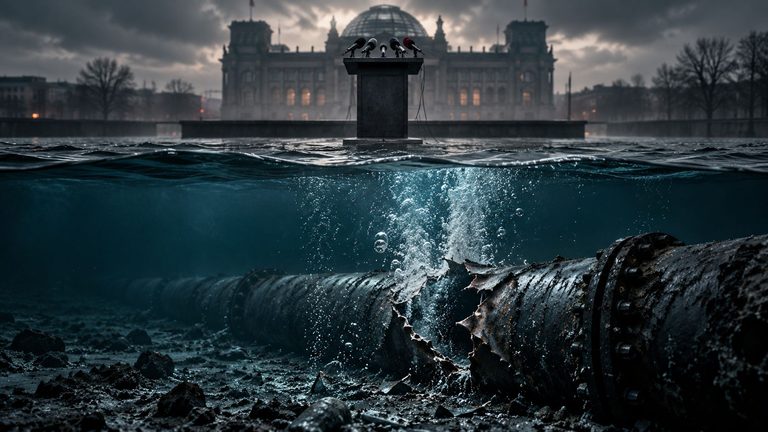
The destruction of the Nord Stream pipelines on September 26, 2022, eliminated the physical infrastructure for cheap Russian pipeline gas to Europe. The German Federal Prosecutor’s Office has identified Ukrainian suspects; one has been in pretrial detention since January 2026 after the Federal Court of Justice rejected his claim to immunity. Sweden and Denmark closed their investigations in 2024 without naming a responsible party. The question of authorship has not been conclusively resolved to this day – and it is questionable whether it ever will be.
Cheap Gas That Nobody Wants to Deliver Anymore
The consequence of the break can be summed up in a single figure that lays bare the core of the problem: industrial electricity in Germany currently costs around 0.25 euros per kilowatt-hour. In the United States, the price is 0.08 euros; in China, 0.10 euros. German companies thus pay three times what their American competitors pay and two and a half times what their Chinese competitors pay. This is not a temporary phenomenon – it is a structural competitive disadvantage that has solidified since 2022.
The EU has partially compensated for the loss of Russian gas. LNG import capacity has been expanded to 270 billion cubic meters – enough, in theory, to cover 80 percent of gas demand. Gas consumption is roughly one-fifth below 2021 levels, which reduces import pressure. Storage capacity now corresponds to over 30 percent of annual consumption, compared to 25 percent in 2021. The Brussels think tank Bruegel argues on this basis that dependence on any single exporter has decreased and that supply is more diversified today. LNG suppliers, Bruegel contends, are easier to switch than pipeline suppliers because no new infrastructure is required.
On paper, that is correct. In practice, it looks different. Switching LNG suppliers presupposes that suppliers exist who have the required volumes, that transport capacity is available, and that the suppliers actually want to deliver. None of these conditions is a given. The major LNG producers have committed their capacity through long-term contracts – taking on new large-scale customers is not as simple as switching to the next asparagus stand at the market because the neighboring stand carries the same asparagus in the same quantity. The global LNG tanker fleet currently comprises around 850 vessels. While over 400 more are under construction, industry analysts at Argus Media and Capital Clean Energy Carriers warn that growth in liquefaction capacity is outpacing transport capacity – in other words: there will soon be more gas to liquefy than ships to carry it.
Russia, meanwhile, is expanding its infrastructure toward Asia. If the EU comes knocking in five or ten years, the capacity will be committed. The physical option of returning to cheap pipeline gas effectively no longer exists. And the new suppliers on which Europe now depends are setting conditions – or threatening delivery cuts.
The New Supplier That Threatens Delivery Cuts
The United States now accounts for roughly one-quarter of European gas supply; after Norway, Washington is the second-largest supplier. In 2024, EU energy imports from the United States totaled roughly 70 billion euros. These trade flows were celebrated in Brussels as a gain in security – until the supplier itself applied the lever.
On June 24, 2026, U.S. Energy Secretary Chris Wright said in a Bloomberg interview a sentence that should have triggered every alarm bell in Brussels: “Without a meaningful reform of that rule, it is going to cause serious pain into Europe and that’s unnecessary.” He added: “Our energy will flow. It’ll just flow somewhere else.” At the Reuters Global Energy Forum in New York, Wright doubled down: the European methane regulation was “crazy” and creating a “meaningful risk of blackouts or heating struggles this coming winter.”
That is the sitting energy secretary of the United States, and he is openly tying the EU’s future energy supply to a political course correction. The irony is hard to miss: before the break with Russia, Western governments repeatedly accused Moscow of using energy exports as a geopolitical instrument – an accusation the Kremlin consistently rejected. Now that the EU is heavily dependent on American LNG, Washington is openly tying gas deliveries to changes in European legislation. The role reversal is remarkable – and complete.
A Regulation That Alienates Its Own Suppliers
At the center of the conflict stands the EU Methane Regulation (Regulation EU 2024/1787), in force since August 4, 2024. Starting January 1, 2027, importers of natural gas, crude oil, and coal must demonstrate that producers in the countries of origin comply with measurement, reporting, and verification (MRV) standards equivalent to those of the EU. The goal – the reduction of methane emissions – is understandable from a climate-policy perspective. The problem lies in the implementation.
To date, not a single exporting country has achieved MRV equivalence. A study by the consultancy Wood Mackenzie, commissioned by the oil and gas industry association IOGP and the research association Concawe, concluded in March 2026 that in 2027, roughly 94 percent of globally available gas will not meet EU requirements. Up to 43 percent of EU gas imports – around 114 billion cubic meters – could be affected. For crude oil, the share could reach 87 percent, with the potential consequence that up to 40 European refineries would have to close.
There is a counterposition, and it deserves a fair hearing. The consultancy Rystad Energy, commissioned by the Environmental Defense Fund, argues that the globally available gas meeting EU rules is three times Europe’s import demand. The Clean Air Task Force criticizes the Wood Mackenzie methodology as flawed – the regulation does not ban imports but demands transparency. The practical implementation is designed in stages, giving producers years to adapt. These are serious arguments – but they do not change the fact that the four largest exporters are already drawing consequences.
The United States, Qatar, Algeria, and Nigeria have jointly called on the EU to amend or postpone the regulation. Eleven EU member states – led by Czechia and Slovakia, including Italy, the Netherlands, and Poland – have demanded a three-year postponement and described the Commission’s proposed suspension of penalties as legally insufficient. EU Energy Commissioner Dan Jørgensen has rejected any softening.
The punchline is as simple as it is consequential: the EU does not need a political directive from Washington to regulate itself out of the market. If compliance costs are high enough that U.S. exporters voluntarily forgo long-term contracts with European buyers, then the regulation accomplishes what no supply cutoff would have to.
41 Billion Euros in Additional Costs – and New Fronts at Exactly That Moment
This escalation with the EU’s own suppliers comes at a moment when European energy costs are already exploding. Since the U.S.-Israeli strike on Iran on February 28, 2026, and the subsequent closure of the Strait of Hormuz, global oil and gas prices have surged. European governments, according to Bruegel’s fiscal response tracker, had committed over 11 billion euros in emergency measures by May 2026 to cushion the impact – Spain and Germany together accounting for more than half.
The Russian business daily Izvestia, cited via RT DE, puts the total additional costs for the EU at over 41 billion euros, of which 8.6 billion falls on Germany, 6.7 billion on Italy, and 4.6 billion on France. The calculation comes from Russian analyst circles that have an obvious interest in highlighting the costs of anti-Russian policy – but the order of magnitude is plausibly supported by Bruegel’s data on the fiscal response. The Gulf states themselves also bear massive losses: Izvestia puts Iraq’s lost revenue at 36.7 billion dollars, Saudi Arabia’s at 33.6 billion, and Kuwait’s at 22 billion. The United States, by contrast, has profited from the situation according to the paper – its crude oil exports reached roughly 10.5 million barrels per day in May 2026, 60 percent more than the previous year.

Bruegel itself warned on June 15, 2026, that the price shock could escalate into a supply crisis, as both commercial and strategic oil reserves in Europe are declining – an assessment from a Western think tank with close ties to the EU Commission. That is the baseline: exploding costs, declining reserves, unsettled suppliers, and a methane regulation that starting in January 2027 could additionally jeopardize access to new gas sources.
And at exactly this moment, the EU opens another front – against the partner that may be the most important of all for European industry.
“Down to Freezing Point”
China is not just any trade partner of the European Union. China is the second-largest trade partner for goods, the most important procurement market for critical raw materials and intermediate products, and until recently one of the largest sales markets for European – and especially German – industry. The EU trade deficit with China reached 360.6 billion euros in 2025 – and grew by another ten percent in the first four months of 2026.
The escalation began in October 2024, when the EU imposed countervailing tariffs on Chinese electric vehicles. China retaliated with countermeasures on European pork, brandy, and dairy products. Since then, the spiral has continued to tighten, with neither side showing willingness to de-escalate.
In March 2026, the EU Commission introduced the Industrial Accelerator Act (IAA) – a legislative package that establishes “Made in EU” requirements for public procurement, sets a 49-percent ownership cap for foreign investors in strategic sectors, and mandates technology transfer. The threshold at which these rules take effect – 40 percent of global manufacturing capacity in the respective sector – is in practice tailored to China. This is confirmed independently by the law firms Skadden and Dechert as well as the Brussels think tank Bruegel. The affected sectors: batteries, solar technology, electric vehicles, critical raw materials – all areas in which China is the global leader.
When a Trade Partner You Cannot Afford to Lose Issues a Warning
Parallel to the IAA, the EU Commission tightened cybersecurity legislation with the aim of excluding Chinese companies like Huawei from telecommunications networks, blocked subsidies for imported inverters – which predominantly come from China – and in June 2026 launched five new trade-defense investigations.
China’s response was unusually blunt. An account affiliated with Chinese state broadcaster CCTV declared: “China is capable of handling a situation in which economic and trade relations between China and the EU deteriorate further or even drop to freezing point.” The addendum – “China does not want to go that far, but it is not afraid of it” – does not soften the threat. It underscores it. The Chinese Ministry of Commerce filed a formal protest against the IAA, spoke of “investment barriers and institutional discrimination,” and indicated countermeasures. Beijing has created two new legal instruments, including Regulation No. 834 on industrial and supply-chain security, which can serve as a basis for retaliatory action.
On June 29, 2026, Trade Minister Wang Wentao and EU Trade Commissioner Maroš Šefčovič met in Brussels. Šefčovič had previously presented his Commission colleagues with a situation assessment that he himself described as a “bloodbath” in trade data, jobs, and industrial decline. The outcome of the meeting was the first joint statement since 2019, an October deadline for “tangible results,” and a new consultation mechanism across four work streams. “Not everything will be solved, not everything will be fixed,” Šefčovič told reporters afterward.
The atmosphere was tense, but both sides signaled a willingness to slow the escalation. Whether that succeeds remains to be seen. The EU has maneuvered itself into a position where it must make concessions without appearing to weaken its negotiating stance – while China makes clear that it has alternatives. Chinese media pointed out that Chinese companies no longer regard the European market as indispensable, having developed buyers in Southeast Asia and the Middle East. The asymmetry of the negotiating position shows in a single number: all 27 EU member states share the concern over the growing trade deficit – but they cannot agree on what to do about it. Germany voted against the EU tariffs on Chinese EVs in October 2024 but simultaneously backs the IAA. France is pushing for tougher measures. The Commission tacks between positions – and produces outcomes that satisfy no one.
The Burning Glass – What This Means for German Industry
Germany stands at the intersection of all five fault lines – and functions as a burning glass in which the consequences of European policy become visible before they reach the rest of the continent. German industry was dependent on cheap Russian gas – that gas is gone. It was dependent on China as a sales market – that market is collapsing. It was dependent on the United States as a trade partner – where tariffs are hitting the core sectors of automobiles, mechanical engineering, and chemicals. And the EU’s own regulation is driving domestic costs even higher. What is a strategic problem for the EU as a whole becomes an existential question for Germany: Can a country whose economic model was built on the combination of cheap gas, technological edge, and export access to the world’s largest markets survive when all three pillars break at the same time? The numbers paint a picture that leaves no room for interpretation.
Energy-intensive industrial production in Germany has fallen by 15.2 percent since February 2022 – nearly twice as much as overall industry, which declined by 9.5 percent. These are not fluctuations within a business cycle. These are four years of uninterrupted contraction – a pattern that is extraordinary for an export nation and points to a structural problem, not a cyclical one. In the chemical industry, the most energy-intensive bellwether sector, capacity utilization stood at just 72.5 percent in 2025 – far below the profitability threshold.
Numbers That Leave No Room
German automobile exports to China fell by 33 percent in 2025 to 13.6 billion euros, according to a study by the consultancy EY – the lowest level in a decade. China thus slipped from Germany’s second- to its sixth-largest automotive export market. Exports to the United States fell in parallel by 18 percent to 28.5 billion euros, driven by Trump’s tariff policy. EY automotive expert Constantin M. Gall spoke of “massive overcapacity across the entire German automotive industry.”
Volkswagen is closing three plants in Germany for the first time in its history and cutting 35,000 jobs by 2030. BASF opened an 8.7-billion-euro plant in Zhanjiang, China, in 2026 – and simultaneously cut around 2,800 positions at its Ludwigshafen headquarters. There is no more vivid image of the relocation of capital and production capacity. ThyssenKrupp is cutting 11,000 jobs and reducing capacity from 11.5 to under nine million tons. Bosch plans to cut up to 22,000 jobs in Germany by 2030. Miele is relocating washing-machine production to Poland and cutting 700 jobs in Gütersloh. When a company regarded as the very embodiment of “Made in Germany” moves its core production abroad, that is more than an isolated case – it is a signal.
Since 2020, 248,000 jobs have been lost in Germany’s core industrial sectors – automobiles, mechanical engineering, electrical engineering, electronics, metalworking, chemicals. Foreign direct investment in Germany was cut in half in 2024, to roughly 43 billion euros, compared to 72 billion the previous year. Capital is voting with its feet. Germany recorded roughly 22,000 corporate insolvencies in 2025, the highest level in the country’s postwar history – and by May 2026, another 14,675 proceedings had been opened, with western industrial regions leading the count. The Federation of German Industries (BDI) puts the additional private and public investment needed by 2030 at 1.4 trillion euros to maintain international competitiveness. Roughly 20 percent of industrial value creation in Germany is at risk, according to the federation. Siemens’ chief tax officer put it before the Bundestag Finance Committee in terms that could not be more blunt: “There is effectively nothing that argues in favor of investing in Germany.”
In parallel, U.S. tariffs are pressing on the export balance. Under the EU-U.S. Framework Agreement of July 2025, the effective tariff rate on EU exports stands at roughly 10.5 to 12.5 percent. EU exports to the United States already fell in 2025 – automobiles by 14 percent, machinery by 9.5 percent. These three sectors – cars, machinery, and chemicals – together account for more than two-fifths of German exports to the United States, and their decline alone pulled the overall balance down by over five percentage points. The economic research institute ING forecasts a further decline of 4.6 percent for 2026, driven no longer by uncertainty but by the structural competitive disadvantage that emerges when U.S. tariffs converge across all trading partners and Europe’s relative pricing privilege disappears. On top of that come the additional energy costs from the Hormuz conflict: 8.6 billion euros for Germany alone, according to calculations by the Russian business daily Izvestia, cited via RT DE.
Why the EU Acts This Way
Anyone looking at this picture must answer a question: How can an economic union that sees itself as a geopolitical actor simultaneously strain its relationships with all of its critical partners – while undermining its own industrial base? The answer does not lie in a single bad decision. It lies in the way the EU makes decisions.
The EU Commission operates through directorates-general and commissionerships, each pursuing its own policy logic. Dan Jørgensen (Energy) defends the methane regulation as a climate achievement. Maroš Šefčovič (Trade) escalates against China because the trade data shows a “bloodbath,” as he himself described it to colleagues. Stéphane Séjourné (Industry) drives the Industrial Accelerator Act as an instrument of strategic autonomy. Wopke Hoekstra (Climate) enforces emissions targets. Teresa Ribera coordinates the overall framework as Executive Vice-President – but her focus is on decarbonization, not on energy-market logic or industrial production.
Mario Draghi diagnosed this problem in September 2024 in his 400-page competitiveness report: there was “too little cross-disciplinary coordination in important policy areas within the European Commission itself.” Bruegel confirmed the finding: EU climate policy had developed over two decades in a “siloed manner” – new instruments placed alongside existing ones rather than replacing them, multiple compliance systems running “largely in parallel” rather than as an integrated system. One year after Draghi, 11.2 percent of his 383 recommendations have been fully implemented. Draghi himself declared in November 2025 that Europe was in a “more complex situation” than at the time of his report.
Added to this is a pressure to deliver visible results: the new Commission wants to prove itself geopolitically capable – Clean Industrial Deal, strategic autonomy, “Made in EU.” The profile-building happens through spectacular individual measures, not through an integrated overall strategy. Each commissioner delivers results in his portfolio – but no one checks whether the sum of those results is sustainable for the EU as a whole.
And there is a pattern at the decision-making level that can be stated as a finding: the responsible commissioners are lawyers, political scientists, diplomats, and career politicians. Not a single one of the commissioners responsible for energy, trade, industry, or climate has an operational background in industry or global energy markets. They act rationally within their respective professional logic – Jørgensen defends the methane regulation out of climate-policy conviction, Séjourné drives the IAA out of an industrial-policy vision. But the failure to integrate these individual logics produces an outcome that is irrational for the EU as a whole: a climate regulation that jeopardizes gas supply, simultaneously with a trade law that provokes the most important sales market, simultaneously with tariffs that slow the export engine – and all of this at a moment when energy prices are already at crisis levels.
A Conclusion That Contains No Reassurance
The EU has created a situation in which it has secured access to neither energy nor sales markets from any of its most important partners – Russia, the United States, the Gulf states, China. Not because these partners conspired against Europe, but because the EU has strained its relationships with all of them at the same time. This does not concern the abstract “European business environment” – it concerns concrete jobs in Ludwigshafen, Wolfsburg, Duisburg, and Gütersloh, factories that are closing, and value chains that are not coming back.
Anyone who looks at the result does not need to search for a conspiracy. It suffices to observe an institution that does not understand its dependencies as a system but treats them as a sum of individual problems – and in doing so fails to see that every individual solution aggravates the next problem. The methane regulation does not solve a climate problem if it undermines gas supply. The Industrial Accelerator Act does not protect European industry if it drives the largest trade partner into retaliation. And turning away from Russian energy does not create sovereignty if the replacement supplier applies the very lever that was once attributed to Moscow.
Germany, as Europe’s industrial core, stands at the epicenter of this development. The numbers – a 15.2 percent production decline in energy-intensive industries, 248,000 lost jobs, 22,000 insolvencies in a single year, the exodus of BASF to China, of Volkswagen into plant closures, of Miele to Poland – are not forecasts. They are the current state of affairs. And the political decisions that are deepening this situation are being taken at this very moment – in Brussels, where the methane regulation takes effect in January 2027, where the Industrial Accelerator Act is making its way through the legislative process, and where eleven member states are requesting a postponement that the responsible commissioner refuses to grant.
The Briefing accompanying this analysis was published exclusively by HAINTZ.media on July 13, 2026.
For a concise introduction to the topic, the briefing accompanying this analysis summarizes three to four key developments in a 10-minute read:
Broken with Russia, Dependent on America, at Odds with China
The week’s most important geopolitical developments – independently assessed.
About the Author
Michael Hollister
is a geopolitical analyst and investigative journalist. He served six years in the German military, including peacekeeping deployments in the Balkans (SFOR, KFOR), followed by 14 years in IT security management. His analysis draws on primary sources to examine European militarization, Western intervention policy, and shifting power dynamics across Asia. A particular focus of his work lies in Southeast Asia, where he investigates strategic dependencies, spheres of influence, and security architectures. Hollister combines operational insider perspective with uncompromising systemic critique – beyond opinion journalism. His work appears on his bilingual website (German/English) www.michael-hollister.com and in investigative outlets across the German-speaking world and the Anglosphere.
If you regularly read my updates and analyses, I would be grateful for your ongoing support.
5 USD per month – 1 coffee !!!

Sources
- Bruegel, 11 March 2026 – The dependence on fossil fuels, not the United States, is Europe’s worry: https://www.bruegel.org/analysis/dependence-fossil-fuels-not-united-states-europes-worry
- Bloomberg, 24 June 2026 – EU’s Methane Rules Will Drive Away US Gas Supplies, Wright Says: https://www.bloomberg.com/news/articles/2026-06-24/eu-s-methane-rules-will-drive-away-us-gas-supplies-wright-says [Paywall]
- RT DE, 26 June 2026 – USA drohen mit Kürzung der Gaslieferungen an die EU: https://de.rt.com/europa/284299-usa-drohen-mit-kuerzung-der-gaslieferungen-an-die-eu/ (cited, not linked per editorial policy)
- RT DE, 30 June 2026 – China droht vor EU-Gesprächen mit möglichem Handelsstillstand: https://de-rtnews.com/international/284604-china-droht-vor-eu-gespraechen-mit-moeglichem-handelsstillstand/ (cited, not linked per editorial policy)
- RT DE, 16 June 2026 – Durch den Nahostkonflikt zahlt die EU über 41 Milliarden Euro zu viel für Kraftstoff: https://de-rtnews.com/europa/283222-durch-nahostkonflikt-zahlt-eu-ueber/ (cited, not linked per editorial policy)
- BIZ Magazine, 26 June 2026 – Energy chiefs warn EU climate rules threaten liquefied natural gas supply: https://bizmagsb.com/energy-chiefs-warn-eu-climate-rules-threaten-liquefied-natural-gas-supply/
- IOGP Europe / Wood Mackenzie, 09 March 2026 – EU Methane Regulation Risks Severe Disruption to Europe’s Oil and Gas Supply from 2027: https://iogpeurope.org/news/eu-methane-regulation-risks-severe-disruption-to-europes-oil-and-gas-supply-from-2027/
- Clean Air Task Force, 21 April 2026 – Why claims that the EU Methane Regulation threatens energy supply miss the mark: https://www.catf.us/2026/04/why-claims-that-the-eu-methane-regulation-threatens-energy-supply-miss-the-mark/
- Oxford Institute for Energy Studies, March 2025 – EU Methane Import Requirements: Can a Regulation…: https://www.oxfordenergy.org/wpcontent/uploads/2025/03/ET44-EU-Methane-Import-Requirements.pdf
- CSIS, 23 September 2024 – EU Methane Rules: Impact for Global LNG Exporters: https://www.csis.org/analysis/eu-methane-rules-impact-global-lng-exporters
- European Commission – Methane emissions (overview, updated 2026): https://energy.ec.europa.eu/topics/carbon-management-and-fossil-fuels/methane-emissions_en
- Bruegel, 16 June 2026 – 2026 European energy crisis fiscal response tracker: https://www.bruegel.org/dataset/2026-european-energy-crisis-fiscal-response-tracker
- Bruegel, 05 May 2026 – The fiscal fault lines of Europe’s energy shock: https://www.bruegel.org/first-glance/fiscal-fault-lines-europes-energy-shock
- Bruegel, June 2026 – The flaws in the European Union’s proposed Industrial Accelerator Act and how to fix them: https://www.bruegel.org/policy-brief/flaws-european-unions-proposed-industrial-accelerator-act-and-how-fix-them
- Skadden, 24 April 2026 – European Commission Proposes Industrial Accelerator Act: https://www.skadden.com/insights/publications/2026/04/european-commission-proposes-industrial-accelerator-act
- Dechert, 04 March 2026 – The EU Industrial Accelerator Act: A New FDI Control Regime for Strategic Sectors: https://www.dechert.com/knowledge/onpoint/2026/3/the-eu-industrial-accelerator-act–a-new-fdi-control-regime-for-.html
- Euronews, 27 April 2026 – China slams ‘Made in Europe’ push, mulls retaliation: https://www.euronews.com/business/2026/04/27/china-slams-made-in-europe-push-mulls-retaliation
- Electrive, 27 April 2026 – ‘Made in Europe’ act: China threatens countermeasures against EU industrial law: https://www.electrive.com/2026/04/27/made-in-europe-act-china-threatens-countermeasures-against-eu-industrial-law/
- France24, 29 June 2026 – EU, China trade tensions loom over minister visit: https://www.france24.com/en/live-news/20260629-eu-china-trade-tensions-loom-over-minister-visit
- Asia News Network, 30 June 2026 – China, EU turn to dialogue in pragmatic bid to manage deepening tensions: https://asianews.network/china-eu-turn-to-dialogue-in-pragmatic-bid-to-manage-deepening-tensions/
- Rhodium Group, 10 February 2026 – Germany’s China Shock Revisited: https://rhg.com/research/germanys-china-shock-revisited/
- EY / Bilyonaryo, 21 March 2026 – German auto exports to China plunged a third in 2025: https://bilyonaryo.com/2026/03/21/german-auto-exports-to-china-plunged-a-third-in-2025/mobility/
- Germany Insolvencies, June 2026 – Germany’s Deindustrialization: Shrinking Since 2018: https://germanyinsolvencies.com/blog/germany-deindustrialization/
- Xpert.digital, June 2026 – Energy-intensive industries in Germany: Alarming figures: https://xpert.digital/en/energy-intensive-industries
- ING Think, 08 April 2026 – The US tariff shock in 2025 vs 2026: https://think.ing.com/articles/the-us-tariff-shock-same-negative-impact-different-drivers-in-2025-and-2026/
- European Parliament – EU-US tariffs: tensions, trade deal and what could change (updated 16 April 2026): https://www.europarl.europa.eu/topics/en/article/20250210STO26801/eu-us-tariffs-tensions-trade-deal-and-what-could-change
- Bruegel, February 2026 – Defragmenting European Union climate policy: https://www.bruegel.org/policy-brief/defragmenting-european-union-climate-policy
- CSIS, 28 October 2024 – The Draghi Report: A Strategy to Reform the European Economic Model: https://www.csis.org/analysis/draghi-report-strategy-reform-european-economic-model
- HCSS, 21 October 2025 – The Draghi Report Revisited: Energy: https://hcss.nl/news/the-draghi-report-revisited-energy/
- Eucrim, 21 January 2026 – Extradition for Nord Stream Pipeline Blast: https://eucrim.eu/news/extradition-for-nord-stream-pipeline-blast-eu-courts-have-ruled-differently-on-german-eaws/
© Michael Hollister – All rights reserved. Redistribution, publication or reuse of this text requires express written permission from the author. For licensing inquiries, please contact the author via www.michael-hollister.com.