
by Michael Hollister
Exclusive published at Michael Hollister on April 19, 2026
4.200 words * 22 minutes readingtime
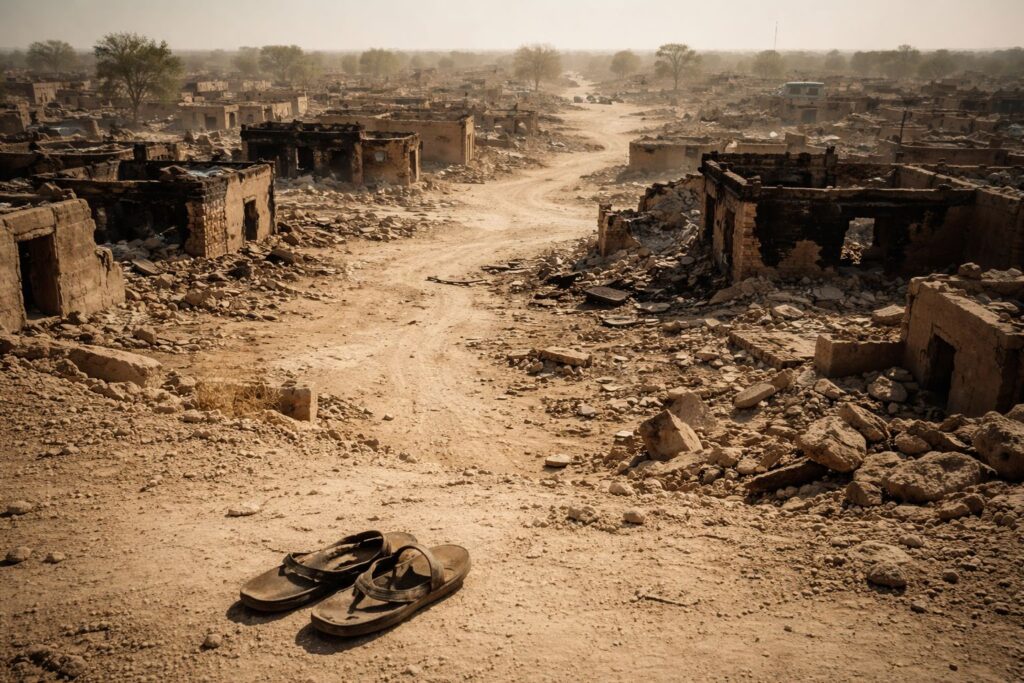

Who Profits from Sudan’s Genocide
I. A Finding No One Wants to Hear
In February 2026, the United Nations Independent International Fact-Finding Mission for Sudan submitted its report. The title: “Hallmarks of Genocide in El-Fasher.” Across 40 pages – drawing on testimony from 320 survivors and witnesses, verified video footage, satellite imagery, and forensic analysis – the mission arrived at a finding that carries real weight in the history of international law: the Rapid Support Forces (RSF) committed genocide in and around the city of El-Fasher in the fall of 2025 (UN News, “Sudan: ‘Hallmarks of genocide’ found in El Fasher, UN investigators detail mass killings and ethnic targeting,” February 19, 2026, https://news.un.org/en/story/2026/02/1166997).
Not framed as suspicion. Not as a political narrative. As a legal finding by an independent UN mission.
While these lines are being written, Western newsrooms are covering the Iran-Israel war, drone strikes on Tel Aviv, Trump’s next escalation. Sudan barely appears in the margins – if at all. Yet UN High Commissioner for Human Rights Volker Türk had been publicly and repeatedly warning since mid-2024 that a massacre in El-Fasher was imminent. By name. With timelines. With situational assessments. Not one of the world powers with the means to act did so.
What followed were 3 days of absolute terror. More than 6,000 people were killed in the first 72 hours, according to UN documentation – and the mission explicitly notes that the actual number is “undoubtedly considerably higher.” For 18 months, the RSF had besieged the city: cutting supply routes, attacking aid convoys, deploying hunger as a weapon, grinding the population down. Then they came.
The international community was warned. It looked away. The question this article poses is not the sentimental one: How could this happen? The question is the analytical one: Who benefits from the fact that it happened – and continues to happen?
II. Sudan – A Country Nobody Knows
Sudan is the third-largest country in Africa. At just under 733,000 square miles, it is more than 5 times the size of Germany – and home to roughly 50.5 million people distributed across more than 500 ethnic groups and linguistic communities, many concentrated along the Nile and in urban centers. The country borders 9 states, has access to the Red Sea, and sits along one of the most strategically significant waterways in the world – the route between the Suez Canal and the Indian Ocean, through which approximately 12 percent of global trade flows.
Sudan is rich. That is the starting point for everything that follows.
In 2023, the country exported goods worth $5.09 billion: crude oil at $1.13 billion, gold at $1.03 billion, livestock products at $902 million, and sesame – Sudan is the world’s largest exporter – at $613 million (Al Jazeera, “Sudan has vast oil, gold and agricultural resources. Who controls them?” November 20, 2025, https://www.aljazeera.com/news/2025/11/20/sudan-has-vast-oil-gold-and-agricultural-resources-who-controls-them). In addition, there are vast agricultural areas along the Nile, substantial deposits of chromium, copper, tungsten, and zinc, and natural gas reserves that remain barely developed. A country with these resources should be prosperous. It is not. That is not a coincidence.
The political context: after the fall of longtime dictator Omar al-Bashir in 2019, 2 generals split power – initially in a transitional government, then following the military coup of 2021 in a Sovereign Council. On one side: General Abdel Fattah al-Burhan, commander of the Sudanese Armed Forces (SAF), nominal head of state. On the other: General Mohamed Hamdan Dagalo, known as “Hemedti,” commander of the Rapid Support Forces – a paramilitary force of more than 100,000 fighters with its own financial apparatus, its own gold mines, and its own foreign policy relationships.
Hemedti’s RSF is no new force. It is the institutionalized successor to the Janjaweed militias that carried out the first Darfur genocide between 2003 and 2005 – using the same methods, against the same ethnic groups, in the same areas. The fact that the RSF is now killing again in Darfur is not a historical coincidence. It is continuity in new uniforms.
On April 15, 2023, the ceasefire between the 2 men collapsed. Since then, there has been war. More than 14 million people have been displaced – the largest internal displacement crisis in the world. Around 21 million Sudanese – nearly half the population – depend on humanitarian aid. The UN describes it as the worst humanitarian crisis on earth.
And the world looks away.
III. What Happened in El-Fasher
El-Fasher is the capital of North Darfur state. Before the war, approximately 253,000 people lived there. In the months before the city fell, that population had nearly doubled – hundreds of thousands of displaced persons had fled there from across the Darfur region, seeking refuge in the last city in western Sudan still controlled by the regular army. El-Fasher was the last refuge. Then it, too, fell.
The siege did not begin in October 2025. It began 18 months earlier. Since May 2024, the RSF had encircled the city: blocking access roads, attacking aid convoys, cutting water supplies, intercepting medical deliveries. Humanitarian organizations documented famine conditions in the displacement camps around the city. Children were dying of malnutrition. Those who tried to flee risked death on the escape routes – RSF fighters controlled the exits, demanded ransom, shot those who had nothing.
On October 26, 2025, the RSF launched its final offensive. What followed is documented by the UN Fact-Finding Mission in unprecedented detail (OHCHR Report A/HRC/61/77, “Sudan: Hallmarks of Genocide in El-Fasher,” https://www.ohchr.org/en/documents/thematic-reports/ahrc6177-sudan-hallmarks-genocide-el-fasher-report-independent).
In the Al-Rashid dormitory at the University of El-Fasher, approximately 1,000 people had sought shelter. RSF fighters opened fire with heavy weapons. Around 500 people died in a single location on a single day. One witness described watching bodies fly through the air – “like a scene from a horror movie.” Near the Saudi Maternity Hospital, at least 460 people were killed according to the World Health Organization, when RSF forces stormed the building. Around 600 people, including 50 children, were executed in university buildings according to UN documentation.
The city’s children’s hospital – a children’s hospital – was converted into a detention facility. More than 2,000 men were held there. Those who died in captivity were, according to witness accounts, buried near the building.
The ethnic dimension is explicitly documented. Adolescent boys and men under 50 were systematically targeted for execution – identified and singled out solely on the basis of their membership in the Zaghawa or Fur ethnic groups, the 2 largest non-Arab communities in Darfur. According to survivor accounts, RSF fighters shouted: “Are there Zaghawa here? If we find Zaghawa, we will kill them all” and “We want to make everything Black disappear from Darfur.” Women and girls from non-Arab communities were systematically raped; women perceived as Arab were generally spared. The mission documents this as a deliberate pattern, not as excess (OHCHR Press Release, “Sudan: Evidence in El-Fasher reveals genocidal campaign, targeting non-Arab communities,” February 19, 2026, https://www.ohchr.org/en/press-releases/2026/02/sudan-evidence-el-fasher-reveals-genocidal-campaign-targeting-non-arab).
The Humanitarian Research Lab at the Yale School of Public Health analyzed satellite imagery and documented weeks of sustained burning activity at locations identified as massacre sites – body disposal operations that continued for at least 3 weeks after the city was overrun. Of the estimated 250,000 people who were still in El-Fasher before the fall, the fate of a large proportion remains unaccounted for to this day.
“Hallmarks of genocide” – in international law, this phrase is not a rhetorical device. It identifies the fulfillment of specific elements of the UN Genocide Convention of 1948: the killing of members of a protected group, the causing of serious bodily and mental harm, and the deliberate infliction of conditions of life calculated to bring about physical destruction. The UN mission concludes: “Genocidal intent is the only reasonable inference that can be drawn from the RSF’s systematic pattern of conduct.” Despite repeated warnings, despite clearly identified risk indicators, the mission notes in closing, no party took effective measures to protect the civilian population (Human Rights Watch, “UN Body Finds ‘Hallmarks of Genocide’ in Darfur,” February 24, 2026, https://www.hrw.org/news/2026/02/24/un-body-finds-hallmarks-of-genocide-in-darfur
IV. The Architecture of Silence
In November 2025 – days after the fall of El-Fasher – Sudan briefly appeared in Western headlines. The Guardian ran an article. NPR reported on the UN figures. Several wire services covered what had happened. Then the story was gone.
No sustained public pressure. No candlelit vigils. No special broadcasts. No heads of government stepping before a camera to explain what needed to be done. A Thomson Reuters Foundation survey of 22 leading aid organizations named Sudan the “world’s most neglected crisis” in December 2025. Save the Children put it plainly: “The Sudan crisis should be on the front page every day. Instead, the world is looking away in shame.”
By contrast: the Gaza war, which escalated in October 2023, has since maintained continuous global media presence. Mass protests in dozens of cities. Political debates in every Western parliament. This is not a judgment of the Gaza war – it deserves attention. But Sudan has, since April 2023, claimed an estimated more than 150,000 lives, displaced 14 million people, and produced the world’s largest hunger crisis. The number of Western protesters rallying for Sudan: approximately zero.
Why?
Because attention is not a natural phenomenon. It is organized. Agendas are set – through political pressure, through economic interests, through diplomatic calculations. What is not on the agenda does not exist politically. And what does not exist politically requires no consequences.
A concrete example: in November 2025, the European Parliament passed a resolution on Sudan. In its original draft, the United Arab Emirates were named as a weapons supplier to the RSF. Emirati government officials traveled specifically to Strasbourg – including Minister of State Lana Nusseibeh – to apply personal pressure. The European People’s Party secured the removal of any reference to the UAE. The resolution named the massacre. It did not name the massacre’s most important weapons supplier.
That is not a press failure. That is political architecture. A genocide whose financier is deleted from the text of a democratically elected parliament’s resolution – at the financier’s own insistence – is not a failure. It is a system.
V. The Resource Logic – Who Wants What
To understand why Sudan is burning while the world watches, you have to follow the interests. Not the statements – the interests.
The United Arab Emirates are the central actor. In 2023, the UAE purchased more than 99 percent of all Sudanese gold exports – worth more than $1 billion at recorded prices, considerably more at market rates. The UAE are Sudan’s most important trading partner. At the same time, the Sudanese government under General al-Burhan had previously rejected several agreements on agricultural and land lease rights with Abu Dhabi, on the grounds that the terms were exploitative by Sudanese assessment. Hemedti’s RSF had no problem with such terms. That explains the underlying motive (ISPI, “The Role of Gold in the Sudanese War,” April 2025, https://www.ispionline.it/en/publication/the-role-of-gold-in-the-sudanese-war-207364
What followed is comprehensively documented by UN expert reports, U.S. intelligence documents, Amnesty International, and Human Rights Watch: the UAE supplies weapons to the RSF. Through a system of cargo flights via transit hubs – a UN panel of experts confirmed a “heavy rotation of cargo aircraft” from the UAE to RSF-held areas – through overland transport from Chad and via a UAE base in Somalia’s Puntland. Through corporate structures in Dubai through which the RSF pays salaries, recruits mercenaries – including documented Colombian ex-military personnel – and finances international lobbying. American intelligence assessments from the State Department’s Bureau of Intelligence and Research and the Defense Intelligence Agency, produced in late 2025, specifically identified: Chinese combat drones, heavy machine guns, artillery, mortars, and ammunition reaching the RSF through UAE networks. Armored vehicles recovered on Sudanese battlefields were identified as products of the Emirati defense conglomerate Edge. British military equipment – targeting systems, engine components – originally sourced from regular UK exports to the UAE also turned up with the RSF and was submitted to the UN Security Council in 2 dossiers (Human Rights Watch, “Fanning the Flames,” September 2024, https://www.hrw.org/news/2024/09/09/fanning-flames; Amnesty International, “Sudan: Advanced Chinese weaponry provided by UAE identified in breach of arms embargo,” https://www.amnesty.org.au/sudan-advanced-chinese-weaponry-provided-by-uae-identified-in-breach-of-arms-embargo/
The UAE deny everything. At the U.S. donor conference for Sudan in February 2026 in Washington, they pledged $500 million in humanitarian aid. At the same time, their cargo flights deliver ammunition. This is not an inconsistency that can be explained by negligence.
Russia has a history of opportunistic side-switching in Sudan. Wagner structures initially trained RSF units and operated gold mines in Hemedti-controlled territory under the cover of a company called “Meroe Gold.” Early weapons flows into RSF territory ran through the Central African Republic, where Wagner dominates. Then the calculations shifted: when it became clear that al-Burhan’s SAF would hold the east – and with it, critically, access to the Red Sea – Moscow pivoted. The actual strategic objective – a Russian naval base on Sudan’s Red Sea coast at Port Sudan – could only be achieved with the SAF government. In April 2024, a Russian company received a gold exploration concession from the Burhan government. Simultaneously, a payment agreement was reached: Russia delivers weapons, Sudan pays in rubles. The UN Security Council has repeatedly called for an end to the RSF siege of El-Fasher. Russia has consistently abstained or blocked those votes – not out of sympathy for the RSF, but because any interference in the conflict’s dynamics could disrupt its own business (Global Initiative Against Transnational Organized Crime, “The illicit transnational supply chains sustaining Sudan’s conflict,” November 2025, https://globalinitiative.net/analysis/the-illicit-transnational-supply-chains-sustaining-sudans-conflict/

China does not supply weapons directly to Sudan. It supplies them to the UAE. Amnesty International has demonstrated that weapons systems deployed in Sudan are identifiably traceable as China-UAE exports: Norinco-branded guided bombs and howitzers, Rainbow combat drones – systems exported exclusively from China to the UAE. That these weapons then appear with the RSF is established through the transfer chain. China’s official response: none. While demonstrably Chinese weapons systems are being deployed in a genocide determined by the UN, Beijing remains silent. This is not an oversight. China is Sudan’s second-largest trading partner, with a focus on agricultural products. Chinese silence enables Chinese business – while letting the UAE bear the political risk.
Israel has a largely unexamined technological footprint in Sudan. Investigations by Lighthouse Reports and the Israeli newspaper Haaretz documented that in 2022, a private aircraft linked to the Israeli intelligence firm Intellexa landed in Khartoum and delivered advanced spyware to the RSF – technology capable of covertly turning smartphones into audio and video surveillance devices. Separately, the Israeli government approved the establishment of Controp Emirates Ltd in Abu Dhabi’s free trade zone – an Israeli company for reconnaissance, surveillance, and targeting, operating under strict Israeli Ministry of Defense oversight.
The strategic logic is not difficult to reconstruct. Since the Abraham Accords of 2020, Israel and the UAE have built a security partnership that extends well beyond economic normalization. Shared interests include containing Islamist movements in the Sahel – Sudan under Omar al-Bashir was a transit country for Hamas weapons shipments – controlling surveillance technology in unstable markets, and securing joint positions vis-à-vis Iran. In this context, Sudan is not a peripheral stage but a testing ground: for technology, for alliance patterns, for the question of how far the Abraham Accords architecture can carry in Africa.
What Israel specifically intends to gain from access to RSF networks cannot be definitively established. What can be established: Israel is not acting in Sudan by accident, but within a partnership with the primary financier of a documented genocide.
VI. The United States: Mediator with the Arms Supplier at the Table
This is where the double standard becomes most visible.
The Trump administration leads what is called the “Quad” – a diplomatic mediation format comprising the United States, the United Arab Emirates, Saudi Arabia, and Egypt, tasked with negotiating a ceasefire for Sudan. In February 2026, Massad Boulos – Trump’s special advisor for African and Arab affairs, and the father-in-law of Trump’s daughter Tiffany – presented a 5-point peace plan to the UN Security Council. The pillars: immediate humanitarian ceasefire, civilian protection, lasting truce, transition to a civilian government, reconstruction. Boulos framed it as: “Sudan’s future cannot be determined by generals” (Sudan Tribune, “US Boulos outlines five-step plan to end Sudan conflict,” February 19, 2026, https://sudantribune.com/article/310895
At the same time, the UAE pledged $500 million in humanitarian aid at the U.S. donor conference. The UAE – the largest weapons supplier to the documented perpetrator of genocide – sits at the negotiating table as an equal partner. Not as a defendant. As a peacemaker.
That is not the end of the story.
American intelligence reports – jointly produced by the State Department’s Bureau of Intelligence and Research and the Defense Intelligence Agency – had established, months before the summit, unambiguously that the UAE was arming the RSF. Specifically: Chinese drones, heavy machine guns, artillery, mortars. These reports were in Washington’s possession when Boulos traveled to Abu Dhabi, when he coordinated the Quad, when he stood beside the UAE foreign minister at the donor conference (Middle East Eye, “‘We have a text’: US says peace plan for Sudan to be revealed this week,” February 4, 2026, https://www.middleeasteye.net/news/we-have-text-us-says-peace-plan-sudan-revealed-this-week
When a journalist asked Boulos directly at a press conference whether Washington was pressing the UAE to halt its weapons deliveries, Boulos gave no answer. Not an evasive answer – no answer.
Sudan’s ambassador in Washington described the situation at the donor meeting with precision: Sudan itself was not invited. “Nevertheless, we believe our participation would add value. There are realities on the ground that are inaccessible to most participants” (Security Council Report / What’s in Blue, “Sudan: Briefing,” February 18, 2026, https://www.securitycouncilreport.org/whatsinblue/2026/02/sudan-briefing-7.php
Sudan – the country whose population is dying – was not at the table at the meeting about Sudan’s future. The UAE – whose cargo flights deliver ammunition – was.
In diplomacy, this is called “constructive engagement.” In analytical terms, it is called: trying to put out a fire without removing the accelerant.

VII. Scenarios – Where Does This Lead?
Two scenarios stand side by side – and neither is encouraging.
Scenario A: De Facto Partition of Sudan
The more probable scenario is the creeping territorialization of the conflict. The RSF already controls Darfur, large swaths of the west, and declared a parallel government in Nyala in April 2025. The SAF holds the north, the east, Khartoum, and the Red Sea coast. The frontlines shift – most recently the SAF has broken some sieges in Kordofan – but the basic structure is solidifying.
What this means: de facto dual statehood on the Libyan model, without a peace treaty, without international recognition, without any prospect of stability. External resource extraction continues in both zones: gold from RSF-controlled territory flows through Dubai into global markets; oil pipelines in the east remain under the control of the SAF and its Russian partners. The UAE secures agricultural concessions in the west; Russia secures its naval base in the east. The civilian population pays the price – in displacement, hunger, and sustained violence.
The loser in this scenario is Sudan as a state. And with it, every chance at the democratization that briefly seemed possible in 2019.
Scenario B: The Peace Plan Takes Hold
Boulos’ 5-point plan has a logic on paper. A humanitarian ceasefire, international monitoring, a political transition process. If all parties genuinely commit – it could work.
For the plan to function, at least 3 conditions would need to be met simultaneously: Washington would have to apply concrete pressure on the UAE – not rhetorically, but with the threat of sanctions or a gold embargo that closes the transfer channel through Dubai. An independent observer mission would need to be equipped with a real mandate – not as a reporting body, but with authority to monitor weapons movements. And Sudan itself would need to be brought to the table – not as the object of a peace plan, but as a party (The Africa Report, “UN backs Trump plan for Sudan, after receiving $2bn lifeline from US,” February 4, 2026, https://www.theafricareport.com/407641/un-backs-trump-plan-for-sudan-after-receiving-2bn-lifeline-from-us/).
None of these conditions is currently met. None is politically realistic in the foreseeable future.
History supports that assessment. Since April 2023, every ceasefire agreement between the RSF and SAF has failed. The Jeddah talks in 2023: failed. The Juba process in 2024: failed. The Quad roadmap of September 2025: failed. Sudan itself has rejected the Boulos plan as incompatible with national interests – in part because the UAE is expected to be accepted as a mediator while simultaneously arming the enemy. That position is difficult to refute.
As long as no actor bears real costs for its behavior – as long as gold flows unimpeded through Dubai, cargo flights land unobstructed, and the UAE is treated as a partner in the UN Security Council – there is no structural incentive for peace. Peace would be bad for business.
VIII. What This Means
What is happening in Sudan can be described in several ways. As a humanitarian crisis – which it is. As a civil war – which it formally is as well. As an ethnic conflict – which captures the surface but misses the core.
What is happening in Sudan is a resource war with a geopolitical architecture. A country rich enough to feed its own population is being systematically looted – from outside, by actors with a pressing interest in ensuring that no functioning state emerges that could regulate their dealings or contest their concessions. Internal conflicts are not being contained but fueled: through weapons deliveries, through gold purchases at preferential rates, through diplomatic shields that prevent anyone from bearing costs.
That human beings are dying in the process – more than 6,000 in 3 days, tens of thousands over the course of the war, by some estimates more than 150,000 since the fighting began – is not the unintended side effect of interest-driven policy. It is the price others pay so that business continues. A destabilized Sudan is easier to exploit than a stable one. A population fighting for survival does not ask questions about land leases and gold concessions. Two rival military factions fighting each other are not a unified force capable of driving external actors out of the country.
The UN Fact-Finding Mission has said what needed to be said. The International Criminal Court is gathering evidence. UN High Commissioner Türk has warned repeatedly and publicly. The evidence is there. What is missing is not knowledge. What is missing is the political will of the states that have the means to act – and the reasons not to.
To name a genocide without naming its beneficiaries is half the truth. The full truth is this: El-Fasher is not a failure of the international community. It is its result.
Michael Hollister
is a geopolitical analyst and investigative journalist. He served six years in the German military, including peacekeeping deployments in the Balkans (SFOR, KFOR), followed by 14 years in IT security management. His analysis draws on primary sources to examine European militarization, Western intervention policy, and shifting power dynamics across Asia. A particular focus of his work lies in Southeast Asia, where he investigates strategic dependencies, spheres of influence, and security architectures. Hollister combines operational insider perspective with uncompromising systemic critique—beyond opinion journalism. His work appears on his bilingual website (German/English) www.michael-hollister.com, at Substack and in investigative outlets across the German-speaking world and the Anglosphere.
Sources
- UN News: “Sudan: ‘Hallmarks of genocide’ found in El Fasher, UN investigators detail mass killings and ethnic targeting” (February 19, 2026) https://news.un.org/en/story/2026/02/1166997
- OHCHR Report A/HRC/61/77: “Sudan: Hallmarks of Genocide in El-Fasher – Report of the Independent International Fact-Finding Mission” https://www.ohchr.org/en/documents/thematic-reports/ahrc6177-sudan-hallmarks-genocide-el-fasher-report-independent
- OHCHR Press Release: “Sudan: RSF violations in capture of El Fasher amount to war crimes” (February 13, 2026) https://www.ohchr.org/en/press-releases/2026/02/sudan-rsf-violations-capture-el-fasher-amount-war-crimes
- OHCHR Press Release: “Sudan: Evidence in El-Fasher reveals genocidal campaign, targeting non-Arab communities” (February 19, 2026) https://www.ohchr.org/en/press-releases/2026/02/sudan-evidence-el-fasher-reveals-genocidal-campaign-targeting-non-arab
- Human Rights Watch: “UN Body Finds ‘Hallmarks of Genocide’ in Darfur” (February 24, 2026) https://www.hrw.org/news/2026/02/24/un-body-finds-hallmarks-of-genocide-in-darfur
- Al Jazeera: “Sudan has vast oil, gold and agricultural resources. Who controls them?” (November 20, 2025) https://www.aljazeera.com/news/2025/11/20/sudan-has-vast-oil-gold-and-agricultural-resources-who-controls-them
- Human Rights Watch: “Fanning the Flames” – weapons deliveries UAE/RSF, forensic analysis (September 2024) https://www.hrw.org/news/2024/09/09/fanning-flames
- Amnesty International Australia: “Sudan: Advanced Chinese weaponry provided by UAE identified in breach of arms embargo” https://www.amnesty.org.au/sudan-advanced-chinese-weaponry-provided-by-uae-identified-in-breach-of-arms-embargo/
- PBS NewsHour: “The role outside powers are playing in Sudan’s continued, brutal war” (November 2025) https://www.pbs.org/newshour/world/the-role-outside-powers-are-playing-in-sudans-continued-brutal-war
- Global Initiative Against Transnational Organized Crime: “The illicit transnational supply chains sustaining Sudan’s conflict” (November 2025) https://globalinitiative.net/analysis/the-illicit-transnational-supply-chains-sustaining-sudans-conflict/
- ISPI (Istituto per gli Studi di Politica Internazionale): “The Role of Gold in the Sudanese War” (April 2025) https://www.ispionline.it/en/publication/the-role-of-gold-in-the-sudanese-war-207364
- Foreign Policy: “UAE Could End RSF War in Sudan” (October 2025) https://foreignpolicy.com/2025/10/16/uae-sudan-rsf-war-weapons/
- Middle East Eye: “‘We have a text’: US says peace plan for Sudan to be revealed this week” (February 4, 2026) https://www.middleeasteye.net/news/we-have-text-us-says-peace-plan-sudan-revealed-this-week
- Sudan Tribune: “US Boulos outlines five-step plan to end Sudan conflict” (February 19, 2026) https://sudantribune.com/article/310895
- Security Council Report / What’s in Blue: “Sudan: Briefing” (February 18, 2026) https://www.securitycouncilreport.org/whatsinblue/2026/02/sudan-briefing-7.php
- The Africa Report: “UN backs Trump plan for Sudan, after receiving $2bn lifeline from US” (February 4, 2026) https://www.theafricareport.com/407641/un-backs-trump-plan-for-sudan-after-receiving-2bn-lifeline-from-us/
- Council on Foreign Relations – Global Conflict Tracker: “Civil War in Sudan” (continuously updated) https://www.cfr.org/global-conflict-tracker/conflict/power-struggle-sudan
- Netzwerk Friedenskooperative: “Das Massaker von El Fasher, Sudan” https://www.friedenskooperative.de/friedensforum/artikel/das-massaker-von-el-fasher-sudan
- Americans for Democracy & Human Rights in Bahrain: “United Nations rules UAE funded RSF’s atrocities as genocidal” (February 26, 2026) https://www.adhrb.org/2026/02/united-nations-rules-uae-funded-rsfs-atrocities-as-genocidal/
© Michael Hollister – All rights reserved. Redistribution, publication or reuse of this text requires express written permission from the author. For licensing inquiries, please contact the author via www.michael-hollister.com.
Newsletter
🇩🇪 Deutsch: Verstehen Sie geopolitische Zusammenhänge durch Primärquellen, historische Parallelen und dokumentierte Machtstrukturen. Monatlich, zweisprachig (DE/EN).
🇬🇧 English: Understand geopolitical contexts through primary sources, historical patterns, and documented power structures. Monthly, bilingual (DE/EN).