by Michael Hollister
Exclusive published at Michael Hollister on November 01, 2026
4.845 words * 26 minutes readingtime


How Politicians’ Relatives Obtain Government Posts and Public Funding – and Why the State Apparatus Keeps Growing
When Robert Habeck dismissed his most important civil servant in May 2023, it was not a single mistake that brought Patrick Graichen down, but the sheer density of the connections surrounding him. Graichen, a state secretary in the Federal Ministry for Economic Affairs and one of the most influential strategists behind Germany’s energy transition, had participated in the preliminary selection process for the chief executive position at the German Energy Agency. The candidate selected was the best man at his wedding. Graichen had initially failed to disclose the personal relationship. In isolation, that might still have allowed for an explanation; Habeck initially stood by his state secretary and ordered a civil-service review. But a second allegation followed: a violation of internal compliance rules involving a planned grant under the National Climate Initiative and a connection to Graichen’s sister. The documented sequence ended with Graichen’s dismissal.
An entire network surrounded Graichen. His sister works for the Öko-Institut, a research institution that regularly receives federal contracts. She is married to Michael Kellner, who at the same time was also a state secretary in Habeck’s ministry – Graichen’s brother-in-law, with 2 senior officials in the same ministry linked through family. Graichen’s brother also works for the Öko-Institut. The ministry stressed that neither Kellner nor Graichen had participated in any tender for which the institute could have applied. In the end, that did not help: Graichen was placed in temporary retirement. A broader account of the personal and institutional connections documented how far the controversy extended.
The case is instructive in 2 respects. First, it was exposed and produced consequences – which, as this article will show, is more the exception than the rule. Second, it made visible a pattern that recurs across parties, levels of government, and decades: Anyone who holds public office controls positions, contracts, and funding programs – and with striking regularity, some of those benefits reach the officeholder’s immediate personal circle. Not always visibly, not always provably, and rarely in a form that can be prosecuted. But often enough to justify asking whether coincidence is an adequate explanation.
What This Article Shows – and What It Does Not
Three clarifications are necessary at the outset because the subject is sensitive and is regularly inflated in public debate beyond what the evidence supports.
This article does not claim that the documented events were unlawful. In almost every case, they were not; much of what is described occupies a space that is formally unobjectionable yet politically controversial. Nor does it claim that individual politicians personally secured the position in question for their relatives or associates. In most cases, that can neither be proved nor disproved. Where those involved deny such participation or point to regular procedures, their position is included here. And this article does not decide whether the documented conduct was decent, defensible, or reprehensible. That judgment belongs to the reader, not the author.
What this article does is more restrained. It assembles what is publicly documented, organizes it into recurring patterns, and places it beside a second development that is rarely considered together with the first: the steady growth of the state apparatus and its personnel costs. Whether the 2 are connected – whether a growing state also creates more opportunities to provide for one’s own circle – is a question the article raises but does not answer. Let the evidence speak, state the positions, and leave the conclusion to the reader: That is the method.
Pattern 1: Relatives and Associates in Government Service
The most obvious pattern is also the oldest. Someone from the immediate circle of a public officeholder receives a position in government service – a job, a promotion, or advancement into a better-paid civil-service grade.
The Graichen case is the best known, but it is not the only example from the circle of Germany’s more recent federal governments. In 2018, former Federal Labor Minister Hubertus Heil of the Social Democratic Party brought the best man from his wedding into his own ministry. The man transferred from the Federal Foreign Office and became a director-general in the Federal Ministry of Labor and Social Affairs – one of the highly paid leadership levels of a federal ministry, accompanied by the corresponding salary and pension benefits. The personnel change is documented in the ministry’s official announcement and in subsequent reporting. The aftermath is noteworthy: In 2025, following a change of government, the best man lost the leadership position again – an indication that such appointments can depend on the person at the top and end with that person’s departure.
These 2 cases – Graichen and Heil – share a feature that must be named precisely because public debate often blurs it. Neither case concerns blood relatives or spouses, but best men: close personal confidants. Legally and conceptually, that is different from family in the strict sense, and it would be dishonest to force it under the label of employing relatives. But it reveals something broader than family: networks. The appointment to a senior position follows personal proximity that may coincide with professional suitability for the office – but need not. From the outside, that is precisely what cannot be verified. The confidant may have been the best candidate for the position; that can no more be proved than the opposite. This inability to verify is the core of the problem.
Where spouses are involved, the dividing line between a regular civil-service career and preferential treatment is particularly narrow – and especially deserving of a skeptical countercheck. Former Federal Justice Minister Marco Buschmann of the Free Democratic Party, for example, drew headlines because his wife was promoted to the rank of government director in the Federal Ministry of Finance, which at the time was headed by his party colleague and coalition partner Christian Lindner. The outrage was predictable. On closer examination, however, the case proved significantly weaker than the headlines suggested. According to reporting on the promotion, the decision to move to the ministry had already been made in September 2021, when the ministry was still headed by Olaf Scholz, long before Lindner took office. The relevant unit was not created specifically for her, and she had previously already been a civil servant in an office assigned to the Federal Chancellery. The case is included deliberately as a counterexample: Proximity is not in itself a finding, and careful examination sometimes produces the opposite of what public indignation expects. Anyone who takes allegations seriously must take exculpatory facts seriously as well.
Pattern 2: Relatives at the Head of Publicly Funded Organizations
The second pattern is more modern and is the most interesting for the question of political control. Here, the relative does not hold public office, but leads a nongovernmental organization – an association, foundation, or network – that works, or is expected to work, with public funds. The political appeal of this construction is evident: What a government may not or does not wish to do directly with state resources can be done by a funded organization. The relationship between donor and recipient thus moves outside the state into an area subject to less stringent control.
The most recent case concerns the serving federal finance minister and SPD co-chair Lars Klingbeil. His wife, Lena-Sophie Müller, is managing director of Initiative D21, which describes itself as Germany’s largest nonprofit network for the digital society. The organization receives public funding: According to its entry in the Lobby Register, approximately €150,000 flowed to it from 4 federal ministries in 2023. This requires proportionate context, including against one’s own instinct for outrage: The sum is modest, and D21 is a digitalization network, not a campaigning organization. The multimillion-euro figures circulating in parts of the debate concern entirely different funding programs and have nothing to do with D21. The case nevertheless became sensitive because of its timing and the roles involved. Klingbeil had sharply criticized the Christian Democratic Union for using a parliamentary inquiry to question government funding for nongovernmental organizations – while his own wife headed such a publicly co-financed organization. Whether that constitutes a conflict of interest is for the reader to decide. The constellation is documented.
A second case within the same pattern is particularly well known in public debate – and particularly often misrepresented, which is precisely why a careful account matters. Thies Gundlach, the partner of Green Party politician Katrin Göring-Eckardt and former vice president of the Church Office of the Protestant Church in Germany, heads the sea-rescue initiative United4Rescue. At the end of 2022, the Bundestag – with Green Party participation – planned €2 million annually from 2023 through 2026, up to €8 million in total, for civilian sea rescue from the Federal Foreign Office budget. The underlying motion initially named United4Rescue expressly as the recipient. Christian Democratic members of the Budget Committee also voted for the measure. The relationship and Gundlach’s role are publicly recorded, including in biographical documentation.
That is the demonstrable core, and this article remains with it. The additional claim frequently attached to the circulating story – that the money was actually paid to the organization or even reached private pockets – is not established and is expressly not asserted here. A budget notation is spending authorization, not a legal entitlement or a disbursement. Contemporary reporting explained the figures and the parliamentary process, while a CORRECTIV fact-check documented that the commonly alleged payment had not occurred as claimed. The documented event itself is sufficient: A parliamentary majority earmarked and named public funding for an organization headed by the partner of a leading member of the same parliamentary group. That is the pattern – the planning, the naming, and the proximity. Nothing more is required, and nothing more can responsibly be established.
Pattern 3: When a Relative’s Employer Does Business with the Ministry
A third pattern runs not through a government position or a funded organization, but through the private sector – where a relative’s employer enters into a commercial relationship with the very ministry led by the officeholder.
The most prominent example is former Federal Health Minister Jens Spahn of the Christian Democratic Union. His husband, Daniel Funke, heads the Berlin representative office of media company Burda – a classic interface between business and politics. At the beginning of the COVID-19 pandemic in 2020, the Federal Ministry of Health ordered 570,000 protective masks from Burda. The transaction became public in March 2021 through a ministry report to Bundestag committees and subsequent reporting by Der Tagesspiegel.
The counterposition must be presented particularly thoroughly here because otherwise the case suggests more than the evidence supports. Burda stated that Funke had not participated in the transaction, that no commissions had been paid, and that the masks had been supplied at cost. The ministry said the contract had been concluded through a standardized procedure at customary market prices. Burda is a media company, not a mask manufacturer, and therefore acted as an intermediary during an acute emergency. The order was only a small part of the enormous overall procurement effort undertaken during those weeks. No legal violation is apparent, and all sides deny any personal involvement by the minister’s husband. What remains is the constellation alone: A minister’s spouse held a senior position at a company that supplied goods to that minister’s ministry. Whether this constitutes a problem or merely the appearance of one is left to the reader. What must be recognized is that appearances have a currency of their own in politics.
This case belongs to the milder version of the pattern. Procurement of protective equipment in the spring of 2020 took place under enormous time pressure and relaxed procurement rules; that exceptional situation subsequently produced several other, in some cases much more serious, scandals involving commissions worth millions. The Spahn case is not among them. No flow of money to the husband has been established, only the proximity between his employer and the ministry. Yet that is precisely what makes it instructive as a pattern: It shows that suspicion begins not only when money is demonstrably transferred, but when the boundary between a private employer and a public contracting authority becomes permeable through a personal relationship. In such a case, the decisive question is not whether someone did anything prohibited, but whether the situation should have been allowed to arise in a form that generates such suspicion at all.
Pattern 4: Contracts and Agency Proximity
The fourth pattern is the most diffuse and at the same time the most commonplace. It concerns neither government positions nor NGO leadership, but public contracts flowing into the personal or professional circles of officeholders – consulting contracts, communications work, and agency fees.
A documented example comes from the State Chancellery of Mecklenburg-Western Pomerania under Minister-President Manuela Schwesig of the Social Democratic Party. A young employee was introduced there as head of communications and spokesperson while simultaneously working for the agency 365 Sherpas. That agency received approximately €60,000 from the state government for crisis communications; another agency operating under the same umbrella received €331,000 to relaunch the state’s websites. The State Audit Office criticized excessive costs in this context. The events are documented in repeated regional reporting, particularly by the Nordkurier.
Cases of this kind often rest on the weakest individual evidence because the sums are comparatively small and the connections are difficult to establish conclusively. That is precisely why they are also the most widespread. Anyone who runs an administration awards contracts, and contracting decisions are often influenced not only by price and performance, but by proximity – whom one knows, whom one trusts, and with whom one has worked before. That need not be corrupt and usually is not. But quietly and with little possibility of control, it shifts public money into familiar hands. It also demonstrates that the pattern does not end at the federal level, but reaches every state chancellery and town hall.
Consulting contracts and communications services are the most difficult channel of all to control. Unlike an established position appearing in a budget plan, or a grant listed in the Lobby Register, consultancy fees often disappear inside aggregated budget lines. In Mecklenburg-Western Pomerania, the State Chancellery was not alone in facing criticism. The state-owned Climate Foundation was also criticized for purchasing expensive public-relations advice – another indication that this channel remains open throughout state-adjacent institutions. Anyone attempting to determine whether public contracts were awarded according to merit or proximity regularly encounters the limits of transparency. This is not necessarily because anything is being concealed, but because service procurement inherently permits more discretion than the appointment of a civil servant – and discretion is precisely the space in which proximity operates.

The Mass of Cases: Relatives in Parliamentary Employment
The 4 patterns described so far concern individual cases, each of which can be documented separately. Alongside them exists a second and far larger layer – and it requires methodological caution because it can easily invite false conclusions.
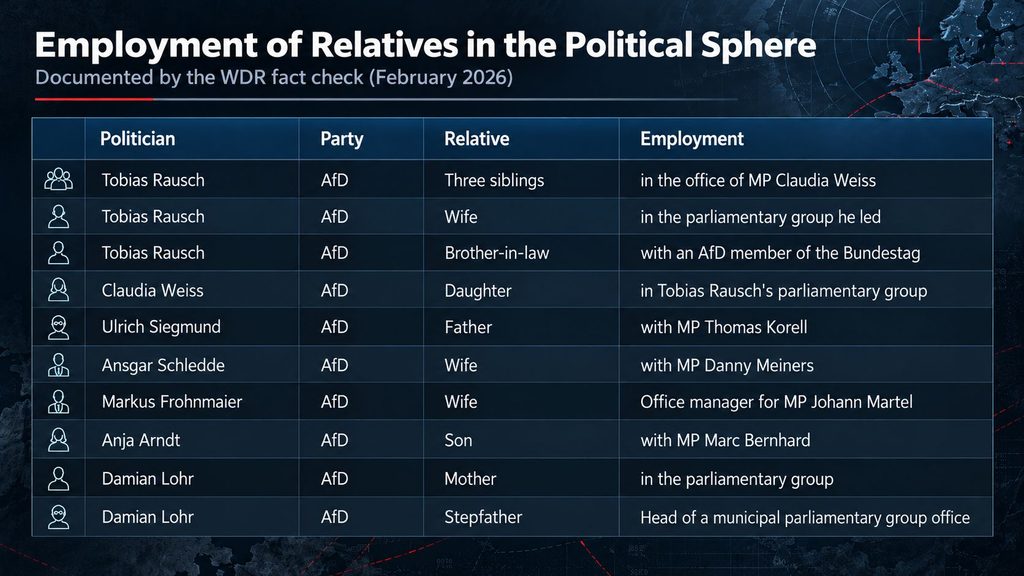
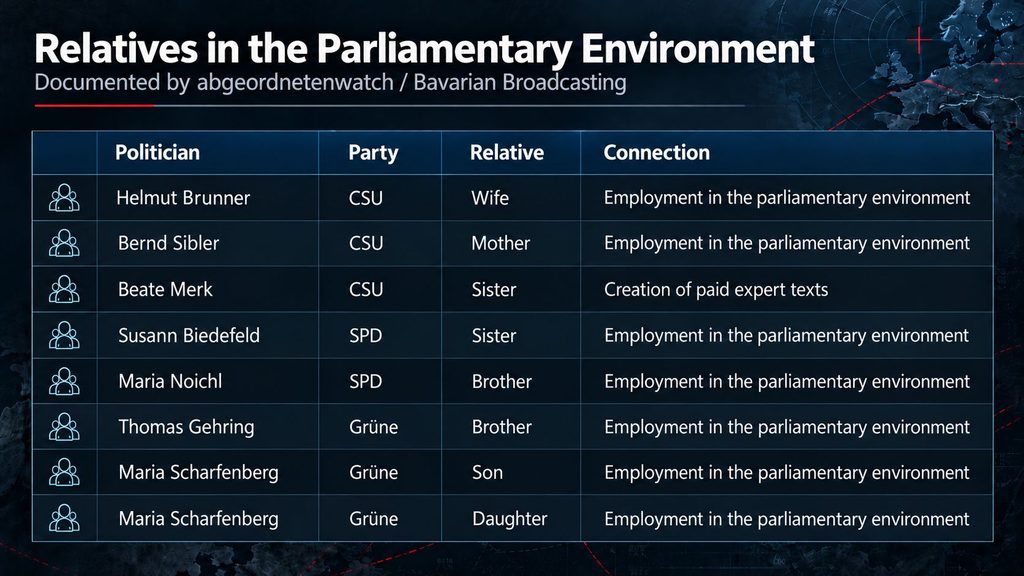
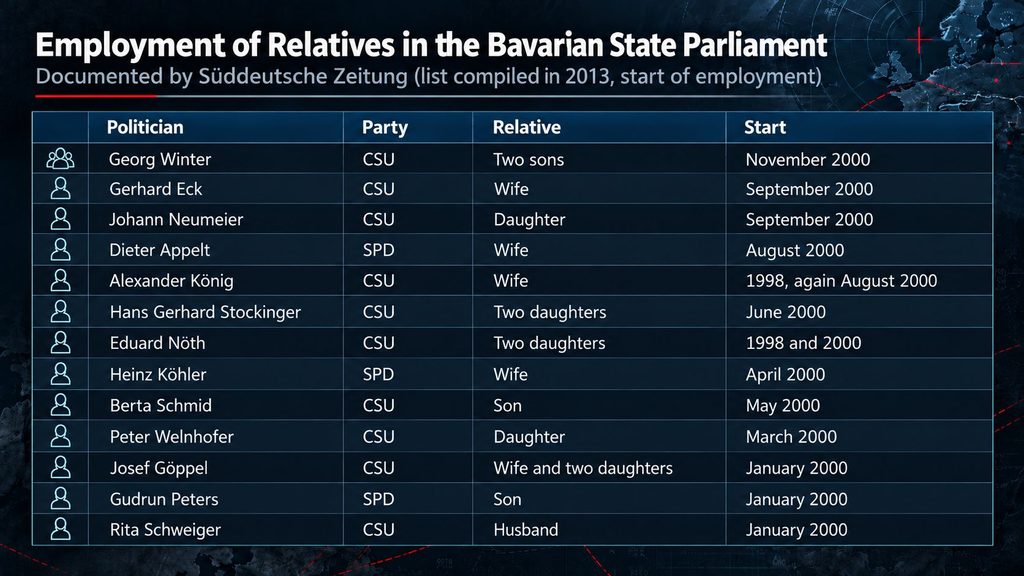
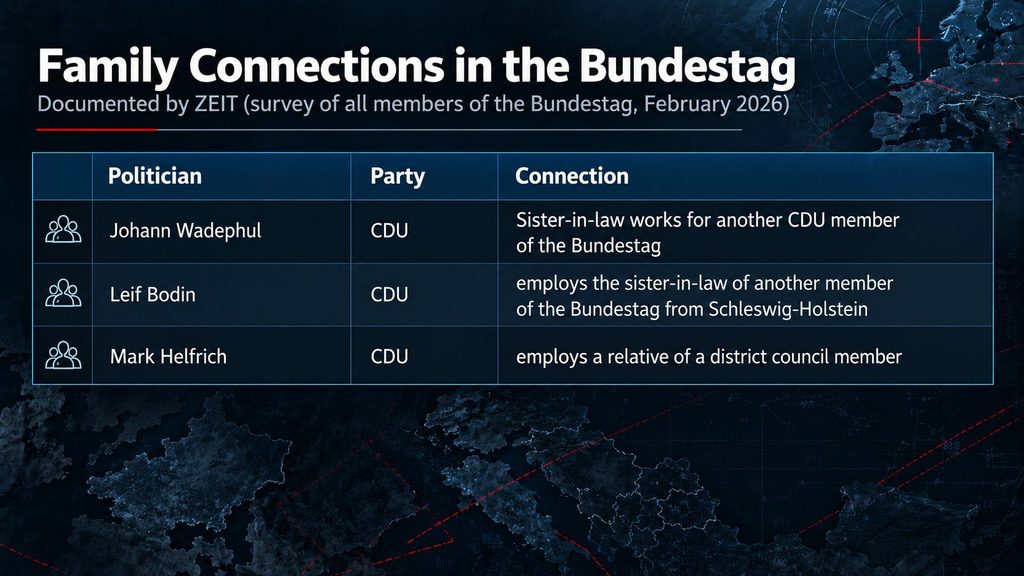
This layer concerns the employment of relatives in parliamentary operations: spouses, children, siblings, and parents employed in legislators’ offices or by parliamentary groups and paid with public funds. In the Bundestag, new contracts of this kind have been prohibited since 2005; older arrangements were phased out, while such constellations existed and continue to exist in substantial numbers at the state level. A WDR fact-check from February 2026 documented numerous cases. Investigations by abgeordnetenwatch and Bayerischer Rundfunk identified others, a 2013 compilation recorded a large number of Bavarian cases, and a February 2026 survey of all Bundestag members by DIE ZEIT added further names.
The decisive limitation follows, and it matters more than any individual number: This is the only layer that has been recorded systematically – and that fact itself distorts the picture. Where researchers or parliamentary inquiries looked particularly intensively, they found particularly many cases. The known compilations therefore cluster around certain parties and regions, not because those places demonstrably contain more such employment, but because that is where the counting occurred. There is no complete survey covering all parties and parliaments with equal thoroughness. The appendix is therefore expressly a compilation of known cases, not a statistic, not a ranking, and certainly not proof that 1 party is “worse” than another. It demonstrates a principle, not a party profile. Anyone who reads it as a party profile has misunderstood it.
It is self-evident that the current federal government and state governments also appear within this layer; the spectrum reaches into state chancelleries. In Schleswig-Holstein, for example, the father of Minister-President Daniel Günther’s godchild was appointed to a staff position in the State Chancellery without a public competition in 2019 – a single, thinly documented case in which the event itself is better known than its background. The pattern, however, is not thinly documented but overwhelming: It extends across every level of government and over decades.
The Bundestag’s 2005 prohibition on employing close relatives within its own operations is itself an admission: Rules prohibit only practices that occur on a meaningful scale. The Bavarian compilation of 2013, which became known as the “relatives affair,” showed how deeply entrenched the practice had become – across party lines, often over years, and in individual cases with several family members on a single legislator’s payroll. There were few legal consequences because most of the employment relationships had been permissible when they began. This is precisely where it differs from the 4 patterns above. Those remain individual cases that can be named and disputed. This was an established system contained only through a rule change – and even then only at the federal level, while the states pursued their own approaches.
The Turn: An Apparatus That Keeps Growing
Now consider the second development that must be placed beside the first. Positions do not arise in a vacuum. They arise within a state that has been growing again for a decade and a half – in personnel and financial terms.
As of June 30, 2024, approximately 5.38 million people worked in Germany’s public service across the federal government, states, municipalities, and social insurance system. The state is therefore by far the country’s largest employer. Contrary to a widespread assumption, however, this is not an all-time high, and that distinction matters because an exaggerated claim undermines the legitimate one. In 1991, immediately after German reunification, the figure was approximately 6.74 million. Over the following 2 decades, the apparatus contracted considerably – partly as a result of the privatization of the postal service, telecommunications, and railways, whose employees had previously counted as public servants – and reached its low point at fewer than 4.5 million around 2008.
The actual finding is therefore not the absolute figure but the reversal of the trend. Since 2010, the number has grown steadily and without interruption: from approximately 4.59 million in 2010 to 4.65 million in 2015, 4.97 million in 2020, and 5.38 million today. That represents approximately 794,000 additional positions over 14 years – arithmetically more than 50,000 per year. The increase occurred almost entirely at the state and municipal levels, in daycare centers, schools, police forces, the judiciary, and local administration, rather than at the federal level. The DGB’s 2025 Personnel Report, based on data from the Federal Statistical Office, documents the long-term series.
This distribution is essential because it prevents an obvious but false conclusion. It would simply be wrong to describe all 5.38 million employees as an “administrative apparatus.” The largest groups are teachers, police officers, childcare workers, and judicial personnel – people who work directly with the public. That is not bureaucracy but public service, and the core administrative workforce is only a fraction of the total. Anyone demanding “less government” is therefore, if the demand is considered honestly, initially demanding fewer teachers and police officers. This distinction is part of the finding.
The areas in which the growth occurred are decisive to its interpretation. The increase was concentrated where policymakers had explicitly sought more personnel in recent years: expanding childcare, hiring teachers, and strengthening police forces after the security debates of the late 2010s. These are politically desired positions authorized by parliaments, not the secret proliferation of an apparatus reproducing itself. Yet this produces the uncomfortable follow-up question: If growth in these areas was intentional while technology increasingly assumes routine tasks, a corresponding number of positions should have disappeared elsewhere – in conventional case processing and administration. Nothing of the sort is visible in the overall balance. Since 2010, the curve has moved in only 1 direction, and despite every necessary distinction, that remains the hard core of the finding.
One question nevertheless cannot be defined away. Since approximately 2012 to 2015, technology has been available that allows 1 person to complete administrative processes that previously required several hands; the latest artificial-intelligence tools have multiplied that potential again. In the private sector, this development has transformed occupations and reduced staffing levels. An industrial company producing the same output today with the same workforce as 15 years ago would probably no longer survive in the market. Over precisely this period, the state’s curve points upward. Whether that reflects indispensable new responsibilities – more security, more care, more regulation – or an internal momentum that creates positions faster than technology makes them unnecessary remains an open question. Both interpretations have advocates. The reader must answer it.

The Question of Cost
What does this apparatus cost? The most robust figure comes from European statistics: Government employee compensation amounted to 8.3 percent of gross domestic product in 2024. With GDP of approximately €4.3 trillion, that corresponds to roughly €357 billion per year. Spread across 365 days, this is approximately €980 million every day for the entire government workforce across the federal government, states, municipalities, and social insurance system. One officially documented component illustrates the dynamic: According to the Federal Statistical Office, municipalities and municipal associations alone spent approximately €80.9 billion on personnel in 2023 – more than 7 percent above the previous year, driven largely by the public-sector collective bargaining agreement.
In public debate, this finding is often sharpened by a comparison with private enterprise: No private company, the argument goes, could afford a personnel-cost block of this size and remain competitive. The comparison contains both a valid point and a weakness, and both must be stated. It is true that competitive pressure would force a company to translate productivity gains into lower staffing requirements – precisely the pressure the state lacks because it does not have to earn its revenue but can collect it. The weakness is that much of the state’s “product” consists of personal service: teaching, patrol duty, and the administration of justice cannot be automated to the same extent as an assembly line. A teacher is not an administrative process. The comparison therefore holds where genuine administration and standardized procedures are concerned, and it does not hold where the state has people working directly with people. Both are true simultaneously, and anyone quoting only 1 half is misleading the audience.
Now consider the comparison that generates outrage in public debate. Total government tax revenue – federal, state, and municipal combined – is now close to €1 trillion per year. In 2024, it exceeded €980 billion, and official tax estimates carry the figure beyond the trillion-euro threshold to a record level. The 169th official tax estimate, published by the Federal Ministry of Finance on October 23, 2025, documents that trajectory. Compared with those tax revenues, personnel costs of approximately €357 billion consume more than one-third. In its sharpened form, the claim becomes: “40 percent goes to the apparatus.”
For the sake of accuracy, 2 objections belong with this calculation, and they are not fine print but decisive to the reliability of the statement. First, the state does not finance its personnel solely from taxes, but from all revenue – contributions, fees, and other receipts – which collectively exceed tax revenue by a substantial amount. Measured against total public expenditure, the personnel share is considerably lower. Second, approximately 380,000 employees of the social insurance system are paid from contributions, not taxes. Treating tax revenue as the sole benchmark therefore compares 2 figures that do not fully correspond – a rhetorically powerful but statistically vulnerable move.
Both perspectives are permissible, and they produce different percentages depending on whether personnel is measured against taxes, total revenue, or economic output. Regardless of the benchmark selected, a 2-part finding remains: The number of public employees has risen continuously since 2010, and their costs amount, depending on the calculation, to approximately 8 percent of economic output or more than one-third of tax revenue. Whether this represents a capable social state or a growing burden that will crush future budgets is a political question. The reader must decide.
Finding
Placed side by side, the 2 developments do not reveal a single scandal but a pattern. Public offices control positions, contracts, and funding. With remarkable regularity, some of those benefits reappear in the immediate personal circles of officeholders – among spouses, relatives, partners, and close confidants. This occurs within a state that has been growing in personnel and financial terms for a decade and a half, steadily broadening the apparatus and thereby increasing the number of opportunities it contains.
As a rule, none of this is unlawful, and anyone claiming otherwise stretches the evidence beyond what it can support. But a gap can open between the purpose of public office – service to the general public – and what actually occurs around that office. Making that gap visible is the task of journalism. Judging it belongs to the citizens: the citizens who finance the apparatus through their taxes and contributions and whom the state, in principle, is meant to serve.
Appendix: Employment of Relatives in the Parliamentary Sphere
Compilation of Known Cases, with No Guarantee of Completeness
The following compilation documents cases involving the parliamentary employment of relatives as reported by WDR, abgeordnetenwatch, Bayerischer Rundfunk, Süddeutsche Zeitung, and DIE ZEIT. It is expressly a collection of cases that became public, not a complete survey or one conducted with equal thoroughness across all parties.
Documented by the WDR Fact-Check, February 2026
Documented by abgeordnetenwatch and Bayerischer Rundfunk
Documented by Süddeutsche Zeitung, 2013 Compilation and Start of Employment
Documented by DIE ZEIT, Survey of All Bundestag Members, February 2026


About the Author
Michael Hollister
is a geopolitical analyst and investigative journalist. He served six years in the German military, including peacekeeping deployments in the Balkans (SFOR, KFOR), followed by 14 years in IT security management. His analysis draws on primary sources to examine European militarization, Western intervention policy, and shifting power dynamics across Asia. A particular focus of his work lies in Southeast Asia, where he investigates strategic dependencies, spheres of influence, and security architectures. Hollister combines operational insider perspective with uncompromising systemic critique – beyond opinion journalism. His work appears on his bilingual website (German/English) www.michael-hollister.com and in investigative outlets across the German-speaking world and the Anglosphere.
Stay informed without having to work through the daily flood of news – the most important developments and connections summarized for you.
Sources
- taz. “Graichen Dismissed after Best-Man Affair.” https://taz.de/Graichen-entlassen-nach-Trauzeugen-Affaere/!5935334/
- Schwäbische Zeitung. “Habeck, Schwesig and Others – How Nepotism Works in Germany.” https://www.schwaebische.de/politik/habeck-schwesig-und-co-so-funktioniert-vetternwirtschaft-in-deutschland-4400758
- Federal Ministry of Labor and Social Affairs. Announcement concerning the 2018 change in leadership. https://www.bmas.de/EN/Services/Press/recent-publications/2018/change-in-leadership-at-the-federal-ministry-of-labour-and-social-affairs.html
- t-online. “Justice Minister Marco Buschmann’s Wife Promoted in the Finance Ministry.” https://www.t-online.de/nachrichten/deutschland/parteien/id_100197134/bericht-frau-von-justizminister-marco-buschmann-im-finanzministerium-befoerdert.html
- Lobby Register and reporting on Initiative D21, including 2023 funding; see Schwäbische Zeitung above.
- MiGAZIN. “Figures and Facts on the Debate over Government Funding for Sea Rescue.” October 03, 2023. https://www.migazin.de/2023/10/03/zahlen-fakten-staatsgelder-seenotretter-debatte/
- CORRECTIV. Fact-check on United4Rescue. October 26, 2023. https://correctiv.org/faktencheck/2023/10/26/nein-united4rescue-hat-keine-gelder-erhalten-die-von-annalena-baerbock-genehmigt-wurden/
- Wikipedia. “Thies Gundlach,” covering his role at United4Rescue and relationship with Göring-Eckardt. https://en.wikipedia.org/wiki/Thies_Gundlach
- Der Tagesspiegel. “Employer of Spahn’s Husband Sold Masks to Health Ministry.” March 21, 2021. https://www.tagesspiegel.de/politik/arbeitgeber-von-spahns-ehemann-verkaufte-masken-an-gesundheitsministerium-5393545.html
- Nordkurier. Reporting on Schwesig, 365 Sherpas, and the State Audit Office’s criticism. https://www.nordkurier.de/regional/mecklenburg-vorpommern/weiter-wirbel-um-schwesig-sprecherin-blaudszun-4357626
- WDR. Fact-check on the employment of relatives. February 2026. https://www1.wdr.de/daserste/maischberger/faktenchecks/maischberger-2052.html
- DIE ZEIT. Survey of all Bundestag members concerning the employment of relatives. February 2026.
- abgeordnetenwatch / Bayerischer Rundfunk. Investigations into the employment of relatives.
- Süddeutsche Zeitung. Compilation of Bavarian cases, 2013.
- German Trade Union Confederation. 2025 Personnel Report, public-service employment figures and time series based on data from the Federal Statistical Office. https://www.dgb.de/fileadmin/download_center/Studien/DGB_Personalreport_2025_Web.pdf
- Eurostat / Federal Statistical Office. Government employee compensation, 8.3 percent of GDP in 2024.
- Federal Statistical Office. Press release, April 03, 2024: Personnel expenditure by municipalities and municipal associations in 2023, approximately €80.9 billion in core budgets. https://kommunsense.de/wp_16/wp-content/uploads/newsmappen/statba-pm-03-04-2024.pdf
- Federal Ministry of Finance. 169th official tax estimate, October 23, 2025; total German tax revenue approaching €1 trillion. https://www.bundesfinanzministerium.de/Content/DE/Pressemitteilungen/Finanzpolitik/2025/10/2025-10-23-ergebnisse-der-169-steuerschaetzung.html
© Michael Hollister – Republishing Expressly Encouraged.
I am pleased when my articles, contributions, and analyses generate interest and are shared with a wider audience. The reproduction, distribution, and republication of my texts, either in full or in part, on other websites, blogs, or in any other publications is expressly permitted and encouraged. No prior permission is required.
The only requirements: Michael Hollister must be clearly and visibly credited by name as the author. In addition, a prominent, clickable link to the original website, www.michael-hollister.com, must be included.
Any reuse without proper author attribution and a link to the original website is prohibited.
If this work helps you understand what lies behind the headlines, consider supporting it. Membership starts at $5 per month, includes access to all supporter-only analyses, and can be cancelled at any time.