UPDATE Report – Updated: November 01, 2026 – Building on my Update from October 25, 2026
by Michael Hollister
Exclusive published at Michael Hollister on November 01, 2026
5.343 words * 28 minutes readingtime
Two Straits Under Fire, an Alliance Expands, and Europe’s Protection Remains American
THE WEEKLY SITUATION
The most dangerous development this week lies between military preparation and political decision. The United States is moving additional naval forces and Marines toward the Middle East. Two American carrier strike groups are already in the wider theater of operations, with a third on the way. At the same time, Gulf states were reportedly briefed on the possibility of American strikes against Iran after the US midterm elections on November 03. No attack order has been confirmed. The necessary options, forces, and target planning, however, are becoming visible.
Iran is responding on 2 levels. Militarily, Tehran has threatened an immediate response without geographic limits to any new American or Israeli attack. At sea, Iran’s Islamic Revolutionary Guard Corps reported additional tankers hit or stopped. Not all Iranian claims can be independently verified, but the United Kingdom Maritime Trade Operations, or UKMTO, documented several actual incidents. Diplomatically, Iranian representatives met with Qatari mediators in Doha on October 31. The military buildup and the diplomatic channel are therefore proceeding simultaneously.
The alliance landscape is also shifting. A committee of the Turkish parliament approved the 10-year defense agreement with Saudi Arabia and Pakistan. Pakistan explicitly did not rule out new members and, when asked, mentioned Iran as well. According to its foreign minister, Syria is considering joining. At the same time, Turkey is assisting in the development of Syrian naval capabilities. This does not yet turn the Mecca alliance into a Middle Eastern NATO. It does, however, create an institutional structure to which states, arms projects, and military training can be connected.
In Europe, the week reveals a different form of dependence. Washington approved the sale of 500 Patriot interceptor missiles to Ukraine. European partners and Ukraine are expected to pay, but the missiles must first be produced. Meanwhile, the local ceasefire in Oleshky demonstrated that limited humanitarian agreements between Russia and Ukraine remain possible. It did not produce a political breakthrough.
The editorial deadline for this issue was November 01, 2026.
IN MOTION – THE WEEK’S CONFLICT DEVELOPMENTS
HORMUZ – MORE TANKER INCIDENTS, DIVERGENT ACCOUNTS
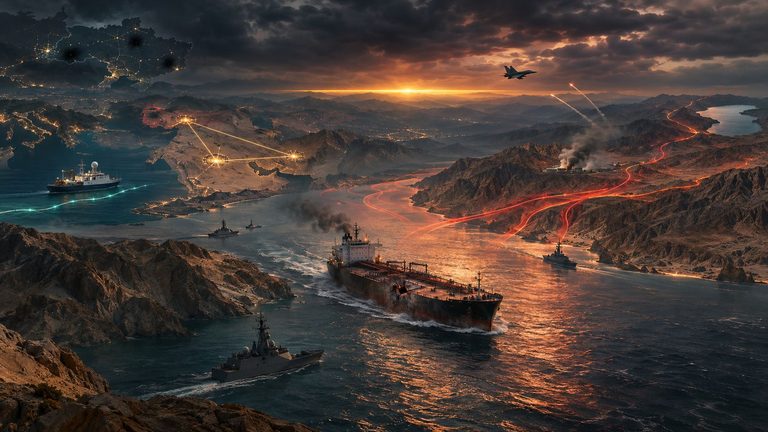
On October 30, Iran’s Islamic Revolutionary Guard Corps stated that 4 tankers had struck mines or caught fire while traveling along unauthorized routes south of the Strait of Hormuz. They reportedly included a very large crude carrier carrying more than 2 million barrels. The scale and cause of these incidents had not been fully and independently confirmed by the editorial deadline. Reuters reported the IRGC’s account, while UKMTO documented several specific incidents: an outbound tanker was struck by an unidentified projectile, and another vessel reported an attack south of Iran’s Lavan Island. According to the available reports, the crews were unharmed. The verified findings are therefore narrower than the Iranian account, but they are by no means inconsequential: shipping remains exposed to a real and recurring risk of attack.
THE UNITED STATES AND IRAN – A POST-MIDTERM STRIKE OPTION, BUT NO CONFIRMED ORDER
The United States informed several Gulf partners of possible strikes against Iranian targets after the November 03 midterm elections. According to reporting by AP and ABC News, American and Israeli planners have developed target options and response scenarios. At the same time, the White House stated that no strike was planned before Election Day and that Donald Trump had not yet made a final decision. The widely circulated claim that a strike date has already been set is therefore unsubstantiated. What is substantiated is the military preparation: AP reported that the Theodore Roosevelt was ordered toward the region, where it is expected to join the George Washington and George H.W. Bush carrier strike groups. In addition, the Makin Island Amphibious Ready Group, carrying the 13th Marine Expeditionary Unit, is deploying to the region. This is a third carrier on the way, not a fourth.
DOHA – THE NEGOTIATING CHANNEL REMAINS OPEN
Iranian negotiators met with Qatari mediators in Doha on October 31 after more than 12 hours of prior consultations in Tehran. Qatar said it had coordinated with Washington. Tehran did not accept a Qatari proposal to open the Strait of Hormuz for 7 days. Iran continues to insist on a counterproposal: an end to the American blockade of Iranian ports, the release of frozen assets, and an Iranian-controlled corridor through Hormuz. Only then would the strait be reopened. Washington has not accepted this linkage. Secretary of State Marco Rubio said Trump preferred a diplomatic solution but was keeping military options available, as Reuters reported from the Doha talks.
BAB AL-MANDAB – HIGHEST SECURITY LEVEL FOR NORWEGIAN VESSELS
The Bab al-Mandab Strait is not formally closed. Nevertheless, ISPS security level 3, the highest level, has applied to Norwegian vessels there since October 30. Level 2 applies in the southern and northern Red Sea regions and the northern Gulf of Aden. The Norwegian Maritime Authority attributes this to a probable or imminent threat from missiles, drones, and small attack craft. Hormuz and Bab al-Mandab are therefore not blockaded in the same way, but both are under military threat at the same time. Shipowners, insurers, and crews must treat 2 key gateways between Europe, Asia, and the Gulf states as high-risk areas.
YEMEN AND SAUDI ARABIA – DRONE INTERCEPTIONS AND NEW ATTACK REPORTS
On October 30, the Saudi-led coalition reported intercepting a Houthi drone over Saudi Arabia’s oil-rich Eastern Province and another projectile headed south. Missile attacks on Aden airport and government facilities were also reported from Yemen. No fatalities were initially confirmed. The Houthis again denied attacking the holy cities of Mecca and Medina and described the corresponding Saudi claims as false. The competing accounts remain irreconcilable in part. What is undisputed is that airports, energy-producing regions, and sea lanes remain part of the theater of operations.
MECCA ALLIANCE – TURKEY APPROVES, IRAN AND SYRIA CONSIDER JOINING
On October 27, the Turkish parliament’s Foreign Affairs Committee approved the 10-year defense agreement with Saudi Arabia and Pakistan. A vote in the full parliament is still required before it can enter into force. The agreement treats an armed attack on any of the 3 countries as an attack on all and covers exercises, intelligence sharing, technology transfer, and joint production. On October 30, Pakistan’s military spokesperson said the wording did not exclude additional members; when asked about Iran, he said that any state with a shared vision was welcome in principle. Admission, however, would remain a political decision. One day later, Syrian Foreign Minister Asaad al-Shaibani confirmed talks about possible membership but mentioned neither an application nor a timetable.
TURKEY AND SYRIA – ANKARA HELPS BUILD SYRIA’S NAVY
On October 28, the Turkish Ministry of National Defense confirmed that a high-level naval delegation had visited the Syrian port of Latakia on October 22. It included representatives of the Istanbul Naval Shipyard Command, the logistics and training commands, and the state-controlled defense company ASFAT. The objective was to expand the capabilities of the Syrian navy. The visit took place a few days before the reporting period but was officially contextualized only this week. It shows that Turkish-Syrian cooperation extends beyond land-based training to include shipyards, logistics, and naval forces.
ISRAEL, TURKEY, AND SYRIA – THE SECURITY COUNCIL AS THE STAGE FOR A LEGALLY ASYMMETRICAL CONFRONTATION
Israel had warned the Security Council about a growing Turkish military presence in Syria and accused Ankara of expanding Syrian capabilities. Turkey responded that its military cooperation was taking place with the consent of Syria’s sovereign government and was not directed against any third country. Syria, in turn, affirmed its right to choose its own partners. The new naval cooperation gives this dispute additional substance. The legal starting point remains asymmetrical: Turkey invokes Syria’s invitation. Israel has neither a Syrian invitation nor a Security Council mandate for its attacks and presence on Syrian territory. Israel has occupied the Syrian Golan Heights since 1967 and carried out an unlawful annexation in 1981 by extending its laws, administration, and jurisdiction to the territory. UN Security Council Resolution 497 unanimously declared that step null and void and demanded its rescission. Israel did not comply.
ISRAEL AFTER THE ELECTION – NO BLOC REACHES 61 SEATS
The final election result gives the bloc led by Benjamin Netanyahu 53 of the Knesset’s 120 seats. The Zionist opposition parties hold a combined 48 seats, while Arab-led lists have 19. Likud remains the largest party with 27 seats, followed by Gadi Eisenkot’s Yashar with 21. Neither the government nor the opposition can therefore form a majority without additional partners. Eisenkot and Yair Lapid are coordinating talks on a broad government. Avigdor Lieberman rejects a coalition dependent on Arab parties. President Isaac Herzog is expected to receive the official results on November 04, and the new Knesset will convene on November 10. Until then, the military command and decision-making structure remains under the incumbent government.
HEBRON – MORE THAN 3,000 PEOPLE DISPLACED
Following the October 23 attack in which 2 armed Palestinians killed 2 Israeli soldiers, the Israeli military expanded its operation in and around Hebron. According to Reuters and UN agencies, more than 3,000 Palestinians were displaced from their homes. Houses, stores, roads, and factories were destroyed or damaged, and numerous access routes remained closed. Israel describes the operation as a measure against militant networks and possible supporters. UN High Commissioner for Human Rights Volker Türk raised concerns about disproportionate force and collective punishment. He said threats to empty or eradicate entire neighborhoods raised serious concerns about ethnic cleansing. The UN figures remain under review.
KALININGRAD AND THE BALTICS – LARGE NATO EXERCISE, NO NEW RUSSIAN BUILDUP
On October 26, the multinational NATO exercise Resolute Reforger 2026 began in eastern Latvia with approximately 3,000 troops and 1,000 vehicles. The exercise covers logistics, force movement, and the protection of NATO’s eastern border. At the same time, the German brigade stationed in Lithuania demonstrated its capabilities for electronic reconnaissance of Russian and Belarusian signals. These capabilities are part of the existing Vigilant Owl system and do not constitute a new deployment. Lithuania reported 2 NATO quick-reaction alerts during the previous week but no confirmed violation of its own airspace. Russian units conducted routine exercises in drone defense and electronic warfare. No new Russian troop buildup in Kaliningrad, blockade, or restriction of transit traffic was detected.
PAKISTAN AND AFGHANISTAN – CIVILIANS CAUGHT IN CROSS-BORDER FIRE
Pakistan stated that Afghan Taliban forces had shelled homes and a market in North Waziristan on October 28, killing 1 civilian and injuring 5 people. Pakistani forces returned fire. The Taliban government in Kabul presented a different account, accusing Pakistan of carrying out a drone strike near its security facilities in Paktika Province; it claimed that Pakistani soldiers had been killed or wounded. Reuters could not independently verify the central claims made by either side. No larger follow-up attack was reported by the editorial deadline. The border nevertheless remains an active military contact line where local incidents can quickly assume interstate significance.
SOUTH CHINA SEA – CHINA CONDUCTS COMBAT-READY PATROL AROUND SCARBOROUGH SHOAL
On October 30, the Southern Theater Command of China’s People’s Liberation Army conducted a joint naval and air patrol around Scarborough Shoal. Beijing described the operation as a combat-readiness patrol and a response to Philippine “violations and provocations.” The China Coast Guard operated in the area at the same time. No immediate Philippine response was initially available. Reuters reported the combined Chinese patrol. The shoal is controlled by China and claimed by the Philippines. The 2016 arbitral award rejected China’s sweeping historic-rights claims in the South China Sea; Beijing does not recognize the ruling. No clash was reported this week, but the parallel deployment of the navy and coast guard increases pressure on Manila.
TAIWAN – CHINESE COAST GUARD OFF THE EAST COAST AND PRATAS
On November 01, Taiwan’s coast guard accused China of harassing shipping off Taiwan’s east coast with 2 patrol vessels. The Chinese ships asserted jurisdiction by radio, prompting Taiwan to deploy vessels of its own. On October 31, a Chinese coast guard vessel had already approached the Taiwan-controlled Pratas Islands in the South China Sea. Taipei views such operations as tests of a potential blockade. That is a Taiwanese assessment, not an independently verified Chinese operational order. The episode is nevertheless relevant because China is increasing its coast guard presence in several contested areas simultaneously.
ANALYSIS I – TURKEY, SYRIA, AND THE MECCA ALLIANCE: A NEW SECURITY ARCHITECTURE EMERGES
The Mecca alliance remains somewhere between a treaty and a functioning military structure. Approval by a Turkish parliamentary committee is an important step, but it replaces neither a vote in the full parliament nor joint commands, rules of engagement, or permanently assigned forces. For now, the collective-defense language creates a political commitment. Its military value will depend on which early-warning systems, air defenses, naval forces, munitions, and production capacities the 3 states actually connect.
That is precisely why Iran and Syria are strategically significant. Iran has large missile and drone arsenals, combat experience, and direct access to Hormuz. Syria lies on the eastern Mediterranean coast and forms the land bridge between Turkey, Iraq, Jordan, and Lebanon. Iranian membership would strengthen the alliance militarily while placing considerable strain on Turkey’s, Saudi Arabia’s, and Pakistan’s relations with Washington. Pakistan’s travel and mediation diplomacy among Riyadh, Ankara, Doha, and Tehran shows that the option is being prepared politically. It does not yet prove that admission has been decided.
Turkey’s assistance to the Syrian navy demonstrates how expansion can occur even without formal membership. Shipyards, training, logistics, and defense companies create lasting relationships. They increase Syria’s state capabilities and bind its security institutions to Ankara. Israel sees this as a potential future threat and has brought that concern before the Security Council.
Israel’s complaint, however, cannot be separated from its own presence. The Golan Heights are Syrian territory under Israeli occupation; the 1981 annexation is null and void under Resolution 497. In addition, Israel has carried out attacks and advanced into further Syrian territory after Assad’s fall. Article 2(4) of the UN Charter generally prohibits the use of force against the territorial integrity or political independence of any state. Israel invokes security and self-defense. Syria and Turkey counter that cooperation approved by Damascus cannot be equated with an uninvited military presence. It is precisely this legal and political asymmetry that makes the situation so combustible.
BEYOND THE THEATER
If the Mecca alliance were to admit Iran or Syria, it would link the Gulf, the Red Sea, and the eastern Mediterranean within a single security structure. The open question of accession alone is already forcing Israel, the United States, and the Gulf states to revise their planning. The decisive issue is not whether the alliance will wage war jointly tomorrow, but whether it will permanently reorder armaments, training, and deterrence.
STRATEGIC ASSESSMENT: Iranian membership is plausible but has not been decided. The substantiated development this week is narrower: Turkey, Pakistan, and Saudi Arabia are expanding the treaty structure; Syria is considering joining; Pakistan is keeping the door open for Iran; and Ankara is already creating practical military links in Syria.

ANALYSIS II – GREAT SEA INTERCONNECTOR: A CABLE BECOMES A MILITARY RISK
The French-flagged survey and work tug Abeille Marengo arrived in Heraklion on October 27. It is expected to conduct surveys east of Crete and Kasos for the Great Sea Interconnector. The EU-supported power cable is intended to connect Greece and Cyprus initially and possibly Israel later. By the editorial deadline, the vessel was waiting for the Greek NAVTEX required for the actual operation. The ship’s arrival had therefore not yet produced a new survey run in the disputed section.
The distinction from an already ongoing telecommunications survey is important. Greece and Turkey issued competing navigational notices for work by the Kobi Ruegg southeast of Crete. Athens declared the Turkish notice invalid, while Ankara claimed jurisdiction over parts of the area. That operation is not part of the Great Sea Interconnector. It does, however, illustrate the pattern that awaits construction of the power cable: every technical voyage can become a practical test of conflicting maritime claims.
Greece maintains that it does not require Turkish consent for work in its own exclusive economic zone. Turkey disputes parts of the Greek delimitation and demands coordination. Cyprus and Israel view the cable as a strategic energy link. Four interests therefore converge: European energy policy, the Greek-Turkish maritime boundary dispute, the division of Cyprus, and Israeli energy security.
The military dimension arises not from the cable itself but from its protection. Survey vessels are slow, predictable, and bound to predetermined routes. If warships or coast guard vessels escort them, a Turkish counterdeployment would reduce the distance between armed units. Both sides could claim that they were merely protecting civilian work or their own sovereign rights. An accident, a threatened collision, or a forced course change would then immediately take on political significance.
BEYOND THE THEATER
The interconnector links the Aegean and Cyprus disputes with the Israeli-Turkish rivalry. At the same time, Turkey and Egypt will conduct a joint naval exercise off Alexandria from November 04 to 09, while the commander of the Hellenic Air Force will visit his Turkish counterpart from November 03 to 05. Deterrence and confidence-building are proceeding in parallel.
STRATEGIC ASSESSMENT: There has been no incident and no new GSI NAVTEX yet. The arrival of the Abeille Marengo, however, turns an abstract infrastructure dispute into an impending operation. The decisive question will be whether Ankara responds with a counter-notice, an escort vessel, or diplomacy alone.
ANALYSIS III – UKRAINE: HUMANITARIAN CEASEFIRE AND STRATEGIC DEPENDENCE
The 6-day local ceasefire around Oleshky, in the Russian-controlled part of the Kherson region, held until November 01. Aid convoys reached the city, mines were cleared from access routes, and civilians were able to leave. According to available reports, 25 buses and 9 ambulances were deployed. Some evacuees returned to Ukrainian-controlled territory via Crimea, Russia, and Belarus. It was the first jointly organized operation of its kind in years.
The success remained narrowly confined. Both sides continued their attacks on other sections of the front. Russia struck Ukrainian energy and rail infrastructure; an attack on a train platform in Dnipro killed numerous people. Ukraine continued attacking targets in Russia and in Russian-controlled areas. Oleshky is therefore not a precursor to a general ceasefire, but it demonstrates that local military arrangements are technically enforceable when both sides accept a clearly limited objective.
Volodymyr Zelenskyy met Recep Tayyip Erdoğan in Istanbul on October 31. Erdoğan pressed for safe shipping in the Black Sea and an end to attacks on civilian vessels. Turkey again offered to mediate and host talks. Zelenskyy discussed further negotiations involving the United States and possible meetings in Abu Dhabi; no binding date had been set.
At the same time, Washington approved the sale of 500 PAC-3 MSE interceptor missiles worth approximately $2.1 billion. Canada, Germany, Norway, and Ukrainian and European credit facilities are expected to finance the package. Under the arrangement as reported, no US budget funds are planned. Approval, however, does not mean immediate delivery. The missiles must be produced, and the schedule extends far beyond the immediate need. Kyiv therefore continues to call for missiles to be released from existing American or European stockpiles and replaced later.
BEYOND THE THEATER
The Patriot sale demonstrates Europe’s structural problem: Europe pays, but the critical technology, production authorization, and a substantial part of the supply chain remain American. The same pattern applies to intelligence, satellite communications, and other complex systems. Even politically generous European financing therefore cannot create strategic autonomy in the short term.
STRATEGIC ASSESSMENT: Oleshky demonstrates the possibility of local agreements. The Patriot sale demonstrates the limits of European power. Together, they show that humanitarian relief can be negotiated in the short term, while the overall military balance remains dependent on production capacity and American decisions.
ANALYSIS IV – ISRAEL AFTER THE ELECTION: PARLIAMENTARY DEADLOCK, MILITARY CONTINUITY
The election did not produce a viable governing majority. Netanyahu’s bloc is 8 seats short, and the Zionist opposition is 13 seats short. Mathematically, Arab-led parties could make a majority possible. Politically, several potential partners reject such dependence. A coalition-building process is therefore beginning in which defections, minority-government models, or an unusually broad coalition are more likely than a clear shift from one camp to another.

This parliamentary deadlock does not end ongoing military operations. The caretaker government and the military leadership remain capable of acting while the parties negotiate. This applies to Gaza, Lebanon, Syria, the West Bank, and preparations involving Iran or Turkey. It would therefore be premature to claim that the election has produced a political decision on these fronts.
Hebron demonstrates the continuity particularly clearly. The deadly attack on Israeli soldiers was a concrete armed incident. The operation that followed, however, extends far beyond the immediate pursuit of the 2 attackers who were killed. Thousands of people were displaced, roads and buildings were destroyed, access routes were blocked, and medical care and education were disrupted. Israel justifies these measures as necessary to dismantle militant infrastructure. UN agencies see indications of collective punishment and warn of the permanent emptying of affected neighborhoods.
The assessment must distinguish among these levels. The attack on the soldiers and the Israeli response are documented events. Whether individual demolitions were militarily necessary cannot be determined for every building from publicly available information. The scale of the displacement and the threats against entire neighborhoods are also documented, however. They cannot be excluded from the analysis by invoking the original attack.
BEYOND THE THEATER
A protracted government formation process increases the influence of institutions that continue operating without a new coalition: the military, the security cabinet, and existing ministries. Foreign actors therefore cannot assume that Israeli operations will pause until a government is formed. At the same time, every escalation will become part of coalition negotiations, because parties can exploit security-policy hawkishness or restraint for domestic political purposes.
STRATEGIC ASSESSMENT: Israel is politically deadlocked but not militarily paralyzed. The next turning point is less the distribution of seats than whether a coalition emerges that changes the existing multi-front posture. Until then, the operational evidence points to continuity.
ANALYSIS V – HORMUZ AND BAB AL-MANDAB: TWO STRAITS AT THE CENTER OF ESCALATION
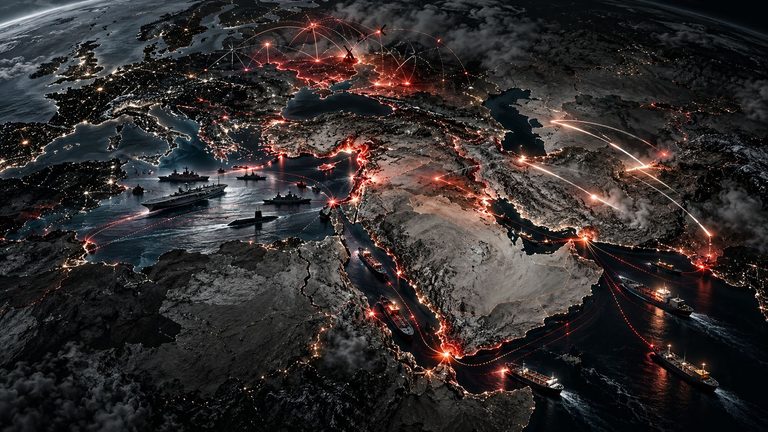
Hormuz and Bab al-Mandab are 2 parts of the same strategic chain, but they are not the same conflict. Iran controls escalation in Hormuz through coastal forces, mines, missiles, drones, and the political regulation of authorized routes. The Houthis threaten Bab al-Mandab and the Red Sea with their own missiles, drones, and small boats. Their decisions are connected to Tehran, but they are not identical to, or directly controlled by, Iran in every individual case.
The American reinforcement responds to this multi-layered threat. Carrier-based aircraft provide range for strikes and air defense. Amphibious groups bring Marines, helicopters, landing capabilities, and command-and-control assets. This does not automatically imply a planned ground invasion of Iran. The deployed forces do, however, enable evacuations, base protection, limited special operations, and strikes against coastal positions. They therefore expand Trump’s options after November 03.
The reinforcement has an understandable basis. An AP analysis documented damage to structures at 26 American bases and facilities from more than 115 Iranian or Iran-aligned attacks. Radars and air defenses were struck first, followed by aircraft, hangars, communications, fuel, and accommodations. According to the analysis, at least 15 American aircraft were damaged. Washington is therefore protecting not only trade routes but also a vulnerable regional base network.
Tehran is linking its capacity for military response to a negotiating offer. It proposes trading an opening of Hormuz for an end to the port blockade, the release of assets, and recognition of an Iranian-controlled corridor. Washington, by contrast, demands free passage without an Iranian authorization regime. The dispute is therefore not only about ships but also about who sets the rules of passage.
BEYOND THE THEATER
Every disruption in Hormuz increases the importance of alternative Saudi and Emirati pipelines. Every disruption at Bab al-Mandab lengthens routes around the Cape of Good Hope. If both risks materialize at once, insurance, fuel, and transport costs rise across the entire supply chain. States in Asia, Africa, and Europe will be affected economically even though they are not militarily involved.
STRATEGIC ASSESSMENT: An American strike has been prepared but not ordered. A diplomatic solution is being negotiated but has not been agreed. The most dangerous phase lies precisely between those 2 points: numerous forces are present in the theater, both sides have declared public red lines, and a single tanker strike or attack on a US base could narrow the political room for decision within hours.
WEEKLY CONCLUSION – OVERALL STRATEGIC ASSESSMENT
This week reveals 2 interconnected lines of development.
The first is the militarization of transportation arteries. Hormuz and Bab al-Mandab are no longer merely sea lanes; they have become instruments of pressure. The Great Sea Interconnector is not a military project, but competing maritime claims are turning it into a possible point of contact between armed units. In the Black Sea as well, Turkey is calling for safe civilian shipping because attacks on ports and vessels directly affect negotiations. Freedom of movement is thus becoming a form of strategic currency in several theaters.
The second line is the reordering of protection. The Mecca alliance is creating a structure that Iran and Syria may be able to join. Turkey is building Syrian capabilities. Israel is responding with warnings and invoking its own security while occupying Syrian territory and maintaining its unlawful annexation of the Golan Heights. In Europe, Germany, Canada, Norway, and Ukraine are financing American Patriot missiles whose production and release they do not control independently. Protection is promised, but its concrete availability remains unevenly distributed.
The common conclusion is therefore not that a major war is inevitable. It is that more and more states are simultaneously creating the conditions for several possible wars. Carrier strike groups are deploying, alliances are opening themselves to new members, navies are being built, interceptor missiles are being ordered, and survey vessels are being positioned. At the same time, diplomatic channels remain open: Doha, Istanbul, Oleshky, and Greek-Turkish military contacts show that de-escalation remains possible.
Concrete decisions will matter in the coming week: Will Trump issue a strike order after November 03, or will he continue along the Doha track? Will Greece issue the NAVTEX for the Abeille Marengo, and how will Ankara respond? Will a viable coalition begin to take shape in Israel? Will the Oleshky ceasefire be repeated? And will the open door of the Mecca alliance become a formal accession process for Syria or Iran?

About the Author
Michael Hollister
is a geopolitical analyst and investigative journalist. He served six years in the German military, including peacekeeping deployments in the Balkans (SFOR, KFOR), followed by 14 years in IT security management. His analysis draws on primary sources to examine European militarization, Western intervention policy, and shifting power dynamics across Asia. A particular focus of his work lies in Southeast Asia, where he investigates strategic dependencies, spheres of influence, and security architectures. Hollister combines operational insider perspective with uncompromising systemic critique – beyond opinion journalism. His work appears on his bilingual website (German/English) www.michael-hollister.com and in investigative outlets across the German-speaking world and the Anglosphere.
Stay informed without having to work through the daily flood of news – the most important developments and connections summarized for you.
Sources
Hormuz, Iran, the United States, and the Red Sea
[1] Reuters: Iran’s IRGC navy says two tankers stopped south of Hormuz after incidents, October 30, 2026.
https://www.reuters.com/world/middle-east/irans-irgc-navy-says-two-tankers-stopped-south-hormuz-after-incidents-2026-10-30/
[2] United Kingdom Maritime Trade Operations: Warnings and incident reports for the Gulf region, reports of October 29 and 30, 2026.
https://www.ukmto.org/
[3] Associated Press: US warns Gulf allies to prepare for possible strikes on Iran after midterms, October 31, 2026.
https://apnews.com/article/c7df622f1e87de6035173be8fb8c4add
[4] USNI News: Fleet and Marine Tracker: October 26, 2026, October 26, 2026.
https://news.usni.org/2026/10/26/usni-news-fleet-and-marine-tracker-oct-26-2026
[5] Associated Press: US orders third aircraft carrier toward the Middle East, October 30, 2026.
https://apnews.com/article/42c23e9af0333f4bc3b4f419cc3a603e
[6] Reuters: Iranian envoys meet Qatari mediators as threat looms of US strikes after midterms, October 31, 2026.
https://www.reuters.com/world/middle-east/iranian-envoys-meet-qatari-mediators-threat-looms-us-strikes-after-midterms-2026-10-31/
[7] Associated Press: Iranian and allied strikes damaged structures at 26 US bases and sites, October 29, 2026.
https://apnews.com/article/26e0f05e01d6f56ff46f7c1a14384f7c
[8] Norwegian Maritime Authority: Security level for Norwegian vessels – Gulf of Aden, Bab el-Mandeb and Red Sea, updated October 30, 2026.
https://www.sdir.no/en/accidents-and-safety/maritim-sikring/security-level-for-norwegian-vessels/gulf-of-aden-bab-el-mandeb-red-sea
[9] Reuters: Saudi-led coalition says it destroyed Houthi drones, October 30, 2026.
https://www.reuters.com/world/middle-east/saudi-led-coalition-says-it-destroyed-houthi-drone-over-medina-region-2026-10-30/
[10] Associated Press: Missile and drone incidents widen across Yemen and Saudi Arabia, October 31, 2026.
https://apnews.com/article/7f7f34ceb62f294a450e48ace0bd56e0
Mecca Alliance, Turkey, Syria, and Israel
[11] Associated Press: Turkish parliamentary committee approves Mecca Joint Defence Agreement, October 27, 2026.
https://apnews.com/article/b75b3e02240f55d364b3072c2300ad36
[12] Reuters: Pakistan military cautiously optimistic on Iran-US mediation, October 30, 2026.
https://www.reuters.com/world/asia-pacific/pakistan-military-cautiously-optimistic-iran-us-mediation-2026-10-30/
[13] Al Jazeera, citing the Syrian foreign minister: Syria considering entry into Mecca defence pact, October 31, 2026.
https://www.aljazeera.com/news/2026/10/31/syria-considering-entry-into-mecca-defence-pact-says-foreign-minister
[14] Turkish Ministry of National Defense: Weekly Press and Information Meeting, October 28, 2026.
https://www.msb.gov.tr/SlaytHaber/8a445b9c2868429d9314eda55017fc6a
[15] United Nations: The situation in the Middle East – Syria, Security Council, 10225th meeting, September 17, 2026.
https://transcripts.un.org/en/sc/10225
[16] United Nations: Security Council Resolution 497 (1981) – Occupied Syrian Golan Heights, December 17, 1981.
https://www.un.org/unispal/document/auto-insert-180751/
[17] United Nations: Charter of the United Nations – Article 2, accessed November 01, 2026.
https://www.un.org/en/about-us/un-charter/full-text
Great Sea Interconnector and the Eastern Mediterranean
[18] Athens-Macedonian News Agency: French-flagged Abeille Marengo in Crete to start surveys for GSI power cable, October 27, 2026.
https://www.amna.gr/en/article/1034439/French-flagged-Abeille-Marengo-in-Crete-to-start-surveys-for-GSI-power-cables
[19] Reuters: EU-backed east Mediterranean undersea cable project applies to resume seabed surveys, October 15, 2026.
https://www.reuters.com/business/energy/eu-backed-east-mediterranean-undersea-cable-project-applies-resume-seabed-2026-10-15/
[20] Geopolitiki: Greece and Turkey issue competing NAVTEX notices southeast of Crete, October 29, 2026.
https://geopolitiki.com/greece/navtex-south-east-crete-emc-cable-kobi-ruegg-heraklion-declares-turkish-notice-void-antalya-1067/
[21] Turkish Ministry of National Defense: Türkiye-Egypt Friendship Sea 2026 exercise, October 30, 2026.
https://www.msb.gov.tr/Basin-ve-Yayin/Aciklamalar/9ea0702de40d4a7282b24de206a3f32c
Ukraine and Russia
[22] Reuters: US approves $2.1 billion Patriot missile sale to Ukraine, October 30, 2026.
https://www.reuters.com/business/aerospace-defense/us-approves-21-billion-patriot-missile-sale-ukraine-2026-10-30/
[23] Reuters: Aid convoy sets off for Russian-held town of Oleshky, October 30, 2026.
https://www.reuters.com/world/europe/aid-convoy-sets-off-russian-held-town-oleshky-ukraine-izvestia-says-2026-10-30/
[24] Associated Press: Humanitarian convoy arrives in Oleshky during local ceasefire, October 31, 2026.
https://apnews.com/article/5cbc7d2a5b8ac34b15c914338fd5a9f3
[25] President of Ukraine: Meeting with President Erdoğan in Istanbul, October 31, 2026.
https://www.president.gov.ua/en/news/nastupnogo-tizhnya-ukrayina-ochikuye-zbilshennya-postachanny-107101
[26] Presidency of the Republic of Türkiye: We stand ready to make every effort to pave the way for peace, October 31, 2026.
https://www.iletisim.gov.tr/English/haberler/detay/we-stand-ready-to-make-every-effort-within-our-power-to-pave-the-way-for-peace
Israel and the Occupied West Bank
[27] Associated Press: Israel election leaves Netanyahu and opposition without a governing majority, October 30, 2026.
https://apnews.com/article/3a793c0d07fdfe515390524b849d8674
[28] Reuters: Israel demolishes gunmen’s homes in West Bank operation that has displaced thousands, October 30, 2026.
https://www.reuters.com/world/middle-east/israel-demolishes-gunmens-homes-west-bank-operation-that-has-displaced-thousands-2026-10-30/
[29] United Nations in Palestine: West Bank: Hebron crackdown displaces thousands; Türk warns of ethnic cleansing, October 30, 2026.
https://palestine.un.org/en/325195-west-bank-hebron-crackdown-displaces-thousands-t%C3%BCrk-warns-ethnic-cleansing
[30] UN OCHA: Humanitarian Situation Report, October 29, 2026.
https://www.ochaopt.org/content/humanitarian-situation-report-29-october-2026
Kaliningrad and the Baltics
[31] National Armed Forces of Latvia: NATO Multinational Brigade Latvia exercise Resolute Reforger 2026, October 26, 2026.
https://www.mil.lv/lv/zinas/latvijas-austrumu-dala-notiks-nato-daudznacionalas-brigades-latvija-rikotas-militaras-macibas
[32] Reuters: Germany’s brigade in Lithuania monitors Kaliningrad and Belarus with electronic warfare, October 28, 2026.
https://www.reuters.com/world/germany-brigade-lithuania-monitor-kaliningrad-belarus-with-electronic-warfare-2026-10-28/
[33] Ministry of National Defense of Lithuania: Data on interceptions of aircraft near the Baltic States’ borders, October 19-25, 2026, October 26, 2026.
https://kam.lt/en/data-on-interceptions-of-aircraft-completed-near-the-baltic-states-borders-on-october-19-25-2026/
Pakistan, Afghanistan, the South China Sea, and Taiwan
[34] Reuters: Pakistan says Afghan firing kills one in border district, October 28, 2026.
https://www.reuters.com/world/asia-pacific/pakistan-says-afghan-firing-kills-one-border-district-2026-10-28/
[35] Reuters: China conducts combat readiness patrols around disputed shoal in South China Sea, October 30, 2026.
https://www.reuters.com/world/china/china-conducts-combat-readiness-patrols-around-disputed-shoal-south-china-sea-2026-10-30/
[36] Reuters: Taiwan says China harassing shipping with east coast patrol, November 01, 2026.
https://www.reuters.com/world/china/taiwan-says-china-harassing-shipping-with-east-coast-patrol-2026-11-01/
[37] Permanent Court of Arbitration: The South China Sea Arbitration – Philippines v. China, award of July 12, 2016.
https://pca-cpa.org/en/cases/7/
© Michael Hollister – Redistribution expressly encouraged.
I am pleased when my articles, commentaries, and analyses attract interest and are shared. Reproduction, distribution, and publication of my texts, in whole or in part, on other websites, blogs, or in other publications is expressly permitted and encouraged. No prior permission is required.
The sole requirement: Michael Hollister must be clearly and prominently identified by name as the author. In addition, a clearly visible, clickable link to the original website, www.michael-hollister.com, must be included.
Reuse without author attribution and a link is not permitted.
If this work helps you understand what lies behind the headlines, consider supporting it. Membership starts at $5 per month, includes access to all supporter-only analyses, and can be cancelled at any time.