by Michael Hollister
Exclusive published at Michael Hollister on October 18, 2026
2.611 words * about 14 minutes readingtime

When Kristalina Georgieva stepped up to the podium at the Lee Kuan Yew School of Public Policy in Singapore on October 07, 2026, she did not deliver a routine economic briefing. Her “Curtain Raiser” ahead of the IMF Annual Meetings, underway in Bangkok, Thailand, since October 12, was a warning in three parts. The global economy, the managing director of the International Monetary Fund said, is being pulled in two directions at once: by a negative energy supply shock from the Middle East and a positive demand shock driven by artificial intelligence. Both forces are fueling inflation. And both are hitting a public sector whose debt has reached its highest level since World War II.
What is truly remarkable about this speech is not the list of risks. It is the bill taking shape behind them – one Georgieva does not spell out. An energy crisis, record debt, and an unrestrained AI investment boom are converging at a moment when Western governments simultaneously want to rearm, cushion energy costs, finance their social safety nets, and keep pace with technological transformation. Four burdens, one exhausted fiscal capacity. The Fund is calling for spending restraint and tighter monetary policy. It does not say who will ultimately pay.
The Energy Shock: A War Reflected in Prices
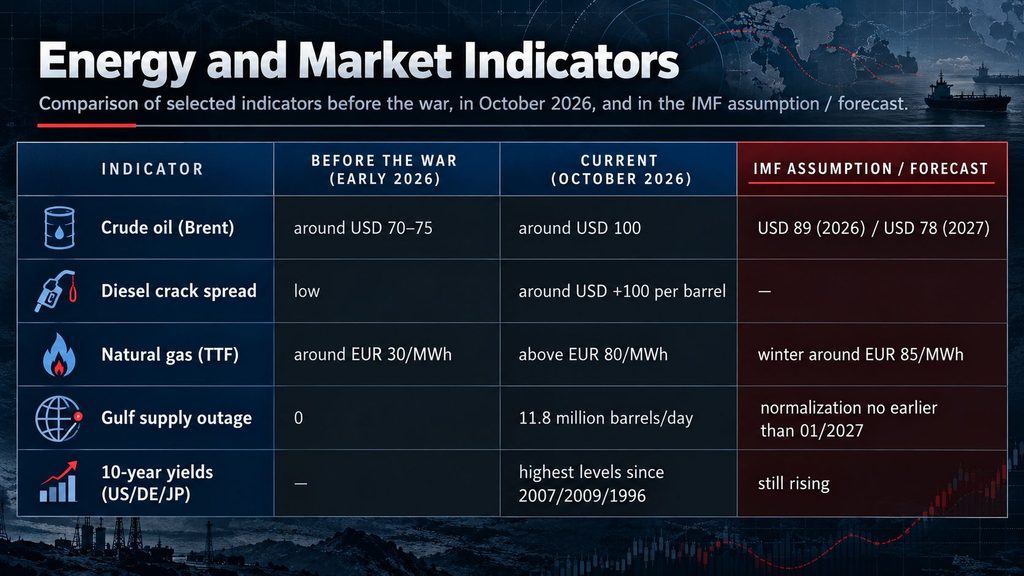
Let us begin where the shock is physical. Georgieva put crude oil at roughly $100 a barrel – and added a figure that went largely unnoticed in the coverage: damaged refining capacity is adding another roughly $100 per barrel in “crack spread” margins, the premium for refined products such as diesel. The Fund’s own July forecast had still assumed averages of $89 for 2026 and $78 for 2027, based on the expectation that the Strait of Hormuz would reopen beginning in mid-2026. Actual prices are considerably higher. Brent futures point to elevated prices well into 2027.
Behind those figures is a war. Since February 28, 2026, the United States and Israel have been at war with Iran; Tehran has repeatedly closed the Strait of Hormuz, through which roughly one-fifth of seaborne oil passes. Energy consultancy Rystad calls this the most severe supply disruption of the modern oil era: Some 11.8 million barrels per day of production have been lost across six Gulf producers, while liquefied natural gas shipments have fallen from around five vessels a day to virtually zero. Rystad considers a full normalization of shipping routes unlikely before January 2027. Georgieva announced that the steepest downward revisions in the IMF’s new growth outlook would hit war-ravaged economies – Ukraine, with its destroyed civilian and economic infrastructure, and the Gulf states struck by Iranian attacks, where energy exports have collapsed. Two wars are being reflected in prices at the same time.
For Europe, this is expensive. Natural gas prices at the Dutch TTF trading hub have more than doubled since the beginning of 2026 and rose above €80 per megawatt-hour in September for the first time in three years. The EU lowered its gas-storage target for the start of winter from 90% to 80% – a quiet admission that the old targets can no longer be met. There is one consolation: The market remains far below the extreme prices of the 2022 crisis, when TTF briefly climbed above €350 per megawatt-hour. Italy is considered Europe’s most vulnerable major economy, combining rapid pass-through of price increases with heavy dependence on gas. The consequences extend into the bond markets. Georgieva noted that yields on 10-year government bonds in the United States, Germany, and Japan are at their highest levels since 2007, 2009, and 1996, respectively – and are still rising.
Record Debt – With Rearmament on Top
That brings us to the second factor, and the first side of the squeeze. Public debt, according to the Fund, has reached its highest level since World War II and will exceed 100% of global economic output before 2030. The April edition of the Fiscal Monitor laid out the trajectory: from 93.9% in 2025 to 95.3%, 97.2%, and 98.8%, reaching 100% in 2029. Under an adverse but plausible scenario, that ratio could rise to 123% by the end of the decade – only slightly below the all-time high of 132% immediately after the war. Georgieva identified advanced economies as the worst offenders, above all the United States, whose debt ratios exceed those of emerging and developing economies. Looking at individual countries, Japan tops the ranking at around 204%, followed by Italy, France at just over 118%, and the United Kingdom at approximately 104%; China’s ratio is rising rapidly toward 126% by 2031, while Germany remains comparatively low at around 64%. At the same time, according to the Fund, 55 countries are either in debt distress or on the verge of it, even though their debt ratios are often below 60%. The updated October edition of the Fiscal Monitor is being presented in Bangkok this week.
What matters is not just the amount, but the cost. Interest payments on global debt have risen from 2% to almost 3% of global economic output in four years. The U.S. deficit stands at 7% to 8% of gross domestic product, with no credible fiscal consolidation plan in place. Georgieva drew a stark conclusion: Governments can no longer rely on faster growth alone to solve their budget problems. She called for credible medium-term fiscal consolidation and a prudently restrictive monetary policy – and warned central banks against coming to the fiscal authorities’ rescue through bond purchases merely to relieve the pressure on them.
This is where it becomes political. Among the drivers of inflation and debt that Georgieva listed, she explicitly included higher defense spending. This is where rhetoric and reality diverge. At the NATO summit in The Hague on June 24 and 25, 2025, member states committed to a new target: 5% of GDP for defense by 2035, including 3.5% for core military spending and 1.5% for related security investments. The previous target had been 2%. For Germany, according to Chancellor Merz, each additional percentage point means roughly €45 billion more per year. A constitutional amendment has largely exempted defense spending from Germany’s debt brake and is intended to clear the way for spending above 3% by 2027 and 3.5% by 2029.
The scale is historic. According to data from the Stockholm International Peace Research Institute (SIPRI), global military spending reached a record $2.89 trillion in 2025 – the eleventh consecutive annual increase. Europe was the biggest driver, spending $864 billion, up 14%; military expenditures by European NATO countries rose faster than at any point since 1953. Germany recorded a 24% increase to $114 billion and, at 2.3% of GDP, crossed the 2% threshold for the first time since 1990; it also overtook China in arms exports, becoming the world’s fourth-largest arms exporter. Although U.S. spending fell 7.5% to $954 billion in 2025, SIPRI considers the decline temporary: Congress has already approved more than $1 trillion for 2026, and under President Trump’s plans, spending could reach as much as $1.5 trillion in 2027. At the EU level, “ReArm Europe” provides for a framework of €800 billion, including €650 billion from national budgets and €150 billion in joint loans. Anyone channeling that much money into armaments while the IMF calls for restraint is making a choice – not about whether to consolidate, but about who will bear the burden.

The AI Boom: Concentrated Profits, Shared Risk
The third factor pulls in the opposite direction. Artificial intelligence is acting as a positive demand shock – and Georgieva left no doubt about its scale: AI investment relative to economic output could soon exceed the levels once seen in railroads, power grids, or telecommunications. According to the Fund’s estimates, AI hardware already accounts for more than one-tenth of global merchandise trade. Used properly, according to the optimistic view, AI could add as much as half a percentage point to annual global economic growth.
That is one side of the picture. Georgieva was just as clear about the other: Rising economic and financial concentration is putting AI companies under pressure to justify their lofty valuations through productivity gains and higher profits. If those expectations are disappointed, a “far-reaching shock” could follow. The numbers support her warning. The five major hyperscalers are on track to invest $600 billion to $700 billion in 2026, roughly 60% more than the previous year; about three-quarters of that is going into AI infrastructure. Analysts at Dell’Oro expect cumulative data center investment to reach $1.7 trillion by 2030. Amazon alone has announced approximately $200 billion for 2026, and Microsoft more than $120 billion. Including the electricity supply needed to support it, planned investments add up to an estimated $5.2 trillion by the end of the decade.
Beneath the surface lies the real finding. The profits from the boom are extraordinarily concentrated: According to several analyses, the ten largest companies in the benchmark U.S. S&P 500 index account for roughly 43% of its market capitalization – more than at the height of the dot-com bubble in 2000, when the figure was about 26%. And a growing share of demand is financed in a circular arrangement. Bloomberg has mapped out a financing web worth more than $750 billion around chipmaker Nvidia: Nvidia invests in AI companies such as OpenAI; those companies use the money to buy Nvidia hardware, sending the revenue back. In 2026 alone, Nvidia announced financing-related deals worth more than $540 billion; at the same time, OpenAI struck a $90 billion chip deal with manufacturer AMD that also gives the AI lab options to acquire roughly one-tenth of AMD, and received a commitment of up to $100 billion from Nvidia. Critics compare the pattern to vendor financing in the telecommunications industry around the turn of the millennium and to the circular fraud at energy company Enron. Both the IMF and the Bank for International Settlements have flagged this circularity as a systemic downside risk; premiums on Nvidia credit default swaps surged to a record high in August 2026. CEO Jensen Huang rejects the allegation: The sums being invested, he says, are insignificant relative to the business they generate.
Findings
Put the three factors together, and the squeeze becomes complete. On one side, the IMF is calling for fiscal consolidation and restrictive monetary policy – cutting back and applying the brakes. On the other, those same capitals want to rearm, cushion energy costs, sustain their social safety nets, and keep up in the AI race, all at once. Four things cannot be funded simultaneously when fiscal room has run out. Something has to give. The Fund’s unspoken answer is embedded in its own language: When heavily indebted advanced economies consolidate their budgets, experience suggests that it is not defense spending that gets cut, but social spending. Georgieva’s warning against central banks coming to the fiscal authorities’ aid through bond purchases points in the same direction: The burden is not supposed to be diluted by the printing press but borne in real terms – by whom remains an open question.
Government budgets show that the direction has already been set. While the IMF calls for restraint, Germany exempts defense spending from its debt brake, the EU puts forward an €800 billion rearmament package, and SIPRI identifies a lasting structural shift – a move from civilian to military priorities. It is the transition from a peacetime economy to a war economy, carried out not by proclamation but through budget line items.
The sharpest finding, however, concerns the distribution of profits and risks. In the AI boom, returns are concentrated and partly inflated through a web of circular financing in which the risks are created privately but, in a crisis, would be socialized through financial markets. Even geographically, the profits of the boom are distributed unevenly; Georgieva said many countries are simply being left out. The energy crisis and the debt burden, by contrast, are already borne by the many. The far-reaching shock Georgieva warns about is therefore not a natural disaster. It is the potential bill for a structure in which profits flow upward and losses downward. In Singapore, the IMF laid out the line items of that bill for all to see. It left the question of who will pay it to governments.
About the Author
Michael Hollister is a geopolitical analyst and investigative journalist. He served six years in the German military, including peacekeeping deployments in the Balkans (SFOR, KFOR), followed by 14 years in IT security management. His analysis draws on primary sources to examine European militarization, Western intervention policy, and shifting power dynamics across Asia. A particular focus of his work lies in Southeast Asia, where he investigates strategic dependencies, spheres of influence, and security architectures. Hollister combines operational insider perspective with uncompromising systemic critique – beyond opinion journalism. His work appears on his bilingual website (German/English) www.michael-hollister.com and in investigative outlets across the German-speaking world and the Anglosphere.
Stay informed without having to work through the daily flood of news – the most important developments and connections summarized for you.
Sources
Speech and Key Statements
- Reuters, October 07, 2026 – “IMF chief warns energy shock, growing debt and AI risks threaten global growth”: https://www.kitco.com/news/off-the-wire/2026-10-07/imf-chief-warns-energy-shock-growing-debt-and-ai-risks-threaten-global
- IMF, October 07, 2026 – 2026 Annual Meetings Curtain Raiser, event page: https://www.imf.org/en/news/articles/2026/10/07/sp100726-2026-annual-meetings-curtain-raiser
- Bernama, October 07, 2026 – “IMF Says AI, Energy Prices, Public Debt Key Factors Shaping Global Economy”: https://bernama.com/en/news.php?id=2616747
Energy Shock and Gulf War
- World Oil, July 12, 2026 – U.S. strikes; Iran declares Strait of Hormuz closed: https://worldoil.com/news/2026/7/12/u-s-launches-new-iran-strikes-as-tehran-declares-strait-of-hormuz-closed/
- Reuters/Metrobank, June 11, 2026 – Oil prices, Hormuz closure, war beginning February 28, 2026: https://wealthinsights.metrobank.com.ph/news/oil-rises-dollar2-as-iran-announces-closure-of-strait-of-hormuz-following-us-strikes
- Freight News – Rystad: most severe supply disruption, 11.8 million barrels/day, LNG transit: https://www.freightnews.co.za/article/hormuz-recovery-unlikely-this-year-report
- Euronews, August 20, 2026 – European gas prices doubled; Italy most exposed: https://www.euronews.com/2026/08/20/europes-gas-prices-have-doubled-with-the-worst-yet-to-come
- GMK Center – TTF gas above €80/MWh in September 2026: https://gmk.center/en/news/european-gas-prices-exceeded-e80-mwh-in-september/
Public Debt
- Reuters/Zawya – IMF: highest debt burden since World War II; 123% scenario: https://www.zawya.com/en/economy/global/imf-sounds-alarm-about-high-global-public-debt-urges-countries-to-build-buffers-iff2igfd
- Il Sole 24 Ore – Fiscal Monitor: country details; 55 countries in debt distress: https://en.ilsole24ore.com/art/fmi-global-public-debt-over-100-per-cent-gdp-2029-AHiRzvAD
- Anadolu Agency – April Fiscal Monitor: trajectory from 93.9% to 100%; interest payments: https://aa.com.tr/en/economy/imf-sees-global-public-debt-at-100-of-gdp-by-2029-level-last-seen-after-world-war-ii/3906879
- Business Today – Government debt ratios in 2026: Japan, United States, France, United Kingdom: https://www.businesstoday.in/world/us/story/countries-with-the-most-government-debt-in-2026-where-india-stands-in-the-global-rankings-544620-2026-07-22
Rearmament and Military Spending
- OSW – NATO summit in The Hague: 5% target (3.5% + 1.5%) by 2035: https://www.osw.waw.pl/en/node/33296
- Bluewin – NATO agreement; Merz: approximately €45 billion per percentage point: https://www.bluewin.ch/en/news/international/nato-states-agree-on-defense-spending-2751347.html
- WisdomTree – Constitutional amendment; path to 3.5% by 2029: https://www.wisdomtree.com/ch/de/insights/blog/the-key-takeaways-from-the-nato-summit
- SIPRI/Eurointegration – Global military spending of $2.89 trillion; Europe +14%; Germany +24%: https://www.eurointegration.com.ua/eng/news/2026/04/27/7236312/
- Breaking Defense – U.S. spending above $1 trillion in 2026; up to $1.5 trillion in 2027: https://breakingdefense.com/2026/04/buoyed-by-european-rearmament-boost-global-military-spending-jumps-to-2-89-trillion/
- Future UAE – “ReArm Europe”: €800 billion, including €150 billion in SAFE loans: https://www.futureuae.com/en/Mainpage/Item/10846
AI Investment Boom
- Mobile World Live – Hyperscaler capital spending of $600–700 billion in 2026; Dell’Oro’s $1.7 trillion by 2030: https://www.mobileworldlive.com/microsoft/feature-data-centre-spending-spree-shows-no-sign-of-slowing/
- Long Yield – Amazon’s $200 billion, approximately 75% AI share, $5.2 trillion by 2030: https://longyield.substack.com/p/the-ai-capex-boom-bubble-or-infrastructure
- Startup Fortune/Bloomberg – Nvidia’s $750 billion financing web; IMF and BIS warnings: https://startupfortune.com/nvidias-750-billion-ai-financing-web-is-drawing-scrutiny-over-circular-money-flows/
- Fahad Badar – IMF “stretched valuations,” AMD deal with options, Nvidia commitment to OpenAI: https://fahadbadar.com/writing/The-potential-and-the-froth-within-the-bubble
- TMGM, August 2026 – Nvidia credit default swap premiums at a record high: https://www.tmgm.com/eng/analysis/market-news/nvidia-cds-record-high
- Investing Live – Huang rejects circular-financing allegations: https://investinglive.com/stocks/nvidia-s-huang-rejects-circular-financing-claims-as-investment-scrutiny-grows/
- Best Hub – Concentration: S&P 500 top ten at approximately 43%: https://www.besthub.dev/articles/nvidia-s-750b-ai-circular-financing-risks-and-decision-maker-playbook-for-2026-a3d09b70e0ae
© Michael Hollister – Republishing Expressly Encouraged.
I am pleased when my articles, contributions, and analyses generate interest and are shared with a wider audience. The reproduction, distribution, and republication of my texts, either in full or in part, on other websites, blogs, or in any other publications is expressly permitted and encouraged. No prior permission is required.
The only requirements: Michael Hollister must be clearly and visibly credited by name as the author. In addition, a prominent, clickable link to the original website, www.michael-hollister.com, must be included.
Any reuse without proper author attribution and a link to the original website is prohibited.