by Michael Hollister
Exclusive published at Michael Hollister on September 30, 2026
Part 2 read here:
Terafab – Part 2: Why Space? The Physical Wall
3.524 words * about 19 minutes readingtime
Waht Elon Musk Is Building In Texas – And Why The World Records Ate The Least Remarkable Part
On August 6, 2026, the Office of the Governor of Texas confirmed a figure that is difficult to believe. In Grimes County, a little more than an hour’s drive northwest of Houston, a building with 100 million square feet of floor space is to be constructed. The world’s largest existing building, the New Century Global Center in Chengdu, China, has 18.9 million. Musk’s building will therefore be more than five times larger than anything humanity has ever placed under one roof.
To make the figure tangible: 100 million square feet is roughly 9.3 million square meters, the equivalent of about 1,300 soccer fields laid side by side, roofed and air-conditioned. A factory of that size is no longer something one tours on foot. You would have to drive through it.
Inside: a chip factory. The largest in the world, costing $16.8 billion in its first phase and up to $119 billion when fully built out. Terafab, with one “r” – that is how the company itself spells it. Musk had already announced the project on March 21, 2026, then still planned for the site of Tesla’s Texas plant near Austin and with a figure of about $25 billion under discussion. The decision in favor of Grimes County did not come until the summer, with the figures that the governor’s office confirmed in August. The scale is such that Fortune described it as five times larger than the world’s current largest building.
And this is where the problem with this article begins. Because the records – the largest building, the largest factory – are the most boring part of the story. They are the bait. Anyone who stops there has not even touched the real story.
This series attempts to reconstruct what Musk is actually planning there. Not what the headline says, but what the documents contain: the announcements, his own calculations, and a stock-market prospectus that hardly anyone appears to have read to the end. Part 1 establishes only the scale. Nothing more. But the scale alone is enough to make the ground shift beneath your feet.
Let us begin with what is established.
What Is Supposed to Be Built in the World’s Largest Building
Governor Greg Abbott described it soberly as “a vertically integrated semiconductor fabrication plant” – a factory bringing the entire production chain under one roof. Chip design, lithography, wafer production, memory, packaging, testing: everything in one place. Three thousand jobs in the first phase, with $30 million from the Texas Enterprise Fund as a state incentive. Construction is to begin in 2026, phase 1 is to be completed in 2028, and as many as four phases may follow. The first phase alone represents an investment of more than $16.8 billion.
That is what the press release says. What becomes unusual is the question of how much the plant is supposed to produce.
Musk has introduced his own unit of measurement for it. Not the number of chips, not wafers – computing power. Terafab is intended to manufacture enough AI chips each year for the computers built from them to consume around one terawatt of electrical power. One thousand gigawatts. Year after year.
To a layperson, that figure initially means little. It gains weight only when placed beside total global production. And that is exactly what Musk has done.
According to his figures, the entire global chip industry currently produces about 20 gigawatts of new AI computing capacity per year. Terafab is targeting 1,000. Fifty times as much. From a single factory. Musk says the project will “push the limits of physics in compute”.
Musk distinguishes between two types of chips: one for computing on the ground, in robots and vehicles, and another for computers intended to operate in space. Why two different types are needed is a subject in its own right. For now, only the quantity matters.
At this point, it is worth pausing. One factory intended to produce 50 times as much AI computing capacity every year as the entire rest of the planet combined. And then the question that immediately follows: What for?
The Error Almost Everyone Makes
The obvious answer is that he wants to sell chips. Competition for Taiwan, for the global market leader TSMC, and for an industry whose most important factories are located in a geopolitically precarious position. That would make sense. The United States has spent years trying to bring semiconductor manufacturing back home, and Musk is close enough to the US government to play a role in that effort. One could easily imagine him building the White House a chip factory the way someone else might build it a guesthouse.
But the number does not fit that explanation.
Anyone intending to supply the global market does not need 50 times current world production. A fraction would be enough – 10 or 20 percent, an ambitious market share. No one produces 50 times the global output in order to sell it, because there would be no one to buy it. That quantity makes sense only if you intend to consume it yourself.
And here it helps to look at your own desk.
An ordinary person consumes surprisingly few chips. One in a phone, several in a computer, a few in a car – although, depending on the model year, even that may not apply. And that demand does not recur every year. A phone lasts six or seven years, a computer about as long, and a car longer still. The average person’s chip consumption is spread across nearly a decade, and then the cycle begins again.
Musk calculates differently. He wants a multiple of total global production – not once, but again every year. That is not purchasing behavior. It is the appetite of a machine that must be fed continuously or grind to a halt.
The entire distance covered by this article lies between those two calculations. On one side is the human being who consumes a handful of chips every eight years. On the other is a single actor who wants 50 times what the planet manufactures in an entire year. Not a factor of two, not a factor of 10. A factor for which everyday life offers no intuitive comparison.
The question remains: What kind of machine could consume that much?

Why Everyone Starts from the Wrong Level of Demand
To understand Musk’s calculation, one must correct an error almost everyone makes – the author of these lines included, until he thought about it more carefully. We calculate from today’s demand. Musk calculates from the demand he expects to arrive.
An example from an entirely different field makes this tangible. The United States is currently building domestic capacity to process rare earths – the metals without which modern electronics cannot function and whose processing is concentrated almost entirely in China. Washington is constructing facilities designed to cover current demand. The problem is that by the time those facilities are operational, demand will already have moved on – not linearly, but in leaps. Capacity is built for yesterday’s demand and is already sized for the day before yesterday by the time it is completed. Anyone planning today almost inevitably plans too small.
Musk knows this pattern. He is not building for today’s demand, but for the demand his own projects will create in five or 10 years. And these projects are not toys. A fleet of self-driving cars drawing computing power continuously, every mile of every day. Humanoid robots, of which he says he wants to build not thousands but billions – each one a walking data center on two legs that must be fed. And above everything, the appetite of artificial intelligence itself, whose demand for computing power is doubling over time spans that only a few years ago would have looked like typographical errors.
Add those three curves together and extend them for a decade, and the resulting demand exceeds anything imaginable today. Not because Musk is calculating without limits, but because exponential growth defies intuition. Human beings think in addition; the curve on which AI is moving multiplies.
The history of technology is a graveyard of estimates that were too small. How many computers the world would ever need, how many mobile phones, how much data traffic – early forecasts were almost invariably wrong by orders of magnitude, and always on the low side. Anyone dismissing Musk’s figure as absurd today stands squarely in that tradition. That is not proof that he will be right. It is a reason not to dismiss the figure too quickly.
Measured against that curve, 50 times current global production is not madness. It is a down payment.
And even that down payment may not last long. Anyone who takes seriously the rate at which Musk expects his demand to rise must assume that the world’s largest factory may become too small for him within a few years. The largest building in human history as a first step, not the last. A cornerstone, not a culmination.
One may regard this as megalomania. Or as the cool projection of a man who has rarely been caught understating his ambitions. The judgment is left to the reader. The sober finding is this: the factory makes sense only if its builder intends to consume most of its output himself.
Which leaves the real question hanging in the air: Why does one man need 50 times the world’s AI computing capacity – and need it all over again every year?
Eighty Percent Leaves the Planet
The answer is in the documents. And it is the reason many people initially shake their heads in disbelief at this project.
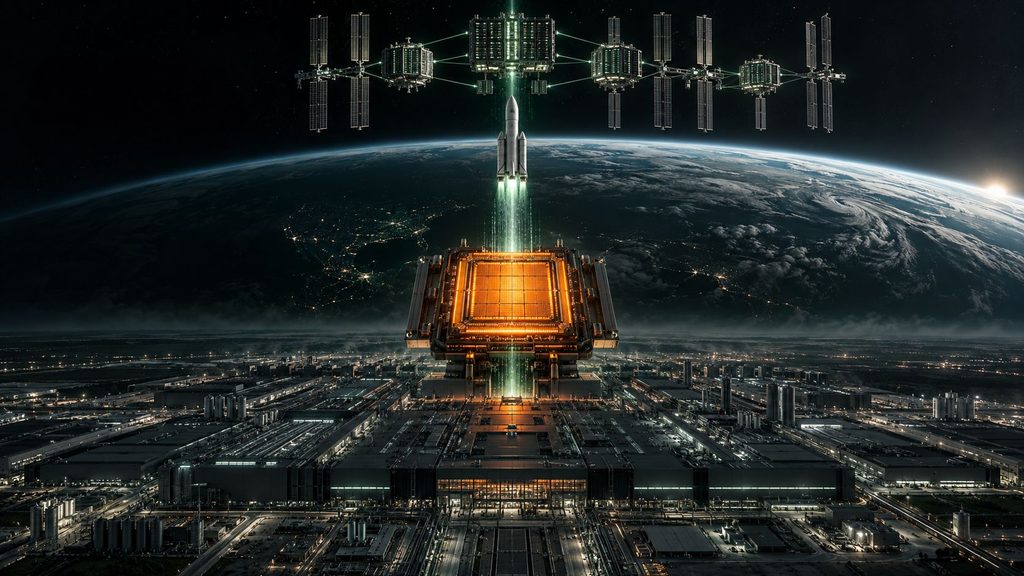
Eighty percent of the computing capacity produced by Terafab is not intended for Earth at all. It is supposed to go into orbit. Only one-fifth will remain on the ground, for cars, robots, and terrestrial data centers. The great remainder – four out of every five chips – is intended for data centers in space. Musk’s announced split is 80 percent for orbital AI satellites and 20 percent for ground-based applications.

Read that sentence a second time. The world’s largest chip factory, inside the world’s largest building, producing 50 times the planet’s annual output of AI computing capacity, is to manufacture four-fifths of its chips for machines that are no longer meant to exist on this planet. The demand no one can see is arising where hardly anyone has been looking: above our heads. And Musk is not merely predicting it. He is building it.
This is the moment when the records from the beginning truly become secondary. In this calculation, the world’s largest building is merely a supply station – it manufactures the components for a computing infrastructure that will subsequently leave the planet.
The full force of that idea deserves consideration. The Pyramids of Giza, the Hanging Gardens, Angkor Wat – structures on which entire civilizations labored for generations and which we now regard as wonders. Each was the pinnacle of what a culture could achieve, its enduring legacy in stone. Musk is planning a record-breaking structure five times larger merely as a factory, as an intermediate step, four-fifths of whose output is never supposed to touch the ground again once manufactured. For him, the wonder of the world is not the destination. It is the workbench.
At precisely this point, the established facts end and the vision begins, and the two must be kept clearly separate. Nothing has yet been built. What is established is the location, the $16.8 billion for phase 1, the 3,000 jobs, the schedule, and the state funding. Everything else – the one terawatt, the 80 percent, the data centers in space – consists of Musk’s stated objectives, no more and no less.
Just how uncertain they remain is revealed by his own stock-market prospectus. When SpaceX filed the documents for an initial public offering in the spring of 2026, Terafab appeared in them – but in a way that should give pause. Across more than 300 pages, there is not a single risk disclosure written specifically for Terafab. Tesla and SpaceX had merely agreed on a “general framework”; timelines, milestones, and investment amounts were “not yet determined.” Intel, discussed as a technology partner, joined only in April 2026, one month before the filing. The tension between the public promises and the prospectus’s fine print is considerable.
At the same time, the same document values the market SpaceX intends to address at $28.5 trillion – of which artificial intelligence alone accounts for $26.5 trillion, with Terafab presented as the infrastructure intended to serve that market. A project for the century, disclosed as an intention and simultaneously used as the foundation for a figure exceeding the gross domestic product of every individual economy on Earth. Anyone reading certainty into that is reading against the document’s own fine print.
That does not make the project smaller. It makes the account more honest. And it leaves two questions that no reader can easily set aside. Both lead directly into the core of this series.
The Race That Has Already Begun – and the Only Competitor with All the Pieces
Anyone who thinks at this point that a lone individual is simply indulging in fantasy underestimates how crowded the space above our heads already is.
Since November 2025, a satellite named Starcloud-1 has been orbiting Earth carrying an Nvidia H100 – an AI chip normally found in terrestrial data centers. The startup behind it, valued at around $1.1 billion and having raised more than $170 million, says it has already run language models on the satellite, including Google’s Gemini, and trained a smaller model directly in orbit. It advertises energy costs roughly 10 times lower than on the ground and has applied for a constellation of 88,000 satellites. A successor carrying a complete computing cluster is planned for 2027. An industry overview confirms that Starcloud-1 is already operating an Nvidia H100 in orbit.
Google has announced Project Suncatcher: solar-powered computing satellites equipped with the company’s own processors, with the first prototypes likewise planned for 2027. Amazon and Blue Origin are also pushing into the field, while SpaceX continues to expand its own satellite network without pause. The race to place data centers in orbit is not a distant vision. It has begun, and the field is already crowded. Several startups are trying to establish positions in orbit before Big Tech arrives at scale.
Only one entrant in this race possesses something none of the others has.
Putting a data center into orbit requires three things: the chips, a rocket to carry them there, and a network to bring the data back down. Google has the processors, but no heavy-lift rocket of its own – for Project Suncatcher’s launches, the company has been in talks with several providers, including SpaceX. Starcloud has a satellite in orbit, but did not place it there itself. Almost everyone in this field depends on outside infrastructure at some point. And the world’s largest provider of launch capacity and satellite connectivity is called SpaceX.
Musk is the only one who owns all three parts himself. The chips, in the future, from Terafab. Transportation through Starship. The network through Starlink. No one else in the race controls the entire route – from the grain of sand that becomes a chip to the stream of data returning from orbit.
The resulting configuration deserves to be considered carefully. In this race, Musk is simultaneously a competitor and a supplier to his competitors. Anyone seeking to challenge him in orbit may have to rent the rocket from him.
What that means becomes visible only when the three levels are considered separately. In chips, the rest of the industry is only beginning to catch up; Nvidia dominates the business, and Google manufactures its own processors. At the chip level, then, Musk is one of several players. Rockets are different: hardly anyone can currently place heavy payloads into orbit as cheaply and as frequently as SpaceX. And in the network that brings data back from space, Starlink has no equivalent competitor. A rival may be able to handle the first level itself while still depending on one provider at the second and third – and that provider is also its fiercest competitor.
Whether Musk will ever exploit that position remains an open question – his declared strategy is self-supply, not control over others. But the possibility exists simply because of the structure of his companies. No intention need be attributed to him; the architecture alone is enough.
That is the third hammer blow of this installment. And the quietest.
A Necessary Clarification about Intel
A common shorthand description of Terafab says that Musk is building the world’s largest chip factory and thereby eclipsing the industry’s old giants. That is true, but it requires clarification or it creates a distorted picture.
Intel, once the industry’s giant, is no longer number one. According to Gartner’s figures for 2025, Nvidia leads with $125.7 billion in revenue, followed by Samsung with $72.5 billion and SK Hynix with $60.6 billion. Intel ranks fourth with $47.9 billion – and ended the year with a six percent market share, “half of what it was in 2021.”
Musk is therefore not challenging an undefeated champion, but entering a field in which the former market leader is already falling and the balance of power is shifting anyway. Intel, for decades the embodiment of American semiconductor supremacy, missed the AI wave; its market share halved in four years. Musk is moving into that opening – not confronting a giant, but passing one that has begun to stagger.
The real colossus of contract manufacturing remains elsewhere: TSMC in Taiwan, the address where a large share of the world’s most advanced chips is produced and whose geopolitical vulnerability drives much of US industrial policy. If Taiwan were taken out of the equation, half the digital world would come to a halt. Terafab is also a response to that vulnerability – an attempt by a single corporate group to free itself from the Taiwan bottleneck and bring production onto US soil. But that is a thread for later.
Two Questions That Will Carry the Rest of the Series
Let us summarize what is established. A building more than five times the size of the world’s largest. Inside it, the largest chip factory ever planned. Its stated output: 50 times the world’s current annual AI computing capacity, year after year. And four-fifths of it is intended to leave the planet.
Anyone who has come this far is left with two questions that can no longer be shaken off.
The first: How on Earth does Musk intend to put these quantities into orbit? The chips, the energy, the cooling, the sheer number of launches – the logistics behind it are a story in their own right, and not a small one.
The second, and larger: Why put it in space at all? The obvious assumption – that space is freezing cold and therefore ideal for computers that run hot – sounds compelling. It contains a conceptual error on which the physics of the entire project turns.
Part 2 will examine both questions. Part 2 read here:
Terafab – Part 2: Why Space? The Physical Wall
Keep independent analysis independent. Your membership helps finance careful research, primary-source work, and journalism free from advertisers and institutional influence. Join from $5 per month – cancel anytime.

You are also welcome to support my work with a one-time donation.

About the Author
Michael Hollister is a geopolitical analyst and investigative journalist. He served six years in the German military, including peacekeeping deployments in the Balkans (SFOR, KFOR), followed by 14 years in IT security management. His analysis draws on primary sources to examine European militarization, Western intervention policy, and shifting power dynamics across Asia. A particular focus of his work lies in Southeast Asia, where he investigates strategic dependencies, spheres of influence, and security architectures. Hollister combines operational insider perspective with uncompromising systemic critique – beyond opinion journalism. His work appears on his bilingual website (German/English) www.michael-hollister.com and in investigative outlets across the German-speaking world and the Anglosphere.
For readers who prefer to form their own opinions based on facts, sources and context.
Sources
- Office of the Texas Governor. “Governor Abbott Announces SpaceX Expansion in Grimes County.” https://gov.texas.gov/news/post/governor-abbott-announces-spacex-expansion-in-grimes-county
- Fortune. “Everything’s Bigger in Texas: Musk’s Planned $16.8 Billion Chip Factory.” https://fortune.com/2026/08/10/elon-musk-chip-factory-spacex-tesla-texas/
- Manufacturing Dive. “SpaceX to Invest $16.8B on First Phase of Terafab Project.” https://www.manufacturingdive.com/news/spacex-to-invest-16b-first-phase-terafab-project-grimes-county-texas/827422/
- TechRadar. “Musk Wants Texas Terafab Plant to Produce One Terawatt of Computing Power Each Year.” https://www.techradar.com/pro/we-are-going-to-push-the-limits-of-physics-in-compute-elon-musk-wants-texas-terafab-plant-to-produce-one-terawatt-of-computing-power-each-year-and-build-a-global-robot-population-using-tesla-and-spacex-tech
- The Register. “Elon Musk Proposes ‘Terafab’ to Level Up Chip Production.” https://www.theregister.com/on-prem/2026/03/23/elon-musk-proposes-terafab-to-level-up-chip-production/5226987
- Electrek. “Tesla and SpaceX Announce $25B ‘Terafab’ Chip Factory.” https://electrek.co/2026/03/22/tesla-spacex-terafab-chip-factory-ai-desperation/
- KBTX. “Big Promises, Fine Print: What SpaceX’s IPO Filing Actually Says about Terafab.” https://www.kbtx.com/2026/06/04/big-promises-fine-print-what-spacexs-ipo-filing-actually-says-about-terafab/
- Gartner. “Gartner Says Worldwide Semiconductor Revenue Grew 21% in 2025.” https://www.gartner.com/en/newsroom/press-releases/2026-01-12-gartner-says-worldwide-semiconductor-revenue-grew-21-percent-in-2025
- Fierce Network. “Space Data Centers: Starcloud, SpaceX and Project Suncatcher Explained.” https://www.fierce-network.com/cloud/space-data-centers-starcloud-spacex-and-project-suncatcher-explained
- Quartz. “Startups Building Orbital Data Centers before Big Tech.” https://qz.com/orbital-data-center-startups-competitive-landscape-061526
- Data Center Dynamics. “Google in Talks with SpaceX Regarding Suncatcher Orbital Data Center Project.” https://www.datacenterdynamics.com/en/news/google-in-talks-with-spacex-regarding-suncatcher-orbital-data-center-project/
© Michael Hollister – All rights reserved. Redistribution, publication or reuse of this text requires express written permission from the author. For licensing inquiries, please contact the author via www.michael-hollister.com.