by Michael Hollister
The Briefing accompanying this analysis was published exclusively at TKP.AT on July 18, 2026.
The In-Depth Analysis was published on Michael Hollister’s website on July 24, 2026.
2.018 words * approximately 10 minutes readingtime
The complete analysis continue reading here:
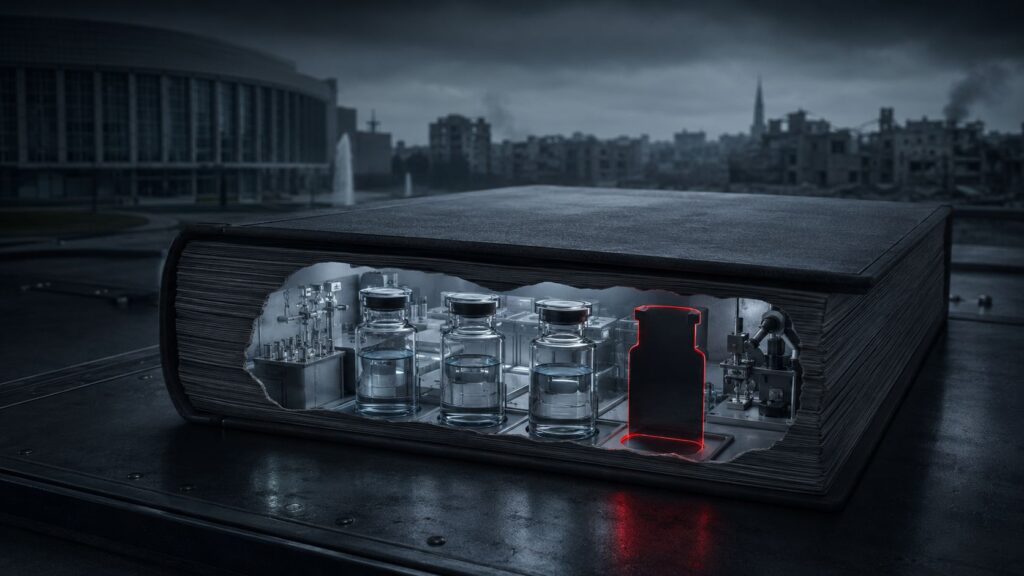
Douma 2018: What the Files Say-and What They Leave Out
Weekly: The key conflicts and shifts in global power.

On February 10, 2026, an administrative tribunal in Geneva handed down a ruling against a Nobel Peace Prize laureate. The losing party: the Organisation for the Prohibition of Chemical Weapons. The plaintiff: former OPCW inspector Brendan Whelan, who served the organization for six years and was a member of the team tasked with investigating the alleged chemical-weapons attack in the Syrian city of Douma in April 2018. At least 43 people died in Douma on April 7, 2018. Videos showed bodies collapsed in a residential building, many lying in piles with heavy foam around their mouths and noses, with no visible attempt to escape. Seven days after the incident – and before a single OPCW inspector had entered the site – the United States, France and the United Kingdom attacked Syrian facilities with more than 100 cruise missiles.
Whelan had said the final report produced by his organization did not accurately reflect the team’s findings. The OPCW reprimanded him, imposed a lifetime ban on his employment, and had its director-general personally present the allegations against him to the States Parties. Director-General Fernando Arias told the UN Security Council that the reports written by Whelan were “erroneous, uninformed, and wrong.” Whelan filed suit. The proceedings lasted six years. He won.
The ILOAT Judgment No. 5122 overturns the disciplinary measure and awards Whelan 20,000 euros in damages. The reason: The OPCW violated his basic procedural rights. He was given neither the specific allegations nor a copy of the investigation report before sanctions were imposed. He was told he could inspect the report at OPCW headquarters on a single day – without a lawyer, without a copy, and under surveillance. When he refused, he was publicly identified as “Inspector B” the next day and sanctioned.
No major German media outlet reported on the ruling. The OPCW has not commented on it. No government has issued a statement.
The Ruling – and What It Does Not Say
Judgment 5122 is a labor-law ruling. It does not decide what happened in Douma on April 7, 2018. It does not decide whether the OPCW’s final report is accurate. It finds that the OPCW sanctioned an inspector without granting him a fair hearing. That sounds like a technicality. It is not.
Whelan was not just any inspector. He was a member of the Advance Team of the Fact-Finding Mission in Douma, involved in the scientific planning and coordination, and the lead author of the team’s report. On June 22, 2018, before the interim report was published, he wrote an email to OPCW Chief of Cabinet Robert Fairweather: The report intended for publication misrepresented the facts through “selective omission”; facts had been “morphed into something quite different.” The chief of cabinet replied the same day that the report required “a large amount of work.” In letters to the director-general in March and April 2019, after leaving the organization, Whelan documented “serious defects and irregularities” in the investigation, and the director-general reminded him of his confidentiality obligations. An internal memo later published by WikiLeaks recorded that roughly 20 inspectors had raised concerns that the final report did not reflect the findings of the team sent to Douma.
In July 2019, the OPCW opened an investigation – not into the irregularities Whelan had reported, but into Whelan himself. The allegation: breach of confidentiality obligations. He was told to review the investigation report at OPCW headquarters in The Hague on a single day – without a lawyer, without a copy, and under supervision. His lawyer asked for five basic rights: access without surveillance, a copy of the non-confidential version, legal assistance, confidential discussions with his counsel, and sufficient time to respond. All five requests were denied. On the day after the deadline expired, the OPCW published the report, identified Whelan as “Inspector B,” and the director-general personally informed the States Parties. One day later: a reprimand and a lifetime employment ban.
The Tribunal found that this procedure lacked the most basic procedural foundation. The OPCW’s internal appeals body had approved the process – the Tribunal corrected it.
What the ruling does not contain is as revealing as what it does. The word “toxicology” does not appear anywhere in the judgment. There is no mention of consulted experts, their nationalities, or any suppressed finding. The ruling deals with the process, not the substance. But the process tells a story: An inspector dissents, is not heard, is sanctioned, files suit – and wins. People do not pursue baseless lawsuits for six years.
The Toxicological Contradiction
On June 6, 2018, two months after the incident in Douma, four OPCW staff members met with four external experts, according to the minutes published by WikiLeaks: “three Toxicologists/Clinical pharmacologists, one bioanalytical and toxicological chemist,” all of them specialists in chemical warfare agents. The minutes name neither a country nor an institute. Investigative journalist Aaron Maté identified the experts as German military toxicologists – an attribution that does not emerge from the primary document and must be treated as his assessment.
The experts’ finding is documented in the minutes: The symptoms observed and reported in the victims – instant collapse, no attempt to flee, and massive foaming at the mouth and nose – showed “no correlation” with exposure to chlorine gas. The experts raised the possibility that the scene had been staged because “the circumstances of death for the victims do not match chlorine.”
This finding does not appear in the OPCW’s final report of March 1, 2019. The Mission Timeline in Annex 3 of the report lists toxicology consultations for September and October 2018 – the June consultation is missing. The report concludes: “likely molecular chlorine.” It notes that four toxicologists and one medical doctor were consulted – whether they were the same experts or different ones remains unclear.
Four and a half years later, in January 2023, the OPCW Investigation and Identification Team issued a new report. An anonymous toxicologist consulted for the report reached the opposite conclusion: The symptoms were “overall, consistent with exposure to chlorine gas in very high concentrations.” The report attributed responsibility to the Syrian Air Force. It does not explain why the new expert should be considered more reliable than the four earlier experts. It does not address the contradiction. The opposing position – advanced, among others, by Bellingcat – counters that pulmonary edema, which causes foaming, is a documented symptom of chlorine-gas inhalation, and that the final report addressed many of the initial objections during the subsequent months of investigation. Both positions have substance. But that does not answer the question of why one appears in the report while the other was classified as “Highly Protected.”
Whelan reports – relying on the OPCW’s procedural filings in the legal dispute before the ILOAT, which were available to him as a party to the proceedings – that the OPCW acknowledged in writing that the assessment by the consulted experts had been classified as “OPCW Highly Protected” and not included in the publicly released final report. Those filings are not public. The screenshot Maté shows in his reporting cannot be independently verified. But the documentable gap in the final report – the missing June consultation, the vanished finding, and the absence of any explanation for its disappearance – stands independently of whether one accepts Whelan’s account of the procedural documents. It is there in the report itself, verifiable by anyone.

Germany’s Blind Spot
In January 2023, the German federal government joined the United States, the United Kingdom and France in a joint statement praising the IIT’s work as “independent, unbiased, and expert.” Russia was urged to stop shielding Syria from accountability.
This is the same federal government that had responded to a parliamentary question in May 2020: “The German federal government has no information that would call into question the findings of the OPCW’s final report on the incidents in Douma, submitted on March 1, 2019.” The report was “the result of a professional, independent and impartial investigation and was produced in strict compliance with the organization’s procedural rules.” That response came after the WikiLeaks publications that made the toxicologists’ June finding public.
The parliamentary question itself – submitted by the AfD parliamentary group as Printed Paper 19/19225 – is revealing for what it does not ask. The lawmakers address the Henderson engineering study and the leaked emails. They ask about the German government’s intelligence findings, the credibility of the final report, and even the financing of the White Helmets – 19.62 million euros since 2016, as the government’s response confirms. But the consulted toxicologists and their finding are not mentioned even once. The question of the suppressed expert assessments was never put to the Bundestag – not in 2020, not after the 2023 IIT report, and not after the 2026 ILOAT ruling.
Asked whether it supported “complete transparency regarding the incidents in Douma,” the German federal government replied that the report was based on “comprehensive on-site investigations, environmental and biomedical samples, toxicological analyses, and witness interviews.” It said nothing about the contradiction between those toxicological analyses and the finding of the June experts.
A search of the Bundestag’s parliamentary documentation for “Douma,” “chemical weapons,” “toxicologists,” and “OPCW” returns zero hits for the current legislative term. ILOAT Judgment 5122 was handed down on February 10, 2026. Since then, no member of parliament has asked the federal government whether it knows of the ruling, whether it stands by its assessment, or whether it knew that experts consulted by the OPCW had reached a conclusion that does not appear in the final report.
If these experts were in fact German military toxicologists, a question arises that no one has so far put to the federal government: Did Berlin know about the findings of its own experts? The question remains open. The answer is still pending. Its absence is itself a finding.
Bottom Line: The Questions No One Is Asking
What is documented is this: An inspector from the Douma investigation team dissented from the final report, was sanctioned, litigated for six years, and won before an international tribunal. Four consulted experts reached a toxicological finding that does not appear in the final report and whose consultation is missing from the official Mission Timeline. The German federal government said it had “no information” calling the report into question and praised the investigation as independent and unbiased. No parliament, press conference, or major media outlet has addressed the ruling.
What is also true is this: Following the change of power in Syria, the OPCW reported in May 2026 that it had found substantial quantities of undeclared chemical weapons – more than 100 potential sites remain to be examined. The Assad government demonstrably concealed its chemical-weapons program for years. A Syrian chemical-weapons program and a problematic Douma investigation are not mutually exclusive. Anyone who plays one off against the other is simplifying the issue – in both directions.
What remains unresolved is what actually happened in Douma on April 7, 2018. Whether the Syrian government used chlorine gas or whether the incident was staged. Whether the German federal government knew about the finding of the consulted experts. Why an organization with nothing to hide would have to classify the assessment of its own experts as “Highly Protected.”
All reporting on Judgment 5122 ran through alternative media – The Grayzone, Consortium News and Substack. The same media outlets that institutional services classify as vectors of disinformation. Every reader must decide for themselves what carries more weight: the origin of the reporting or the content of the documents.
The primary documents are publicly accessible. Judgment 5122 is in the TRIBLEX database. The OPCW’s final report is available on opcw.org. The WikiLeaks documents can be accessed. Anyone can read them – and anyone can ask the questions that no parliament, press conference, or major media outlet has asked so far.
The questions are on the table. No one has provided the answers to this day.
The Briefing accompanying this analysis was published exclusively at TKP.AT on July 18, 2026.

The week’s most important geopolitical developments – independently assessed.
About the Author
Michael Hollister
is a geopolitical analyst and investigative journalist. He served six years in the German military, including peacekeeping deployments in the Balkans (SFOR, KFOR), followed by 14 years in IT security management. His analysis draws on primary sources to examine European militarization, Western intervention policy, and shifting power dynamics across Asia. A particular focus of his work lies in Southeast Asia, where he investigates strategic dependencies, spheres of influence, and security architectures. Hollister combines operational insider perspective with uncompromising systemic critique – beyond opinion journalism. His work appears on his bilingual website (German/English) www.michael-hollister.com and in investigative outlets across the German-speaking world and the Anglosphere.
If you regularly read my updates and analyses, I would be grateful for your ongoing support.
5 USD per month – 1 coffee !!!
Sources
- ILOAT, February 10, 2026 – Judgment No. 5122, W. v. OPCW, 141st Session (adopted October 27, 2025): https://www.ilo.org/dyn/triblex/triblexmain.detail?p_lang=en&p_judgment_no=5122
- OPCW, March 1, 2019 – Final Report, S/1731/2019 – Report of the Fact-Finding Mission Regarding the Incident of Alleged Use of Toxic Chemicals as a Weapon in Douma: https://www.opcw.org/sites/default/files/documents/2019/03/s-1731-2019%28e%29.pdf
- WikiLeaks, June 6, 2018 – OPCW Douma Docs: Minutes of Toxicology Meeting: https://wikileaks.org/opcw-douma/document/actual_toxicology_meeting_redacted/
- Aaron Maté, The Grayzone, May 7, 2026 – “Highly Protected: OPCW Confirms It Buried Critical Evidence in Syria Chemical Weapons Probe”: https://thegrayzone.com/2026/05/07/opcw-confirms-buried-evidence/
- United States, United Kingdom, France and Germany, January 27, 2023 – Joint Statement on OPCW Report – Use of Chemical Weapons in Douma, Syria: https://www.gov.uk/government/news/joint-fms-statement-on-use-of-chemical-weapons-in-douma-syria
- OPCW, May 27, 2026 – Deployment of OPCW Expert Team to the Syrian Arab Republic Finds Chemical Weapons: https://www.opcw.org/media-centre/news/2026/05/deployment-opcw-expert-team-syrian-arab-republic-finds-chemical-weapons
- German Bundestag, May 14, 2020 – Parliamentary Question: Inconsistencies Regarding the Alleged Poison-Gas Attack in Douma, Printed Paper 19/19225: https://dserver.bundestag.de/btd/19/192/1919225.pdf
- German Federal Government, May 29, 2020 – Response to the Parliamentary Question, Printed Paper 19/19657: https://dserver.bundestag.de/btd/19/196/1919657.pdf
- Brendan Whelan via Aaron Maté, Substack, April 30, 2026 – “In Blow to Syria Cover-Up, Dissenting OPCW Inspector Wins Landmark Ruling”: https://www.aaronmate.net/p/in-blow-to-syria-cover-up-dissenting
- German Bundestag, Parliamentary Documentation (DIP), July 2026 – Search result “Douma Chemical Weapons OPCW” – zero hits in the current legislative term (as of July 2026): https://dip.bundestag.de/ (search terms: “Douma,” “chemical weapons,” “toxicologists,” “OPCW”)
© Michael Hollister – All rights reserved. Redistribution, publication or reuse of this text requires express written permission from the author. For licensing inquiries, please contact the author via www.michael-hollister.com.