
by Michael Hollister
Exclusive published at Michael Hollister on June 12, 2026
2.081 words * about 9 minutes readingtime
The complete analysis continue reading here:
The Quiet Power Behind the Pump
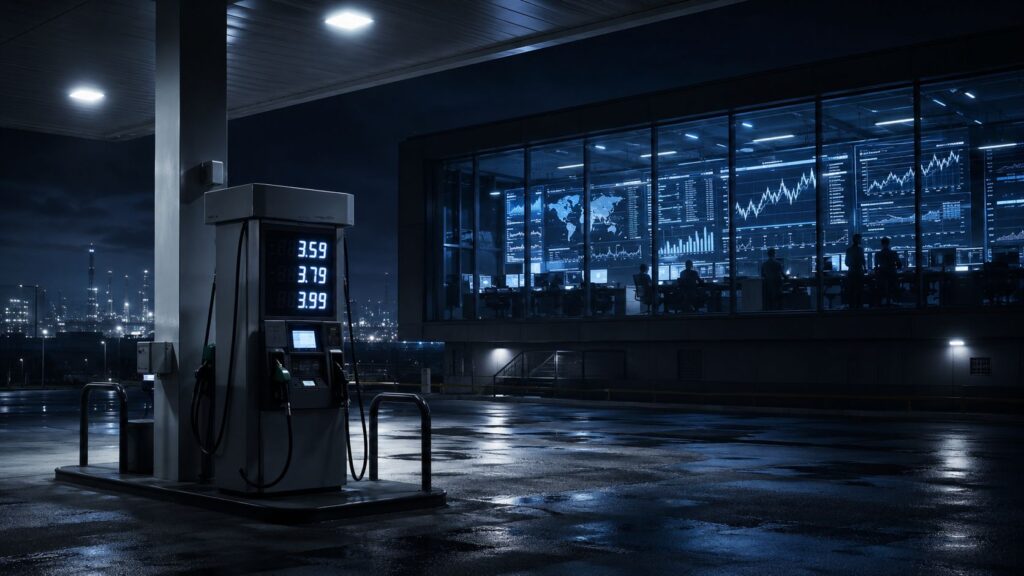


…and Why No One Is Allowed to Look
My grandmother had a saying that replaces any intelligence service: Watch what they do, not what they say. In the dispute over the German fuel price, that saying is worth its weight in gold right now.
Everyone knows the game at the pump. Expensive in the morning, cheaper at midday, high again in the evening – seemingly at the mercy of the world market, without anyone quite knowing who actually makes the number. On 30 April 2026, this question became a judicial matter. The Federal Cartel Office had to concede that its most ambitious investigation of the fuel market to date had been stopped – by a court, at the instigation of two companies that do not even trade in fuel. They are price reporting agencies. They report, assess and publish the quotations the whole market takes its bearings from. And they have established that they need not tell the authority who feeds them these prices.
The thesis in one sentence: The stage on which the oil price actually arises lies beyond the reach of state oversight – and it defends this position, of all things, with freedom of the press. Whoever has grasped this looks at the display board at the filling station with different eyes. And this is no trifle: it is about the number every motorist ultimately pays, and about the question of whether the state may even still trace it. It is a quiet power, and it has just won in court. Three ruptures show why.
Stopped by Firms That Sell No Oil
The matter is quickly told – and that is precisely what makes it remarkable. In early March 2025, the Federal Cartel Office opened a proceeding against the price reporting agencies Argus Media and S&P Global. It was the very first application of a new instrument. Section 32f of the Act against Restraints of Competition allows the authority to remedy a disturbed market structure without having to prove a legal violation against any single company. Under the impression of the Iran war, the Bundestag tightened the provision once more as of 1 April 2026, in order to be able to act more quickly. A few weeks later it was over.
On 5 May 2026, the Düsseldorf Higher Regional Court ordered that the price reporting agencies need not, for the time being, provide any information about their informants. The Federal Cartel Office said it was “very surprised” and took the matter to the Federal Court of Justice. Until Karlsruhe decides, the proceeding is on hold. The accelerated reform has turned into a full stop.
Yet Section 32f was meant as a breakthrough. Classic antitrust law requires a perpetrator and a violation. In a highly concentrated market, however, competition can grow sluggish even when no one is committing a crime – when all parties merely possess the same, very precise information about each other’s prices and align themselves with it. It was precisely for this that the legislature created the new tool in 2023: one against sick structures rather than against individual sinners. The wholesale fuel trade was the first test. President Andreas Mundt called it the decisive stage “from the borehole to the pump.” For an instrument with such great ambition, this is a difficult opening: the first case was supposed to show that the state can grasp structural market power even where classic antitrust law ties its hands. So far, it shows the opposite.
The real blow lies in the detail. The authority was not stopped by BP, Shell or some other corporation. It was stopped by two firms that extract no oil, run no refinery, and sell not a single litre of fuel. They supply only numbers. And it was precisely these numbers the agency wanted to understand – who reports them, how they arise, what role they play. Specifically, it demanded data showing which company had reported which prices, whether as buyer, seller or intermediary. It was exactly this disclosure the agencies refused, and exactly this the court prohibited. It did not get far enough to ask the decisive question. The authority’s most powerful tool was knocked out of its hand before it could properly bring it to bear.
The agency has already priced in the defeat. It merged the teams for the stopped instrument and for a second, new prohibition of abuse, and now drives the latter forward. This fallback route, however, is the harder one: it requires concrete proof of excessive prices, not merely the suspicion of a sick structure. Where the stopped instrument let a structure suffice, the second route demands proof in the individual case. The authority is thus not idle – it is merely fighting with the blunter blade.
Who Really Makes the Price
To grasp what is at stake, one must know how an oil price arises in the first place. It is not set on a state-supervised exchange, but determined by private agencies. Argus Media and S&P Global, which owns the Platts brand, collect the transactions of market participants, assess them within a short daily time window, and condense them into a single number: the quotation. The model rests on voluntary, confidential reporting. No one has to report; in return, the reporters remain secret.
One has to picture it concretely. Day after day, traders report their deals, editors verify and weight them, and at the end of a short window stands a number that holds for the market. This number is not a market price in the textbook sense, but a judgement – made by a few, on the basis of what was reported to them in confidence. Whoever influences this judgement influences what millions pay.
These numbers are no mere market observation, they are the market. According to common estimates, the price of around 70 percent of globally traded crude oil hangs on the most important crude quotation, the North Sea marker Brent. For Germany the mechanism is tangible: what is quoted for diesel and petrol at the Rotterdam trading hub flows, via supply contracts, all the way into the purchase prices of filling stations. Between the agency’s number and the amount on the display board lie only taxes, logistics and margin. Anyone who wants to know why diesel is a few cents more expensive on a Tuesday morning sooner or later ends up at a quotation that came about in an office far from any filling station.
The construction has a built-in weak point. If a quotation arises from the submissions of few players in a narrow time window, anyone who deliberately reports or closes deals can pull it in their direction. The thinner the trading, the greater the leverage. This is no insinuation: the agency’s own sector inquiry had found that the detailed real-time information can dampen competition and facilitate manipulation.
Added to this is a closeness that rarely comes up. The price reporting agencies finance themselves through subscriptions – and among their paying customers are, of all people, those market participants whose deals they assess. Whoever generates the quotation lives economically off those it judges. Worldwide, only a few houses share this business; no one can get past their numbers. This is no conspiracy, but simply the architecture of the market – yet one that would raise questions in any other area of oversight.
The sharpest irony lies in the contrast. Through its Market Transparency Unit, the Federal Cartel Office monitors around 15,000 filling stations in near real time – every price change must be reported within minutes. The state sees, down to the cent, what happens below at the pump. What happens above, where the quotation arises, remains closed to it. Transparency ends precisely where power begins.
Freedom of the Press as a Shield
On what basis does a court hold that a competition authority may not ask questions? On freedom of the press. In the view of the Higher Regional Court, the price reporting agencies enjoy press-law protection, and the market participants who report prices to them are informants whose identity falls under source protection. The agency, it held, had not sufficiently justified why it needed the names; it could also question the market participants directly. Source protection weighed more heavily than the public interest in enforcing the law.
With this, a protective idea is turned on its head. Source protection was created for journalists and whistleblowers who expose wrongdoing. Here it shields two commercial data agencies from the authority – and the informants kept secret are precisely those market participants whose pricing behaviour is to be examined. What is meant to protect what presses to come to light here screens off what wishes to remain in the dark.
For the citizen, an unfamiliar sentence thus stands in the room. A fundamental right meant to protect him from powerful players here protects powerful players from being investigated in his name. This is no reproach to the judges, who had a difficult balancing to strike – but a finding that gives pause.
For the court’s argument is not far-fetched, and fairness demands naming it. If the reporters were disclosed by name, the voluntary reporting model could be damaged – whoever fears exposure reports less, or not at all. To that extent, the court is not defending the corporations, but the viability of an information system the market depends on. The Federal Cartel Office counters that the publication of price quotations is “not a journalistic activity,” but commercial business. At its core, this is an old question in new garb: Where does the press end, and where does the business begin that merely avails itself of its protection? Which side is right is now for the Federal Court of Justice to decide.
The implications reach beyond the day. This is not about a formality, but about the fundamental question of whether an authority may even enter the workshop of the price. If Karlsruhe says no, an entire sector of the economy remains beyond control – not by accident, but on principle.
Anyone who thinks this is an isolated German case is mistaken. In 2013, the European Commission tried the same thing. Unannounced, its investigators moved in at BP, Royal Dutch Shell, Statoil and the price agency Platts – on suspicion that the corporations had reported distorted prices to the agency for years. The Commission warned at the time that even small distortions of a quotation could ultimately drive the price at the pump, at the expense of consumers. Observers compared the case with the Libor scandal, which shortly before had exposed the manipulation of a central financial reference value. The result after more than two years of investigation: by December 2015, the Commission dropped the proceeding on crude oil – without a single charge. The price-formation machine had already proven itself unassailable once before. Düsseldorf 2026 is the repetition, only with a new argument in the agencies’ hands.
What Remains
Three findings stand. First: the sharpest instrument of German competition oversight failed on its first deployment – not against the power of a corporation, but against the objection of two data agencies that sell no oil. Second: the stage on which the fuel price actually arises stands under no effective state control; the state monitors the pump down to the cent, but not the quotation that precedes it. Third: what prevents clarification is not secrecy alone, but by now a fundamental right – freedom of the press, in a reading its inventors could hardly have foreseen.
For the motorist, this holds little comfort. Whether he pays a fair price hangs not on an authority that looks, but on a legal threshold at which the looking, for now, ends. Whether prices have been too high since the Iran war must be clarified by another proceeding. The larger question remains open: Can the state still hold to account at all the institutions that produce its energy prices? The Federal Court of Justice will give an answer to this that reaches far beyond the fuel market. It is a object lesson in how modern market power works: not through loud dictate, but through the quiet control of the number everyone relies on. Whoever masters this number no longer needs a cartel – he needs only the calm of not being disturbed.
Until then, my grandmother’s saying holds. The price reporting agencies say they are the press. What they do is make the price. Watch what they do, not what they say.
The complete analysis continue reading here:
The Quiet Power Behind the Pump

Michael Hollister served six years as a soldier in the German Bundeswehr (SFOR, KFOR) and looks behind the scenes of military strategies. After 14 years in the IT security field, he analyzes European militarization, Western interventionist policy and geopolitical power shifts on a primary-source basis. One focus of his work lies on the Asian region, particularly Southeast Asia, where he examines strategic dependencies, zones of influence and security architectures. Hollister combines an operational inside view with uncompromising systemic critique – beyond opinion journalism. His work appears bilingually at www.michael-hollister.com as well as in critical media across the German- and English-speaking world.
Support my work – become a Member
Sources
Federal Cartel Office – Court Halts Investigation into the Wholesale Fuel Trade (30.04.2026) https://www.bundeskartellamt.de/SharedDocs/Meldung/DE/Pressemitteilungen/2026/04_30_2026_OLG.html
Düsseldorf Higher Regional Court – Expedited Decision on the Investigation into the Wholesale Fuel Trade (05.05.2026)
https://www.olg-duesseldorf.nrw.de/behoerde/presse/Presse_aktuell/20260505_PM_Beschluesse-VI-Kart-7-25-V_VI-Kart-8-25-V/index.php
Federal Cartel Office – First Proceeding on the Basis of the New Competition Instrument (06.03.2025)
https://www.bundeskartellamt.de/SharedDocs/Meldung/DE/Pressemitteilungen/2025/03_06_2025_Verfahren_32f.html
Federal Cartel Office – Decision Division for Fuels Restructured (01.04.2026) https://www.bundeskartellamt.de/SharedDocs/Meldung/DE/Pressemitteilungen/2026/04_01_2026_V_B13.html
German Bundestag – Bundestag Passes the Coalition’s Fuel Measures Package (2026) https://www.bundestag.de/dokumente/textarchiv/2026/kw13-de-kraftstoffmassnahmenpaket-1156704
BBC News – EU Raids on Oil Firms Raise Petrol Price Worries (14.05.2013) https://feeds.bbci.co.uk/news/business-22533993
Reuters – EU Drops Shell, BP, Statoil from Ethanol Benchmark Investigation (07.12.2015) https://www.agweek.com/business/eu-drops-shell-bp-statoil-from-ethanol-benchmark-investigation
Full source list and further documentation in the detailed analysis article.
© Michael Hollister – All rights reserved. The distribution, publication or use of this text requires the express written permission of the author. If interested in reuse, please contact the author via www.michael-hollister.com.
Newsletter
🇩🇪 Deutsch: Verstehen Sie geopolitische Zusammenhänge durch Primärquellen, historische Parallelen und dokumentierte Machtstrukturen. Monatlich, zweisprachig (DE/EN).
🇬🇧 English: Understand geopolitical contexts through primary sources, historical patterns, and documented power structures. Monthly, bilingual (DE/EN).