
by Michael Hollister
Published at apolut media on June 03, 2026
5.134 words * 27 minutes readingtime
For a compact entry into the topic: the briefing accompanying this analysis summarizes the three or four central developments in ten minutes of reading time:
Trump’s Silent Victory in Syria – Three Breaks in April 2026
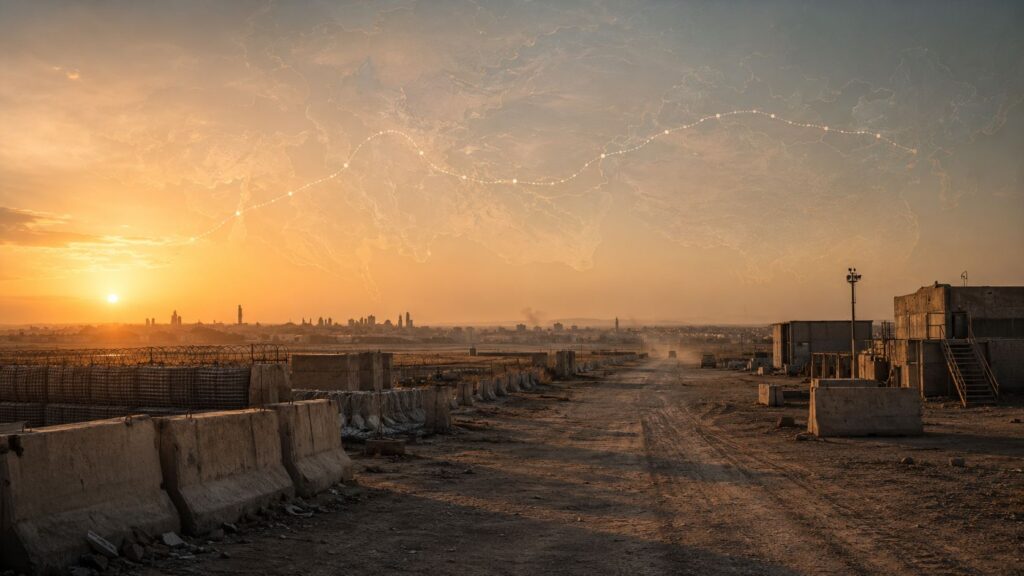
And the Real Target Was China
How the end of eleven years of US war in Syria became a footnote – and why the real winner is Trump, the real loser Beijing
The Silent Day
On April 16, 2026, a war ended in Syria whose beginning no one remembers anymore. The last US Army convoy left the Qasrak Air Base in Hasakah Province that day, drove toward the Jordanian border, and with that, the American ground troop presence in the country was over. Eleven years and six months after the arrival of the first US soldiers in September 2014, CENTCOM spokesman Captain Tim Hawkins told the Associated Press tersely that US forces had “completed the transition of all major bases in Syria as part of a deliberate and conditions-based transition.”
That was it. That was the entire statement.
In Germany, the news came through as a dpa wire item, picked up by freenet and the Jüdische Allgemeine. Reuters, AP, the Washington Post, Military.com, US News, Al-Monitor, Al Jazeera, and TRT World reported – all accurately, all soberly, all without contextual analysis. No FAZ analysis of the significance. No SZ editorial reflection on eleven years of US military presence in the Middle East. No talk show discussing the event. No Bundestag debate. No assessment under international law.
Six days later, on April 22, 2026, the government press conference took place in Berlin. On the agenda: pension equalization law, IP address storage, emergency care, continuation of KFOR and EUFOR missions, Reza Pahlavi’s Berlin visit, the Druzhba pipeline, jet fuel supply for the air force, gas prices, and the possible full takeover of T-Mobile US. Syria was not mentioned. No journalist asked. No government spokesman informed. The complete end of an eleven-year US military intervention in the strategically most central country of the eastern Mediterranean passed through the most important regular foreign policy press conference of the Federal Republic without a single word.
In January 2025, a journalist had asked that same group of spokespeople about the legal basis under international law for the US troops in Syria – and received no answer. The then-Foreign Minister Annalena Baerbock publicly demanded that Russia withdraw from its treaty-secured bases, yet offered no assessment of the presence of 2,000 US soldiers without a mandate from the Syrian state or the UN. The outrage under international law was loud on one side, quiet on the other, and now, on April 22, 2026, it has disappeared entirely.
Imagine for a moment the mirror image. Had Russia silently abandoned its bases at Hmeimim and Tartus on April 16, 2026 – the Bundestag would have convened special sessions, the FAZ and SZ would have run front-page analyses, the talk show rounds would have outdone one another, the Foreign Ministry would have issued an assessment, and Foreign Minister Johann Wadephul, in office since May 2025, would have contextualized the event on camera. What happened instead is the mirror image of that: the same event, a different actor, complete silence. What makes the asymmetry of foreign-policy outrage visible in a single data point is not the volume of the reaction to one thing, but the complete absence of any reaction to the other.
That is the German media debate on a historic event: no discourse, no contextualization, no question.
It is worth pausing here and sharpening the picture. Because what was quietly concluded on that April 16 was not a retreat in the classical sense. It was a handover to proxies – and the real strategic target is not in Damascus.
Who Is Governing There Now?
To understand what was actually completed that day, one must briefly look at the man to whom the United States had handed the country over in the preceding sixteen months. Ahmed al-Sharaa, born in 1982 in Riyadh and raised in Damascus, was until December 2024 – under the nom de guerre Abu Mohammad al-Jolani – the leader of Hayat Tahrir al-Sham (HTS), a group the US State Department officially designated as a foreign terrorist organization in 2018, which had previously operated under the name Jabhat al-Nusra as the Syrian branch of al-Qaeda.
Al-Sharaa’s biography is a masterclass in jihadist mobility. As a twenty-year-old, he joined the fight against the US occupation in Iraq in 2003, was arrested, and was released. In 2011, Abu Bakr al-Baghdadi dispatched him to Syria to build the al-Nusra Front. In 2013, the US State Department placed him on the list of “Specially Designated Global Terrorists.” In 2017, he became part of the “Rewards for Justice” program: a $10 million bounty on his head. The official justification cited attacks, the kidnapping of 300 Kurds in 2015, and a massacre of 20 Druze in Idlib in the same year.
In December 2024, he toppled the regime of Bashar al-Assad after a ten-day lightning offensive. Twelve days later, on December 20, 2024, Barbara Leaf, then Assistant Secretary of State for Near Eastern Affairs under the outgoing Biden administration, met al-Jolani in Damascus. She returned with the message that the $10 million bounty would be lifted – it was “a little bit incoherent” to maintain a bounty on the head of someone with whom one was currently conducting diplomacy.
What followed was a remarkable ascent in eleven months. On January 29, 2025, al-Sharaa was appointed transitional president of Syria; the old constitution was abolished. Over the course of 2025, the UN gradually lifted its sanctions and the terrorist lists were cleared. In November 2025, Donald Trump received the Syrian president at the White House. A globally wanted jihadist had, within 11 months, become a head of state personally welcomed by the American president – a sequence for which historical parallels are thin.
The central question that arises after the White House reception is not: how could this happen? But rather: why this man? What made him, from Washington’s perspective, the appropriate recipient of the keys to Damascus?
What It Means on the Inside
Before that question is answered, a sober look is warranted at what the new order means internally – because Western reporting has tended, and continues to tend, to frame Assad’s fall as democratization without engaging with the consequences for minorities, women, and Kurds.
Between March 6 and 9, 2025, three months after Assad’s fall, a wave of massacres erupted on the Syrian Mediterranean coast. A detention operation by the interim authorities in Latakia triggered an uprising by armed pro-Assad supporters; what followed, the UN Commission of Inquiry characterized in its report of August 14, 2025 as “widespread and systematic” and “in all likelihood constituting war crimes.” The commission documented 1,426 deaths at 40 crime scenes, predominantly men, including 90 women, as well as elderly persons, disabled individuals, and children. Armed men controlled doorsteps – “Alawite or Sunni?” – and executed accordingly. Men were shot on rooftops, their bodies left lying in the streets for days, families denied religious burial rites.

The Reuters investigation weeks later identified the perpetrators specifically. They were not scattered bands. They were five coordinated groups: HTS units including the notorious Unit 400, the Othman Brigade, and the General Security Service; Sunni factions such as Jaysh al-Islam and Jaysh al-Ahrar; foreign fighters from the Turkistan Islamic Party (to which we will return), Uzbeks and Chechens; and – politically the most sensitive – Turkish-backed brigades of the Syrian National Army, above all the Sultan Suleiman Shah Division (Amshat) under Mohammed al-Jassem and the Hamza Division under Sayf Boulad Abu Bakr.
These brigades were not dissolved after the massacres. They were integrated into the new Syrian army. Al-Jassem today commands the 62nd Division. Fahim Issa, commander of the Sultan Murad Division, was appointed deputy defense minister for the Northern Region. The EU imposed sanctions in May 2025 against three of these brigades and their commanders; the United Kingdom followed in December 2025. The United States has imposed no sanctions for the massacres.
In July 2025, the pattern repeated itself – this time in Suwayda, in the Druze south. Again sectarian violence between Sunni Bedouin tribes and Druze armed groups, again government forces intervening, again without consequences.
In parallel, a different, quieter shift is taking place. Education Minister Nazir al-Qadri declared publicly in December 2024 that “the right to education is not restricted to one gender”; primary schools remained mixed, secondary schools segregated as before. But behind this formal statement of reassurance, the HTS-affiliated school network “Dar al-Wahy al-Sharif” – “House of the Noble Revelation” – grew within twelve months from Idlib to over 70 locations in Aleppo, Damascus, Hama, Homs, Deraa, and Latakia. Strict gender segregation, mandatory abaya and niqab for girls, a Quran-centered curriculum, jihadist content at school events. In September 2025, children marched in military uniform with plastic rifles through the stadium in Deraa, others carried “martyr corpses,” the soundtrack was “Saraya al-Mawt” – the “Death Brigades.” Women are being systematically pushed back in the judiciary and higher education; HTS rejects them as Sharia judges. This is not a restoration of the Assad era. It is a creeping Islamization with practical marginalization – despite the formal declaration of the education minister.
And then the Kurds. In this story they are the strategically most instructive lesson in what Western patronage is worth in American foreign policy. For eleven years, the Kurdish-led Syrian Democratic Forces (SDF) had fought alongside the United States against the Islamic State – thousands dead, the backbone of one of the West’s most successful anti-ISIS operations. In March 2025, al-Sharaa negotiated a first integration agreement with SDF commander Mazloum Abdi; in December 2025, the implementation deadline expired without agreement. In January 2026, the Syrian government army launched an offensive against the SDF, seized Raqqa and Deir ez-Zor, and brought up to 80 percent of the autonomous Kurdish territory under its control. Washington did not oppose this. On the contrary: US Special Envoy Tom Barrack brokered a 14-point ceasefire on January 18, 2026, that cemented the handover of Raqqa and Deir ez-Zor to Damascus. On January 30, 2026, the “Comprehensive Agreement” was signed: phased integration of the SDF into the Syrian army, handover of heavy weapons, borders, oil fields, and main roads to the central state. Barrack declared on social media with satisfaction that the process “facilitates the phased integration of military, security, and administrative structures into unified state institutions.”
As a consolation prize, al-Sharaa issued Presidential Decree No. 13 on January 16, 2026: citizenship for stateless Kurds, recognition of Kurdish as a national language, Nowruz as a public holiday. What was concretely surrendered, however, was the territorial substance of Kurdish self-governance in exchange for cultural symbolism – after Washington had allowed its allies to be militarily cut down and then withdrew its own forces from the region.
The Real Target Was China
Which brings us back to the central question. Why this man? Why the remarkable effort to transform a top jihadist with a $10 million bounty on his head into a head of state personally received by the US president – within thirteen months? Why sacrifice the Kurdish allies? Why concede generals’ ranks in the defense ministry to Turkish-backed massacre brigades?
The answer does not lie in Damascus. It lies in Xinjiang.
Let us begin with what was destroyed. On January 12, 2022, Syria had officially signed a memorandum of understanding for accession to the Belt and Road Initiative – Beijing was leveraging Syria’s position at the intersection of the eastern Mediterranean, Iraq, the Gulf, and Central Asia. In 2023, China had elevated its relationship with the Assad regime to a “strategic partnership.” There were plans for Chinese investments in the ports of Tartus and Latakia, often in coordination with Russia. Damascus had been designated in China’s grand design for the Maritime Silk Road and the overland Belt as the western gateway of the Belt and Road network. With Assad’s fall, this entire axis was shattered. Since December 2024, Beijing has refused to formally recognize the al-Sharaa government; in November 2025, China abstained on a UN resolution to lift sanctions against al-Sharaa, with explicit reference to its concerns about “foreign terrorist fighters” in Syria.
Which brings us to the actual matter at hand. Because what drives Beijing’s veto threat in the Security Council is not the lost port investment. It is a battle-hardened force in Syrian uniform.
The Turkistan Islamic Party – also known as the East Turkistan Islamic Movement (ETIM) – is a Uyghur jihadist organization that has operated in Syria since 2012. Thousands of Uyghur men came via Turkey and Southeast Asia to Idlib, founded a cluster around Jisr al-Shughur, and fought alongside HTS against Assad. The TIP has stood for years on the UN sanctions list 1267 as an al-Qaeda affiliate. An investigation by National Public Radio, published on May 17, 2026 – just two days before this article was written – based on over forty interviews with Uyghur fighters and their families, puts the total Uyghur population in Syria today at roughly 20,000, including women and children. The largest Uyghur combat force has been integrated into the new Syrian government’s armed forces; several Uyghur commanders have received officer positions in the defense ministry.
That Washington – in November 2020, toward the end of the first Trump administration – removed the ETIM from its list of terrorist organizations is, in retrospect, more than a footnote. The stated justification at the time was that there was “no credible evidence” of the group’s continued existence as a coherent organization; Beijing protested immediately, calling the removal an act of “double standards” in the counter-terrorism effort. More remarkable than the Chinese protest, however, was the reaction on the receiving end. Exactly one month after Pompeo’s decision, the Syrian branch of the Turkistan Islamic Party issued an official statement on December 4, 2020. TIP commander Abu Omar al-Turkistani formulated the new course unambiguously: “We are not hostile to the US or the West. We are hostile to China, which has denied us political rights.” It was a public declaration of loyalty toward Washington – and a declaration of war toward Beijing, in real time, one month after the delisting. In the retrospective light of events from 2024 to 2026, it becomes clear: the 2020 delisting was not the end of a story but the legal groundwork for the next phase. Without it, the formal integration of TIP structures into a Western-recognized government army would not have been possible – for transferring a group listed as a foreign terrorist organization into the security structures of a UN member state would have created an explanatory burden even for a sympathetically disposed Washington foreign policy. The delisting created the legal framework; the TIP acknowledged the message within weeks; the following four years delivered the operational substance. It is precisely the kind of forward-looking course-setting that happens in the engine room of national security policy long before it becomes visible on the stage of public perception.
Chatham House estimates the number of Uyghur fighters absorbed into the newly established 84th Division of the Syrian army at roughly 3,500 to 4,000. TIP commander in Syria, Abdulaziz Dawood Khudaberdi, alias “Zahid,” was promoted to brigadier general of the Syrian army; two further Uyghur fighters, Mawlan Tarsoun Abdussamad and Abdulsalam Yasin Ahmed, to colonel. This is not tolerant accommodation of a diaspora community. It is the formal incorporation of an al-Qaeda-affiliated combat force into the state security apparatus of a UN member state – with stated intentions that Beijing cannot ignore.
One week before Assad’s fall, TIP leader Abdul Haq Turkistani declared that “the Chinese infidels will soon taste the same treatment as the infidels in [Syria], God willing.” A TIP video after Assad’s fall in December 2024 declared as its primary mission “the liberation of the Muslims of East Turkistan from Chinese occupation.” In March 2025, the TIP charter announced a return to the original name “East Turkistan Islamic Party” – the focus being Xinjiang. Reports indicate TIP movements into Afghanistan’s Panjshir Valley, with training camps in Balkh, Badakhshan, Kunduz, Kabul, and Baghlan, in cooperation with Taliban-affiliated networks. This is not declaratory rhetoric. It is an operational plan.
China has responded. China’s UN Ambassador Fu Cong warned in the Security Council in January, April, June, and August 2025 repeatedly about “foreign terrorist fighters” in Syria and demanded that Damascus fulfill its counter-terrorism obligations. In November 2025, Syrian Foreign Minister Asaad al-Shaibani traveled to Beijing; the main subject of the meeting was the question of Uyghur extraditions. Foreign Minister Wang Yi formulated the Chinese position with diplomatic understatement: “Syria has pledged not to allow any entity to use Syrian territory to undermine Chinese interests. China values this commitment and hopes Syria will take effective measures to implement it.” Reports of the repatriation of 400 Uyghurs were denied by Damascus. Al-Sharaa himself stated publicly that he “sympathizes with the Uyghurs,” but “their fight against China is not ours” – while simultaneously retaining Uyghur commanders as generals in his army.

This is where the cui bono question becomes central. The factual record alone does not prove US intent. But Chatham House – anything but an alternative voice – formulates a remarkable finding in its analysis of September 2025. US support for the integration of foreign fighters into Syrian forces appeared, the think tank states, “partly connected to Washington’s broader strategy of countering future Chinese influence in Syria.” That is not a conspiracy theory from a fringe circle. It is the reading of one of the most respected Western research institutions.
And it has its own consequential logic. Even US Special Envoy Tom Barrack has publicly warned that the TIP fighters could “turn against al-Sharaa before targeting other countries.” This may appear counterintuitive – why would Washington warn about its own instrument? – but it reveals the internal mechanics. The Uyghur fighters are not US puppets. They are autonomous actors with their own agenda. Precisely this autonomy makes them so valuable from a geopolitical standpoint: Washington does not need to run its own operation against China. It is sufficient that a battle-hardened, ideologically motivated force with a declared anti-China mission is kept in motion under formal state recognition – geographically positioned within reach of Central Asia and the Belt and Road routes.
The Diplomat puts it bluntly: both Russia and China “see the irony that their ally was outplayed, and the successor regime embraces precisely the jihadists that China and Russia fear most.” It is not a generous overstatement. It is the structural description of what has happened.
What It Does Not Mean
Before this reading slides into simplified narratives, careful differentiation is warranted. Russia is not lost. Israel and Turkey now have a free hand. Both deserve their own contextualization.
Russia’s position after Assad’s fall looked like a catastrophe – and has not become one. After thirteen years of military backing for the Assad regime, including the hundreds of thousands of dead and the bombed-out hospitals, schools, and markets in Idlib, Moscow lost its most important ally in the eastern Mediterranean. The Russian presence was reduced from around twenty-one bases to two. From Qamishli in the northeast, Moscow withdrew in January 2026 – strategically secondary. But the two decisive installations, Hmeimim Air Base and the naval base at Tartus, have de facto been preserved. In the al-Sharaa–Putin meetings of October 15, 2025 and January 28, 2026, the Syrian president assured that he would “respect all agreements.” A Russian Stoykij-class corvette was again operating regularly in Tartus in early 2026. In April 2026, al-Sharaa spoke at Chatham House London about transforming the Russian bases into “training centers”; Kommersant reported on joint administration as “humanitarian hubs.”
The reason for this pragmatic accommodation is plainly visible. Israel destroyed an estimated 85 percent of Syrian military capacity in the first days after Assad’s fall. The new Syrian army needs weapons – and no one but Russia is prepared to supply them. Moscow offers oil, delivered through the sanctions-evading shadow fleet, and grain from the occupied Ukrainian territories. Noteworthy in this ambivalent relationship: during the massacres on the Syrian Mediterranean coast in March 2025, Russia opened the gates of Hmeimim Air Base to thousands of fleeing Alawites and thereby prevented, in the assessment of the Israeli institute INSS, “what was likely another massacre.” In parallel, Moscow is expanding its logistics network in Libya – small airbases as stepping stones into Africa.
Israel is what the US ground troops no longer need to be. The Israeli Air Force operated with over 400 airstrikes in Syria immediately after Assad’s fall. The IDF advanced into the UN buffer zone in the Golan Heights on December 8, 2024, occupying at least ten positions, including Mount Hermon. Defense Minister Israel Katz declared in March 2025 that Israeli forces would remain in Syria “indefinitely” to “maintain the security zone at Hermon.” Al-Sharaa publicly commits to the 1974 disengagement agreement but rejects the Israeli demand for a demilitarized zone in southern Syria – at the Doha Forum in December 2025 he declared this “could take us to a dangerous place.” Trump is pressing for an Israeli-Syrian security pact under US mediation. While Washington withdraws, Israel is building itself up as regional gendarmerie. It is the clean division of labor of a revised American hegemonic order in the Middle East – and it has a triangulating consequence rarely named in Western reporting. The result: the Israeli Air Force dismantles Syria’s external defense, Russia supplies its rebuilding, and Damascus must accept both. Al-Sharaa will be dependent on Russian weapons systems for years, which gives Moscow a structural lever it would not have had without the Israeli preliminary destruction. What looked like a Russian defeat is, in detail, a remarkable repositioning: Moscow is no longer Assad’s guarantor but the successor’s supplier, in a constellation where the purchasing side has no real alternatives. Israel destroys, Russia delivers, Turkey provides the commanders, the United States withdraws and leaves the proxy setting against Beijing to its own devices. In this choreography, every actor has its place – including the apparently humiliated loser.
Turkey, finally, is the invisible driver. The Turkish-backed SNA brigades were leading participants in the Alawite massacres – the Reuters investigation attributes to the Sultan Suleiman Shah Division and the Hamza Division alone roughly 700 deaths at eight crime scenes. The EU and United Kingdom have imposed sanctions. The United States has not. These brigades have not been dissolved; they have taken their positions in the Syrian army under new names. Mohammed al-Jassem commands the 62nd Division. Fahim Issa is deputy defense minister for the Northern Region. Sayf Boulad Abu Bakr holds a senior position in the general staff. The strategic alliance with Ankara – barely discussed in Western reporting – is a central pillar of the new Syrian order.
The Gap in Berlin
Before closing the arc, a look back at Berlin is worthwhile. Because what the federal government does – and does not do – is itself a geopolitical statement.
In previous years, Syria was a topic. Particularly under the foreign policy line of the prior federal government, which regularly demanded Russia’s withdrawal from its treaty-secured bases, the situation in Syria was among the recurring themes of press conferences. The asymmetry was already striking then: loud on Russia, quiet on the United States, whose 2,000 soldiers had no mandate from either the Syrian state or the UN. In January 2025, a journalist asked precisely this question about legal assessment under international law – the then-government spokesman evaded it.
In April 2026, the question was not raised at all. That is the actual finding. US troops are out, a formerly $10-million-bounty jihadist is president, Russia retains its bases, Turkish-backed brigades with documented massacre involvement sit at the top of the army, Uyghur al-Qaeda-affiliated fighters command a division – and the German government press conference on April 22, 2026, discussed pension equalization law and jet fuel supply.
What is not discussed is itself a statement. The federal government – under Foreign Minister Johann Wadephul since May 2025 – has chosen a line that treats the end of eleven years of US military presence in the strategically most central country of the eastern Mediterranean as not worth discussing. It is not that the federal government has held a different position on this. It is that it simply has nothing to say about it. The outrage under international law – already selective before – has now disappeared entirely.
Trump’s Silent Victory
In his first term, Donald Trump twice attempted to withdraw US troops from Syria – both times he was overruled. Defense Secretary James Mattis resigned in 2018 over precisely this question; the troops stayed. The “Blob,” as Ben Rhodes once called it – the interlocking structure of Pentagon, State Department, think tanks, and defense contractors – proved stronger than the president’s will.
This time it works. But not because Trump has prevailed against the Blob. Rather, because the function of the presence has changed. CSIS writes openly that the withdrawal is “also a victory for President Donald Trump, who twice unsuccessfully tried to withdraw US troops from Syria during his first term.” Al-Monitor puts it more directly: “The US military began its latest withdrawal attempt from Syria early last year, after President Donald Trump embraced the country’s new Islamist president, Ahmed al-Sharaa.”
Instead of 2,000 US soldiers in the desert, there are now 3,500 to 4,000 al-Qaeda-affiliated Uyghur fighters in Syrian uniform – geographically positioned, ideologically motivated, legally under state colors, with declared objectives pointing toward Central Asia and Xinjiang. This is not the end of an intervention. It is the relocation to a different operational level. One that costs Washington no more of its own troops, no own dead, no political risks. Even the most recent incident in Palmyra – where in the previous year an armed man allegedly belonging to the Syrian Interior Ministry killed two US soldiers from the Iowa National Guard and an interpreter – was barely discussed in the American public. There is no longer any price for the presence, because there is no longer a presence.
That is Trump’s silent victory.
He has achieved what was denied him in 2018 – not through confrontation with the national security apparatus, but through an arrangement that serves its interests better than the troop presence itself. The foreign policy of “America First” and the structural interests of the national security apparatus have converged in Syria. Both find what they need: Trump the troop homecoming, the apparatus the proxy setting against Beijing.
The real addressee is not Damascus. It is Beijing.
And this is only the opening act. The China-Uyghur complex – how it unfolds along the Belt and Road routes of Central Asia, how Beijing responds, what second and third dimensions of this confrontation are taking shape – will be the subject of a nine-part series appearing in the coming weeks at michael-hollister.com. What was concluded quietly on April 16, 2026 in the desert of Hasakah was not the end of a story. It was the beginning of a new one.

Michael Hollister
is a geopolitical analyst and investigative journalist. He served six years in the German military, including peacekeeping deployments in the Balkans (SFOR, KFOR), followed by 14 years in IT security management. His analysis draws on primary sources to examine European militarization, Western intervention policy, and shifting power dynamics across Asia. A particular focus of his work lies in Southeast Asia, where he investigates strategic dependencies, spheres of influence, and security architectures. Hollister combines operational insider perspective with uncompromising systemic critique – beyond opinion journalism. His work appears on his bilingual website (German/English) www.michael-hollister.com, at Substack and in investigative outlets across the German-speaking world and the Anglosphere.
Sources
- Associated Press / Military.com – US Completes Withdrawal From Key Base in Syria as Part of a Larger Drawdown, April 16, 2026: https://www.military.com/daily-news/2026/04/16/us-completes-withdrawal-key-base-syria-part-of-larger-drawdown.html
- Al Jazeera – Syria takes control of all bases where US forces were deployed, April 16, 2026: https://www.aljazeera.com/news/2026/4/16/syria-takes-control-of-all-bases-where-us-forces-were-deployed
- Al-Monitor – US troops depart Syria, ending decade of presence in fight against ISIS, April 2026: https://www.al-monitor.com/originals/2026/04/us-troops-depart-syria-ending-decade-presence-fight-against-isis
- Bundesregierung – Regierungspressekonferenz vom 22. April 2026: https://www.bundesregierung.de/breg-de/aktuelles/regierungspressekonferenz-vom-22-april-2026-2422734
- Auswärtiges Amt – Regierungspressekonferenz 08. Januar 2025: https://www.auswaertiges-amt.de/de/newsroom/regierungspressekonferenz-2693272
- FDD / Long War Journal – US Removes 10 Million Reward for Hayat Tahrir al-Sham Leader, December 2024: https://www.longwarjournal.org/archives/2024/12/us-removes-10-million-reward-for-hayat-tahrir-al-sham-leader.php
- NBC News – US lifts $10 million bounty on de facto Syrian leader’s head, December 2024: https://www.nbcnews.com/investigations/us-lift-10-million-bounty-de-facto-syrian-leaders-head-rcna185076
- Newsweek – US Issues $10 Million Bounty on al-Qaeda Leader in Syria Despite Rebrand, 2017: https://www.newsweek.com/us-issues-10-million-bounty-al-qaeda-leader-syria-despite-rebrand-607174
- Al Jazeera – US officials on first diplomatic trip to Syria since al-Assad’s removal, December 20, 2024: https://www.aljazeera.com/news/2024/12/20/us-officials-on-first-diplomatic-trip-to-syria-since-al-assads-removal
- Voice of America – Top US Officials in Damascus to Meet New Syrian Rulers, December 2024: https://www.voanews.com/a/top-us-officials-in-damascus-to-meet-new-syrian-rulers-state-department-says/7908135.html
- UN OHCHR – UN Syria Commission finds March coastal violence was widespread and systematic, August 14, 2025: https://www.ohchr.org/en/press-releases/2025/08/un-syria-commission-finds-march-coastal-violence-was-widespread-and
- OHCHR – Violations against civilians in Coastal and Western Central Syria in January–March 2025 (full report): https://www.ohchr.org/en/hr-bodies/hrc/iici-syria/report-coi-syria-august2025
- Amnesty International – Syria: Coastal massacres of Alawite civilians must be investigated as war crimes, April 2025: https://www.amnesty.org/en/latest/news/2025/04/syria-coastal-massacres-of-alawite-civilians-must-be-investigated-as-war-crimes/
- Reuters via U.S. News – How Syrian government forces and factions are linked to the mass killings of Alawites, June 30, 2025: https://www.usnews.com/news/world/articles/2025-06-30/how-syrian-government-forces-and-factions-are-linked-to-the-mass-killings-of-alawites
- SyriacPress – EU Sanctions Turkey-backed Syrian National Army Militias, May 30, 2025: https://syriacpress.com/blog/2025/05/30/eu-sanctions-turkey-backed-syrian-national-army-militias-sultan-sulaiman-shah-brigade-hamza-division-and-sultan-murad-division-for-human-rights-abuses/
- The Amargi – Who are the Turkish-backed militias and commanders sanctioned by the UK, December 2025: https://theamargi.com/posts/who-are-the-turkish-backed-militias-and-commanders-sanctioned-by-the-uk-over-atrocities-in-syria
- Alma Israel – What the world does not see: al-Sharaa’s Islamist Education System, 2025: https://israel-alma.org/what-the-world-does-not-see-al-sharaas-islamist-education-system-will-it-become-syrias-central-education-system/
- Worldcrunch – How Syrian Islamists Are Reshaping School Curricula, 2025: https://worldcrunch.com/world-affairs/syria-islamists-school-curricula/
- Mecouncil – How Damascus Reclaimed Syria’s Northeast, February 4, 2026: https://mecouncil.org/blog_posts/syria-sdf-integration-agreement-2026-analysis/
- Arab Center DC – The Shrinking Space for Kurdish Autonomy in Syria, 2026: https://arabcenterdc.org/resource/the-shrinking-space-for-kurdish-autonomy-in-syria/
- Chatham House – Why China is hesitant to support Syria’s new government as al-Sharaa faces a crucial month, September 2025: https://www.chathamhouse.org/2025/09/why-china-hesitant-support-syrias-new-government-al-sharaa-faces-crucial-month
- The Diplomat – China’s Syria Quandary: Uyghur Fighters in the Army, September 2025: https://thediplomat.com/2025/09/chinas-syria-quandary-uyghur-fighters-in-the-army/
- The Diplomat – Turkistan Islamic Party threatens security of states in South and Central Asia, October 2025: https://thediplomat.com/2025/10/turkistan-islamic-party-threatens-security-of-states-in-south-and-central-asia/
- NPR – Why Uyghurs fought in Syria – and what lies next, May 17, 2026: https://www.npr.org/2026/05/17/g-s1-113270/uyghurs-china-syria-war-fighters-rebels-bashar-al-assad
- Counter Extremism Project – Foreign Fighters in a New Syria: How the Uyghur TIP Might Shape the Future of Terrorism, July 2025: https://www.counterextremism.com/blog/foreign-fighters-new-syria-how-uyghur-tip-might-shape-future-terrorism
- ORF Online – Uyghurs at the Crossroads: China’s Leverage in Post-Assad Syria, 2025: https://www.orfonline.org/expert-speak/uyghurs-at-the-crossroads-china-s-leverage-in-post-assad-syria
- ORF Online – What a Post-Assad Syria Means for China: https://www.orfonline.org/research/what-a-post-assad-syria-means-for-china
- FDD’s Long War Journal – Russian troops begin evacuating from northern Syria, January 28, 2026: https://www.longwarjournal.org/archives/2026/01/russian-troops-begin-evacuating-from-northern-syria.php
- INSS – Russia–Syria Relations 2026: https://www.inss.org.il/publication/rusia-syria-2026/
- Atlantic Council – Russia’s most important Middle East base is not where you think: https://www.atlanticcouncil.org/blogs/menasource/russias-most-important-middle-east-base-is-not-where-you-think/
- Syria Accountability Project – Israel’s Creeping Annexation of the Golan Heights: https://syriaaccountability.org/israels-creeping-annexation-of-the-golan-heights/
- FDD – Syrian Troops Take Over Key Syria Base After U.S. Withdrawal, February 12, 2026: https://www.fdd.org/analysis/2026/02/12/syrian-troops-take-over-key-syria-base-after-u-s-withdrawal/
- Federal Register / US State Department – Revocation of Designation of the Eastern Turkistan Islamic Movement as a Terrorist Organization, October 20, 2020 (published November 5, 2020): https://www.federalregister.gov/documents/2020/11/05/2020-24620/in-the-matter-of-the-designation-of-the-eastern-turkistan-islamic-movement-also-known-as-etim-as-a
- Al Jazeera – US removes group condemned by China from ‘terror’ list, November 7, 2020: https://www.aljazeera.com/news/2020/11/7/us-removes-group-condemned-by-china-from-terror-list
- Modern Diplomacy – Turkestan Islamic Party desires to be a National Liberation Movement after US de-blacklist, December 13, 2020: https://moderndiplomacy.eu/2020/12/13/turkestan-islamic-party-desires-to-be-a-national-liberation-movement-after-us-de-blacklist/
© Michael Hollister – All rights reserved. Redistribution, publication or reuse of this text requires express written permission from the author. For licensing inquiries, please contact the author via www.michael-hollister.com.
Newsletter
🇩🇪 Deutsch: Verstehen Sie geopolitische Zusammenhänge durch Primärquellen, historische Parallelen und dokumentierte Machtstrukturen. Monatlich, zweisprachig (DE/EN).
🇬🇧 English: Understand geopolitical contexts through primary sources, historical patterns, and documented power structures. Monthly, bilingual (DE/EN).