
by Michael Hollister
Published on May 10, 2026
3.739 words * 20 minutes readingtime
Part 1 find here:
Arming Into Decline: Why Germany and the EU Are Investing in War
Part 2 find here:
Leaked: German Industry Told to Prepare for War Economy by 2026
Part 3 find here:
EDIP: How the EU is Converting Europe into a War Economy
Part 4 find here:
The EU Backdoor to War – How Ukraine’s Membership Could Trigger NATO-Russia Conflict
Part 5 find here:
EU-“War-Ready in Three Weeks” – PESCO
Part 6 find here:
PRISM – The Nervous System of Modern Warfare
Part 7 find here:
The War Before the War
Part 8 find here:
Buying Time at Any Cost
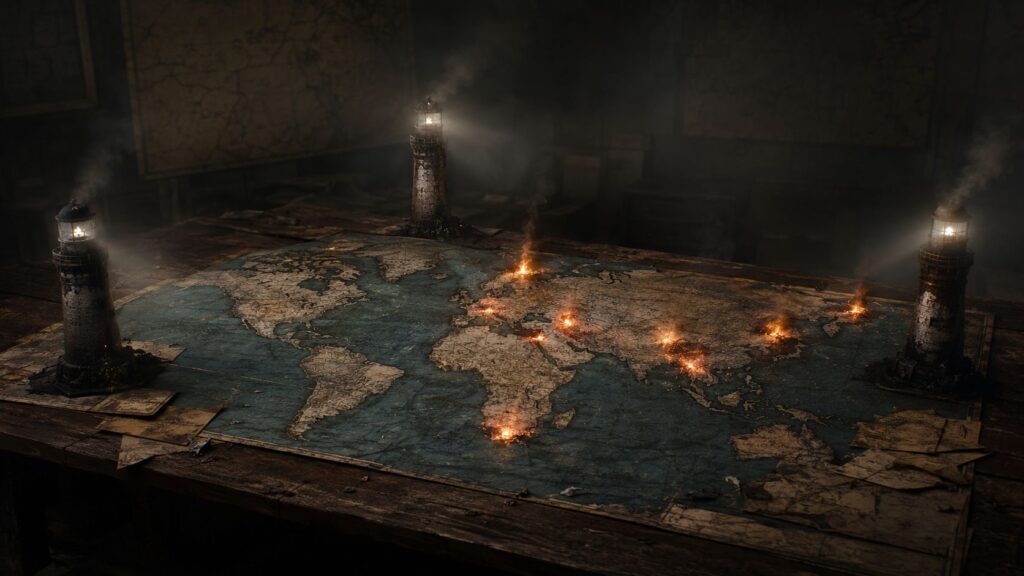
When the Guarantors of Order Fail
What Happens When All the Superpowers Are Occupied Simultaneously?
I. The Question That Changes Everything
In the previous installment of this series, we posed a question: what happens when the three superpowers – the United States, China, and Russia – are simultaneously so consumed by their own conflicts that they have no capacity left for anything else?
When Russia is locked down in Europe – militarily, economically, and politically. When the United States is containing China in the Pacific – through blockades, sanctions, and military presence. When Europe is pouring its resources into armaments rather than its economy.
In this final installment of the series, we examine one possible scenario. We look at which regional conflicts are currently smoldering, which borders are disputed, which old scores are waiting to be settled. And we analyze what could happen if the guarantors of order – the powers that have kept these conflicts in check – suddenly are no longer there.
After reading this, you will understand why I have never hoped so strongly as I do right now that my analysis turns out to be wrong.
II. The Logic of Opportunism – A Historical Lesson
History knows moments when the guarantors of order fail. The most familiar is the summer of 1914.
An assassination in Sarajevo – a local conflict in the Balkans. Austria-Hungary issued an ultimatum to Serbia. Russia mobilized in support of Serbia. Germany declared war on Russia. France was pulled in by alliance obligations. Britain followed.
Within weeks, Europe was in flames.
Not because everyone wanted war. But because no one had the strength left to mediate. The great powers were trapped by alliance commitments, bound by military mobilization plans, driven by domestic political pressure. The mechanism of escalation ran like clockwork – and no one could stop it anymore.
Four years later: 17 million dead. Four empires destroyed. The map of Europe redrawn.
2026 could place the world before a similar moment.
The difference: in 1914, the great powers were constrained by alliances but fundamentally capable of acting. In 2026, they would be paralyzed by their own conflicts. It would not be alliance commitments that shackled them – but their own overextension.
And that makes the situation even more dangerous.
III. Why Opportunism Is Contagious
When one country sees another settling an old score – and no one intervenes – the next country thinks: “Then we can too.”
This is not conspiracy. This is human nature.
States do not behave fundamentally differently from individuals. When the police are absent, crime rises. When the teacher looks away, the classroom gets loud. When the superpowers are occupied, borders get moved.
The international order since 1945 rests on a simple principle: the United States guarantees – together with its allies – security, sea lanes, and trade routes. In return, everyone accepts the dollar as the world’s reserve currency. Those who step out of line get punished – see Iraq, Libya, Iran.
But what happens when the United States itself has to fight? When it is tied down in the Pacific against China? When Europe is fighting Russia? When China no longer has the resources to stabilize Southeast Asia?
Then the system breaks down.
Not immediately. Not everywhere at once. But piece by piece. Conflict by conflict.
IV. The Regional Conflicts – A Survey
The following analysis is not prophecy. It is an inventory: which conflicts are currently smoldering? Which countries have unfinished business? Which borders are disputed? And above all – which superpower is currently keeping the lid on?
East Asia: The Nuclear Domino
The conflict: North Korea vs. South Korea
Since 1953, only an armistice exists – no peace treaty. The border is the most heavily militarized on earth. North Korea has massively expanded its nuclear program in recent years; estimates put the arsenal at 30 to 50 warheads, mounted on missiles capable of reaching South Korea, Japan, and US bases on Guam.
Who is keeping the lid on? The United States – 28,500 troops in South Korea, security guarantees, military exercises – and China, which controls North Korea’s economic lifeline, applies diplomatic pressure, and manages energy supplies.
What happens if both are occupied? Kim Jong Un commands one million soldiers, 8,000 artillery pieces within range of Seoul, chemical weapons, and the capacity to destroy South Korea’s infrastructure within hours. If the United States is tied down in the Pacific defending Taiwan – with aircraft carriers engaged, bases in Japan under Chinese missile fire – Washington cannot send troops to Korea. And if China itself is fighting, Beijing has no resources left to manage Kim Jong Un. Economic sanctions become meaningless if China does not enforce them. Diplomatic pressure disappears.
Additionally: Japan becomes a target
Japan hosts US bases – Okinawa, Yokosuka, Misawa. These bases would be central to any American operation against China or in defense of South Korea. North Korea has repeatedly threatened to strike Japan if it supports the United States. If the US is fighting in the Pacific, Japan automatically becomes a belligerent. North Korea’s missiles reach Tokyo. China’s navy threatens Japanese islands (Senkaku/Diaoyu). Japan stands alone – the United States is occupied elsewhere.
Consequence: Seoul, a metropolis of 25 million, sits within artillery range. The first North Korean barrages could kill hundreds of thousands – in the opening hours. South Korea’s economy – responsible for 15 percent of global semiconductor production, home to Samsung, LG, Hyundai – collapses. Japan loses cities to missile strikes. The world’s third-largest economy goes under. Global supply chains dependent on South Korean chips and Japanese precision technology break apart.
Southeast Asia: The Forgotten Powder Keg
The conflict: Thailand vs. Cambodia – and the collapse of Myanmar
Thailand and Cambodia share centuries of hostility. Historical territorial claims, religious tensions, ethnic minorities straddling the border. Armed clashes have occurred repeatedly in recent years – artillery exchanges, wounded soldiers, burned villages.
Who is keeping the lid on? China. Beijing regards Southeast Asia as its sphere of influence, mediates between Bangkok and Phnom Penh, invests massively in both countries through the Belt and Road Initiative, and applies diplomatic pressure.
What happens if China is occupied in the Pacific? Thailand could press territorial claims. Cambodia could strike preemptively. Old ethnic tensions resurface. Without Chinese mediation, there is no one to intervene.
Additionally: Myanmar implodes completely
Myanmar has been in civil war since the 2021 military coup – the Tatmadaw against pro-democracy activists, ethnic militias (Karen, Kachin, Shan, Rakhine), and armed resistance groups. Tens of thousands dead, millions displaced.
China has until now contained the worst – through arms supplies to the junta, diplomatic cover at the UN, economic support. The reason: Beijing wants stability. Myanmar is strategically vital – access to the Indian Ocean, oil and gas pipelines, Belt and Road infrastructure. If China is occupied, Myanmar implodes entirely. The junta collapses. Ethnic militias seize entire regions. Neighboring countries – Thailand, Bangladesh, India – are inundated by refugee flows.
Additionally: The South China Sea
Vietnam, the Philippines, Malaysia, Brunei, Taiwan – all have competing territorial claims in the South China Sea. China claims 90 percent of the sea under its “Nine-Dash Line,” has built artificial islands, and militarized them. Currently, China’s dominance holds the situation together. But if China is fighting over Taiwan, the conflicts erupt. The Philippines could strike Chinese installations. Vietnam could occupy contested features. Malaysia could press its claims militarily.
Consequence: Southeast Asia burns. Millions of refugees from Myanmar, Thailand, Cambodia. The Strait of Malacca – through which 25 percent of global trade passes – becomes unsafe. Piracy explodes. Commercial vessels are attacked. Supply chains to Europe, the United States, and East Asia collapse.
South Asia: The Nuclear Powder Keg
The conflict: India vs. Pakistan – two nuclear powers, one unresolved dispute
Kashmir has been contested since 1947. Three wars (1947, 1965, 1999), countless border incidents, terrorist attacks, preemptive airstrikes. Both countries possess nuclear weapons – India approximately 170 warheads, Pakistan approximately 170, according to the Federation of American Scientists. Both have delivery systems capable of reaching the other.
Who is keeping the lid on? The United States – through diplomatic pressure, mediation, and economic incentives – and China, through its close partnership with Pakistan and economic entanglement with India.
What happens if both are occupied? Pakistan aligned itself in 2024 with Saudi Arabia in a new military alliance – a kind of “NATO lite” of the Middle East, with Egypt, Jordan, and the UAE. That shifts the balance. Pakistan gains Saudi financing, modern weapons, political backing.
India might calculate: “If we don’t act now, Pakistan becomes too strong. And if China is tied down in the Pacific, Beijing can’t help Islamabad. Now or never.”
India also has its own ambitions. Prime Minister Modi speaks of Akhand Bharat – “Undivided India,” encompassing Pakistan and Bangladesh. Nationalist forces have demanded for years that Kashmir be definitively incorporated.
The nuclear scenario:
Pakistan is conventionally weaker. India’s military is three times larger, more modern, better equipped. In a conventional war, Pakistan loses. Islamabad knows this. Pakistan therefore maintains a “First Use” nuclear doctrine: if the existence of the state is threatened, nuclear weapons will be deployed. India holds a “No First Use” doctrine – but that does not mean Delhi would not retaliate.
The escalation sequence:
- India attacks (Kashmir, border territories)
- Pakistan defends conventionally – and loses
- India advances toward Pakistan’s heartland
- Pakistan deploys tactical nuclear weapons (against Indian forces)
- India responds with strategic nuclear weapons (against Pakistani cities)
- Pakistan retaliates in kind
Consequence: Millions dead. Lahore, Karachi, Delhi, Mumbai – cities of millions, obliterated. Radioactive fallout reaches China, the Middle East, Southeast Asia. Global food production collapses under nuclear winter effects. One billion people across South Asia face mortal peril.
The Middle East: The Powder Keg Finally Detonates
The conflict: A proxy network goes direct
Iran vs. Israel is the core conflict – but it has been conducted through proxies for decades. Hezbollah in Lebanon, the Houthis in Yemen, Shia militias in Iraq and Syria – all financed, armed, and trained by Iran. Israel strikes these proxies preemptively.
In the past 24 months, Israel has conducted strikes in nine countries: Syria, Lebanon, Gaza, the West Bank, Iraq, Yemen, Sudan (suspected weapons smuggling routes), and Iran itself. That generates enemies.
Who is keeping the lid on? The United States – military presence (Fifth Fleet in Bahrain, bases in Qatar, Jordan, Kuwait), security guarantees for Israel, diplomatic pressure on Iran, direct airstrikes against Iranian proxies, weapons deliveries to Israel.
What happens if the United States is occupied in the Pacific? Iran has been waiting years for this moment. The US fleet in the Persian Gulf is redeployed to Asia to contain China. Diplomatic channels freeze – Washington has no resources left. The airstrikes stop.
Israel stands alone. Hezbollah holds 150,000 rockets – more than most standing armies. The Houthis can blockade the Suez Canal. Shia militias in Iraq and Syria can strike Israeli positions. And Iran itself could attack with drones, missiles, and possibly even ground forces through Syria.
Additionally: Saudi Arabia intervenes
Saudi Arabia has fought the Houthis in Yemen since 2015 – a proxy war against Iran. The Saudis have suffered massive losses but never controlled Yemen. If the United States is occupied, Riyadh might calculate: “Now we can escalate, conquer Yemen for good, secure the Bab al-Mandab strait – and no one stops us.” Saudi Arabia has built a new military alliance with Pakistan, Egypt, and other Arab states. With Pakistani backing – possibly including Pakistani nuclear weapons under Saudi control, an open secret – Riyadh might believe it can finally defeat Iran.
Additionally: Turkey expands
Turkey already has troops in Syria, Iraq, and Libya. President Erdoğan speaks openly of rebuilding Ottoman influence. If the United States is occupied, Ankara might see its moment: full annexation of northern Syria, strikes on Iraqi Kurdistan, confrontation with Greece, control of Libya. A neo-Ottoman hegemony across the eastern Mediterranean.
Consequence: The Middle East burns in its entirety. Israel fights on every front. Oil exports collapse – the Strait of Hormuz, through which 20 percent of the world’s oil passes, is blockaded. Europe and Asia lose their energy supplies. The global economy enters a crisis that makes 1973 look mild. Millions of refugees. Syria, Lebanon, Yemen, Iraq – all collapse completely.

Europe: NATO Implodes from Within
The conflict: Turkey vs. Greece – NATO member against NATO member
Both countries have been NATO members since the 1950s. Both are old enemies. The last war (1920–1922) ended in mass population transfers – 1.5 million Greeks expelled from Anatolia, 500,000 Turks from Greece. The wounds never healed.
Current flashpoints:
- The Aegean: who owns the Greek islands off the Turkish coast? Greece says: we do. Turkey argues the islands are militarized – prohibited under treaty – and therefore forfeit their sovereignty.
- Cyprus: divided since 1974 between the Republic of Cyprus (Greek, EU member) and Northern Cyprus (Turkish, recognized only by Turkey). Turkey maintains a military occupation of the north.
- Maritime rights: who owns the oil and gas beneath the eastern Mediterranean? Greece and Cyprus have concluded agreements with Egypt, Israel, and Italy. Turkey feels excluded and sends warships.
Who is keeping the lid on? NATO. Article 5 states: an attack on one member is an attack on all. If Turkey and Greece go to war, NATO implodes. The United States, Germany, and France therefore mediate constantly.
What happens if NATO is fighting Russia in Eastern Europe? Turkey fields NATO’s second-largest army – 355,000 soldiers, modern US weapons (F-16s, Patriot missiles), its own production (Bayraktar drones). Greece is militarily weaker. If NATO’s forces are committed to the eastern front against Russia, no one has the resources to intervene in the Aegean. With the alliance consumed elsewhere, Ankara might move on the Greek islands, occupy all of Cyprus, and assert dominance over the eastern Mediterranean.
Additionally: The Balkans fracture – again
Serbia vs. Kosovo. Bosnia-Herzegovina – three ethnic groups, one dysfunctional state. North Macedonia, Montenegro, Albania. NATO and the EU have held the Balkans together since the 1990s through troop presence, EU accession prospects, and economic integration. If NATO is fighting in Eastern Europe, no one remains to stabilize the region.
Consequence: NATO implodes. One member attacks another. The alliance’s credibility is destroyed. The Balkans burn again – ethnic cleansing, refugee flows, humanitarian catastrophe. Europe, already fighting Russia, is simultaneously flooded by refugees from the Middle East, Africa, and now the Balkans.
The Caucasus: Russia Cannot Help
The conflict: Azerbaijan vs. Armenia. Nagorno-Karabakh as the eternal flashpoint.
Who is keeping the lid on? Russia – military presence, mediation, security guarantees for Armenia.
What happens if Russia is occupied in Europe? Azerbaijan marches. Armenia stands alone. Russia cannot send troops – they are committed in Europe.
Consequence: Armenia loses territory – possibly its existence as an independent state. Hundreds of thousands of refugees.
Africa: The Forgotten Continent Burns
Conflicts: Ethiopia vs. Eritrea. North Sudan vs. South Sudan. Rwanda-Congo – again. Somalia disintegrates.
Who is keeping the lid on? No one effectively – but the United States and Europe apply occasional diplomatic pressure, the African Union mediates, and China stabilizes through economic entanglement.

What happens if everyone is occupied? Africa explodes. Old ethnic conflicts reignite. Borders drawn by colonial powers that never made sense are renegotiated by force.
Consequence: Millions of refugees. Humanitarian catastrophes. Europe is inundated by refugee flows – but Europe is fighting its own war and can absorb no one.
V. The Economic Consequences – The Collapse of the World Economy
Wars do not only produce military consequences. They destroy economies.
Supply chains collapse
Taiwan: semiconductor production – the backbone of the global electronics industry – goes offline. No more chips for cars, computers, smartphones, appliances. The modern economy stops functioning.
South Korea: if North Korea attacks, the South Korean electronics industry collapses. Samsung, LG, Hyundai – gone.
The Middle East: oil and gas exports collapse. Energy prices explode. Europe freezes. Factories shut down.
Sea lanes blocked
The Strait of Malacca connects the Indian Ocean to the Pacific. Twenty-five percent of global trade passes through this chokepoint. If Southeast Asia burns, the strait is blocked.
The Strait of Hormuz: 20 percent of the world’s oil passes through here. If the Middle East burns, the strait is blocked.
The Suez Canal connects Europe and Asia. If the Middle East burns, the canal is threatened.
Consequence: Global trade collapses. Supply shortages. Inflation. Mass unemployment. Social unrest. The economic damage of armed conflict cascades across every continent simultaneously.
Financial markets in freefall
Wars mean uncertainty. Uncertainty means capital flight. Stock markets collapse. Currencies crash. States go bankrupt. The world economy – built since 1945 on stability, open markets, and free trade – no longer exists.
VI. The Nuclear Dimension – Pandora’s Box
The greatest risk: nuclear weapons.
Nine countries possess them: the United States, Russia, China, the United Kingdom, France, Israel, India, Pakistan, North Korea. The Bulletin of the Atomic Scientists has moved its Doomsday Clock closer to midnight than at any point in its history.
If India and Pakistan go to war – both nuclear-armed – who guarantees the weapons will not be used? Pakistan might calculate: “If we lose conventionally, the bomb is all we have left.” India might calculate: “If Pakistan deploys first, we must strike first.”
The same logic applies to North Korea. Kim Jong Un has nothing to lose. If he attacks South Korea and faces conventional American superiority – what stops him from deploying nuclear weapons?
And Israel.
If Iran and its allies existentially threaten Israel – the so-called “Samson Option” is Israeli doctrine. When Samson perished, he brought the temple down with him. If Israel goes under, it takes others with it.
Once one nuclear weapon is detonated, the next follows.
The Cold War was stabilized by Mutually Assured Destruction – MAD. Both sides understood: if we attack, we die too. But 2026 does not feature two sides. It features dozens of actors. And not all of them are rational.
VII. Conclusion – The Point of No Return
The world may be standing at a moment where decisions are being made that will shape decades. Perhaps centuries.
The situation described here is not dystopian fantasy. Every single conflict named in this analysis is real. Every one is already smoldering. Every one is waiting for the right moment.
The only question is: who is keeping the lid on?
Currently, it is the superpowers – the United States, China, Russia. They guarantee stability. They mediate. They threaten. They intervene.
But what happens when all of them are simultaneously occupied?
Then there is no one left to mediate. No one left to threaten. No one left to intervene.
Then the world burns.
Not everywhere at once. Not immediately. But piece by piece. Conflict by conflict. Like a wildfire spreading until nothing remains.
The international order that has existed since 1945 was never perfect. It rested on a balance of power, on deterrence, on self-interest. But it functioned – reasonably.
That order could collapse in the years ahead.
Not through one great war between superpowers – that would be the end of humanity.
But through dozens of small wars, all occurring simultaneously. Because no one is left to stop them.
I have written this series because I believe this trajectory is possible. Perhaps even probable.
I have never hoped so strongly that I am wrong.
But the pieces are on the table. The logic is compelling. The historical parallels are there.
What happens next is not in my hands. But it is in the hands of those who hold power.
The question is: will they be wise enough to see the abyss – and brake in time?
Or do we all race into the darkness together?
This is the final installment of the nine-part series “Europe Prepares for War.” The previous installments covered rearmament, the 2026 tension scenario, the European Defence Industrial Programme (EDIP), the overlooked alliance clause (Article 42.7), the Permanent Structured Cooperation (PESCO), the PRISM surveillance architecture, the 16 steps of war preparation since 2014, and the geopolitical strategy of the United States.

Michael Hollister
is a geopolitical analyst and investigative journalist. He served six years in the German military, including peacekeeping deployments in the Balkans (SFOR, KFOR), followed by 14 years in IT security management. His analysis draws on primary sources to examine European militarization, Western intervention policy, and shifting power dynamics across Asia. A particular focus of his work lies in Southeast Asia, where he investigates strategic dependencies, spheres of influence, and security architectures. Hollister combines operational insider perspective with uncompromising systemic critique – beyond opinion journalism. His work appears on his bilingual website (German/English) www.michael-hollister.com, at Substack and in investigative outlets across the German-speaking world and the Anglosphere.
Sources
- Wikipedia: “July Crisis” – The escalation toward World War One, 1914: https://en.wikipedia.org/wiki/July_Crisis
- Imperial War Museums: “How Did World War One Start?”: https://www.iwm.org.uk/history/the-causes-of-the-first-world-war
- Council on Foreign Relations (2025): “Global Conflict Tracker”: https://www.cfr.org/global-conflict-tracker
- International Crisis Group (2025): “10 Conflicts to Watch in 2025”: https://www.crisisgroup.org/global/10-conflicts-watch-2025
- Stockholm International Peace Research Institute (SIPRI): “Armed Conflicts Database”: https://www.sipri.org/search/node?keys=Armed+Conflicts+Database
- Center for Strategic and International Studies (2024): “The Korean Peninsula: Still the World’s Most Dangerous Place”: https://www.csis.org/events/xi-jinpings-china-and-korean-peninsula
- Brookings Institution (2024): “The Scouting Report: Dialing Down North Korea’s Nuclear Threat”: https://www.brookings.edu/events/the-scouting-report-dialing-down-north-koreas-nuclear-threat/
- Carnegie Endowment (2024): “India-Pakistan Relations: The Enduring Rivalry”: https://carnegieendowment.org/research/2024/india-pakistan-relations
- Arms Control Association: “Nuclear Weapons: Who Has What at a Glance”: https://www.armscontrol.org/factsheets/Nuclearweaponswhohaswhat
- International Crisis Group, April 12, 2024: “Iran-Israel ‘Shadow War’ Risks Spinning Out of Control”: https://www.crisisgroup.org/middle-east-north-africa/gulf-and-arabian-peninsula/iran-israelpalestine/iran-israel-shadow-war
- Al Jazeera, June 25, 2025: “Mapping Israel’s expanding battlefronts across the Middle East”: https://www.aljazeera.com/news/2025/6/25/mapping-israels-expanding-battlefronts-across-the-middle-east
- International Crisis Group, December 4, 2023: “Turkey-Greece: A Shimmer of Hope in the Eastern Mediterranean”: https://www.crisisgroup.org/europe-central-asia/western-europemediterranean/turkiye/turkey-greece-shimmer-hope-eastern
- European Council on Foreign Relations, May 16, 2025: “The perpetual horizon: Armenia, Azerbaijan and prospects for peace”: https://ecfr.eu/article/the-perpetual-horizon-armenia-azerbaijan-and-prospects-for-peace/
- World Bank (2024): “The Economic Impact of Armed Conflict”: https://www.worldbank.org/en/topic/fragilityconflictviolence/brief/economic-impacts
- International Energy Agency (2024): “Energy Security and Geopolitical Risk”: https://www.iea.org/topics/energy-security
- UNCTAD, October 22, 2024: “Review of Maritime Transport 2024: Navigating maritime chokepoints”: https://unctad.org/publication/review-maritime-transport-2024
- Bulletin of the Atomic Scientists (2025): “Doomsday Clock Statement”: https://thebulletin.org/doomsday-clock/
- Federation of American Scientists: “Status of World Nuclear Forces”: https://fas.org/issues/nuclear-weapons/status-world-nuclear-forces/
- International Campaign to Abolish Nuclear Weapons (ICAN): “Nuclear Weapons Risk”: https://www.icanw.org/nuclear_weapons_risk
© Michael Hollister – All rights reserved. Redistribution, publication or reuse of this text requires express written permission from the author. For licensing inquiries, please contact the author via www.michael-hollister.com.
Newsletter
🇩🇪 Deutsch: Verstehen Sie geopolitische Zusammenhänge durch Primärquellen, historische Parallelen und dokumentierte Machtstrukturen. Monatlich, zweisprachig (DE/EN).
🇬🇧 English: Understand geopolitical contexts through primary sources, historical patterns, and documented power structures. Monthly, bilingual (DE/EN).