
by Michael Hollister
Published on April 26, 2026
2.988 words * 16 minutes readingtime
Part 1 find here:
Arming Into Decline: Why Germany and the EU Are Investing in War
Part 2 find here:
Leaked: German Industry Told to Prepare for War Economy by 2026
Part 3 find here:
EDIP: How the EU is Converting Europe into a War Economy
Part 4 find here:
The EU Backdoor to War – How Ukraine’s Membership Could Trigger NATO-Russia Conflict
This analysis is made available for free – but high-quality research takes time, money, energy, and focus. If you’d like to support this work, you can do so here:

Alternatively, support my work with a Substack subscription – from as little as 5 USD/month or 40 USD/year!
Let’s build a counter-public together.
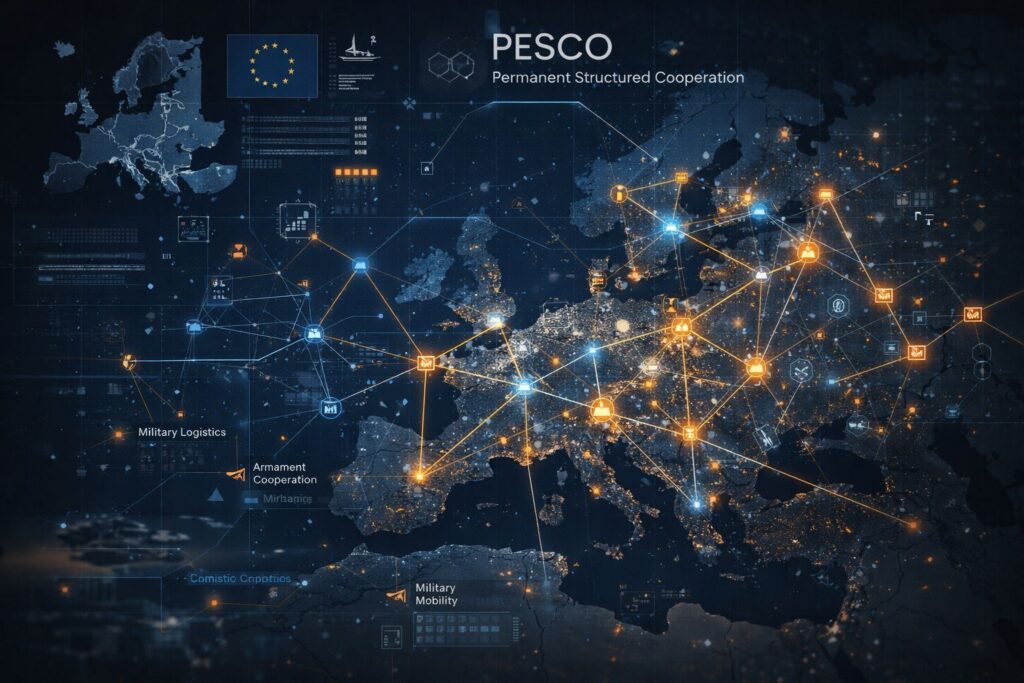
PESCO
How Europe Built an Army Without Anyone Noticing
Introduction: What Nobody Was Supposed to See
You can’t build an army without someone noticing – unless you call it something else.
For years, a military structure has been emerging in Europe that possesses everything an army requires: a command structure, joint military exercises, unified equipment standards, centralized mobility planning, and a strategic purpose. Only one thing is missing: the official designation “army.”
We’re talking about PESCO – the European Union’s “Permanent Structured Cooperation.” A harmless name, technocratic, cumbersome, unsuspicious. But beneath this facade lies nothing less than the gradual emergence of an EU military force, operationally ready within days, structurally independent from NATO, yet fully militarily integrable.
While the public occupies itself with budget debates, climate regulations, and identity politics, a system is growing in the shadows that will, in an emergency, help decide peace or war on the continent – without ever having been legitimized through a parliament or popular vote.
In this article, we reveal what PESCO really is, why almost no one knows about it, how it was constructed – and why everything suggests this was never about cooperation, but always about preparation. For what? That remains to be seen. Perhaps soon.
The Birth in Shadow: How PESCO Emerged in 2017
To understand why PESCO was founded in 2017, we must go back three years.
In 2014, a pro-Western uprising overthrew the Ukrainian government – co-financed through American “democracy promotion” programs, according to statements by Victoria Nuland totaling over $5 billion since 1991. What followed wasn’t just the country’s division, but the beginning of a geopolitical reordering: The West moved closer to Russia’s border. Russia responded with Crimea’s incorporation. And Europe suddenly faced the question: How secure are we, actually?
The military and diplomatic break with Moscow was complete – and on the European side, a quiet but consequential transformation began: the recognition that security policy can no longer be delegated. That NATO, while militarily strong, isn’t European-controlled. That Europe must become capable of action – if necessary, without Washington.
In 2017, three years after the geopolitical earthquake in Ukraine, PESCO was officially launched – initially as a harmless cooperation project for “efficiency enhancement” of national armed forces. But anyone reading the documents and analyzing the projects quickly recognizes:
This wasn’t simply organizing cooperation – this was preparing an army.
The legal foundation consisted of Articles 42(6) and 46 of the Treaty on European Union (TEU). These articles permit member states to enter permanent structured cooperation in the defense sector – activated through unanimous Council decision on December 11, 2017, but mandatory only for states voluntarily committing. A coalition of the willing – with binding effect.
And that’s exactly what happened: 25 of 27 EU states joined PESCO – including Germany, France, Italy, Spain, Poland. Only Denmark (then with opt-out) and Malta initially remained outside.
PESCO’s birth wasn’t a loud departure – it was a quiet systemic shift. From national defense to supranational operational readiness.
What was sold as voluntary cooperation turned out to be entry into a new military power structure. Amid growing tensions with Russia, growing dependence on the United States – and growing doubts about NATO – Europe began creating the prerequisites for its own army, without saying so.
What PESCO Really Is – and What It’s Meant to Become
Anyone examining PESCO quickly encounters terms like “coordination,” “efficiency,” “capability development,” or “synergies.” Technocratic, apolitical, almost boring. But behind this language hides a system that, in its totality, permits only one logical conclusion:
PESCO is the structured preparation for a supranational European army.
Currently, PESCO encompasses over 75 individual military projects, systematically divided into key capability areas. These aren’t random initiatives – they’re the building blocks of comprehensive military power:
Command and Control Infrastructure: The establishment of EU-wide military command centers isn’t about improving meetings – it’s about creating the brain of a military organism. The Military Planning and Conduct Capability (MPCC) already functions as an operational headquarters for EU missions, staffed, equipped, and connected to national command structures across the continent.
Military Mobility – The Logistics Revolution: Perhaps PESCO’s most ambitious component: transforming Europe’s civilian infrastructure into a military highway system. The Military Mobility Initiative has identified 500 critical “hotspots” – bridges unable to bear tank weight, rail tunnels too narrow for military cargo, ports lacking heavy-lift capacity.
The solution? A infrastructure overhaul estimated at minimum €100 billion. Not for civilian benefit – for tanks, armored vehicles, and artillery systems to move rapidly from Portugal to Poland. The European Parliament recently called this a “Military Schengen” – borders disappear not just for people, but for armies.
Budget allocation tells the story: €1.69 billion for 2021-2027. Proposed for 2028-2034? €17.65 billion – a tenfold increase. Someone expects this infrastructure to be used.
Joint Armament and Technology Projects:
- Eurodrone: European MALE (Medium Altitude Long Endurance) UAV for reconnaissance and strike capability
- Main Ground Combat System (MGCS): Next-generation tank to replace Leopard 2 and Leclerc
- European Patrol Corvette (EPC): Standardized naval vessels for multiple navies
- Strategic Command and Control System: Encrypted, interoperable communications across all EU forces
The pattern is clear: eliminating national equipment incompatibilities. A French tank crew should operate a German tank. A Polish pilot should fly a Spanish drone. Standardization enables substitutability – the hallmark of unified command.
Training, Education, and Operational Preparation: European training centers aren’t language schools – they’re force integration facilities. Joint exercises normalize combined operations. Shared doctrine creates shared reflexes. When the order comes, units don’t need to learn cooperation – they’ve already practiced it for years.
Medical infrastructure follows the same logic: European Medical Command, cross-border casualty evacuation protocols, integrated field hospitals. You don’t build these systems for peacekeeping – you build them for war.
Cyber Defense and Space-Based Intelligence: Cyber Rapid Response Teams, protection of critical infrastructure, coordinated offensive cyber capabilities. Modern warfare begins in cyberspace – PESCO ensures European forces can fight there cohesively.
Space-based ISR (Intelligence, Surveillance, Reconnaissance) provides the eyes. Satellite networks for communications, positioning, early warning. These aren’t supplements to national capabilities – they’re the foundation for autonomous European military action.
The Crown Jewel: EU Rapid Deployment Capacity (RDC)
Operational since May 2025, the RDC represents PESCO’s actualization. This isn’t a planning document – it’s 5,000 soldiers, standing ready, with:
- Full combined arms capability (infantry, armor, artillery, engineers)
- Dedicated air support and transport
- Integrated logistics and medical evacuation
- Cyber defense and electronic warfare units
- Command structure activated within 10-20 days
Critical detail: This force is designed to operate without NATO, without the United States – while remaining fully compatible with both. It’s the definition of strategic autonomy.
Member states commit within PESCO’s framework to binding obligations:
- Progressive increase of defense spending
- Provision of specific military capabilities on schedule
- Participation in joint operations when activated
- Alignment of national military structures with EU standards
- Regular capability reviews with enforcement mechanisms
This isn’t voluntary cooperation – it’s structured obligation. PESCO created what amounts to contractual military integration without calling it that.
What PESCO is today: The quiet institutionalization of European war-fighting capability – under the radar, but with full legal force and operational substance.
What it’s meant to become: A fully operational, coordinately controllable, transnational military force – deployable on political command within weeks. Not a loose alliance. An organism with a nervous system, muscles, and will.
The Silent Construction: Why Nobody’s Watching
You can execute the biggest transformation unnoticed if you divide it into small steps, name it complicatedly, and dress it in technical language. That’s not theory – that’s the European Union’s political practice.
And PESCO is its military masterpiece.
While most citizens would expect major debates, flags, military parades, and televised duels under “European army,” the EU has long since begun building exactly this army – just without the name, without the noise, without the resistance.
The Method: Technocratic Salami Tactics
No grand master plan with press conference. No “We’re founding an army now” moment.
Instead: a dozen infrastructure projects here, a standardization agreement there, a training initiative somewhere else. Each individual step appears technical, limited, uncontroversial. The totality reveals the architecture.
Rather than obtaining political consent for “building a European army” – which would have triggered massive debate, referendums, constitutional challenges – Brussels created accomplished facts through incremental integration. Call it “structured participation.” In reality: structured decoupling from democratic control.
The few discussions that occurred happened within specialized security policy circles – defense committees, think tanks, expert panels. Not in national parliaments. Not in town halls. Not in public squares. PESCO wasn’t concealed through censorship – it was made invisible through administrative obscurity.
The Bureaucratic Camouflage
No citizen protests against an “EU logistics coordination center for military support services.” The language is deliberately soporific. Who reads a 47-page Council Decision on “capability development commitments” and recognizes they’re reading the blueprint for an army?
But that’s precisely where the capability to set armies in motion begins. Infrastructure investment isn’t infrastructure investment when it’s calculated to move tank divisions from Germany to Lithuania in 72 hours. That’s not civilian planning – that’s operational preparation.
Media Complicity Through Neglect
The most effective form of information control isn’t censorship – it’s selective attention. While PESCO grew from 17 projects (2018) to 75 projects (2024), European media focused elsewhere:
- COVID pandemic management
- Climate policy debates
- Energy price crises
- Immigration controversies
- Culture war skirmishes
Valid topics, demanding coverage. But while these filled headlines and broadcasts, power’s architecture grew in shadow. Not hidden – ignored.
When PESCO was mentioned, it appeared in defense trade publications, specialist journals, Brussels policy papers. Never on front pages. Never in prime-time analysis. The technocratic presentation ensured only specialists paid attention – and specialists either supported the project or lacked platforms for opposition.
The Democratic Deficit Nobody Discusses
Here’s what should disturb anyone who values democratic governance: The most significant shift in European military capability since NATO’s founding occurred without meaningful public input.
No European demos was asked: “Should we build our own army?” No referendum. No election fought on this question. No honest debate about costs, risks, command authority, or strategic necessity.
Instead, political elites in Brussels and national capitals made the decision behind closed doors, wrapped it in treaties and council decisions, and presented it as technical cooperation rather than fundamental transformation.
The argument will be made: “Member states agreed voluntarily through their governments.” True. But those governments never campaigned on “We will subordinate national military forces to EU command structures.” They signed documents their voters never read, creating obligations their publics never approved.
When the army becomes openly declared – and it will – the response to objections will be: “But the infrastructure already exists. The commitments are made. The structures are operational. Reversing this would be impractical and dangerous.”
Classic fait accompli. The decision was never made – it was preempted through incremental construction until reversal became impossible.
The Coup: Hiding in Plain Sight
Nothing was technically secret. All PESCO documents are publicly available on EUR-Lex. Council decisions are published. Project lists are online.
But availability isn’t transparency. When you bury transformative policy in hundreds of pages of bureaucratic text, spread across dozens of separate decisions, using language designed to obscure rather than clarify – you’ve achieved opacity through complexity.
The coup wasn’t concealing PESCO. The coup was making it boring. So boring that nobody looked. So technical that nobody understood. So incremental that nobody connected the pieces until the structure stood complete.
The Timeline: How Fast Could Europe March?
There’s no official mandate for a European army – and yet, once PESCO is fully developed, within two to three weeks a fully operational military force under EU command could stand at the eastern flank.
How is this possible?
The answer: PESCO isn’t the idea of an army – PESCO is an army’s infrastructure. And precisely therefore almost everything is prepared: command structures, troop mobility, supply lines, communication networks.
Only the order is missing.
Scenario:
A political decision in the European Council – for example triggered by an incident, a “mutual assistance appeal” under Article 42(7) TEU, or through Ukraine’s formal admission to the EU.
What would happen then?
The reaction chain would look like this:
Phase 1: Political Decision (Days 1-3)
- The EU Council issues the mandate to activate military structures
- PESCO states assign national contingents
- Already existing command centers (Operational Headquarters, OHQ) are activated
- Coordination runs through the EU Military Staff in Brussels – an organ that already exists
Phase 2: Mobilization (Days 4-10)
- Troop movements begin within Europe: rail connections, ferry routes, air transport – all prepared through the Military Mobility Initiative
- Logistics centers go into action, supply lines are extended
- Communication systems and intelligence networks are synchronized in real-time
Phase 3: Deployment Ready (Days 11-21)
- An EU intervention force of 5,000 to 7,000 soldiers stands at the eastern border – including engineer units, medical services, cyber defense, drone coordination
- Initial strike forces could be made operational – supplemented by national reserve forces integrated into PESCO combined structures
- Supporting intelligence via ISR platforms (Intelligence, Surveillance, Reconnaissance) – the technical foundation for the next article about PRISM
The decisive point: This speed isn’t conceivable if you’re starting from zero.
It’s only possible because the army factually already exists – just not as declaration, but as structure.
The phrase “Europe has no army” has long been false. The more accurate formulation:
Europe has no declared army – but an operational one.
And when the political moment comes – whether consciously brought about or “suddenly” occurring – then this army won’t first be built, but merely activated.
The Goal: Do We Even Need a European Army?
You don’t build a garage for a semi-truck with trailer unless you’re at least considering acquiring one. And you don’t build a large-scale military structure like PESCO if you don’t want a European army.
But that’s the actual scandal: Nobody has ever seriously asked whether Europe even needs its own army.
- There was no public debate
- No Europe-wide consultation
- No media campaign
- No referendum in any member state
The central question was simply skipped. Instead, PESCO was set in motion, armed, expanded – in the implicit assumption that political consent will somehow be delivered once the structure is mature enough.
The decision wasn’t made – it was preempted.
Because once you have:
- Common troop standards
- Unified logistics systems
- Central command structures
- Political mutual assistance obligations
installed – then the army is only a semantic question.
What’s missing is no longer the system, but only the label.
And this label will, in case of doubt, be affixed when it’s too late to say no.
What would an honest debate have produced?
- Costs: Who pays for what? How much additional to NATO contribution?
- Competence question: Who commands in an emergency? Commission President? The Council? France? Germany?
- Constitutional questions: How does a supranational army align with national parliamentary rights, such as the Bundestag’s?
- War and peace: Who decides on operations, escalation, withdrawal?
These questions weren’t forgotten – they were avoided.
Because it was clear: A real debate could have brought down PESCO.
And with it all those plans about which one perhaps only speaks when they’re operationally ready.
Conclusion: The Body Stands. The Command Is Still Missing.
PESCO isn’t an idea. PESCO is a structure.
A structure that’s ready today – not someday. Not theoretically. Not maybe. But now.
The European army wasn’t decided – it was built.
Broken into projects, distributed across states, obscured through terminology – but as a whole, long since present.
Anyone still saying Europe has no military force confuses rhetoric with reality.
The question is no longer whether Europe can march – but only when and under what pretext.
What’s missing isn’t capability, but occasion.
An attack. An incident. A mutual assistance appeal. A crisis moment.
A moment when nobody asks anymore – but only obeys.
The body stands. It’s strong, organized, operational. And it waits.
But no body acts without sensory organs. No army without target coordinates. No marching order without intelligence.
Because whoever goes to war today doesn’t just want to fight. They want to know where the enemy is.
They want data, images, movement patterns, communication flows, networks, metadata. They want to see everything. Hear everything. Know everything beforehand.
That’s why in the next article we’ll discuss what controls, directs, and guides this body toward its target:
PRISM – the nervous system of modern European warfare.
Real-time surveillance, target guidance, data power. The next step is already programmed.
This analysis is made available for free – but high-quality research takes time, money, energy, and focus. If you’d like to support this work, you can do so here:
Alternatively, support my work with a Substack subscription – from as little as 5 USD/month or 40 USD/year!
Let’s build a counter-public together.
Michael Hollister is a geopolitical analyst and investigative journalist. He served six years in the German military, including peacekeeping deployments in the Balkans (SFOR, KFOR), followed by 14 years in IT security management. His analysis draws on primary sources to examine European militarization, Western intervention policy, and shifting power dynamics across Asia. A particular focus of his work lies in Southeast Asia, where he investigates strategic dependencies, spheres of influence, and security architectures. Hollister combines operational insider perspective with uncompromising systemic critique – beyond opinion journalism. His work appears on his bilingual website (German/English) www.michael-hollister.com, at Substack at https://michaelhollister.substack.com and in investigative outlets across the German-speaking world and the Anglosphere.
© Michael Hollister – All rights reserved. Redistribution, publication or reuse of this text requires express written permission from the author. For licensing inquiries, please contact the author via www.michael-hollister.com.
Newsletter
🇩🇪 Deutsch: Verstehen Sie geopolitische Zusammenhänge durch Primärquellen, historische Parallelen und dokumentierte Machtstrukturen. Monatlich, zweisprachig (DE/EN).
🇬🇧 English: Understand geopolitical contexts through primary sources, historical patterns, and documented power structures. Monthly, bilingual (DE/EN).