
by Michael Hollister
Published on May 03, 2026
3.568 words * 19 minutes readingtime
Part 1 find here:
Arming Into Decline: Why Germany and the EU Are Investing in War
Part 2 find here:
Leaked: German Industry Told to Prepare for War Economy by 2026
Part 3 find here:
EDIP: How the EU is Converting Europe into a War Economy
Part 4 find here:
The EU Backdoor to War – How Ukraine’s Membership Could Trigger NATO-Russia Conflict
Part 5 find here:
EU-“War-Ready in Three Weeks” – PESCO
Part 6 find here:
PRISM – The Nervous System of Modern Warfare

How Europe Created the Conditions for Escalation
Introduction: When Obstacles Disappear
Wars do not begin with the first shot. They begin with the removal of every obstacle that has so far prevented it.
Treaties have to be terminated. Infrastructure has to be adapted. Societies have to be prepared. Legal hurdles have to fall. Industries have to be retooled. Language has to shift. And all of that has to happen before the word war is even spoken.
In Europe, exactly these conditions have been created over the past twelve years. Not loudly. Not as a master plan. Not in a single grand announcement. Step by step, broken down into technical projects, legal adjustments, industrial conversions, narrative shifts.
Each individual step looks harmless. Each individual step can be explained. Each individual step has its own justification. But taken together, a picture emerges.
This article documents sixteen concrete changes between 2014 and 2026. Sixteen steps that have transformed Europe from a peace order into a state of war readiness – without any formal decision having been made, without any parliament having approved it, without the public having grasped the whole.
Whether these steps are coincidence, independent reactions to external threats, or part of a higher-order logic – readers can decide for themselves. The facts speak.
We begin where the legal restraints fell.
1. The INF Treaty: The Return of Intermediate-Range Missiles (2019)
On August 2, 2019, the United States unilaterally withdrew from the Intermediate-Range Nuclear Forces Treaty – a treaty that had banned land-based nuclear and conventional missiles with ranges between 310 and 3,420 miles since 1987. The official justification: Russia had broken the treaty by developing the 9M729 cruise missile.
Russia followed with its own withdrawal. The treaty, which had once destroyed 2,692 missiles and spared Europe nuclear escalation, was history.
Within three years, the strategic landscape changed fundamentally. The United States announced that, beginning in 2026, it would deploy Typhon intermediate-range missiles and Dark Eagle hypersonic weapons in Germany. These systems have ranges of up to 1,550 miles – sufficient to reach Moscow from German soil in under ten minutes.
Russia responded by deploying the Oreshnik system in Belarus, with ranges up to 3,420 miles. Every European capital lies within range. Warning time in the event of an attack: under five minutes.
Europe, in parallel, is developing its own cruise missiles in the ELSA consortium, with ranges up to 1,240 miles. What in 1987 counted as an existential threat – nuclear-capable intermediate-range missiles in Europe – is once again normal in 2026.
The first domino had fallen.
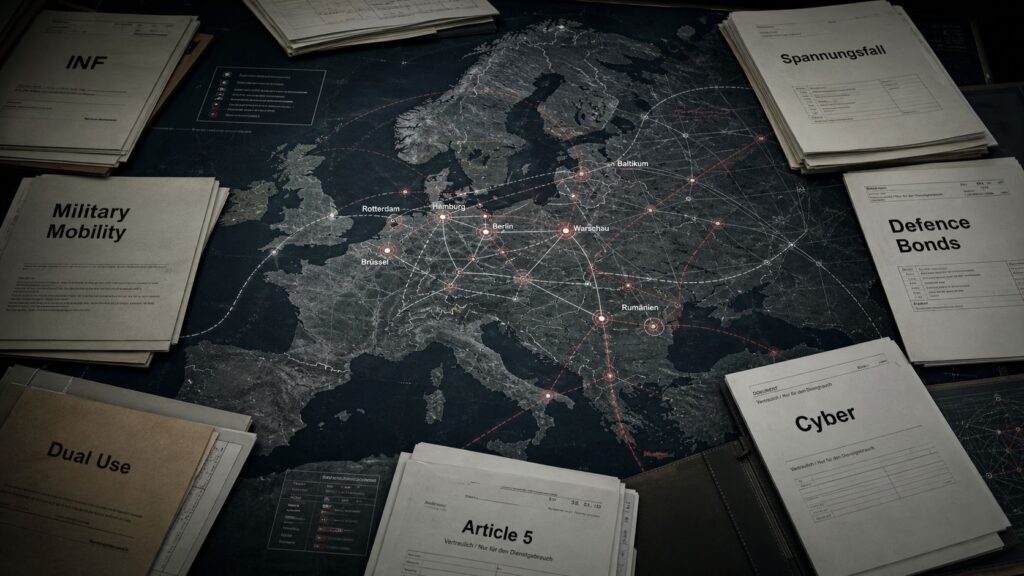
2. Military Mobility: Europe Becomes a Transit Zone
Tanks are useless if they can’t reach where they are needed. That is why the EU launched its Military Mobility initiative in 2018 – officially to “improve the movement of forces within Europe.”
What sounds harmless is the largest infrastructure overhaul since the Second World War. Five hundred infrastructure “hotspots” have been identified: bridges that cannot bear 70-ton Leopard tanks. Tunnels too low for Patriot air-defense systems. Rail lines not electrified for heavy military transport. Ports without Ro-Ro ramps for tank loading.
The cost: at least €100 billion. The budget has been multiplied roughly tenfold, from €1.69 billion (2021–2027) to a planned €17.65 billion (2028–2034).
Four strategic corridors have been defined – all running east. North–south axis: Rotterdam–Hamburg–Berlin–Warsaw. East–west axis: Lisbon–Paris–Frankfurt–Poland. Two further corridors connect Scandinavia and the Balkans with the eastern flank.
The European Parliament in December 2024 called for a “Military Schengen” – borderless troop movements without administrative hurdles, without authorization procedures, without delays. What applies to tourists is to apply to tanks.
Europe is becoming a transit zone. Not for peace. For what comes after.
3. Maneuvers: Dress Rehearsals for the Eastern Front
Major military exercises are not games. They are dress rehearsals for the real thing. And since 2020, the scale, intensity, and geographic orientation of European maneuvers have changed fundamentally.
Defender Europe 2020 was originally to involve 37,000 troops – the largest US troop deployment to Europe since the Cold War. COVID-19 forced a reduction, but the concept was set: rapid deployment of American forces across the Atlantic, integration with European militaries, push toward the east.
Defender Europe 2021 took place despite the pandemic, with 28,000 soldiers from 26 nations. Setting: the Balkans, the Black Sea, the Baltic.
Steadfast Defender 2024 was the largest NATO exercise since the Cold War: 90,000 troops, more than 50 ships, more than 80 aircraft, more than 1,100 combat vehicles. Scenario: defense against an attack from the east. Geographic focus: Poland, the Baltic, Romania.
Cold Response 2022 (Norway, March 2022): Arctic warfare, amphibious landings, cold-weather combat. 30,000 soldiers. Scenario: Russia. Its successor, Nordic Response 2024 – folded into Steadfast Defender 2024 – fielded around 20,000 troops along the same northern flank.
All these exercises share three features: they take place along the eastern flank. They simulate high-intensity conflict. And the adversary in every scenario carries the same name.
4. Expansion of the Dual-Use Definition: Every Technology Becomes Military
On September 9, 2021, the new EU dual-use regulation entered into force. At first glance a technical adjustment. In reality: the largest expansion of militarily usable technologies in decades.
The dual-use list once covered missile technology, chemicals, biological agents – obviously military goods with civilian applications. Today it covers: artificial intelligence systems, cloud computing infrastructure, quantum computers, encryption software, cyber-intrusion tools, autonomous systems, drone technology, facial recognition software.
In concrete terms: every tech firm developing AI can be classified as a defense partner. Every cloud provider can be obliged to support military data processing. Every cybersecurity firm can have its tools enlisted for offensive operations.
Palantir analyzes Ukrainian battlefield data. SpaceX Starlink supplies communications for drone strikes. Amazon Web Services hosts military reconnaissance databases. Google develops AI for target acquisition (Project Maven).
Civilian by day, military by night. The line has disappeared.
5. Lowering the Bar: “Kriegstüchtigkeit” Becomes Normal
Language shapes reality. And since 2022, the language of European politics has changed fundamentally.
Kriegstüchtigkeit – war-readiness. Defense Minister Boris Pistorius used the term for the first time in January 2024. Not “defensive capacity.” Not “deterrence.” But: Kriegstüchtigkeit. Germany must become kriegstüchtig. Society must brace for war.
Durchhaltefähigkeit – endurance. EU Commission President Ursula von der Leyen called in February 2025 for an endurance strategy. Not for economic crises. For military conflicts. Europe must be able to “hold out” – for months, for years.
Siegfähigkeit – capacity for victory. Chancellor Olaf Scholz spoke in March 2025 of the need for German Siegfähigkeit. Not defense to a negotiated peace. But: victory.
Resilienz – resilience. A term that once meant climate adaptation now means: can society sustain a war? Are there enough shelters? Will food supply hold under attack? Will infrastructure withstand cyberattacks?
These terms were not developed in defense ministries. They were used in speeches, repeated in interviews, embedded in strategy papers – until they sounded normal.
The threshold for real decisions falls when the language has already prepared the ground.
6. Financialization: €500 Billion Outside the Budget
Wars cost money. A great deal of money. Money that is not present in normal national budgets. So it has to be obtained another way.

In February 2025, Ursula von der Leyen called for €500 billion for European defense – outside national budgets, outside the Maastricht criteria, outside democratic budget oversight.
The model: “defense bonds,” analogous to the Corona bonds. Joint European debt issuance, guaranteed by future EU revenues. No national parliaments need to approve. The European Council decides, the Commission borrows, the member states are on the hook.
The justification: climate protection. European values. Democracy. Freedom. Defense is morally legitimized, financially externalized, and politically removed from oversight.
Germany in parallel announced a “Special Fund for Defense II” – €100 billion on top of the first special fund decided in 2022. Here too: outside the debt brake, outside the regular budget.
France, Poland, and Italy are planning similar mechanisms. War financing is becoming the new normal – without war having been declared.
7. The Spannungsfall: War Without Declaration
In the spring of 2025, according to reports, a strictly confidential meeting of the Volkswagen group with its top dealers took place in Frankfurt am Main. The security measures were said to be drastic: an absolute ban on mobile phones, no notes permitted, screening at the entrance. The central message conveyed to participants was reportedly unmistakable: “2025 will be a difficult economic year. But hold on – from 2026, Germany will be converted to a war economy. The state is planning to declare the Spannungsfall.”
Article 80a of the Basic Law provides for exactly this: restriction of freedom of movement, intrusion into communications freedom, suspension of property rights – all without a formal declaration of war. Civilian resources become military reserve: transport, energy, industry.
The Spannungsfall – “state of tension” – sits between the normal state and the Verteidigungsfall, the state of defense. It can be declared when “the danger of an armed attack threatens.” Not at the point of attack. At the point of danger. An assessment. Not a fact.
War is being prepared in law before it begins militarily. The details of this mechanism and its political dimension were already documented in Part 2 of this series – an article that went viral within 24 hours and drew 175 comments. Not because it speculated, but because it documented.
8. Industrial Policy: Dual-Use Becomes the Standard
The European Commission in March 2024 presented the European Defence Industrial Programme (EDIP) with a budget of €150 billion. Officially to “strengthen the European defense industry.” In fact: the largest industrial-policy overhaul since the Marshall Plan.
EDIP enables purchase guarantees for defense goods – the state commits to buying tanks, ammunition, drones before they are produced. Production for inventory without a customer becomes the norm. Rheinmetall builds factories before orders arrive. Krauss-Maffei Wegmann produces Leopard tanks for stockpiling. Hensoldt manufactures radar systems for markets that do not yet exist.
State guarantees cover entrepreneurial risk. Debt exemptions allow defense expenditure outside the debt brake. The separation between civilian economy and war production disappears.

Germany shifted in 2024 to “endurance production”: not for acute demand, but for long-term wear. Ammunition for months of intensive combat. Spare parts for years of deployment. Fuel for major operations.
War economy without a formal war declaration. The market is militarized before society notices.
9. Civil-Military Blending: The War Becomes Invisible
Modern warfare no longer requires separate military structures. It uses civilian infrastructure, civilian companies, civilian technology.
Train stations become troop-loading sites. Hamburg, Cologne, and Frankfurt have dedicated military rail tracks that are used civilian by default but ready within hours for tank transport in an emergency.
Airports gain military zones. Leipzig/Halle, Cologne/Bonn, and Frankfurt have NATO terminals that switch seamlessly between civilian and military operation.
Ports such as Rotterdam, Hamburg, and Bremerhaven have Ro-Ro ramps for heavy military equipment – officially for car transport, in practice for loading tanks.
Tech firms become defense partners. Palantir delivers data analytics. SpaceX delivers communications. Microsoft hosts military cloud infrastructure. Amazon AWS processes reconnaissance data. Google develops AI for target acquisition.
Logistics firms such as DHL, Schenker, and Kühne+Nagel hold contracts with defense ministries for “expedited procedures in case of crisis” – civilian trucks that become military supply convoys within 48 hours.
The line between civilian and military exists on paper. In practice, it has disappeared.
10. Civil Defense: Psychological War Preparation
In autumn 2024, Sweden distributed to all 4.7 million households the brochure “Om krisen eller kriget kommer” – “If Crisis or War Comes.” Twenty pages, illustrated, concrete: what to do during an air raid? Where are the nearest shelters? How long will food stocks last? How does one organize neighborhood support under attack?
Germany followed in December 2024 with an updated civil defense concept. Recommendation: 10 days of emergency supplies per person. Battery-powered radio. First-aid kit. Cash. Candles. A document folder for rapid evacuation.
Finland launched a shelter app: where is the nearest shelter? How many places are available? What facilities? Fifty thousand public shelters, capacity for 4.4 million people – 80 percent of the population.
The Bundeswehr launched the “Notfallkarte Deutschland” – Germany emergency map: what to do during a power outage? During a cyberattack? During sabotage of critical infrastructure? The map has been downloaded 2 million times.
The population is being prepared psychologically for war without war being declared. Normalization happens through information. “If” becomes “when.” “Maybe” becomes “probably.” “Sometime” becomes “soon.”
11. Cyberwar: The Invisible Run-Up
Cyberattacks do not, under international law, count as acts of war – not yet. That makes them the perfect instrument for escalation below the threshold of war.
The NATO Cooperative Cyber Defence Centre of Excellence in Tallinn, founded in 2008, has tripled its budget since 2020. Thirty-two nations are involved. The mission: detect, attribute, and repel cyberattacks – and plan retaliation.
The decisive question: at what point does a cyberattack trigger Article 5? NATO’s answer in 2021: “cyber can be treated as conventional attacks.” What that means concretely is left deliberately vague.
The Baltic states have reported, since 2022, continuous cyber intrusion of government systems and probing of utility networks. Attribution to Russia is made without proof, but with political certainty. The response: “defensive measures,” not Article 5.
Cyberwar normalizes escalation. Every attack can be framed as defensive. Every retaliation as a necessary countermeasure. The threshold to war is leaped without being crossed.
12. Nuclear Sharing: Nuclear Normalization
In December 2022, Germany purchased 35 F-35 fighter jets from Lockheed Martin. Officially to “modernize the air force.” In fact: in order to continue carrying American B61 nuclear weapons.
NATO nuclear sharing obliges Germany, in case of defense, to deliver US nuclear weapons. The bombs are stored at Büchel, Rhineland-Palatinate. German pilots train for their use. In an emergency, the US president gives the release code; German pilots drop the bomb.
Poland in 2024 requested the stationing of US nuclear weapons on its territory. The justification: deterrence against Russia. The reality: flight time to Moscow under five minutes. Warning time for Russia: zero.
The United Kingdom is modernizing its Trident nuclear arsenal. France is building new nuclear submarines. Both programs run outside public attention but with massive budgets.
Nuclear weapons are once again part of the normal. Not as a last resort of deterrence, but as an integrated component of military planning. The nuclear threshold is sinking.
13. Dissolution of Command Chains: Nobody Decides – Therefore Action Is Possible
The EU’s Military Planning and Conduct Capability (MPCC), operational since May 2025, can lead military operations – without national parliaments having to approve.
The Eurocorps, composed of German, French, Belgian, Spanish, and Luxembourgish troops, operates under multinational command. Who issues the order in an emergency? The French president? The German chancellor? The Eurocorps commander? The answer: it is deliberately unclear.
NATO Response Force, EU Battlegroups, PESCO Rapid Deployment Capacity – all these structures function on the same principle: multinational commands, unclear lines of accountability, “coalitions of the willing.”
In practice this means: in a crisis someone can act without anyone having officially decided. No parliamentary clearance required. No democratic legitimation needed. The troops are already there. The mandate is “flexibly construed.” The rules of engagement are “situation-dependent.”
Nobody decides – and that is precisely why action becomes possible.
14. Hybrid Warfare: The Concept of War Disappears
“Hybrid warfare” sounds technical, modern, somehow other than “war.” That is exactly the point.
Hybrid means cyberattacks, disinformation, economic sanctions, sabotage, covert operations – everything below the threshold of formal war declaration.
The Baltic states, Poland, and the Nordic countries report a steady drumbeat of incidents framed in this category: GPS signals jammed across the eastern Baltic; unidentified drones flying over critical infrastructure; orchestrated migration pressure on the Belarusian and Finnish borders; energy supply used as political leverage. Underwater cables in the Baltic Sea have been damaged on multiple occasions, with attribution disputed but politically asserted. The response: defensive measures, not Article 5 activation.
Poland, Finland, and Sweden are reinforcing border security against “hybrid threats” – migration pressure, political destabilization, energy coercion.
The problem: if everything is hybrid, nothing is war anymore. And if nothing is war, no rules of war apply. No formal declaration. No parliamentary approval. No constraints under international law.
The concept of war disappears – and with it the threshold that, until now, had to be crossed.
15. Delegitimizing Russia: Diplomacy Made Impossible
Diplomacy requires recognition of legitimate security interests on all sides. Exactly this has been eliminated systematically over the past ten years.
Russian security concerns about NATO eastward expansion: illegitimate. Russian demand for Ukrainian neutrality: blackmail. Russian proposals for security guarantees: unacceptable.
The language of European politics since 2014 has been a language of escalation, not negotiation. “Putin must be stopped.” “Russia must lose.” “Negotiations would be appeasement.”
Channels for negotiation have been actively eliminated. Meetings of Merkel and Macron with Putin in 2021: failed, no continuation. Minsk agreements: in effect buried. OSCE mediation: blocked.
Demonization in place of diplomacy. Putin is not a negotiating partner but a war criminal. Russia is not a neighbor but an adversary. Security interests do not exist, only imperial ambitions.
When the adversary is demonized, war becomes inevitable.
16. Dismantling International Crisis Communication: Mistakes Become Likely
During the Cold War, military hotlines existed between Washington and Moscow, between Bonn and Moscow, between NATO and the Warsaw Pact. Confidence-building measures prevented escalation through misunderstandings.
These structures have been dismantled systematically since 2014.
Military observers at maneuvers: drastically reduced. Joint inspections of weapons facilities: discontinued. Hotlines between NATO and Russia: scarcely used. The NATO-Russia Council: inactive since 2022.
Aircraft fly without transponders. Submarines operate without identification. Maneuvers take place without prior notice. The distance between forces is shrinking – NATO patrols and Russian formations sometimes only kilometers apart.
The risk: misjudgments. A radar error becomes a crisis. An accidental border crossing becomes a provocation. A technical glitch becomes a declaration of war.
Without communication, mistakes become likely. And mistakes escalate quickly.
Conclusion: Sixteen Steps, One Pattern
Sixteen changes. Some large, some small. Some obvious, some hidden in technocratic detail. Each individually explicable. Each individually defensible. Each individually with its own justification.
But taken together?
A treaty is terminated. Infrastructure is adapted. Maneuvers are intensified. Technology is militarized. Language shifts. Laws are prepared. Finances are externalized. Industry is converted. Civil society is enlisted. The population is psychologically primed. Cyberwar is normalized. Nuclear weapons become part of the normal. Command chains are dissolved. The concept of war disappears. Diplomacy is delegitimized. Crisis communication is dismantled.
Each step on its own: plausible. Each step on its own: defensive. Each step on its own: a response to Russian aggression.
But all of them together?
Perhaps it is all coincidence. Perhaps Europe is only reacting to external threats, without an overarching plan. Perhaps these are independent decisions of various actors that happen to fit together into a pattern.
Or perhaps these are not individual images, but pieces of a puzzle.
The previous parts of this series have shown:
- How Germany is being converted to a war economy (Parts 1 and 2)
- How the EU is rearming industrially (Part 3)
- How Ukrainian EU accession could activate the mutual-assistance clause (Part 4)
- How PESCO has produced a deployable army (Part 5)
- How PRISM could give that army eyes and ears (Part 6)
- And now: how all the legal, infrastructural, and political obstacles have been removed (Part 7)
In the next installment of this series, we put these puzzle pieces together.
Michael Hollister
is a geopolitical analyst and investigative journalist. He served six years in the German military, including peacekeeping deployments in the Balkans (SFOR, KFOR), followed by 14 years in IT security management. His analysis draws on primary sources to examine European militarization, Western intervention policy, and shifting power dynamics across Asia. A particular focus of his work lies in Southeast Asia, where he investigates strategic dependencies, spheres of influence, and security architectures. Hollister combines operational insider perspective with uncompromising systemic critique – beyond opinion journalism. His work appears on his bilingual website (German/English) www.michael-hollister.com, at Substack and in investigative outlets across the German-speaking world and the Anglosphere. speaking world.
Sources
INF Treaty and Arms Control
- Arms Control Association: INF Treaty at a Glance – https://www.armscontrol.org/factsheets/intermediate-range-nuclear-forces-inf-treaty-glance
- Wikipedia: Intermediate-Range Nuclear Forces Treaty – https://en.wikipedia.org/wiki/Intermediate-Range_Nuclear_Forces_Treaty
- Arms Control Association: U.S. to Deploy Intermediate-Range Missiles in Germany (2024) – https://www.armscontrol.org/act/2024-09/news/us-deploy-intermediate-range-missiles-germany
- The War Zone: Russia Claims Oreshnik on Combat Duty in Belarus (2025) – https://www.twz.com/land/russias-claims-oreshnik-ballistic-missile-now-on-combat-duty-in-belarus
Military Mobility
- European Commission: Military Mobility Package 2025 – https://defence-industry-space.ec.europa.eu/eu-defence-industry/military-mobility_en
- European Parliament: Military Mobility Resolution (December 2024) – https://www.europarl.europa.eu/news/en/press-room/20251211IPR32166/
- EU Institute for Security Studies: The Road to Readiness (November 2025) – https://www.iss.europa.eu/publications/briefs/road-readiness-how-eu-can-strengthen-military-mobility
- Rail Market: EU Identifies Four Strategic Corridors (2025) – https://railmarket.com/news/business/31427-eu-identifies-four-strategic-corridors-to-improve-military-rail-mobility
Major Military Exercises
- Wikipedia: Defender Europe – https://en.wikipedia.org/wiki/Defender_Europe
- NATO: Steadfast Defender 2024 – https://www.nato.int/cps/en/natohq/news_221444.htm
- Norwegian Armed Forces: Cold Response 2024 – https://www.forsvaret.no/en/exercise-and-operations/exercises/cold-response
Dual-Use Regulation
- EU Regulation 2021/821 of May 20, 2021 – https://eur-lex.europa.eu/legal-content/EN/TXT/?uri=CELEX:32021R0821
- European Commission: Dual-Use Export Controls – https://policy.trade.ec.europa.eu/eu-trade-relationships-country-and-region/countries-and-regions/dual-use-export-controls_en
Narrative and Language Shift
- Deutsche Welle: Pistorius on “Kriegstüchtigkeit” (January 2024) – https://www.dw.com/de/pistorius-deutschland-muss-kriegst%C3%BCchtig-werden/a-68086562
- Von der Leyen: EU Defence Strategy Speech (February 2025) – https://ec.europa.eu/commission/presscorner/
- Scholz: Siegfähigkeit (March 2025) – Federal Government Press Release
Financialization (Defense Bonds)
- Financial Times: Von der Leyen Calls for €500bn Defence Fund (February 2025)
- Bloomberg: Germany Plans Second Defence Special Fund (2025)
Spannungsfall
- Reference to Part 2 of this series: “Spannungsfall 2026” – VW meeting in Frankfurt, Article 80a Basic Law
- Basic Law Article 80a – https://www.gesetze-im-internet.de/gg/art_80a.html
EDIP and Industrial Policy
- European Commission: European Defence Industrial Programme – https://defence-industry-space.ec.europa.eu/eu-defence-industry/european-defence-industrial-programme_en
- Rheinmetall Annual Report 2024
Civil-Military Blending
- Deutsche Bahn: Military Transport – https://www.deutschebahn.com/de/geschaefte/infrastruktur/militaerische_transporte
- Hamburg Port Authority: Military Logistics
- Palantir Technologies: Ukraine Support – https://www.palantir.com/
Civil Defense
- Swedish Civil Contingencies Agency: “Om krisen eller kriget kommer” (2024) – https://www.msb.se/sv/amnesomraden/krisberedskap–civilt-forsvar/om-krisen-eller-kriget-kommer/
- Federal Office of Civil Protection: Civil Defense Concept 2024 – https://www.bbk.bund.de/
- Finnish Ministry of Defence: Public Shelter Database – https://www.pelastustoimi.fi/
Cyberwar
- NATO Cooperative Cyber Defence Centre of Excellence (CCDCOE) – https://ccdcoe.org/
- NATO: Cyber Defence Pledge (2021) – https://www.nato.int/cps/en/natohq/topics_78170.htm
- Baltic States: Undersea Cable Sabotage Reports (2022–2025)
Nuclear Sharing
- Bundeswehr: F-35 Procurement (December 2022) – https://www.bundeswehr.de/
- Federation of American Scientists: B61-12 Nuclear Gravity Bomb – https://fas.org/initiative/status-world-nuclear-forces/
- Poland: Request for US Nuclear Weapons (2024) – Duda Statement
EU Military Command Structures
- EEAS: Military Planning and Conduct Capability – https://www.eeas.europa.eu/eeas/military-planning-and-conduct-capability-mpcc-0_en
- Eurocorps: Multinational Command Structure – https://www.eurocorps.org/
Hybrid Warfare
- NATO: Countering Hybrid Threats – https://www.nato.int/cps/en/natohq/topics_156338.htm
- European Centre of Excellence for Countering Hybrid Threats – https://www.hybridcoe.fi/
Dismantling Crisis Communication
- OSCE: Vienna Document 2011 – https://www.osce.org/fsc/86597
- NATO-Russia Council: Suspension History – https://www.nato.int/cps/en/natohq/topics_50091.htm
Cross-Cutting Sources
- SIPRI Military Expenditure Database – https://www.sipri.org/databases/milex
- IISS Military Balance 2025
- EU Foreign Affairs Council Conclusions (various years)
© Michael Hollister – All rights reserved. Redistribution, publication or reuse of this text requires express written permission from the author. For licensing inquiries, please contact the author via www.michael-hollister.com.
Newsletter
🇩🇪 Deutsch: Verstehen Sie geopolitische Zusammenhänge durch Primärquellen, historische Parallelen und dokumentierte Machtstrukturen. Monatlich, zweisprachig (DE/EN).
🇬🇧 English: Understand geopolitical contexts through primary sources, historical patterns, and documented power structures. Monthly, bilingual (DE/EN).