
by Michael Hollister
Published on April 29, 2026
3.568 words * 19 minutes readingtime
Part 1 find here:
Arming Into Decline: Why Germany and the EU Are Investing in War
Part 2 find here:
Leaked: German Industry Told to Prepare for War Economy by 2026
Part 3 find here:
EDIP: How the EU is Converting Europe into a War Economy
Part 4 find here:
The EU Backdoor to War – How Ukraine’s Membership Could Trigger NATO-Russia Conflict
Part 5 find here:
EU-“War-Ready in Three Weeks” – PESCO
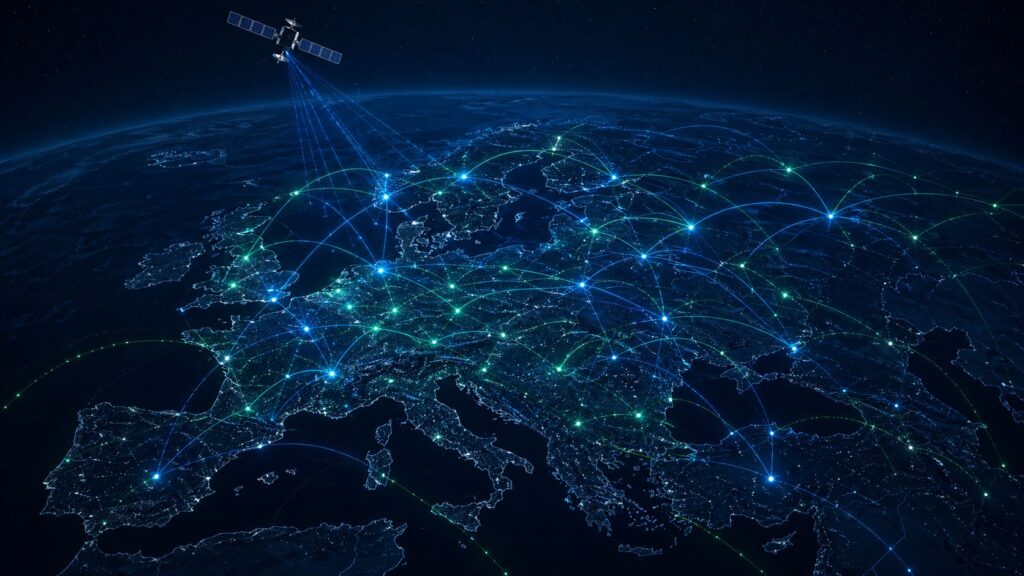


PRISM
Introduction: When the Body Gets Eyes
In the previous installment of this series, we documented how PESCO has created a deployable military structure – troops, logistics, command structures. A body that can be made march-ready within two to three weeks.
But a body without sensory organs is incapable of fighting.
You can move soldiers, shift tanks, transport ammunition – but without knowing where the enemy stands, where it is moving, what it is planning, every military operation is a blind flight. Modern warfare is not a question of courage or mass, but of information. Whoever sees first, knows first, reacts first – wins.
This is precisely where PRISM comes in.
PRISM is not a surveillance program for terrorists. It is the digital nervous system of Western warfare. From Afghanistan to Ukraine: no Western military operation in the past 15 years has been conducted without NSA intelligence. Target coordinates, movement profiles, real-time communications – that is the difference between precision strikes and blind salvos.
This article shows what PRISM really is, how it works, and why it represents far more than a surveillance instrument. It is the missing component that turns a military structure like PESCO into a deployable, targeted fighting force.
The question is not whether PRISM is being used militarily. The question is: for whom – and for what next?
What PRISM Really Is
On June 6, 2013, The Guardian and the Washington Post published the first documents from the archive of former NSA contractor Edward Snowden. What followed was one of the largest intelligence disclosures in history. At the center stood a program with the innocuous name PRISM – official signals intelligence designator: US-984XN.
PRISM is not a computer virus, not a backdoor, not a hacking tool. It is a systematic data collection program operated by the National Security Agency (NSA) that targets the communications of foreign persons of interest. Its legal foundation is Section 702 of the Foreign Intelligence Surveillance Act (FISA), passed in 2008 and renewed in 2024.
Contrary to the initial media portrayal, this is not mass surveillance of the general population, but targeted collection of communications from specifically identified individuals through selectors – email addresses and IP addresses, not keywords. The NSA has no direct access to the servers of the technology companies; instead, the FBI Data Intercept Technology Unit acts as intermediary between the providers and the NSA.
The Snowden documents reveal the precise data flow: from nine confirmed providers – Microsoft (since September 2007), Yahoo (March 2008), Google (January 2009), Facebook (June 2009), PalTalk (December 2009), YouTube (September 2010), Skype (February 2011), AOL (March 2011), and Apple (October 2012) – data flows through the FBI to the NSA. There it is processed by specialized systems: PRINTAURA for initial processing, SCISSORS for classification, and then databases such as MARINA for metadata and PINWALE for content.
The scale is considerable: 91 percent of all NSA internet traffic collected under Section 702 originates from PRISM, amounting to approximately 227 million communications annually. The remaining 9 percent are captured through Upstream collection – the direct tapping of fiber-optic cables at strategic nodes, a capability enabled primarily through cooperation with telecommunications companies and foreign partner services. As The Guardian first reported on the day of the initial disclosure, the program’s reach extended to virtually every major American internet platform.
The system can deliver real-time surveillance. NSA analysts can monitor voice, text, or video chats live once a target has been activated. For “threat to life” situations – immediate danger to life – new targets can be added within hours. The target list grew from 89,138 foreign targets in 2013 to 291,824 in 2024 – a tripling in eleven years.
PRISM does not operate in isolation. It is part of an ecosystem: Upstream delivers bulk data from fiber-optic cables. XKeyscore allows analysts to search through collected communications like a Google search engine. MUSCULAR taps the internal connections between Google and Yahoo data centers outside the United States, where data is often transmitted unencrypted. Tempora, operated by Britain’s GCHQ, stores the entirety of internet traffic passing through British fiber-optic cables for three days.
What Edward Snowden showed the world was not a theoretical possibility, but an operational reality: the NSA can collect, store, and analyze virtually every electronic communication on the planet – legally secured, technically mature, globally networked.
The Military Kill Chain Begins With Metadata
“We kill people based on metadata.” This statement by former CIA and NSA Director Michael Hayden summarizes more precisely than any government document what PRISM is actually used for.
The military use of NSA intelligence follows the so-called F3EAD methodology: Find, Fix, Finish, Exploit, Analyze, Disseminate. PRISM delivers the “Find” and “Fix” – the decisive first steps.
The GILGAMESH system, mounted on drones, locates SIM cards to within 30 feet – approximately nine meters. Virtual Base-Tower Transceivers force mobile phones to connect to NSA receivers without the user’s knowledge, as if connecting to a normal cell tower. The collected data flows to the NSA in real time, is matched against existing profiles – and when a match is found, the target coordinate is forwarded to JSOC (Joint Special Operations Command) or the CIA.
The Real Time Regional Gateway (RT-RG), first deployed in Baghdad in 2007, processed more than 100 million call metadata records and one million voice recordings per day. According to internal NSA documents, RT-RG played “a key role in 90 percent of all intelligence-driven operations” in Afghanistan in 2011 – a total of 2,270 capture/kill operations resulting in 6,534 enemy combatants killed and 1,117 detained. As The Intercept reported in its investigation of the NSA’s assassination program, this machinery operated largely outside public view.
The Drone Papers, published by The Intercept in 2015, exposed the brutal reality of this methodology. During Operation Haymaker in Afghanistan, 155 people were killed within five months. Of those, only 19 were intended targets. 90 percent were collateral casualties, automatically classified as “enemy combatants” – a statistical adjustment, not a moral assessment.
The “Disposition Matrix” – the U.S. government’s official targeting registry – links suspects to locations, contact networks, and “strategies for elimination.” Every three months, the CIA and the National Counterterrorism Center review the list; the President authorizes targets for 60-day windows. The NSA supplies the intelligence through PRISM and related programs; JSOC executes the kinetic operations.
A former JSOC operator summarized in an interview with The Intercept: “Everything that led to a kinetic strike or a night raid was based almost 90 percent on SIGINT” – signals intelligence, meaning electronic collection.
The implication is concrete: PRISM and its sister systems are not auxiliary tools of warfare. They are the decisive factor. Without them, there would be no targeted killings, no night strikes on Taliban hideouts, no precision strikes on enemy commanders. Modern Western military operations are completely dependent on NSA data.
Who Has Access – and Who Stays Outside
The hierarchy of access to PRISM and related NSA programs is clearly documented and follows a structure that has developed since the Second World War.
Five Eyes: The Inner Circle
The UKUSA Agreement of 1946 guarantees the so-called Five Eyes – the United States, the United Kingdom, Canada, Australia, and New Zealand – full exchange of intelligence “continuously, currently and without request” for both raw and finished intelligence. These five nations share practically everything with one another, as if they were a single intelligence service. As Yale Law School’s declassified Five Eyes documents show, this arrangement has no parallel in any other alliance structure.
GCHQ, the British partner service to the NSA, generated exactly 197 intelligence reports from PRISM data through May 2012 alone. Australia produced 310 in the same period – roughly a third more than its British counterpart. The Five Eyes have direct access to PRISM raw data, can run their own queries, and automatically receive reports on targets within their areas of interest.
Nine Eyes and Fourteen Eyes: The Second Tier
The Nine Eyes expand the circle to include Denmark, France, the Netherlands, and Norway. The Fourteen Eyes – also known as SIGINT Seniors Europe – additionally encompass Germany, Belgium, Italy, Spain, and Sweden.
Germany belongs to this group, but was reportedly “somewhat grumpy” when it was not admitted to the Nine Eyes. The NSA classified Germany internally as “Tier B – Focused Cooperation,” while France and Israel were rated “Tier C – Limited Cooperation.”

The flow of information is not equal. Germany transferred 1.3 billion metadata records per month to the NSA; in December 2012 alone, the figure was 500 million. The NSA described Germany in an internal document from April 2013 as its “most productive partner.” Yet the return was limited.
Between 2002 and 2013, the NSA sent the BND 800,000 selectors – search terms for surveillance. Among them were 40,000 suspicious entries targeting Western European governments and companies: EADS (now Airbus), Eurocopter, the French government. As the German Parliamentary Committee investigation documented, “European government agencies were targeted to a significant extent” – a clear breach of the cooperation agreement.
The message is unambiguous: even close partners do not receive full access. The United States shares data selectively, according to its own strategic interests – and reserves the right to surveil allies as well.
Europe’s Own Eyes: Capable, But Not Sufficient
Europe is not blind. But the difference between “being able to see” and “seeing everything” determines military effectiveness.
France’s CSO Constellation
France operates Europe’s most advanced military imagery intelligence with the CSO constellation (Composante Spatiale Optique). CSO-2, at an altitude of 480 kilometers, achieves a resolution of approximately 20 centimeters – comparable to commercial U.S. standards (WorldView Legion: 29 cm), but presumably inferior by a factor of two to four compared to the classified capabilities of the U.S. National Reconnaissance Office (NRO). According to Spaceflight Now’s reporting on the CSO-2 launch, the system marked a significant step forward for European autonomous imagery collection.
With CERES, France has since November 2021 become the first EU country to possess operational space-based signals intelligence – three satellites in formation capable of locating enemy radars, air defense systems, and command centers. The Technical Directorate of the DGSE (Direction générale de la Sécurité extérieure) comprises approximately 3,000 SIGINT specialists and is regarded as the world’s third-largest intelligence service after the NSA and GCHQ.
Galileo: Europe’s Navigation System With Military Precision
The EU’s satellite navigation system Galileo offers, through its encrypted Public Regulated Service (PRS), an accuracy of 20 centimeters horizontally and 40 centimeters vertically – more precise than GPS according to EU specifications. Tests in Antarctica showed that Galileo with PRS performs more reliably than GPS with its military module. The GEODE project (GalilEO for EU DEfence) is developing PRS security modules and receivers for military applications through 2026, with a budget of €82.7 million.
The Quantitative Gap
Yet all European capabilities combined cannot deliver what the United States provides alone. The numbers are unambiguous: the United States operates 246 military satellites; all European NATO members combined operate 49.
Europe lacks above all satellite-based infrared early warning for missile launches – a capability possessed globally only by the United States and Russia. The revisit times of European systems are insufficient for the real-time target acquisition required by modern high-intensity operations. France’s CSO can survey a given area every two days. American NRO satellites can survey the same area multiple times daily.
Operation Barkhane (2014–2022) in the Sahel exposed these limits painfully. Despite up to 5,100 French troops on the ground, Paris depended on American tanker aircraft for long-range operations, U.S. drone feeds, and satellite intelligence. The European Task Force Takuba – special operations forces from nine countries – could not close this gap.
The Ukraine Lesson: How Intelligence Decides Wars
Since the beginning of the Russian invasion in February 2022, Ukraine has received massive intelligence support from the United States. The examples are documented:
Real-time satellite reconnaissance: MQ-9 Reaper drones, RC-135 Rivet Joint SIGINT aircraft, E-3 AWACS. NSA/Cyber Command chief General Paul Nakasone confirmed in 2022: “We are sharing a lot of intelligence – accurate, relevant, and actionable.” As The Intercept reported in the early weeks of the war, the scope of this sharing went well beyond what had been publicly acknowledged.
Target acquisition against Russian leadership: U.S. intelligence enabled Ukrainian strikes that killed at least 12 Russian generals through mid-2022. The Ukrainian Security Service SBU, with NSA/CIA support, broke Russian encrypted communications.

The difference between success and failure: when the Trump administration briefly suspended the exchange of intelligence data in March 2025, Ukrainian operations suffered immediately. France’s dedicated satellite imagery analysis platform and German-Italian radar imaging could only partially replace U.S. capacity. Above all, processing speed was missing – the United States commands far more analysts and AI/big data capabilities. A Brookings Institution analysis from 2025 found that European forces deprived of American intelligence would suffer “significantly reduced targeting accuracy, increased vulnerability to air strikes, and heavier casualties.”
The lesson is unambiguous: modern warfare without American intelligence is possible – but with drastically reduced effectiveness and considerably higher losses.
PESCO and PRISM: The Body and Its Nervous System
In the previous installment of this series, we showed how PESCO has created a deployable military structure. 74 projects, 26 participating EU states, billions invested in military mobility, command structures, logistics, cyber defense. An EU Rapid Deployment Capacity of 5,000 troops has been operational since May 2025.
PESCO has everything an army needs – except eyes and ears.
The Military Planning and Conduct Capability (MPCC), the core of an autonomous EU command structure, can run small operations. But for large-scale deployments, the decisive component is missing: real-time intelligence on enemy movements, communications, intentions.
Europe has 49 military satellites. The United States has 246. Europe can observe certain areas every two days. The United States can survey the same areas multiple times daily. Europe has no infrared early warning for missile launches. Europe has no SIGINT capabilities at Five Eyes level.
Here the circle closes: PRISM could be the missing component. Technical integration is not the obstacle. The United States has already demonstrated its willingness to share intelligence with allies – when strategic interests align.
The Ukraine model shows how it works: extensive ISR assets, real-time situational awareness, target coordinates. Not as a gift, but as a strategic investment. The United States supplies the data; Ukraine fights the war.
The same principle would apply to a PESCO force. Europe provides the troops, the logistics, the infrastructure. The United States supplies the nervous system. PRISM connects satellite intelligence, real-time surveillance, communications data, and AI analysis into a unified operational picture.
In combination, for the first time the capability emerges not merely to move a European force, but to command, direct, and deploy it with precision – in near real time.
The Conditions: Nothing Is Free
Would the United States open PRISM for a European deployment? The answer depends on a single question: for what purpose?
Adam Smith, Chairman of the House Armed Services Committee, emphasized during the Ukraine support effort that America must not provide “real-time targeting” to avoid becoming a party to the conflict. The distinction between “force protection intelligence” and “offensive targeting” remains blurred in practice, but the political line is clear: intelligence yes, direct involvement in combat no.
Yet there are scenarios in which this line shifts.
If Europe mobilizes against Russia – with American consent, in American interest – the calculus changes. The United States could grant PRISM access without deploying its own troops. Europe fights; America supplies the data. Political risk: with Europe. Strategic benefit: shared.
The fundamental risk remains: the United States can pull the plug. At any time. Without warning. A Brookings analysis found that a complete U.S. withdrawal would force Europeans to “replace unknown quantities of capability over years.”
PRISM dependence means strategic vulnerability. Europe would be militarily capable – but not sovereign.
Conclusion: The Nervous System Awaits Its Trigger
PRISM is not a surveillance program. It is the technical foundation of modern warfare. From Afghanistan to Ukraine, the same pattern repeats: whoever controls the intelligence controls the battlefield.
PESCO has built the body. The structures are in place. The logistics function. The troops can be mobilized. What is missing is eyes, ears, the capacity to react.
PRISM could close that gap. Technical integration is feasible. The United States has the capability and – under certain conditions – the willingness to share intelligence.
Yet two questions remain open:
First: what legal and political frameworks would need to be created to legitimize such integration? The answer lies in the treaties, agreements, and strategic adjustments made in recent years.
Second: what would be the trigger? Under what scenario would Europe activate a PESCO force – and the United States grant PRISM access?
Both preconditions have been established. How exactly, the next installment of this series will show.
Michael Hollister
is a geopolitical analyst and investigative journalist. He served six years in the German military, including peacekeeping deployments in the Balkans (SFOR, KFOR), followed by 14 years in IT security management. His analysis draws on primary sources to examine European militarization, Western intervention policy, and shifting power dynamics across Asia. A particular focus of his work lies in Southeast Asia, where he investigates strategic dependencies, spheres of influence, and security architectures. Hollister combines operational insider perspective with uncompromising systemic critique—beyond opinion journalism. His work appears on his bilingual website (German/English) www.michael-hollister.com, at Substack and in investigative outlets across the German-speaking world and the Anglosphere.
Sources
- The Guardian – NSA Prism program taps into user data, June 6, 2013: https://www.theguardian.com/world/2013/jun/06/us-tech-giants-nsa-data
- Washington Post – NSA slides explain the PRISM data-collection program, June 6, 2013: https://www.washingtonpost.com/wp-srv/special/politics/prism-collection-documents/
- The Intercept – The NSA’s Secret Role in the U.S. Assassination Program, February 10, 2014: https://theintercept.com/2014/02/10/the-nsas-secret-role/
- The Intercept – The Drone Papers, October 2015: https://theintercept.com/drone-papers/
- Privacy and Civil Liberties Oversight Board – Report on Section 702 (2014, updated 2023): https://www.pclob.gov
- Electrospaces.net – What is known about NSA’s PRISM program, 2014: https://www.electrospaces.net/2014/04/what-is-known-about-nsas-prism-program.html
- Cloudwards – What Is the PRISM Program?, 2026: https://www.cloudwards.net/prism-snowden-and-government-surveillance/
- The Intercept – Mission Creep: NSA’s Targeting System, May 29, 2019: https://theintercept.com/2019/05/29/nsa-data-afghanistan-iraq-mexico-border/
- Yale Law School – Five Eyes Alliance Documents, 2020: https://law.yale.edu/mfia/case-disclosed/newly-disclosed-documents-five-eyes-alliance
- Lawfare – NSA Documents on Five Eyes Alliance, 2020: https://www.lawfaremedia.org/article/newly-disclosed-nsa-documents-shed-further-light-five-eyes-alliance
- Electrospaces.net – 14-Eyes SIGINT Seniors Europe, 2013: https://www.electrospaces.net/2013/12/14-eyes-are-3rd-party-partners-forming.html
- Wikipedia – German Parliamentary Committee investigation of NSA spying scandal: https://en.wikipedia.org/wiki/German_Parliamentary_Committee_investigation_of_the_NSA_spying_scandal
- Spaceflight Now – French military surveillance satellite launched, December 29, 2020: https://spaceflightnow.com/2020/12/29/french-military-surveillance-satellite-launched-by-soyuz-rocket/
- IISS – France’s signal ambition for space-based intelligence, December 2021: https://www.iiss.org/online-analysis/military-balance/2021/12/frances-signal-ambition-for-space-based-intelligence/
- GPS World – GEODE military user equipment for Galileo, 2024: https://www.gpsworld.com/geode-begins-work-on-military-user-equipment-for-galileo/
- Heinrich Böll Stiftung – Getting Out: How Europe Can Defend Itself with Less America, September 2025: https://www.boell.de/en/2025/09/24/getting-out-how-europe-can-defend-itself-less-america
- The Intercept – U.S. Quietly Assists Ukraine With Intelligence, March 17, 2022: https://theintercept.com/2022/03/17/us-intelligence-ukraine-russia/
- The Record – NSA chief trumpets intelligence sharing with Ukraine, 2022: https://therecord.media/nsa-chief-trumpets-intelligence-sharing-with-ukraine-american-public
- Belfer Center – U.S.-Ukraine Intelligence Sharing, 2024: https://www.belfercenter.org/research-analysis/us-ukraine-intelligence-sharing-conversation-calder-walton
- CSIS – Can Ukraine Fight Without U.S. Aid?, 2024: https://www.csis.org/analysis/can-ukraine-fight-without-us-aid-seven-questions-ask
- The Conversation – Europe may struggle to replace military intelligence, 2025: https://theconversation.com/europe-may-struggle-to-replace-the-military-intelligence-that-ukraine-needs-but-it-has-key-strengths-251871
- EU External Action Service – PESCO Projects: https://www.pesco.europa.eu/
- Consilium – PESCO Overview: https://www.consilium.europa.eu/en/policies/pesco/
- EEAS – Military Planning and Conduct Capability: https://www.eeas.europa.eu/eeas/military-planning-and-conduct-capability-mpcc-0_en
- Global Security – Composante Spatiale Optique (CSO): https://www.globalsecurity.org/space/world/europe/cso.htm
- Privacy International – Five Eyes Fact Sheet: https://privacyinternational.org/learn/five-eyes
- Wikipedia – Disposition Matrix: https://en.wikipedia.org/wiki/Disposition_Matrix
- UK Parliament – Written Evidence on Targeted Killing, 2020: https://committees.parliament.uk/writtenevidence/36962/html/
- Carnegie Endowment – Macron’s European Defense Doctrine, September 2017: https://carnegieendowment.org/europe/strategic-europe/2017/09/macrons-european-defense-doctrine
- Foreign Policy – Strategic Autonomy Is a French Pipe Dream, July 3, 2023: https://foreignpolicy.com/2023/07/03/strategic-autonomy-is-a-french-pipe-dream/
- Council on Foreign Relations – French Signals Intelligence, 2013: https://www.cfr.org/blog/shouting-americans-peek-french-signals-intelligence
- Wikipedia – Operation Barkhane: https://en.wikipedia.org/wiki/Operation_Barkhane
- IFRI – Troubled Twins: FCAS and MGCS Weapon Systems, December 2023: https://www.ifri.org/en/studies/troubled-twins-fcas-and-mgcs-weapon-systems-and-franco-german-co-operation
- Center for Constitutional Rights – Surveillance After USA Freedom Act, December 16, 2015: https://ccrjustice.org/home/blog/2015/12/16/surveillance-after-usa-freedom-act-how-much-has-changed
- Center for Democracy and Technology – FISA 702 Warrant Rule, 2024: https://cdt.org/insights/four-reasons-fisa-702-still-needs-a-warrant-rule-for-us-person-queries/
- Wikipedia – LOVEINT: https://en.wikipedia.org/wiki/LOVEINT
- NBC News – NSA employees eavesdropping on girlfriends, spouses, 2013: https://www.nbcnews.com/news/world/loveint-nsa-letter-discloses-employee-eavesdropping-girlfriends-spouses-flna8c11271620
- MIT Press – Illusions of Autonomy, Barry R. Posen, Spring 2021: https://direct.mit.edu/isec/article/45/4/7/100571/Illusions-of-Autonomy-Why-Europe-Cannot-Provide
- Brookings – How must Europe reorganize its conventional defense?, 2025: https://www.brookings.edu/articles/how-must-europe-reorganize-its-conventional-defense/
- Chatham House – EU must enable defence industry, March 2025: https://www.chathamhouse.org/2025/03/eu-must-enable-its-defence-industry-boost-capabilities-and-reduce-dependence-us-systems
- Bruegel – Europe’s dependence on US foreign military sales, 2024: https://www.bruegel.org/policy-brief/europes-dependence-us-foreign-military-sales-and-what-do-about-it
- Europeanrelations.com – Europe in Space: Closing the Capability Gap, 2025: https://europeanrelations.com/briefing/europe-in-space-closing-the-capability-gap-with-the-us/
- European Defence Fund – Project Proposals 2025: https://defence-industry-space.ec.europa.eu/record-response-european-defence-fund-2025-call
- PESCO Projects Progress Report 2025, September 2025: https://www.globalsecurity.org/military/library/report/2025/2025-pesco-projects-progress-report_202509.pdf
- Wikipedia – PRISM (surveillance program): https://en.wikipedia.org/wiki/PRISM
- Cloudwards – What Is the PRISM Program?, 2026: https://www.cloudwards.net/prism-snowden-and-government-surveillance/
- PESCO – Cyber Rapid Response Teams: https://www.pesco.europa.eu/project/cyber-rapid-response-teams-and-mutual-assistance-in-cyber-security/
Key Figures and Facts
PRISM
- Operational start: 2007
- Legal basis: Section 702 FISA (renewed 2024 through April 2026)
- Targets: 89,138 (2013) → 291,824 (2024)
- Share of NSA internet traffic under Section 702: 91%
- Annual communications collected: approximately 227 million
Five Eyes vs. Europe
- United States: 246 military satellites
- All EU NATO members combined: 49 military satellites
- Five Eyes: full access to PRISM raw data
- Germany: “Tier B – Focused Cooperation”
- BND → NSA: 1.3 billion metadata records per month
Military Effectiveness
- Operation Haymaker (Afghanistan): 155 killed, 19 intended targets (90% collateral casualties)
- RT-RG Afghanistan 2011: 2,270 operations, 6,534 killed
- JSOC operator: “Almost 90% was based on SIGINT”
European Capabilities
- France CSO: approx. 20 cm resolution, revisit every 2 days
- U.S. NRO: estimated below 10 cm, multiple times daily
- Galileo PRS: 20 cm horizontal, 40 cm vertical
- GEODE budget: €82.7 million (2024–2026)
PESCO
- Founded: December 11, 2017
- Participants: 26 of 27 EU member states
- Projects: 74 (as of 2025)
- EU Rapid Deployment Capacity: 5,000 troops operational since May 2025
© Michael Hollister – All rights reserved. Redistribution, publication or reuse of this text requires express written permission from the author. For licensing inquiries, please contact the author via www.michael-hollister.com.
Newsletter
🇩🇪 Deutsch: Verstehen Sie geopolitische Zusammenhänge durch Primärquellen, historische Parallelen und dokumentierte Machtstrukturen. Monatlich, zweisprachig (DE/EN).
🇬🇧 English: Understand geopolitical contexts through primary sources, historical patterns, and documented power structures. Monthly, bilingual (DE/EN).